

If you keep the books for a nonprofit, odds are you didn’t apply for the job. Maybe you’re the treasurer who said “sure, I can do that” at a board meeting two years ago. Maybe you’re the executive director who does it Thursday nights because there’s no one else. Either way, you’ve probably had the quiet 11 p.m. thought: am I doing this right?
Nonprofit bookkeeping is the ongoing recording of an organization’s financial activity — donations, grants, expenses, payroll — organized so the organization can report by fund, by restriction, and by function. That’s the textbook answer. Here’s the truer one: regular bookkeeping tracks money. Nonprofit bookkeeping tracks promises. Every restricted dollar that arrives is a promise to a donor, and your ledger is the place you prove you kept it.
This guide covers the whole system — how nonprofit books differ from business books, the chart of accounts and software to start with, a monthly close checklist you can run this month, how to track restricted gifts, the internal controls that actually matter at small scale, how the books feed your Form 990, and what each staffing option honestly costs. Where a topic deserves a full article, we link to our deeper guide on it.
Key Takeaways
A small business and a small nonprofit can use the same software, the same debits and credits, even the same bookkeeper. The difference is what the books have to answer for. A business ledger answers one question: did we make money? A nonprofit ledger answers three:
This is why fund accounting exists, and why a bookkeeper who’s excellent with business books can still stumble in a nonprofit: the mechanics are familiar, but the promises are new. It’s also the working boundary between roles — a bookkeeper records these answers, an accountant interprets them, and we map that split in bookkeeper vs accountant vs CPA.
Your chart of accounts is the filing cabinet every transaction lands in. Get the drawers right early and everything downstream — reports, restriction tracking, the 990 — mostly organizes itself. Here’s the starter structure we recommend for small organizations:
Starter nonprofit chart of accounts
| Range | Category | Examples |
|---|---|---|
| 1000s | Assets | Checking, savings, grants receivable, prepaid insurance |
| 2000s | Liabilities | Accounts payable, payroll liabilities, deferred revenue |
| 3000s | Net assets | With donor restrictions / without donor restrictions |
| 4000s | Revenue | Individual gifts, grants, program fees, in-kind gifts |
| 5000–8000s | Expenses by function | Program (5000s), management & general (7000s), fundraising (8000s) |
Start this small and add accounts only when a real report needs them. Full walkthrough with account-by-account numbering: nonprofit chart of accounts.
On software: most small nonprofits land on QuickBooks Online, and the price difference is worth knowing. Retail QBO Plus — the tier with class and fund tracking — runs $115/month as of mid-2026 (Intuit has announced price changes taking effect August 2026, so check current pricing). Through TechSoup, verified 501(c)(3)s get a one-year QBO Plus license for an $80 annual admin fee — roughly a 94% discount. Our guides to QuickBooks for nonprofits and the first 90 days of bookkeeping setup take you from blank file to first clean month.
Monthly bookkeeping is dishes. Do them every night and it’s ten quiet minutes; let them stack until company’s coming and you’re scrubbing at midnight before the auditor — or the board — arrives. Most nonprofit bookkeeping disasters aren’t caused by hard transactions. They’re caused by easy transactions left unrecorded for eight months.
Here’s the close we recommend. Run it the same week every month. Start with these five rows and add more only as your organization grows — a short list you actually run beats a comprehensive one you avoid.
The 5-step monthly close
| # | Step | What done looks like |
|---|---|---|
| 1 | Reconcile | Every bank and credit card account matches its statement to the penny; unexplained differences investigated, not carried |
| 2 | Record | All gifts entered with donor, date, amount, and restriction; all expenses coded to a function (program / management / fundraising) |
| 3 | Acknowledge | Written acknowledgment sent for every gift of $250+ (and quid pro quo disclosures for payments over $75) |
| 4 | Review restrictions | Restricted-fund balances updated: what came in, what was released to use, what remains promised |
| 5 | Report | A one-page budget-vs-actual goes to whoever governs — monthly beats quarterly, and either beats never |
Two companions to this checklist: nonprofit bookkeeping best practices for the habits around the close, and the bookkeeping mistakes we see most — nearly all of which are a skipped step 1, 2, or 4 compounding quietly.
Picture a board meeting in October. The treasurer’s report shows $58,000 in checking, and a board member — reasonably — proposes finally hiring the part-time program coordinator. But $41,000 of that balance is a foundation grant restricted to next spring’s youth program. The real hiring budget is $17,000, and nobody in the room knows it, because the books show one number where there should be two. That’s how organizations hire people with money that was never theirs to spend.
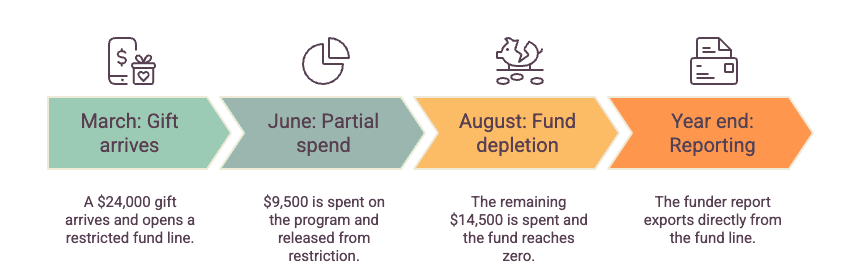
Restriction tracking is the promise ledger in action, and it only takes one habit: every restricted gift gets its own tracking line the day it arrives. Here’s a $24,000 restricted grant moving through the books:
A restricted grant, month to month
$24,000 grant arrives, restricted to the summer literacy program. Recorded as revenue with donor restrictions; a “Summer Literacy” fund line opens at $24,000.
$9,500 spent on program staff and materials, coded to program expense against that fund. The books release $9,500 from restriction — the promise is being kept, on the record. Fund balance: $14,500.
Remaining $14,500 spent as the program wraps. Fund balance: $0. Restriction fully released.
The funder’s report takes ten minutes: opening balance, spending by month, zero balance — exported straight from the fund line, not reconstructed from memory.
Every treasurer’s report should show both numbers — total cash and unrestricted cash — side by side. If yours shows one, that’s the single highest-value fix in this article, and it’s a natural fit for the reporting rhythms in nonprofit treasurer duties. Our free board financial report template puts both on one page, alongside the restricted balances that explain the gap.
In the ACFE’s 2026 Report to the Nations — a study of 2,402 fraud cases worldwide — the median loss in nonprofit cases was $69,000, and organizations with fewer than 100 employees suffered the highest median losses of any size category. And in more than half of all cases, the fraud involved either a lack of internal controls or an override of the controls that existed. Not sophisticated schemes. Unlocked doors.
“We’re too small for controls” has it backwards — small organizations are where controls matter most, because one trusted person often touches everything. The core rule, straight from the New York Attorney General’s charities guidance: no single individual should be responsible for receiving, recording, and depositing funds and writing and signing checks. In a three-person shop that can be as simple as: the ED approves bills, the bookkeeper records them, a board member signs checks over a threshold and receives the unopened bank statement. Our guide to internal controls for small nonprofits turns this into a checklist sized to teams of one to five.
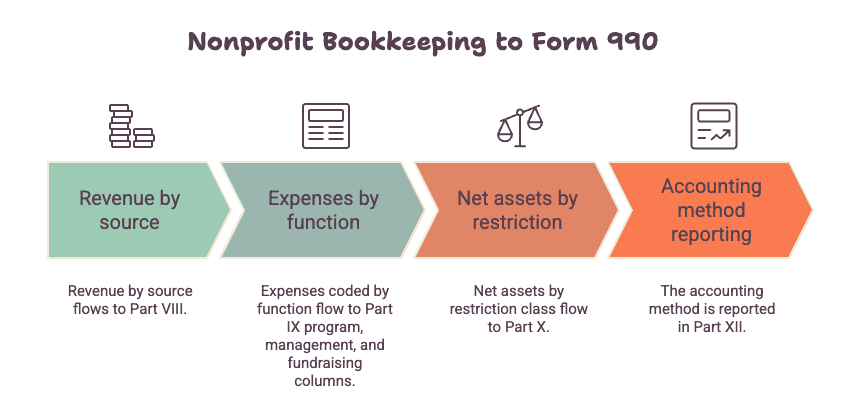
A Form 990 isn’t a research project — it’s an export. If the books are kept the way this guide describes, the return’s core schedules fill from reports you already run:
Ledger → Form 990
| What your books track | Where it lands on the 990 |
|---|---|
| Revenue by source (gifts, grants, program fees) | Part VIII, Statement of Revenue |
| Expenses coded by function | Part IX — columns for program services, management & general, and fundraising |
| Net assets by restriction class | Part X, Balance Sheet |
| Your accounting method (cash or accrual) | Part XII — the IRS asks which method you used; it does not require accrual |
That Part XII point deserves a beat, because it confuses everyone: the IRS accepts cash-basis 990s. Your checkbook and your calendar tell different stories — cash basis records money when it moves, accrual records it when it’s earned or promised — and the IRS will take either, consistently applied. Accrual becomes mandatory when you need GAAP financial statements: California requires GAAP audited statements at $2 million in gross revenue, New York requires a CPA audit above $1 million (and a CPA review from $250,000), and most grantmakers requesting “audited financials” are implicitly requesting accrual. Practical path: start cash, switch when multi-year grants and pledges make cash numbers misleading. Which return you file — and what preparing it costs — is covered in 990-EZ vs 990 and our 501(c)(3) bookkeeping requirements guide.
Here’s the section nobody on page one of Google will give you numbers for. Bookmark accordingly.
DIY (founder or staff)
$0–$115/mo software
TechSoup’s QBO Plus license is $80/yr for verified 501(c)(3)s vs $115/mo retail. The real cost is your hours — fine at 990-N scale, increasingly expensive above it.
Volunteer treasurer
Free — with two risks
Continuity (knowledge leaves when they do) and controls (one person touching everything). Works early; watch for the signs your nonprofit has outgrown its volunteer treasurer.
Outsourced service
~$300–$1,500/mo
Scales with transaction volume, funds, and grant complexity — our pricing calculator shows the math openly. Full decision framework: outsourcing nonprofit accounting.
A useful rule of thumb maps the decision to your 990 tier: at 990-N scale (under $50,000), DIY with good software is usually right. At 990-EZ scale, a volunteer or a light outsourced engagement works if the monthly close actually happens. By full-990 scale — $200,000 or more — functional expense reporting, restriction tracking, and public scrutiny make professional bookkeeping the norm rather than the exception. And if you’re switching from a provider that isn’t working, here’s how to switch bookkeepers without losing your history.
Want the close off your plate? GivingArc runs the monthly close, restriction tracking, and 990-ready books for small nonprofits — starting around $300/month, priced openly.
See the service →Funders rarely see your programs in person. What they see is your reporting — the funder report that reconciles to the penny, the 990 that tells a coherent story, the treasurer’s report that distinguishes cash from promises. Clean books aren’t the boring back-office part of the mission. They’re the evidence the mission is real, produced one monthly close at a time.
Start small: this month, run the five-step close once. Next month, do it again. That rhythm — not software, not credentials — is what separates organizations whose year-end is an afternoon from organizations whose year-end is archaeology.
Watch: why the bank balance is not the year’s result, and what a year-end close catches (video).
Common questions from small nonprofits handling their own bookkeeping.
Doing it yourself, the software runs $0–$115 per month — TechSoup offers QuickBooks Online Plus to verified 501(c)(3)s for an $80 annual admin fee versus $115/month retail. Outsourced nonprofit bookkeeping typically runs from about $300 to $1,500 per month, scaling with transaction volume, number of funds, and grant complexity.
Yes — many small nonprofits start with a volunteer treasurer, and it works at 990-N scale. The two risks to manage are continuity (the knowledge leaves when they do) and controls: no single person should receive, record, and deposit funds and also write and sign checks. As restricted grants and functional reporting grow, most organizations move to professional help.
The IRS accepts either for the Form 990 — Part XII simply asks which method you used. Accrual becomes necessary when you need GAAP financial statements: California requires GAAP audited statements at $2 million in gross revenue, New York requires a CPA audit above $1 million, and most funders requesting audited financials expect accrual. A common path is starting on cash and switching as multi-year grants and pledges grow.
Per IRS Publication 4221-PC: records supporting income and deductions generally until the statute of limitations runs (usually three years from filing), employment tax records at least four years, and governing documents — exemption application, determination letter, articles, bylaws, board minutes — permanently. Your Form 990 must also be publicly available for three years.
Bookkeeping is the recording: entering gifts and expenses, reconciling accounts, tracking restrictions, running the monthly close. Accounting is the interpreting: preparing financial statements under ASC 958, advising on treatment, and handling the Form 990. Small nonprofits usually need bookkeeping continuously and accounting periodically.
Books that keep your promises — without your Thursday nights.
GivingArc handles monthly nonprofit bookkeeping and Form 990 preparation for small and mid-size 501(c)(3)s.
GivingArc provides bookkeeping, Form 990 preparation, and nonprofit-specialized accounting for small and mid-size 501(c)(3) organizations across the US. This article is general information, not accounting or legal advice — audit thresholds and requirements vary by state. Reviewed by Min Kim, CPA.