
Picture a small nonprofit whose annual report has been printed for six years by a company owned by a board member’s spouse. The price has always been fair, and nobody on the board sees a problem, because there is none. In March, whoever prepares the Form 990 asks three questions nobody has considered since the founding: is there a written conflict of interest policy, does everyone on the board disclose their interests every year, and how is it enforced? The honest answers are “somewhere,” “no,” and “we would notice.”
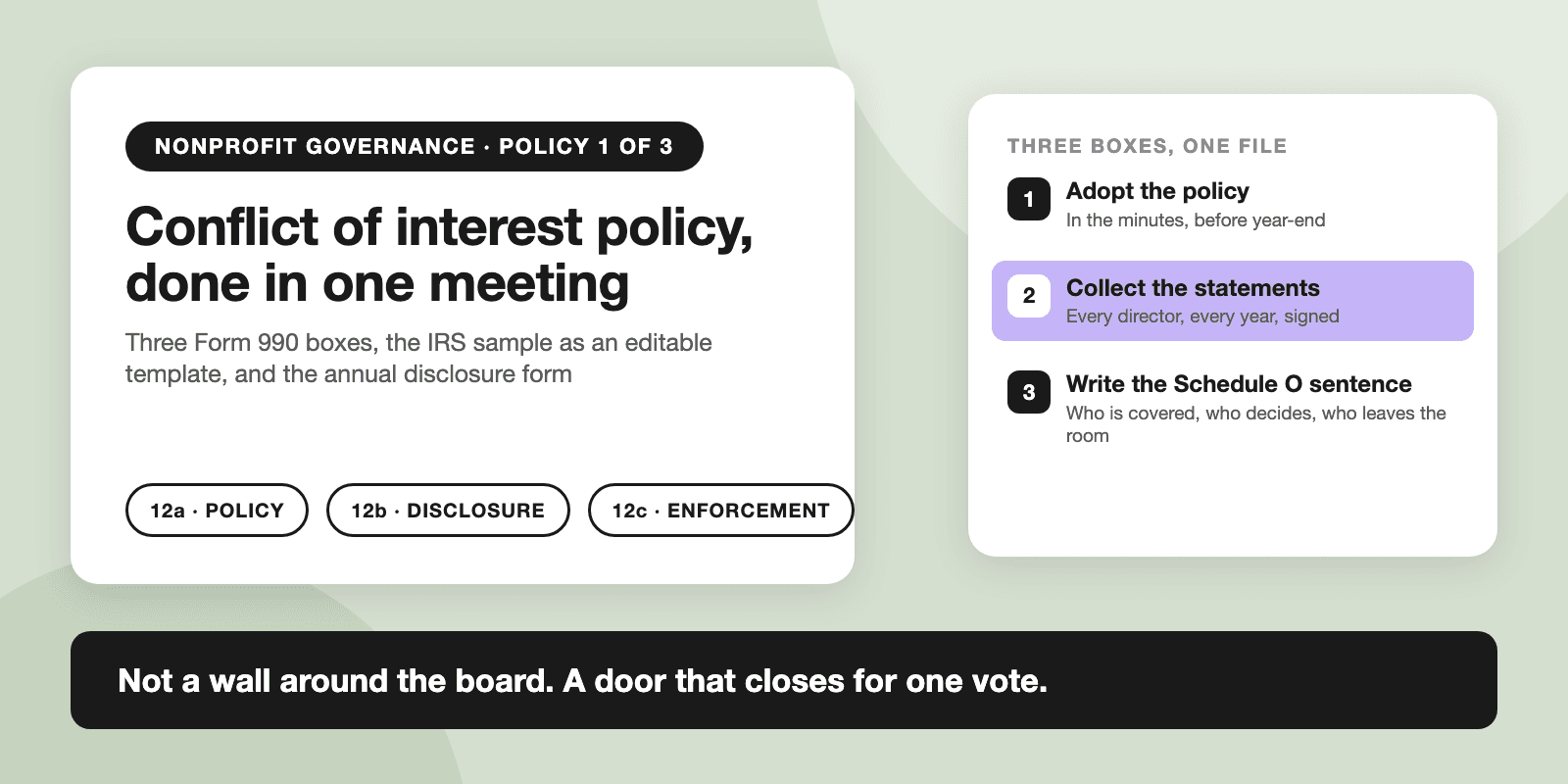
This guide is the nonprofit conflict of interest policy we would want a board to adopt in one meeting. It explains the three boxes on Form 990 Part VI line 12 and what earns a “Yes” in each one, walks through the IRS’s own sample policy, and gives you that sample as an editable template with a matching annual disclosure statement, no email required. It then covers what actually happens when a conflict shows up, the excise tax numbers that make the policy worth having, and the one sentence Schedule O asks for. A policy is not a wall around the board. It is a door that closes for one vote.
Key Takeaways
Section B of Form 990 Part VI opens with a parenthetical that surprises most boards: it “requests information about policies not required by the Internal Revenue Code.” The instructions say the same thing twice more and then add the catch: every organization filing the full Form 990 has to answer every question in Part VI anyway, and the IRS “considers such policies and procedures to generally improve tax compliance.” The form is public. Funders, Candid, and journalists read Part VI as a governance scorecard, and a “No” on line 12a is one of the few answers on the return that cannot be explained with a number.
Line 12 is three questions in a row, and each one asks for a different piece of evidence. The instructions let you answer “Yes” to a policy question only if the governing body (or a committee it delegated to) adopted the policy by the end of the tax year, and only if the policy applies to the organization as a whole. A policy your parent organization has does not count for you unless your own board adopted it.
12aPolicy
“Did the organization have a written conflict of interest policy?”
A written policy that defines conflicts, says who is covered, makes disclosure possible, and sets the procedure for managing a conflict, adopted by the board before the end of the tax year and applying to the whole organization.
The signed policy and the board minutes recording its adoption.
12bDisclosure
“Were officers, directors, or trustees, and key employees required to disclose annually interests that could give rise to conflicts?”
A requirement, in the policy, that each covered person disclose or update at least once a year their interests and their family members’ interests: business and investment holdings, affiliations, and transactions with organizations that deal with yours.
One signed disclosure statement per covered person, per year, in the board file.
12cEnforcement
“Did the organization regularly and consistently monitor and enforce compliance with the policy? If ‘Yes,’ describe on Schedule O how this was done.”
A practice, not a paragraph: proposed transactions get checked against the statements, conflicts get raised and resolved at the meeting, and the minutes show it. Schedule O must say who is covered, who decides whether a conflict exists, who reviews actual conflicts, and what restrictions apply.
Minutes that record disclosures, recusals, and votes, plus the Schedule O paragraph.
Two things about who gets asked. Form 990-EZ has no governance section at all; the IRS’s own FAQ says so in one sentence, and the word “conflict” does not appear anywhere on the 990-EZ. Form 990-N asks nothing. So an organization that qualifies for the 990-EZ (gross receipts under $200,000 and total assets under $500,000) can go years without the question ever being put to it on a return. Many organizations meet the question once, at the start: the full Form 1023, the application for exemption, asks whether you have adopted a conflict of interest policy consistent with the IRS sample in Appendix A of its instructions, and the instructions say adoption “isn’t required to obtain tax-exempt status” in the same breath as they recommend it. Form 1023-EZ does not ask. So the question is put to an organization once, at the start, and then not again until it files a full Form 990. A policy adopted at the first board meeting and filed with the determination letter answers line 12a. Lines 12b and 12c are about what happened after.
The Form 990 instructions define the document in one sentence. A conflict of interest policy “defines conflicts of interest, identifies the classes of individuals within the organization covered by the policy, facilitates disclosure of information that can help identify conflicts of interest, and specifies procedures to be followed in managing conflicts of interest.” Four jobs. Anything that does all four is a policy for line 12a purposes; anything that does fewer is a values statement.
The instructions also define the thing itself, and the definition is narrower than most boards assume. A conflict of interest arises when “a person in a position of authority over an organization, such as an officer, director, manager, or key employee can benefit financially from a decision he or she could make in such capacity, including indirect benefits such as to family members or businesses with which the person is closely associated.” Financial is the operative word. Sitting on the boards of two charities that disagree about a bill is not a conflict of interest for Form 990 purposes; the instructions give exactly that example and say it does not count because no material financial interest is involved. Voting on a contract with your spouse’s printing company is.
The IRS will not publish model governance policies, with one exception it points to every time it is asked: the sample conflict of interest policy in Appendix A of the Form 1023 instructions. It is eight short articles, it is a public-domain government document, and the IRS’s note on it says it “does not prescribe any specific requirements.” Here is what each article does and which line of the 990 it answers.
Article I
Purpose
Protect the organization when a transaction “might benefit the private interest of an officer or director” or “might result in a possible excess benefit transaction.” Supplements state law; does not replace it.
Line 12aArticle II
Definitions
Interested person: any director, principal officer, or member of a committee with board-delegated powers who has a direct or indirect financial interest. Financial interest: ownership, investment, or compensation ties, “through business, investment, or family,” to anyone the organization deals with. A financial interest “isn’t necessarily a conflict of interest”; the board decides.
Line 12aArticle III
Procedures
Duty to disclose; the interested person leaves while the board decides whether a conflict exists; may present, then leaves for the discussion and the vote; the chair may appoint someone to investigate alternatives; the disinterested directors decide by majority whether the deal is in the organization’s best interest, fair, and reasonable. Plus what happens when someone fails to disclose.
Line 12cArticle IV
Records of proceedings
The minutes must carry the names of the people with a financial interest, the nature of the interest, the board’s decision on whether a conflict existed, who was present for discussion and votes, the alternatives considered, and the votes.
Line 12c and Schedule OArticle V
Compensation
Anyone paid by the organization, directly or indirectly, cannot vote on their own compensation, on the board or on a compensation committee. They can still provide information.
Line 15 and section 4958Article VI
Annual statements
Each director, principal officer, and committee member signs a statement every year that they received, read, understood, and agreed to the policy, and understand the organization must engage primarily in exempt activities. Note what it does not ask: for the list of interests. See the disclosure statement below.
Line 12b, half of itArticle VII
Periodic reviews
Review whether compensation is reasonable and the result of arm’s-length bargaining, and whether joint ventures and management arrangements follow written policy and do not produce inurement, private benefit, or an excess benefit. (The IRS text drops the “Article VII” heading; Article VIII refers to it, so the template restores it.)
Line 12cArticle VIII
Outside experts
The board may use outside advisors for the periodic reviews, and using them “shall not relieve the governing board of its responsibility.”
Line 12c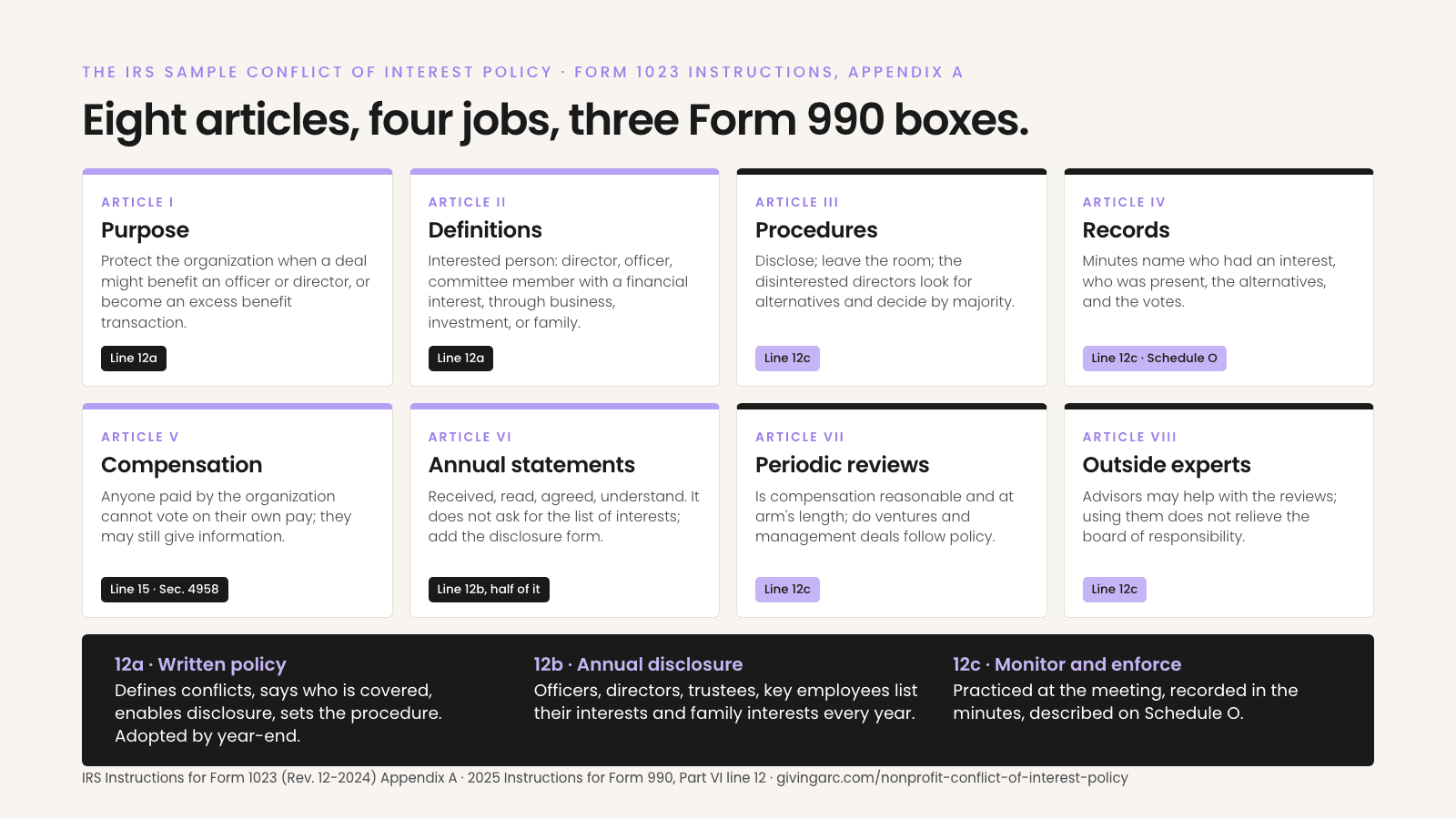
Read the eight articles against the four jobs in the instructions and the mapping is exact: Articles I and II define and identify, Articles III and VI facilitate disclosure, and Articles III, IV, VII, and VIII specify procedures. That is why the IRS keeps pointing to it. It is also why adopting it as written is a reasonable choice for a small organization and a slightly incomplete one for line 12b, which is the subject of the annual statement section below.
The three files below are the IRS sample, adapted. The policy is the Appendix A text with the hospital inserts removed, the missing Article VII heading restored, one added section in Article III that bars an interested person from improperly influencing the deliberation or vote (New York requires it, and every board benefits from it), bracketed fields for the organization’s name and the officer who collects statements, an adoption block for the minutes, and editing notes for New York and California at the end that you delete before the board votes. The disclosure statement is the piece the IRS sample does not include. The PDF holds both for reading and printing. There is no email gate, because a template you have to ask for is not a template.
Nonprofit conflict of interest policy template
Three files, editable, no email required. Adapted from IRS Form 1023 instructions Appendix A (Rev. December 2024). Template only, not legal advice.
Conflict of Interest Policy (editable Word)
Eight articles, bracketed fields, board adoption block, editing notes for Form 990 line 12, New York, and California.
Annual Disclosure Statement (editable Word)
One page: the four affirmations from Article VI, a table of interests that could give rise to a conflict, the compensation question, signature and receipt lines.
Policy and statement pack (PDF)
Both documents in one file for reading, printing, and the board packet.
Six edits, and the policy is yours. One: the organization’s name, everywhere it appears in brackets. Two: who is covered. The IRS sample covers directors, principal officers, and members of committees with board-delegated powers; if a staff member signs vendor contracts or approves purchases, add “any employee with authority over purchasing or contracting,” because a staff member who picks the vendor makes a decision the board never votes on. Three: who receives the annual statements and who reviews them. The template says Secretary and Board Chair; a board with an audit or finance committee usually routes them to that chair. Four: the vote. The sample requires “a majority vote of the disinterested directors”; make sure your bylaws’ quorum and voting rules do not say something different. Five: the adoption block, filled in from the minutes, with the date the board voted. Line 12a turns on that date being inside the tax year. Six: delete the editing notes.
Then adopt it the way you adopt anything else: a motion, a vote recorded in the minutes, the signed policy in the corporate records next to the bylaws. The same meeting can collect the first round of disclosure statements, which means a single agenda item can turn the first two line 12 answers to “Yes,” with the third earned over the following year by using the policy at the meetings where it applies.
Scope noteNew York: the policy is required by statute
Not-for-Profit Corporation Law section 715-a, added by the Nonprofit Revitalization Act of 2013, requires every New York not-for-profit board to adopt a conflict of interest policy with six minimum provisions: a definition, disclosure procedures, a rule that the conflicted person is not present for and does not vote on the matter, a prohibition on improperly influencing the deliberation or vote, documentation in the minutes, and procedures for related party transactions under section 715. It also requires each director to submit a written statement of interests before initial election and annually, to the secretary or a compliance officer, who gives copies to the audit committee chair or the board chair. A policy “substantially consistent” with those provisions is deemed to comply. The IRS sample addresses four of the six; the template adds the improper-influence prohibition, so what remains is the related party procedures. Add those and have New York counsel confirm.
Scope noteCalifornia: no policy mandate, but section 5233 has its own steps
No California statute requires a public benefit corporation to have a written policy; the Attorney General’s own guide to Form 990 ties line 12a to Corporations Code sections on directors’ standard of care, self-dealing, loans, and liability, none of which mandates one. What California does regulate is the transaction. Corporations Code section 5233 treats a transaction in which a director has a material financial interest as self-dealing unless the Attorney General approved it or the board, by a majority of directors then in office without counting the interested director, approved it in advance after finding that it was for the corporation’s own benefit, fair and reasonable, and that a more advantageous arrangement could not be obtained with reasonable effort (or, when advance board approval was not reasonably practicable, a committee approved it on the same standards and the board ratified it at its next meeting). The section carves out a director’s own compensation as a director or officer, benefits received as part of a charitable program, and small transactions the director did not know about. Adopting a policy does not perform those steps; the board does, at the meeting. Section 5227 separately caps interested persons at 49 percent of the board.
EverywhereThe template supplements state law; it does not replace it
Article I says so in the IRS’s own words. Many states have conflict of interest or related party rules for nonprofit corporations, and some attorneys general have their own guidance. Before the board votes, have counsel in your state of incorporation read the policy once. It is a short document.
Line 12b is the box a board can answer “No” while holding a signed policy in its hands, because of a mismatch between what the IRS sample asks people to sign and what the form asks about. Article VI of the sample has each director, principal officer, and committee member sign an annual statement affirming four things: they received the policy, read it, agreed to comply with it, and understand the organization must engage primarily in exempt activities. Useful. But line 12b asks whether those people were “required to disclose annually interests that could give rise to conflicts,” and the instructions spell out what that means: information about “their interests and those of their family members,” such as “a list of family members, substantial business or investment holdings, and other transactions or affiliations with businesses and other organizations and those of family members.” An affirmation is not a disclosure. The statement has to ask for the list.
The disclosure statement in the download does both jobs on one page. The affirmation is section 1, in the IRS’s four items. Section 2 is a table: every business, nonprofit, or other entity of which the signer or a family member is an officer, director, partner, owner, or employee, or holds an ownership or investment interest, and with which the organization has or is negotiating a transaction. Section 3 asks whether the signer is paid by the organization, because Article V of the policy turns on that. Section 4 is a free line for anything a reasonable person might see as a conflict. Section 5 is the signature and a promise to update the statement if anything changes mid-year. The receipt lines at the bottom are for the secretary and the chair, which is the New York routing and a sensible one anywhere.
Annual disclosure statement, one page
AffirmationReceived, read, agreed to comply, understand the exempt-purpose requirement (Article VI, in the first person).
Interests that could give rise to a conflictEntity, your or your family member’s relationship, the organization’s transaction, approximate annual amount. Or “no interests to report,” signed.
CompensationPaid by the organization, directly or indirectly, or not (Article V).
Other mattersAnything a reasonable person might view as a possible conflict.
Signature and mid-year update promiseThen receipt by the secretary and review by the chair.
Who, when, where
A statement that says “no interests to report” still gets signed and filed. The signed zero is the evidence. When the printing company comes up two years later, the board can show that the director disclosed the relationship on the statement, that the board looked at it, and that the minutes recorded the decision. Without the statements, the same fair contract looks like something nobody wrote down on purpose.
Every Form 990 we prepare starts with a questionnaire that asks the three line 12 questions in the IRS’s words. If you are answering them for the first time this year, our Form 990 preparation is priced per return, from $1,500 for a full 990 and from $500 for a 990-EZ when we keep your books ($1,800 and $600 for the return alone), with a fixed quote before work begins.
See 990 pricing →The policy earns its “Yes” on line 12c at the meeting where a conflict is on the agenda. The IRS sample lays out the sequence in Articles III and IV, and the rebuttable presumption regulation under section 4958 lays out what the minutes need to contain for the organization to get the benefit of the doubt. Put together, one transaction with an interested person looks like this.
DiscloseArticle III.1
The interested person states the financial interest and all material facts to the board or committee before the transaction is considered. If the annual statement already lists the relationship, this is a sentence, not a confession.
Present, answer questions, leaveArticle III.2 and III.3(a)
The person may present the proposal and answer questions, then leaves the room. The remaining members first decide whether a conflict of interest exists at all, then discuss and vote without the person present. The regulation uses the same mechanic: someone who “meets with other members only to answer questions” and then recuses is not counted as part of the deciding body.
Look for alternativesArticle III.3(b) and (c)
The chair may appoint a disinterested person or committee to investigate alternatives. The board determines whether it can get “a more advantageous transaction or arrangement” from someone without a conflict, with reasonable effort. Two other quotes for the printing job is the small-organization version of this step.
Decide, by a majority of the disinterested directorsArticle III.3(d)
If no better alternative is reasonably available, the disinterested directors vote on whether the transaction is in the organization’s best interest, for its own benefit, and fair and reasonable. In California this is where the section 5233 findings are made and recorded, by a majority of the directors then in office without counting the interested director.
Write it down, concurrentlyArticle IV and Reg. 53.4958-6(c)(3)
The minutes carry the names of the people with an interest and its nature, the decision on whether a conflict existed, who was present for the discussion and vote, the alternatives considered, the comparability data relied on and how it was obtained, and the votes. For the presumption, the record must be prepared before the later of the next board meeting or 60 days after the decision, and approved by the board as accurate within a reasonable time after that.
Report it where the form asksSchedule L and Part VI
A properly handled transaction with an interested person may still belong on Schedule L of the Form 990. Schedule L is disclosure, not accusation: it is where the public copy shows that the board knew, recused, and decided. And the whole sequence, described in a few sentences, is the Schedule O answer for line 12c.
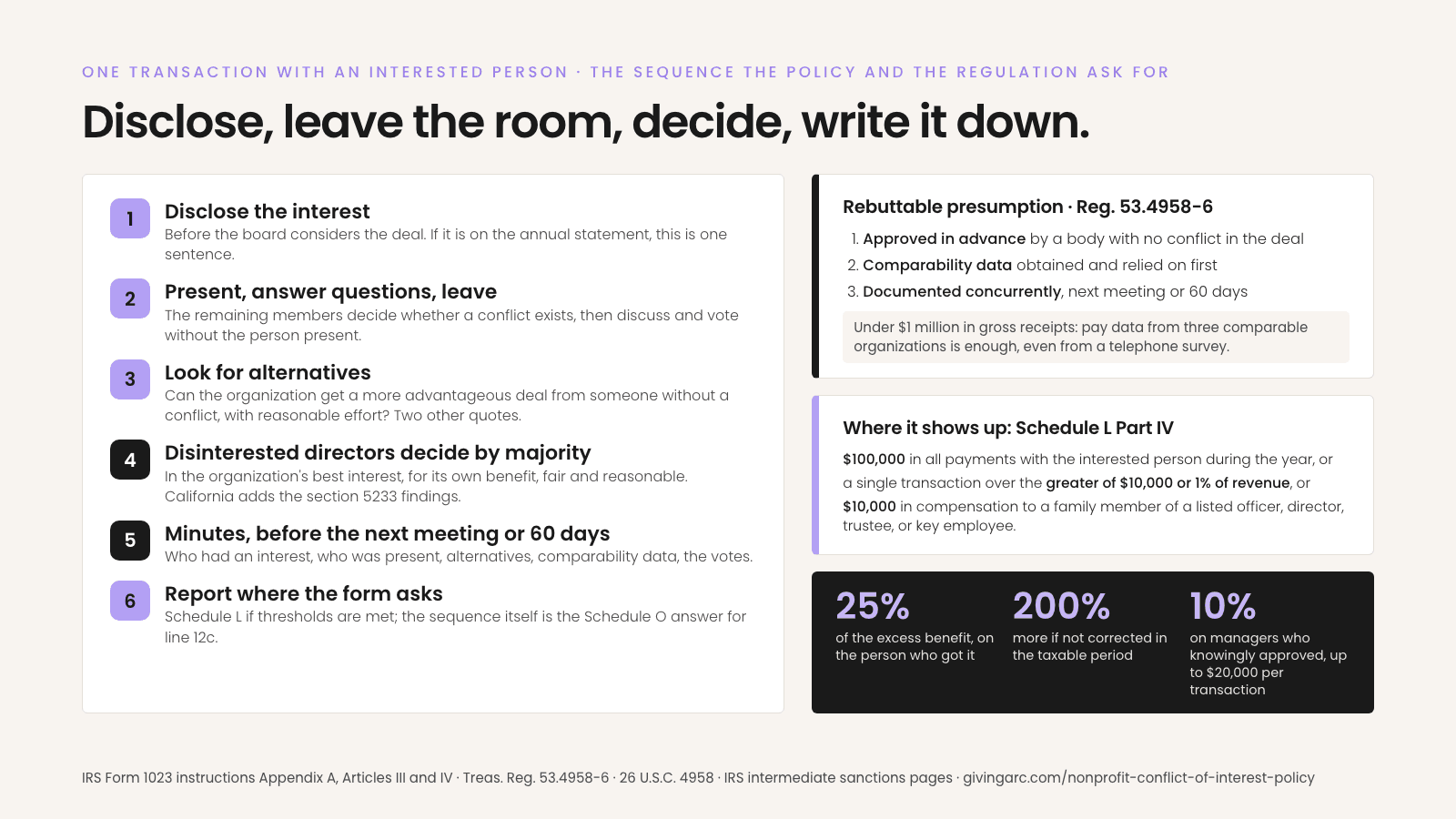
The reason the minutes matter this much is the rebuttable presumption of reasonableness in Treasury Regulation 53.4958-6. If three conditions are met, a compensation arrangement is presumed reasonable and a property transfer is presumed to be at fair market value, and the IRS can rebut the presumption “only if it develops sufficient contrary evidence to rebut the probative value of the comparability data relied upon by the authorized body.” The three conditions: the arrangement was approved in advance by a body composed entirely of people without a conflict of interest in it; that body obtained and relied on appropriate comparability data before deciding; and it adequately documented the basis for its decision concurrently with making it. The IRS’s plain-language page on the presumption lists the same three.
Comparability data sounds expensive and, for a small organization, is not. The regulation has a safe harbor for organizations with annual gross receipts under $1 million: data on compensation paid by three comparable organizations in the same or similar communities for similar services is appropriate data. Its own example is a repertory theater with receipts between $400,000 and $800,000 whose board relied on “a telephone survey of three other unrelated performing arts organizations of similar size in similar communities,” summarized in a brief written note by one board member. That was enough. For a property transaction, the regulation points to independent appraisals and offers received in an open, competitive bidding process, which for the printing contract means the two other quotes.
25%
of the excess benefit, paid by the person who received it
The initial excise tax under section 4958 on each excess benefit transaction between a public charity and a disqualified person. The organization does not pay it.
200%
more if the benefit is not corrected in time
The additional tax if the transaction is not corrected within the taxable period, which runs from the transaction date to the earlier of a deficiency notice or assessment. It can be abated if corrected within a 90-day correction period.
10%
on managers who knowingly approved it, capped at $20,000 per transaction
Imposed only if the 25% tax applies, the manager participated knowingly, willfully, and without reasonable cause. A manager who opposed the transaction is not a participant, and one who relied on the rebuttable presumption being satisfied is not “knowing.”
An excess benefit transaction is one in which the economic benefit the organization provides to a disqualified person exceeds the value of what it gets back. A fair contract with a director’s spouse is not one, however it was approved. The taxes are the reason the approval process matters when the contract is arguable, and the reason the 10% manager tax exists is to give every other director a personal stake in following the policy. Note the two protections written into the same IRS page: a manager who opposed the transaction “in a manner consistent with the fulfillment of the manager’s responsibilities” has not participated, and a manager who relied on the presumption’s requirements being met is not treated as knowing.
Schedule L is where the transaction is reported, whether or not it was handled well. Part I covers excess benefit transactions, regardless of amount. Part II covers loans to or from interested persons outstanding at year-end, each one regardless of amount. Part III covers grants or assistance to interested persons, including scholarships and discounts, regardless of amount. Part IV covers business transactions, and it has thresholds: all payments between the organization and the interested person during the year exceeded $100,000; payments from a single transaction exceeded the greater of $10,000 or 1% of total revenue; compensation to a family member of a listed officer, director, trustee, or key employee exceeded $10,000; or a joint venture in which the organization has invested $10,000 or more and each party’s interest exceeds 10%. For Parts II through IV, “interested person” includes current and former officers, directors, trustees, and key employees, the founder, any substantial contributor, meaning anyone who gave $5,000 or more in the year and appears on Schedule B, the family members of all of those people, and entities they control by more than 35%, which is how the spouse-owned printing company reaches Part IV. The ordinary-course-of-business exception that applies to Part VI line 2 does not apply to Schedule L, apart from a narrow exception for publicly traded companies.
A “Yes” on line 12c has to be described on Schedule O, and the instructions say what the description must include: the organization’s practices for monitoring proposed or ongoing transactions for conflicts and dealing with them whether discovered before or after the transaction; which persons are covered; the level at which determinations of whether a conflict exists are made; the level at which actual conflicts are reviewed; and any restrictions imposed on persons with a conflict, such as being barred from deliberations and votes. Our Schedule O guide covers the other required narratives, including line 11b and line 19, which asks how the policy itself is made available to the public. For line 12c, two versions that meet the instructions:
Small board, no committees
Form 990, Part VI, Section B, line 12c: The conflict of interest policy covers all directors and officers. Each signs an annual disclosure statement listing interests of the director or officer and family members in entities that do business with the organization; the Secretary collects the statements and the Board Chair reviews them. Before the board considers any transaction with a person or entity named on a statement, the interested director discloses the interest, may answer questions, and leaves the meeting; the remaining directors determine whether a conflict exists, consider alternatives, and vote. Disclosures, recusals, and votes are recorded in the minutes. The board reviews the policy annually.
Board with a finance or audit committee
Form 990, Part VI, Section B, line 12c: The conflict of interest policy covers directors, officers, members of committees with board-delegated powers, and employees with contracting or purchasing authority. Covered persons complete an annual disclosure statement, which the Secretary provides to the Audit Committee Chair. The Audit Committee reviews the statements and screens proposed vendor contracts and compensation arrangements against them; the full board determines whether a conflict exists and approves or declines the transaction with the interested person absent from deliberation and the vote. The minutes record the disclosure, the alternatives considered, the comparability data relied on, and the vote, and are prepared before the next board meeting.
Write the version that is true. The description is a statement of what the organization did during the year, and a Schedule O paragraph describing a committee you do not have is worse than a “No” on 12c with a policy adopted in December and a plan for next year.
Every full Form 990 we prepare starts with a client questionnaire, and the governance section asks line 12 in the IRS’s words: whether there was a written conflict of interest policy, whether officers, directors, trustees, and key employees were required to disclose annually, and whether the organization regularly and consistently monitored and enforced compliance. If the third answer is “Yes,” the questionnaire asks for the monitoring practice in a few sentences, and we draft the Schedule O paragraph from that answer, in the structure the instructions require, for the board to confirm before the return is signed. The same questionnaire asks about the whistleblower policy and the document retention policy on lines 13 and 14, which are the other two guides in this series.
For organizations whose books we keep, the adopted policy and the year’s signed statements live in the same compliance folder as the determination letter and the prior returns, so the answer to line 12 is a file, not a memory. For organizations that come to us for the return alone, the questionnaire is where the three questions get asked. Either way, the return is priced per filing: from $1,500 for a full Form 990 and from $500 for a Form 990-EZ when we keep your books, or $1,800 and $600 for the return alone, with a fixed quote before work begins, and the pricing page shows the rest. The treasurer usually keeps the file, and the annual statement reminder belongs in the same calendar as the budget and the 990 review. The gift acceptance policy, the expense reimbursement policy, and the internal controls that go with them are covered in their own guides, and they belong in the same annual governance review as this one.
Three questions on line 12, answered once and kept on file.
We prepare Form 990s from $1,500 ($1,800 without our bookkeeping) and keep the governance file for our bookkeeping clients, so line 12 is answered from records, not memory. Ask us how the Form 990 questionnaire works.
Common questions from boards adopting or updating a nonprofit conflict of interest policy.
Not by federal tax law. Form 990 Part VI Section B says it asks about policies not required by the Internal Revenue Code, and the Form 1023 instructions say adoption is not required to obtain exemption. Some states do require one: New York’s N-PCL section 715-a requires every New York not-for-profit board to adopt a policy with six minimum provisions. California does not require a written policy, but Corporations Code section 5233 sets approval steps for any self-dealing transaction.
No. Form 990-EZ has no governance section, and the IRS FAQ on 990-EZ governance says so directly; the line 12 questions appear only on the full Form 990. The section 4958 excise taxes on excess benefit transactions apply to 990-EZ filers all the same, and a 990-EZ filer still reports excess benefit transactions and insider loans on Schedule L when Part V lines 40b or 38a are answered yes.
Under the IRS sample policy, any director, principal officer, or member of a committee with board-delegated powers who has a direct or indirect financial interest, through business, investment, or family, in an entity the organization deals with or is negotiating with. Form 990 line 12b names officers, directors, trustees, and key employees. Schedule L uses its own list for reporting, which adds the founder, any substantial contributor who gave $5,000 or more in the year, the family members of all of those people, and entities they control by more than 35%.
Yes, if the policy is followed: the director discloses the interest, leaves the room, the disinterested directors look for alternatives and decide by majority that the arrangement is in the organization’s best interest and fair and reasonable, and the minutes record all of it. In California the board also makes the section 5233 findings. The transaction is reported on Schedule L Part IV if it crosses the thresholds there. It becomes an excess benefit transaction only if the organization pays more than the value it receives.
Statements at least annually, because that is what line 12b asks; the IRS instructions say annually or more frequently, and New York requires one before a director’s initial election and every year after. The policy itself should be reviewed on the same annual cycle as the gift acceptance and document retention policies, and sooner if the organization adds staff with purchasing authority, changes its committee structure, or incorporates in a state with its own requirements.
GivingArc provides bookkeeping, Form 990 preparation, and nonprofit-specialized accounting for small and mid-size 501(c)(3) organizations across the US. The policy and disclosure statement above are templates adapted from a public-domain IRS document and are not legal advice; have counsel in your state review them before adoption. Sources checked September 2026. Reviewed by Min Kim, CPA.