
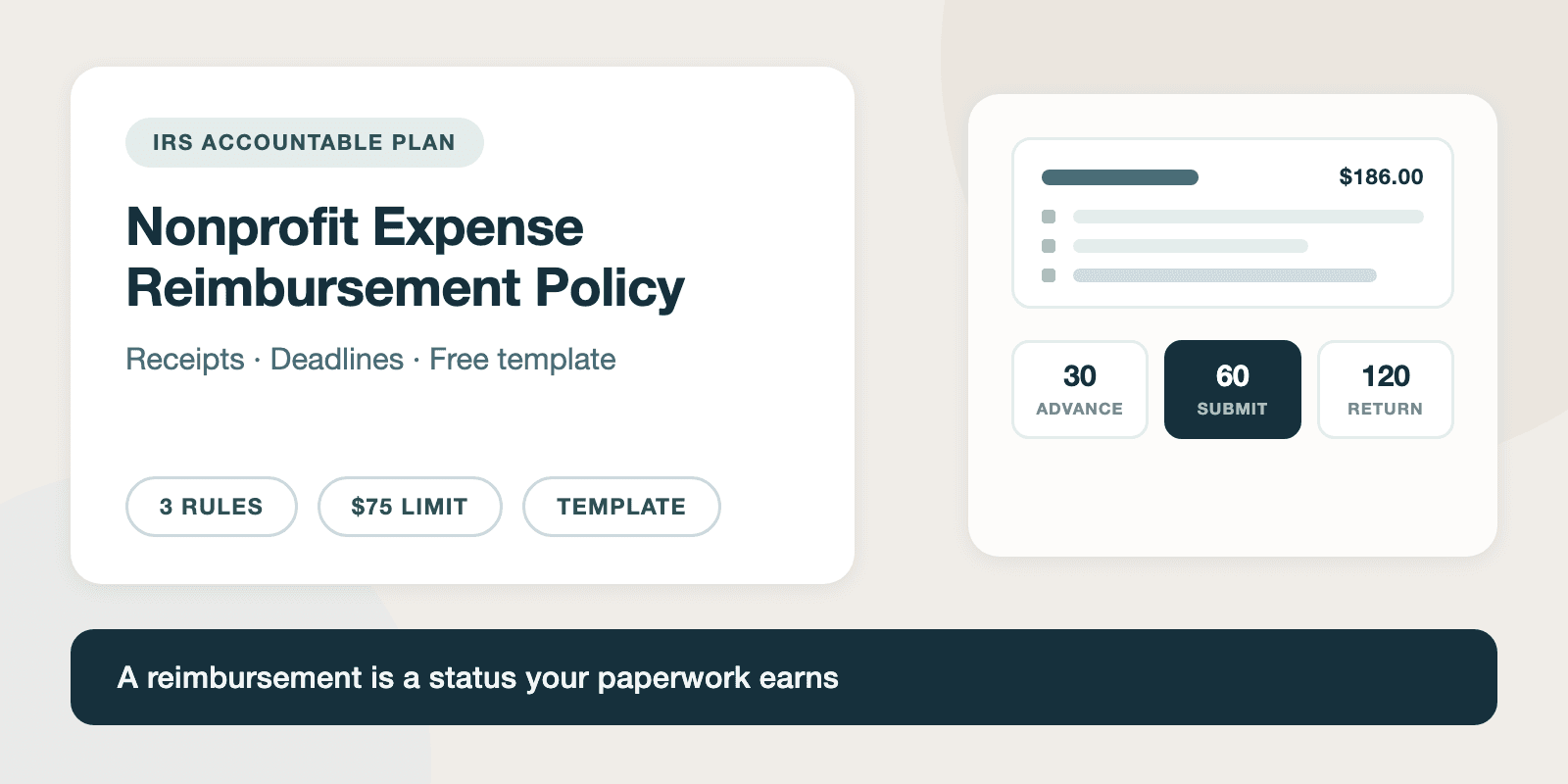
Your program director drives to three site visits, buys supplies for a family workshop, and covers parking. She sends you a text: “$186 this month, can you add it to my next check?” You add it to her next check. Everyone in the organization would call that a reimbursement.
The IRS might call it wages.
Here’s the reframe that makes this whole topic click: “reimbursement” isn’t a type of payment — it’s a status your paperwork earns. Money leaving your organization toward a person is compensation by default. A written policy, receipts, and a deadline are what convert it back into a tax-free reimbursement. Skip them and the money doesn’t just stay untidy; it legally becomes taxable wages that belong on a W-2, with withholding and payroll taxes attached.
The good news is that the qualifying standard — an accountable plan — is short, and most of it is habits your organization probably already has in some informal form. This guide covers what the IRS actually requires, the deadline rules people most often get wrong, and a nonprofit expense reimbursement policy you can copy into your board packet this week.
Key Takeaways
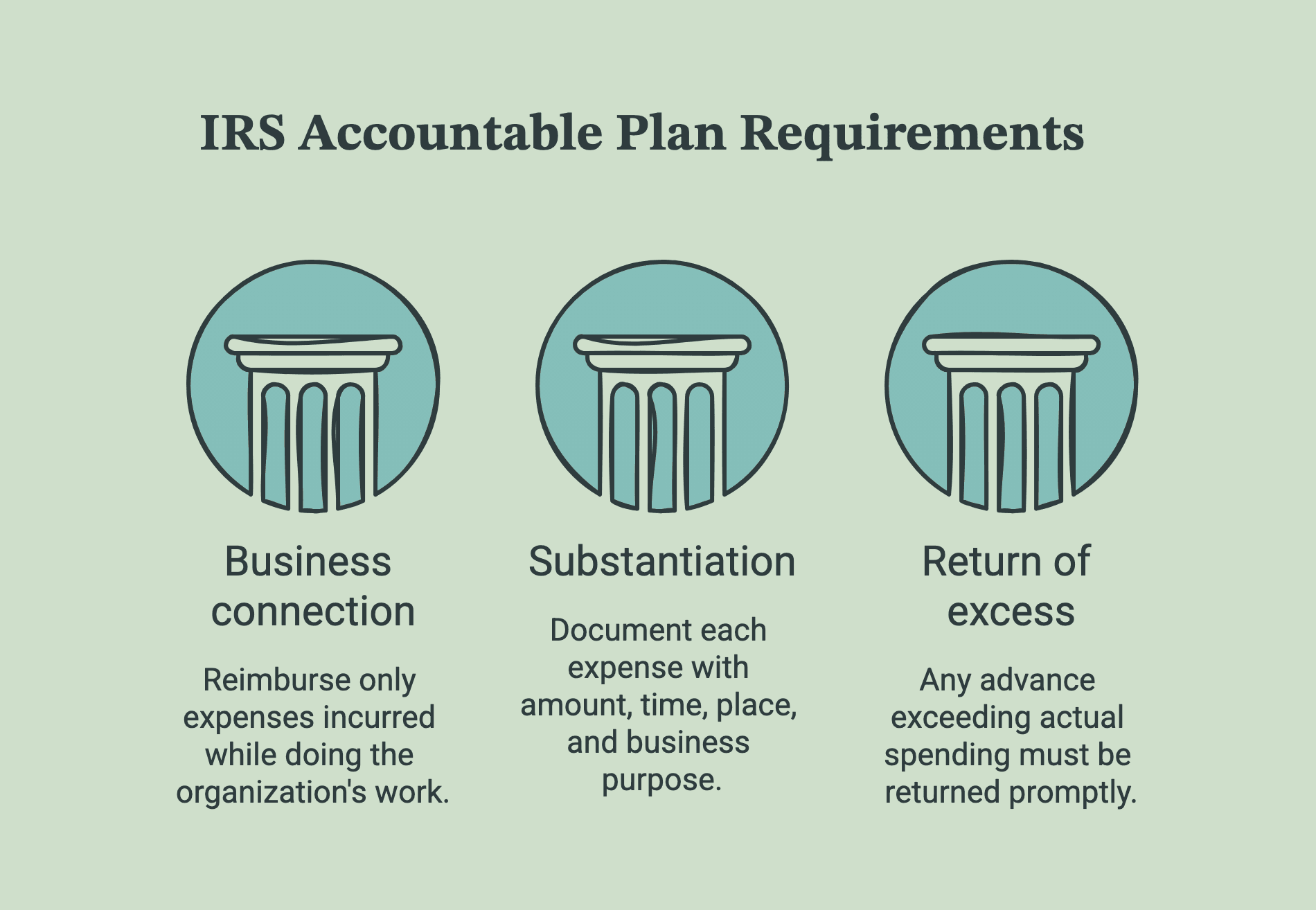
An accountable plan is an expense reimbursement arrangement that meets three conditions set out in Treasury Regulation §1.62-2. It doesn’t require an application, an IRS filing, or approval from anyone. You either meet the three conditions or you don’t — and the regulation is blunt about the consequence: if an arrangement fails one or more of them, all amounts paid under it are treated as paid under a nonaccountable plan.
01
Business connection
You reimburse only expenses the person incurred while doing the organization’s work. Paying a flat monthly “expense allowance” whether or not anything was spent fails this test.
02
Substantiation
Each expense is documented to the organization within a reasonable time. For travel and vehicle costs that means four elements: amount, time, place, and business purpose.
03
Return of excess
If you advance money and the person spends less, they give the difference back within a reasonable time. Letting people keep leftovers quietly converts the arrangement.
One nuance worth knowing, because it prevents a lot of panic: if your plan meets all three requirements and one employee simply fails to return an excess advance, only that excess amount is treated as nonaccountable. A single sloppy month doesn’t contaminate everyone else’s reimbursements. What does put the whole plan at risk is a pattern — the regulation specifically denies the safe harbors to organizations with a practice of over-reimbursing and not collecting the difference.
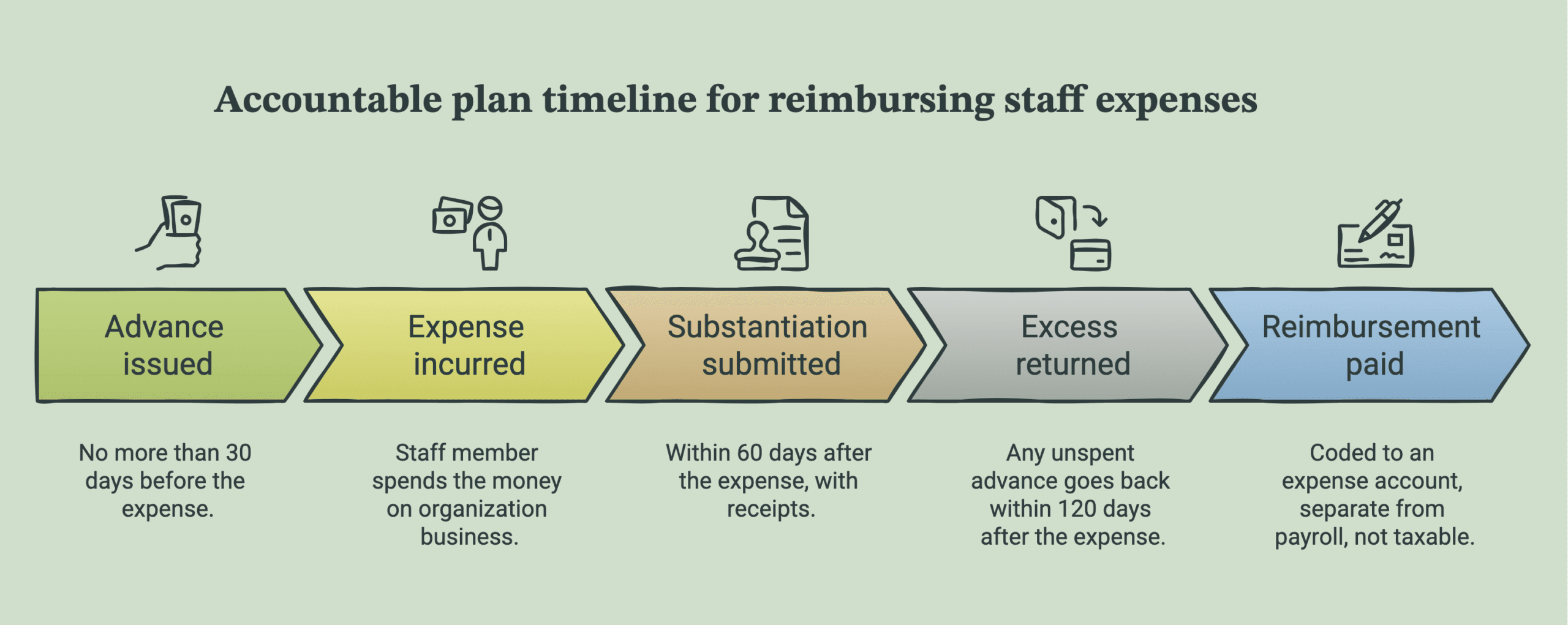
“Within a reasonable period of time” is the phrase that governs both substantiation and return of excess — and the regulation admits it depends on facts and circumstances. Rather than leave everyone guessing, the IRS offers a safe harbor with fixed dates. Meet these and the timing question is settled:
Fixed date safe harbor
30 days
before the expense — the earliest you should hand out an advance.
60 days
after the expense — the deadline to submit substantiation.
120 days
after the expense — the deadline to return any unused advance.
These are safe harbors, not the only way to comply — but writing them into your policy means you never have to argue about what “reasonable” meant.
There’s a second, less-known option that fits organizations running expenses through a monthly close. Under the periodic statement method, you send people a statement at least quarterly showing any amount they haven’t yet substantiated or returned, and give them 120 days from that statement to fix it. The distinction matters: in the fixed date method the 120-day clock starts at the expense; in the periodic statement method it starts at the statement. Pick one and say which in your policy — mixing them is how organizations end up with neither.
Substantiation is where most policies get vague, so here are the actual thresholds — including the two rules people most often invert. One scoping note before the table: the $75 and lodging rules below come from the IRS substantiation rules for travel, meals, gifts, and vehicles under Regulation §1.274-5. They aren’t a universal receipt law for every purchase — but most organizations apply them across the board anyway, because one standard is easier to administer than two.
What documentation is required
| Expense | Rule | Watch out for |
|---|---|---|
| Anything $75 or more | Documentary evidence — a receipt or paid bill | The threshold applies per expenditure, and it is a floor, not a ceiling — your policy may require receipts for everything |
| Lodging | Receipt required at any amount when traveling away from home | The $75 exception never applies to lodging — this is the most-missed line |
| Under $75 | Receipt excused, record still required | You still need amount, date, place, and business purpose — “misc supplies $40” isn’t enough |
| Mileage | Log of date, destination, purpose, and miles | The IRS business standard rate changed mid-2026: 72.5¢ per mile for January–June, 76¢ for July–December |
| Per diem | Amounts up to the federal per diem rate are deemed substantiated under Revenue Procedure 2019-48 | You still need time, place, and business purpose — only the dollar receipts are replaced by the GSA rate |
Two clarifications that save arguments later. First, the mid-year mileage change means a single annual rate in your policy will be wrong half the time — reference “the current IRS standard mileage rate” instead of a number. Second, the 14¢ charitable mileage rate you may have heard of is set by statute and applies to what a volunteer can deduct on their own return. It is not a cap on what you may reimburse an employee for organizational driving.
Whatever you collect, keep it. Employment tax records must be retained for at least four years, and reimbursement documentation is exactly what an auditor asks to sample first — see our audit preparation checklist for how these files get requested in practice.
Here’s a starting policy that satisfies all three requirements. Adopt it by board resolution, note the adoption date in your minutes, and adapt it as you grow — a two-person organization doesn’t need the approval matrix a twenty-person one does.
Copy-paste starter policy
[Organization] Expense Reimbursement Policy
1. Purpose. This policy establishes an accountable plan under Treasury Regulation §1.62-2. Reimbursements made under it are not taxable income to the recipient. Payments that do not meet these requirements will be reported as taxable compensation.
2. Eligible expenses. [Organization] reimburses ordinary and necessary expenses incurred in carrying out its exempt purpose — including approved travel, mileage, program supplies, professional development, and meals directly tied to organizational business. Personal expenses, spousal or family travel, fines, and alcohol are not reimbursable.
3. Approval. Expenses over $[amount] require advance written approval from [role]. The Executive Director’s expenses are approved by the Board Chair or Treasurer — no one approves their own reimbursement.
4. Documentation. Submit a completed expense report listing the amount, date, place, and business purpose of each item. Attach a receipt for every expense of $75 or more and for all lodging regardless of amount. Mileage requires a log of date, destination, purpose, and miles; reimbursement is at the current IRS standard mileage rate.
5. Deadlines. Submit expense reports within 60 days of the date the expense was incurred. Advances are issued no more than 30 days before an anticipated expense, and any unspent portion must be returned within 120 days of the expense. Amounts not substantiated or returned within these periods will be reported as wages.
6. Payment. Approved reimbursements are paid within [X] business days, separately from payroll, and recorded to the appropriate expense account rather than to compensation.
7. Records and review. Expense documentation is retained for at least four years. The Board reviews this policy annually and approves any changes by resolution.
Section 6 does more work than it looks like. Paying reimbursements separately from payroll — and coding them to real expense accounts in your chart of accounts instead of burying them in salaries — is what makes the arrangement visible and defensible later. It also keeps your functional expense allocation honest, since program mileage belongs in program costs, not in management and general.
Not sure your current reimbursements are coded correctly? A clean monthly close catches this before it becomes a payroll correction.
See our bookkeeping service →The failure mode isn’t an IRS agent knocking on your door. It’s quieter: a payroll correction, a restated W-2, and a conversation with a staff member about why their taxable income went up for a year in which nothing about their pay changed.
When a reimbursement becomes wages
Under a nonaccountable plan, the regulation is explicit: the amounts are included in the employee’s gross income, reported as wages on Form W-2, and subject to withholding and payment of employment taxes. Per IRS Publication 15, that means income tax withholding plus Social Security and Medicare — the organization’s share included.
And the employee can’t simply deduct the expense on the other side to make themselves whole. Since 2018, unreimbursed employee business expenses are no longer deductible as miscellaneous itemized deductions. The paperwork you skipped becomes a real, permanent cost to the person who spent their own money on your mission.
There’s a second cost that’s easy to miss: a documented reimbursement process is a basic internal control. Requiring receipts and a second approver is exactly the separation of duties that keeps small expense fraud from ever starting — the same logic behind the rest of our internal controls guide for small organizations.
Reimbursing leadership carries a risk that reimbursing a program coordinator doesn’t. Voting board members and top officials — your executive director, and whoever holds ultimate responsibility for finances — are treated as having substantial influence over the organization, which makes them “disqualified persons” for purposes of the intermediate sanctions rules. Payments to them that aren’t properly documented as compensation or reimbursement can be treated as an excess benefit transaction under Internal Revenue Code §4958.
Here’s the encouraging half of that rule, and it’s the single best argument for adopting a policy: reimbursements made under an arrangement that meets the accountable plan requirements are disregarded entirely in the excess benefit analysis. A compliant policy doesn’t just save payroll tax — it removes leadership reimbursements from the question altogether. Without one, the excise taxes are steep: 25% of the excess benefit on the recipient, 10% on any organization manager who knowingly approved it (capped at $20,000 per transaction), and an additional 200% if the transaction isn’t corrected.
Board and executives
Same policy, one addition: nobody approves their own reimbursement. Route the Executive Director’s expenses to the Board Chair or Treasurer, and note the arrangement in your minutes. And if compensation levels put you into Schedule J with your Form 990, providing any of the perquisites it lists — first-class or charter travel, companion travel, club dues, housing — brings a follow-up question about whether you followed a written policy for all of them. Have one.
Volunteers
The accountable plan regulation is written around employer-employee arrangements, and how it reaches volunteers depends on the facts — a volunteer working under the organization’s direction may be treated much like an employee. The safe default is simple: run volunteers through the same process, and reimburse documented actual costs. Payments that aren’t substantiated can become reportable income to the recipient. And tell volunteers plainly: IRS Publication 526 says costs you reimburse are generally not deductible by them as a charitable contribution.
One last note for volunteer-heavy organizations: don’t confuse reimbursement with revenue recognition. Reimbursing a volunteer’s costs is simply an expense. Whether donated services get recorded as contribution revenue is a separate accounting test — routine volunteer hours generally aren’t recognized, while services requiring specialized skills, provided by someone who has them, that you would otherwise have had to purchase, generally are. Our guide to in-kind donations draws that line.
If you’re building out policies generally, this one belongs next to the recurring filings on your nonprofit compliance checklist, and it’s a natural agenda item for whoever owns finance — usually the treasurer. Adopt it once, review it annually, and it quietly does its job.
Common questions from EDs and treasurers writing a nonprofit expense reimbursement policy.
The IRS does not require a specific written document, but an accountable plan must actually require substantiation and return of excess amounts — and proving that in practice is far easier with a written policy adopted by the board. Auditors, grantmakers, and payroll providers all ask for it, so treat writing it down as the practical requirement.
Business connection, substantiation, and return of excess. The arrangement must reimburse only expenses incurred in performing services for the organization, require each expense to be substantiated within a reasonable period, and require the person to return any amount paid in excess of substantiated expenses. Failing any one of the three makes the entire arrangement nonaccountable.
Under the IRS substantiation rules for travel, meals, gifts, and vehicle expenses, documentary evidence such as a receipt is required for any expenditure of $75 or more, and for lodging while traveling away from home at any amount. Under the threshold the receipt is excused but the record is not: you still need the amount, date, place, and business purpose. Many organizations simply require receipts for everything, because one rule is easier to follow than two.
Under the IRS fixed date safe harbor, substantiation within 60 days after an expense is paid or incurred is treated as within a reasonable period of time, and any excess advance returned within 120 days after the expense also qualifies. An advance itself should be issued no more than 30 days before the anticipated expense.
Most organizations reimburse employees at the IRS business standard mileage rate, which changed mid-year in 2026: 72.5 cents per mile for January through June and 76 cents for July through December. Write “the current IRS standard mileage rate” into your policy rather than a fixed number. The 14 cents per mile charitable rate is set by statute and relates to what a volunteer may deduct, not to what you may reimburse an employee.
The payments are treated as made under a nonaccountable plan, which means they are included in the recipient’s gross income, reported as wages on Form W-2, and subject to income tax withholding and employment taxes. For board members and executives, undocumented payments can also raise excess benefit transaction questions under Internal Revenue Code section 4958.
Reimbursements coded right, every month — not reconstructed in January.
GivingArc handles bookkeeping and Form 990 preparation for small and mid-size 501(c)(3)s.
GivingArc provides bookkeeping, Form 990 preparation, and nonprofit-specialized accounting for small and mid-size 501(c)(3) organizations across the US. This article is general information, not legal or tax advice — confirm specifics with your CPA before adopting a policy. Reviewed by Min Kim, CPA.