
When a nonprofit is brand new, the books rarely feel urgent. There’s a mission to launch, a first grant to chase, a board to recruit. “We’ll sort out the accounting once we’re a little bigger” is one of the most common — and most expensive — decisions a new organization makes.
Here’s the better way to think about it. The first 90 days are a wet-cement window. Right now the foundation is still soft — you can shape it in an afternoon. Wait a year, and it’s set: every fix means breaking up hardened habits and re-pouring. This guide is a practical, do-this-then-that plan for getting your nonprofit bookkeeping setup right while the cement is still wet, so the foundation supports everything that comes later — board reports, grants, restricted funds, and a calm Form 990 season.
Key Takeaways
Most nonprofit accounting problems aren’t born at year three. They’re born in month one, when a well-meaning founder opens a generic accounting file, starts lumping every donation into one “income” bucket, and skips the structure that nonprofit finances actually require. The damage is invisible at first — and then a grant report, an audit, or a Form 990 forces all of it to the surface at once.
Setting up correctly from the start does three things at once. It makes day-to-day recordkeeping faster, because every transaction has an obvious home. It makes oversight possible, because the board can see real numbers instead of guesses — the heart of the board’s financial oversight role. And it makes compliance routine instead of frightening — the IRS expects every exempt organization to be able to document the sources of its receipts and expenditures, and a clean setup is how you do that without scrambling.
The next three sections break the work into one month at a time. You don’t have to do it all at once — you just have to do it in order.
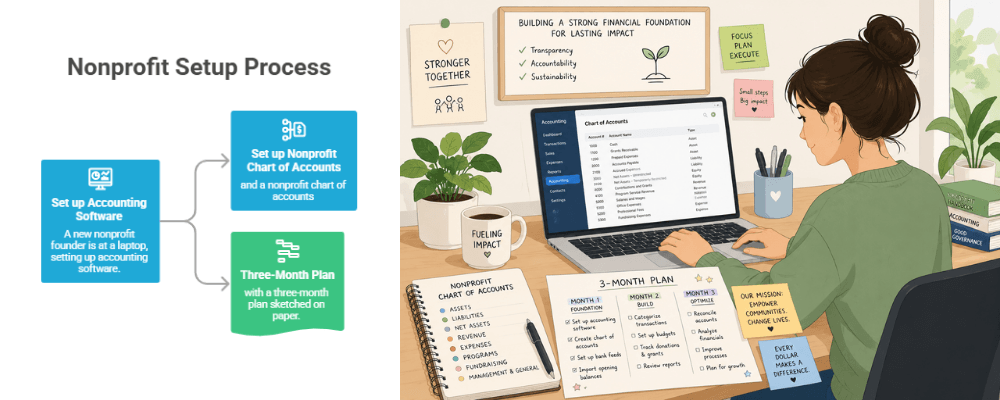
Month one is structural. Nothing here is glamorous, and all of it pays off every single month afterward. The goal is a system where every dollar that comes in or goes out has one obvious, correct place to land.
Build the foundation
With the structure in place, month two is about habit. A nonprofit that closes its books a little every month never faces the year-end cliff that buries the organizations that don’t. Think of it like brushing your teeth versus an emergency root canal — small, boring, and regular beats rare and painful.
Build the rhythm
A starter month-end close checklist
Not sure what “closing the books” actually includes? Use this as a baseline — then add or remove items as your nonprofit grows and your funding gets more complex. The goal isn’t a perfect list; it’s running the same list every month.
Reconcile every bank and credit card account to the statement
Match donation-platform and payment-processor deposits to your records
Categorize every transaction — clear anything still “uncategorized”
Confirm restricted gifts are coded correctly, and release any spent as intended
Record any in-kind (non-cash) donations received
Review payroll and contractor entries
Run a budget-vs-actual review for the month
Generate the two board financials (statement of financial position and activities)
Lock the period so closed months can’t change
If a few of these don’t apply yet — no payroll, no restricted gifts — skip them. A short checklist you actually run beats a complete one you avoid.
Numbers nobody reads aren’t accounting — they’re data entry. Month three turns your clean books into decisions, by producing reports the board and funders can actually use.
Build the reporting
Not sure your foundation is set up right?
GivingArc can set up your nonprofit’s books correctly from the start — chart of accounts, fund tracking, and a monthly rhythm built for grants and Form 990.
A few setup mistakes show up again and again, and each one is far easier to avoid now than to unwind later:
We cover these in depth in nonprofit bookkeeping mistakes and the related 501(c)(3) bookkeeping requirements — both worth a read once your foundation is in place. Avoiding the chart-of-accounts mistake alone prevents most of the rest.
Plenty of brand-new nonprofits handle their own books for a season, and that’s fine. But a few signals mean it’s worth bringing in nonprofit-specialized help sooner rather than later: you’ve received your first restricted grant, you’re filing a full Form 990 (not the 990-N postcard), you’ve hired staff and started payroll, or a funder will examine your financials. Each of these adds technical complexity that’s easy to get wrong and expensive to fix.
The good news: getting help early is cheaper than cleanup later, and a clean nonprofit bookkeeping setup from day one means you may only need a light touch — a professional to establish the structure and review the monthly close — rather than a full rescue. Our guides on best practices for nonprofit bookkeeping and the most common Form 990 mistakes are good places to gauge where you stand.
Here’s the whole plan on one page. Work top to bottom — each phase builds on the one before it.
Month 1 — Foundation
Choose fund-accounting-capable software
Open dedicated bank & credit card accounts
Build a nonprofit-specific chart of accounts
Define donation, grant, and revenue categories
Month 2 — Rhythm
Set one consistent method for capturing receipts
Reconcile every account, every month
Track payroll and contractors correctly
Run a repeatable month-end close checklist
Month 3 — Reporting
Produce board-ready financial statements
Compare budget vs. actual monthly
Track restricted funds separately
Set up grant budgets and reporting deadlines
If your nonprofit is new or growing, you don’t have to build this foundation alone. GivingArc sets up nonprofit bookkeeping correctly from the beginning — the right chart of accounts, fund and restricted-gift tracking, a monthly close rhythm, and reports your board can read — so your books support your grants, your Form 990, and your mission decisions instead of holding them back.
Start your nonprofit’s books on a clean foundation
From bookkeeping setup to Form 990 support, GivingArc helps new and growing 501(c)(3)s get it right from day one.
Common questions from founders and boards setting up a new nonprofit’s books.
Work in three phases over your first 90 days. Month 1: choose fund-accounting-capable software, open dedicated bank accounts, and build a nonprofit chart of accounts. Month 2: establish a monthly rhythm of capturing receipts, reconciling accounts, and closing the books. Month 3: produce board-ready financial statements, budget-vs-actual reports, and restricted-fund and grant tracking.
The best software is one that supports fund accounting — the ability to tag transactions by fund, program, and donor restriction. Several mainstream and nonprofit-specific platforms do this well. Rather than chase a brand, prioritize the capability: if the tool can’t separate restricted from unrestricted funds and produce nonprofit financial statements, it will create cleanup work later regardless of its name.
Yes. A generic for-profit chart of accounts can’t cleanly separate restricted from unrestricted funds or support the functional expense reporting (program, management, fundraising) that Form 990 requires. Setting up a nonprofit-specific structure at the start is far easier than restructuring after a year of transactions are already coded the wrong way.
Before the first restricted gift arrives. Restricted funds are donations a donor has designated for a specific purpose or time period, and they must be tracked separately from general operating money. Deciding how you’ll track them during setup — rather than after a funder asks for a report — prevents one of the most common and stressful nonprofit accounting problems.
Exempt organizations must be able to document the sources of their receipts and expenditures. Records that support Form 990 should generally be kept at least three years from the filing date, employment tax records at least four years, and organizing documents (articles, bylaws, IRS determination letter, board minutes) permanently. State or grant requirements may call for longer retention.
Consider nonprofit-specialized help once you receive a restricted grant, file a full Form 990, hire staff and run payroll, or expect a funder to review your financials. Getting help early — even just to set up the structure and review the monthly close — is far cheaper than cleaning up a year or more of misclassified books.
GivingArc provides bookkeeping, Form 990 preparation, and nonprofit-specialized accounting for small and mid-size 501(c)(3) organizations across the US. This article is general information, not tax or legal advice. Reviewed by Min Kim, CPA.