

Key Takeaways
If you run a small nonprofit, you probably already know your books aren’t perfect. Maybe a volunteer started QuickBooks two years ago and stopped. Maybe a part-time bookkeeper handles transactions but no one closes the month. Maybe you’ve been telling yourself you’ll fix it later, after the next grant, after the next board meeting, after the audit.
This is the article we wished we could send to executive directors before they call us. We’ve also written companion pieces on smart software buying through TechSoup and the hidden cost of “free” fundraising tools — same root problem, different angle.
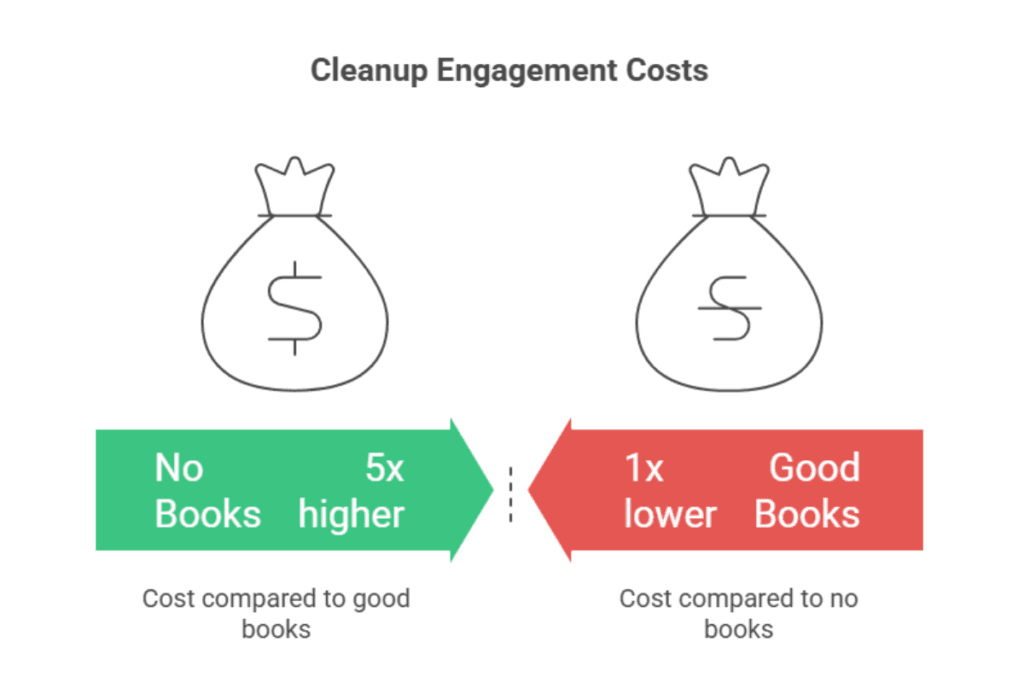
The thesis up front: Bad bookkeeping is roughly five times more expensive to fix than no bookkeeping at all. And the cheapest path forward isn’t perfect books — it’s saved records.
That sounds counterintuitive. Most ED training tells you something is better than nothing. With bookkeeping, that’s only true if “something” is actually correct. Wrong entries, misclassified income, mixed personal and organizational expenses — every wrong line of data has to be unwound before the right one can replace it. Starting from zero with a clean stack of bank statements and receipts is faster, cleaner, and cheaper than untangling someone else’s well-meaning mistakes.
When we take on a new cleanup engagement at GivingArc, the first conversation usually sounds like this:
“We’ve been doing our books in QuickBooks for three years. Our bookkeeper just left. We need someone to take over.”
What that often turns out to mean: three years of transactions entered in the wrong account, donor restricted funds never tracked separately, payroll running through the wrong category, board reports that don’t reconcile to bank statements, and a Form 990 filed using whatever the books said — accurate or not.
Compare that to a fresh start:
“We’ve never really kept books. We have all our bank statements and a folder of receipts. Help.”
That second nonprofit will get to a clean, reportable financial picture faster and cheaper than the first one. By a wide margin. Cleanup isn’t entering transactions — it’s investigating, undoing, and re-entering. Every wrong entry has to be traced back, verified, corrected, and reposted in the right account, often with cascading effects on twelve months of reports. In our cleanup engagements, the rule of thumb has been roughly: starting from nothing with intact records takes about one-fifth the hours of starting from bad books.
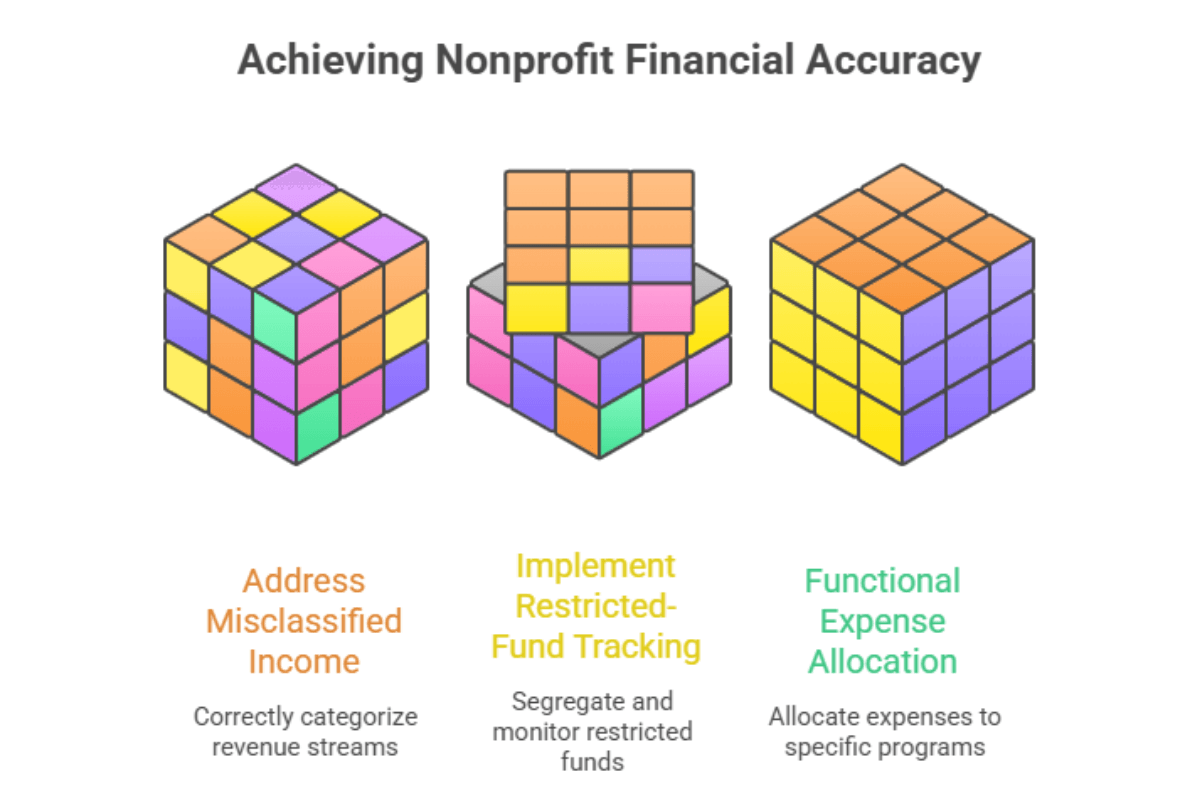
These are the five patterns we see most often in nonprofit cleanups. If any sound familiar, your books may need attention more than you realize.
Restricted grants entered as unrestricted revenue, program fees coded as donations, donor advised fund distributions mixed with individual gifts. Cascades into Form 990 Part VIII and audit findings.
Under FASB ASC 958, every dollar must be classified as “with donor restrictions” or “without donor restrictions.” Many small nonprofits dump everything in one bucket and can’t reconstruct.
ED uses the org credit card for personal coffee, intending to pay it back. Forgets. Sits there two years. Multiply by dozens of small mixups — the single biggest source of cleanup pain.
Books that aren’t reconciled to the bank statement at month-end drift further from reality. A year of unreconciled books can disguise a missing $20,000 — or a fraud.
Form 990 Part IX requires every expense split across program, management/general, and fundraising. Bookkeepers without nonprofit training skip this entirely, destroying overhead ratios in funders’ eyes.
If two or more of these describe your books, the books are creating risk faster than they’re creating clarity.
A few specific reasons cleanup work scales the way it does:
Best case
No Books, Good Records
$2K–$5K
Build books from scratch using intact bank statements + receipts. Fast, clean, audit-ready.
Worst case
Bad Books, Partial Records
$8K–$25K
Investigate every wrong entry, undo it, re-enter. Often 3–5x more hours than starting fresh.
Unrecoverable
Bad Books, Missing Records
Reset
May require new file, fresh chart of accounts, accepting prior years can’t be restated.
Both the first two end up in the same place: accurate financials. The bad-books nonprofit paid three to five times the price to get there.
This is the single most important paragraph in this article. If you take only one thing away:
You don’t need to do bookkeeping today to make bookkeeping possible tomorrow. You need to preserve the records.
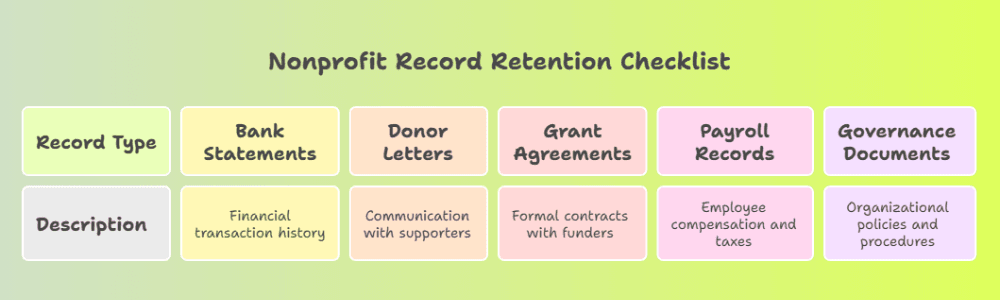
Here’s the minimum survival kit. Save everything in these categories per IRS recordkeeping guidance:
Bank & credit card statements (every month, every account)
Keep 7 years
Donor records, receipts, acknowledgment letters
Keep 7 years
Grant agreements (with restriction terms)
Permanent
Payroll: W-2s, W-3s, Form 941s, 1099s
4 years min
Vendor invoices and receipts (all of them)
7 years
Board minutes, resolutions, articles, bylaws, IRS determination letter
Permanent
Form 990 and supporting workpapers
3 years min
A nonprofit with three years of no books but complete source records can be fully caught up. A nonprofit with three years of bad books and missing source records may not be reconstructable at all — at least not in a way that survives an audit.
If your budget today doesn’t include a bookkeeper: file every statement, keep every donor letter, save every receipt. The bookkeeping can wait. The evidence can’t.
Most general bookkeepers work with for-profit businesses. The principles look similar — debits, credits, assets, liabilities, revenue, expenses. But three structural differences make nonprofit accounting a separate discipline:
1. Fund accounting and net asset classification. Under FASB ASC 958, nonprofits classify net assets as either “with donor restrictions” or “without donor restrictions.” Every donation must be tracked from the moment it’s received through the moment its restriction is released by being spent on the donor’s intended purpose. A generalist bookkeeper rarely sets up the chart of accounts or class tracking to make this possible.
2. Functional expense allocation. Form 990 Part IX requires expenses split across program services, management and general, and fundraising. The same staff salary is typically split across all three using a documented time study or allocation method. A bookkeeper who doesn’t know this will dump 100% of salaries into “management and general,” which makes your overhead ratio look terrible to grant funders.
3. Revenue recognition rules unique to contributions. Donations are recognized when promised (the pledge), not when received. Conditional grants are recognized only when conditions are substantially met, per FASB ASU 2018-08. Exchange transactions (program fees, fee-for-service) follow ASC 606 like for-profits. Mixing these up creates major audit findings.
These aren’t bookkeeping nuances. They’re foundational structural decisions that affect every month-end report, every Form 990, every grant application, and every audit. A generalist bookkeeper at $25/hour who doesn’t know them will produce books that need to be redone by someone who does.
Here’s where the math gets painful. A nonprofit hires a generalist bookkeeper at $25–$40/hour, thinking they’re saving money compared to a nonprofit-specialized CPA firm at $75–$150/hour.
Three years later, the org has $30,000 of accumulated bookkeeping fees and a set of books that doesn’t meet nonprofit accounting standards. They hire a nonprofit specialist to clean up. The cleanup runs $15,000–$25,000.
Total: $45,000–$55,000 to end up where they would have been at $30,000–$40,000 if they’d started with the specialist. Net loss: roughly 30–50%.
We’ve watched this exact arithmetic play out dozens of times. It’s not the generalist bookkeeper’s fault — they’re often competent, careful, and trying their best. They just weren’t trained for the structural specifics. The same is true of generalist accountants and even generalist CPAs who don’t focus on the nonprofit sector. Nonprofit accounting is a specialty, not a footnote.
If you take nothing else from this article: if your organization is going to spend money on bookkeeping, spend it on someone who works with nonprofits as their core practice — not as a side specialty.
A few practical signals it’s time to bring in a nonprofit-specialized accountant:
What to ask when interviewing:
A generalist will get vague on these questions. A nonprofit specialist will have a specific answer for each.
For most $250K–$2M nonprofits we work with, the question isn’t whether to invest in proper bookkeeping — it’s how to recover from years of accidental shortcuts and what to do differently from here.
If you’re in the situation this article describes — bad books, missing records, a generalist bookkeeper who didn’t quite work out, or a Form 990 you’re not sure was right — we handle nonprofit bookkeeping cleanup and Form 990 preparation as core services. Reviewed by Min Kim, CPA. The team specializes in small and mid-size nonprofits across the U.S.
But honestly: this article isn’t a sales pitch. It’s a warning shaped by years of cleanup work. If you’re not ready to hire anyone today, the most valuable thing you can do — at zero cost — is preserve every bank statement, every donor letter, every receipt, and every grant agreement starting this month. The books can wait. The evidence can’t.
If you do reach the point of hiring, hire a nonprofit specialist. That’s true whether it’s us or someone else. Generalists are often less expensive on paper and much more expensive in practice. You can learn more about our team and approach or browse the rest of our blog for related nonprofit accounting topics.
Not sure where your books actually stand?
Get a free 30-minute review — we’ll be honest about what you need (and whether we’re the right fit).
Common questions from small-nonprofit executive directors and bookkeepers facing cleanup decisions.
Yes — in cleanup time and cost. Starting from zero with intact source records (bank statements, receipts, donor letters, grant agreements) usually takes about one-fifth the hours of cleaning up books that contain misclassified or wrong entries. The result is the same — accurate financials — but bad books require investigation, undoing, and re-entering of every wrong line. In our cleanup engagements, a typical “no books / good records” rebuild runs $2,000–$5,000, while a comparable “bad books” cleanup runs $8,000–$25,000.
The minimum survival kit: bank and credit card statements (every month, every account), donor records and acknowledgment letters, grant agreements with restriction terms, payroll records (W-2s, W-3s, Form 941s, 1099s), vendor invoices and receipts, and governance documents (articles, bylaws, IRS determination letter, board minutes). The IRS requires three years for Form 990 supporting records, four years for employment tax records, and permanent retention for organizing documents.
Three structural differences. First, fund accounting under FASB ASC 958 — every dollar must be classified as “with donor restrictions” or “without donor restrictions” and tracked through release. Second, functional expense allocation — every expense on Form 990 must be split across program, management/general, and fundraising. Third, contribution revenue recognition is different — donations are recognized when promised, conditional grants only when conditions are met. A generalist bookkeeper trained on for-profit businesses rarely knows these structures.
Sometimes — for the simplest organizations (small 990-N filer, no restricted grants, single funding source). For most nonprofits with restricted funding, multiple programs, or any Form 990 filing obligation, the answer is no. The volunteer can absolutely handle data entry under the supervision of someone who’s set up the chart of accounts and class structures correctly. The risk is the volunteer making structural decisions without the training to make them right. Two years of well-intentioned wrong decisions is exactly what creates cleanup engagements.
Highly variable, but as a rough range: a “no books / good records” rebuild for a $250K–$1M nonprofit typically runs $2,000–$5,000 for one to three years of catch-up. A “bad books / partial records” cleanup for the same organization typically runs $8,000–$25,000. A “bad books / missing records” situation may not be fully recoverable and may require starting a new accounting file with a fresh chart of accounts.
The clearest triggers: you file Form 990 (not 990-N or 990-EZ), you receive donor-restricted grants, you’re approaching the Single Audit threshold ($1 million in federal awards), your state requires an audit at your revenue level, or a grant reviewer will examine your financials. Even before these triggers, if your annual revenue is over $250,000 and you’re using a generalist bookkeeper, consider a one-time consultation with a nonprofit specialist to review your chart of accounts before more years accumulate.