
Service / Nonprofit Tax Service
Form 990, state filings, and 1099s — prepared by CPAs throughout the year. If we keep your books, your 990 is already aligned with your financials by December. If you only need the return, we work from the books you have.
Tax Workflow
Three phases of 990 prep — done throughout the year, not crammed into March.
03 Filed
Acme Nonprofit
FiledForm 990
E-filed IRSState Filings
RRF / CHAR5001099-NEC Batch
ContractorsFAQ
Filing requirements, deadlines, extensions, and what the IRS expects from tax-exempt nonprofits.
Form 990 is an annual information return that most tax-exempt nonprofit organizations file with the IRS. It reports the organization’s revenue, expenses, programs, governance, compensation, and compliance-related information. For many nonprofits, Form 990 is also a public transparency document that donors, grantmakers, board members, and the public may review.
Most tax-exempt nonprofits are required to file some version of Form 990 each year, but the correct form depends on the organization’s size and activity. Smaller nonprofits may qualify for Form 990-N or Form 990-EZ, while larger organizations generally file the full Form 990.
Most tax-exempt nonprofits are required to file a version of Form 990 each year. The required form generally depends on the organization’s gross receipts, total assets, and entity type.
Form 990 is generally due on the 15th day of the 5th month after the nonprofit’s fiscal year ends. For example, if your organization’s fiscal year ends on December 31, the Form 990 is generally due May 15.
If the organization is not ready to file Form 990 by the original due date, an automatic 6-month extension can generally be requested by filing IRS Form 8868.
Filing an extension does not negatively impact the organization’s tax-exempt status. It simply provides additional time to prepare and file the return properly.
Please note that the extension extends the filing deadline, not any tax payment obligations that may apply.
Common information needed for Form 990 preparation includes financial statements, revenue and expense details, program service descriptions, board and officer information, compensation details, grants paid, fundraising activity, related party information, and certain governance policies. Clean bookkeeping and organized records can make the Form 990 process much smoother.
Form 990 is more than a tax filing. It is often used by donors, grantmakers, board members, and the public to understand how a nonprofit operates. A clear and accurate Form 990 can support transparency, trust, and accountability.
If a nonprofit fails to file Form 990 for three consecutive years, its tax-exempt status may be automatically revoked by the IRS. Late or missing filings can also create penalties, administrative issues, and donor or grantmaker concerns. If your nonprofit has missed filings, it is important to address the issue as soon as possible.
Yes. Form 990 includes information about programs, revenue, expenses, governance, compensation, and public support. When reviewed properly, it can help board members better understand the organization’s financial structure, compliance responsibilities, and public accountability.
Clean bookkeeping helps ensure that revenue, expenses, grants, restricted funds, payroll, and program activities are properly organized before Form 990 preparation begins. When the books are messy or incomplete, Form 990 preparation can take longer and may require additional cleanup work.
Yes. Most Form 990 filings are publicly available. Donors, grantmakers, board members, and the public may be able to review your nonprofit’s Form 990. This is why accuracy, clarity, and consistency matter.
Common issues include incomplete program descriptions, inconsistent financial categories, missing schedules, incorrect public support reporting, unclear governance answers, and books that do not match the Form 990 presentation. A careful review process can help reduce errors and improve the quality of the filing.
Some small nonprofits may be able to file a simple version of Form 990 on their own, especially if they qualify for Form 990-N. However, as revenue, grants, payroll, restricted funds, programs, and compliance complexity grow, working with a professional can help reduce mistakes and improve confidence in the filing.
The first step is to gather your financial records, prior-year Form 990, bookkeeping reports, payroll information, board and officer details, and program descriptions. GivingArc can help review what you have, identify missing information, and guide the next steps for organizing your Form 990 preparation process.
Six minutes on price
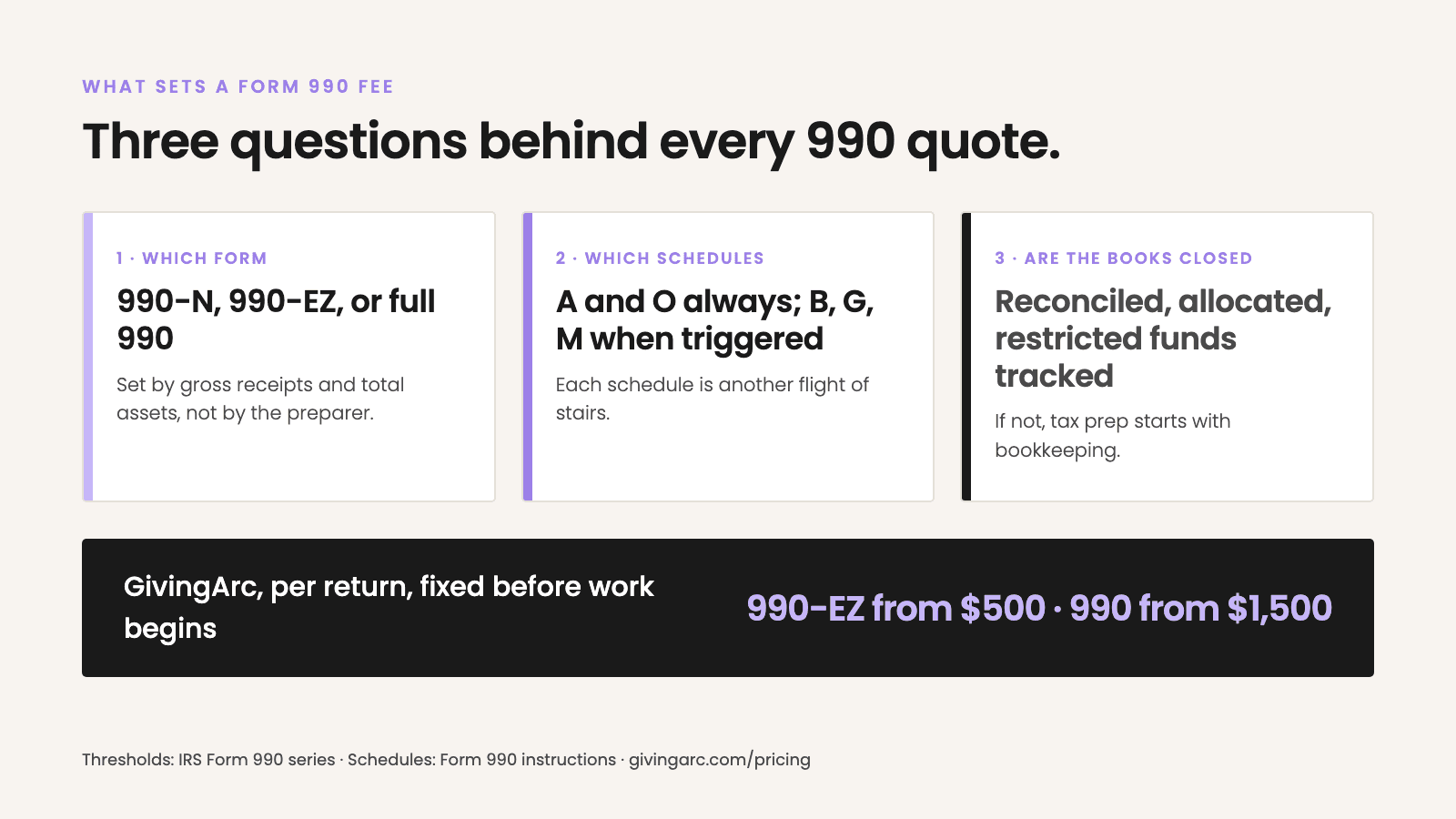
The same nonprofit can get both numbers for the same return. Three questions set the fee: which form you file, which schedules it triggers, and whether the books are closed. This video walks through all three, using the starting prices we publish.
Our starting prices: Form 990-EZ from $500, Form 990 from $1,500, fixed before work begins, and Forms 1099-NEC and 1099-MISC prepared and e-filed at $30 per form. See the full price table or the Form 990 cost guide.
Tax Service
No year-end scramble. No surprise filing fees. Just on-time 990s, state filings, and 1099s — prepared by a dedicated team with CPA oversight, working in QuickBooks Online throughout the year.
990 & 990-EZ
Prepared & e-filed
From $500
Per return
CPA oversight
23+ yrs nonprofit