
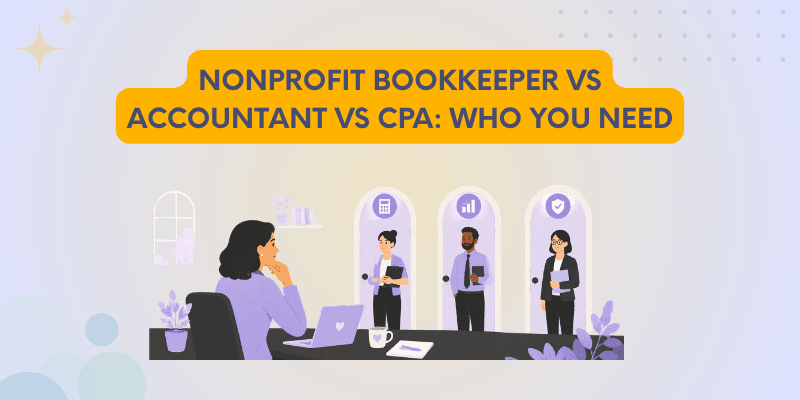
A funder asks for your “audited financials.” A board member wants to know if the bookkeeper can “just handle the 990.” Someone at a conference says you “really should have a CPA.” And you, the executive director, nod along — while quietly wondering what the difference even is. If the words bookkeeper, accountant, and CPA blur together, you’re in good company. The nonprofit bookkeeper vs accountant vs CPA question comes up in almost every first conversation we have.
Here’s the reassuring part: the distinctions are simpler than they sound. Once you see them clearly, a lot of decisions get easier — who to hire, what to pay for, and what you can safely skip. You’re not really choosing between three job titles. You’re making sure a handful of jobs get done well — and sometimes one person or firm covers all of them. Which arrangement to hire for those jobs, a freelancer, a firm, or yourself with periodic CPA review, is a separate question, and we cover it in freelance bookkeeper vs. firm vs. doing it yourself.
Key Takeaways
A bookkeeper records what happens, an accountant explains what it means, and a CPA is licensed to vouch for it to outsiders. Those are three different jobs, not three names for the same person — and a healthy nonprofit usually needs the first two on an ongoing basis and the third only at specific moments.
Think of a medical clinic. A medical assistant records your blood pressure and weight — that’s the bookkeeper. A physician reads those numbers, makes a diagnosis, and writes the plan — that’s the accountant. And when something has to be certified to an outside authority, you need a licensed specialist whose signature actually carries weight — that’s the CPA. All three matter. They’re simply not the same job, and you don’t call the specialist in for a routine check-up.
| Bookkeeper | Accountant | CPA | |
|---|---|---|---|
| Main job | Records daily transactions | Interprets & reports the numbers | Certifies the numbers to outsiders |
| Typical work | Deposits, bills, payroll, reconciliations, monthly reports | Adjusting entries, GAAP statements, Form 990, advising | Audits, reviews, attestations, IRS representation |
| State license required? | No | No | Yes — passed CPA exam + state board |
| Can prepare Form 990? | Yes | Yes | Yes |
| Can perform an independent audit? | No | No | Yes — only a CPA can |
| When you need them | Every month, ongoing | Monthly close, year-end, 990 season | When an audit or formal opinion is required |
A bookkeeper keeps your financial records accurate and current. They enter income and expenses, run or process payroll, reconcile your bank and credit card accounts, track receivables, and produce the monthly reports you bring to your board — the steady, unglamorous work that everything else depends on.
For nonprofits, good bookkeeping is a little more involved than for a small business, because money often comes with strings. Restricted grants, donor-designated gifts, and program-by-program tracking all live in the bookkeeping layer. When the books are clean here, your 990 and any audit get dramatically easier — and when they’re not, every later step costs more. (If your books have slipped, our guide to the most common nonprofit bookkeeping mistakes is a useful place to start, and fund accounting basics covers the restricted-money piece.)
An accountant works a level above the bookkeeper, turning accurate records into meaning. They make adjusting entries, ensure your books follow nonprofit accounting standards, prepare your formal financial statements, and typically prepare or review your Form 990. Where a bookkeeper answers “what happened,” an accountant answers “what does it mean, and is it right?”
An accountant generally has formal accounting training, but is not necessarily a licensed CPA — and for most day-to-day nonprofit needs, that’s perfectly fine. They’re the ones who help you read your financial statements with confidence and keep you aligned with your 501(c)(3) compliance requirements. Many small organizations first feel the need for this level of help right around the time they outgrow a volunteer treasurer.
A CPA — Certified Public Accountant — is an accountant who has passed the CPA exam and been licensed by a state board. The decisive difference is authority: only a CPA can perform an independent audit of your nonprofit and issue the formal opinion that funders, states, and lenders treat as trustworthy. A bookkeeper or accountant simply cannot sign that opinion, no matter how skilled.
CPAs can also represent your organization before the IRS and are the right call for unusually complex situations. But “you should have a CPA” is often advice in search of a reason. You need one when an outside party requires a CPA’s work — most commonly an independent audit triggered by a funder, state, or federal grant. If that day is coming, our audit preparation checklist will help you get ready. When you’re actively hiring, our guide to choosing a nonprofit CPA walks through what to look for.
Wondering what the bookkeeping and accounting layer should cost?
Use our calculator to see your exact monthly rate in about 30 seconds — transparent pricing, no signup required.
Yes. Form 990 is an information return that your organization files, and a bookkeeper or accountant can prepare it — there is no requirement that a CPA sign it. This surprises a lot of leaders who assume the 990 demands a CPA the way an audit does. It doesn’t.
What matters more than the title is the complexity of your return. A straightforward 990 for a small organization is well within an experienced bookkeeper’s or accountant’s reach. But once you have multiple grants, significant revenue, related entities, or unrelated business income, the value of an accountant or CPA preparing — or at least reviewing — the return goes up fast. For the mechanics and deadlines, see our step-by-step Form 990 guide, the filing deadline calendar, and the IRS’s own About Form 990 and 990-series filing requirements pages.
Match the role to your stage, not to the most impressive title. Nearly every nonprofit needs the bookkeeping function from day one and the accounting function as it grows; the CPA function comes into play only when an audit or formal opinion is on the table.
Just starting / small budget
Bookkeeper. Keep clean, current books and simple monthly reports. That alone puts you ahead of most early-stage nonprofits.
Growing, grants, a real board
Bookkeeper + accountant. You now need proper financial statements, nonprofit-standard reporting, and a well-prepared Form 990. Many organizations cover both with one outsourced firm.
An audit is required
Add a CPA. When a funder, state, or federal grant requires an independent audit, bring in a licensed CPA for that engagement — on top of your ongoing bookkeeping and accounting.
This is also why the “in-house vs. outsourced” question matters: a single outsourced partner can cover the bookkeeping and accounting functions together and coordinate a CPA when an audit is required, instead of you hiring, training, and managing each piece. We walk through that trade-off in when to outsource nonprofit accounting.
Take five minutes and write down four jobs: reconciliations, financial statements, Form 990, and audit (if you’re required to have one). Next to each, name the actual person or firm doing it. The blanks are exactly where things quietly fall through — and now you know which role fills each one.
Not sure which roles you’ve actually got covered?
We handle the bookkeeping and accounting together — ongoing bookkeeping & accounting and Form 990 preparation — and coordinate a CPA audit when you need one.
GivingArc provides bookkeeping, Form 990 preparation, and nonprofit-specialized accounting for small and mid-size 501(c)(3) organizations across the US. This article is general information, not accounting or legal advice for your specific situation. Reviewed by Min Kim, CPA.
Common questions from small nonprofits deciding who to hire for their finances.
A bookkeeper records your day-to-day transactions — deposits, bills, payroll, and reconciliations — and produces your monthly reports. An accountant works a level up, interpreting those numbers, applying nonprofit accounting standards, and preparing financial statements and Form 990. Most small nonprofits need both functions, even when one person or firm covers them.
Not always. You need a CPA specifically when an outside party requires one — most often an independent audit demanded by a funder, a state, or a federal grant. A CPA is also valuable for complex Form 990s and IRS representation. For routine bookkeeping and financial statements, a skilled bookkeeper and accountant are usually enough.
Yes. Form 990 is an information return your organization files, and a bookkeeper or accountant can prepare it — there is no requirement that a CPA sign it. That said, the more complex your finances, with multiple grants or significant revenue, the more it helps to have an accountant or CPA prepare or review the return.
Yes. If your nonprofit is required to have an independent audit, only a licensed CPA can perform it and issue the audit opinion — a bookkeeper or accountant cannot. If you only need internal financial statements rather than an audit, you do not need a CPA for that.
Often, yes. Many outsourced accounting firms, including GivingArc, bundle bookkeeping and accounting into one service and bring in or coordinate a CPA when an audit or attestation is needed. The key is making sure each function is actually covered, not just that someone holds the title.
Bookkeeping and accounting are usually billed monthly — GivingArc’s nonprofit bookkeeping starts at $300 per month, with the exact rate based on your size and activity, which you can calculate instantly on our pricing page. A standalone CPA audit is a separate, larger engagement priced per project.