
Key Takeaways
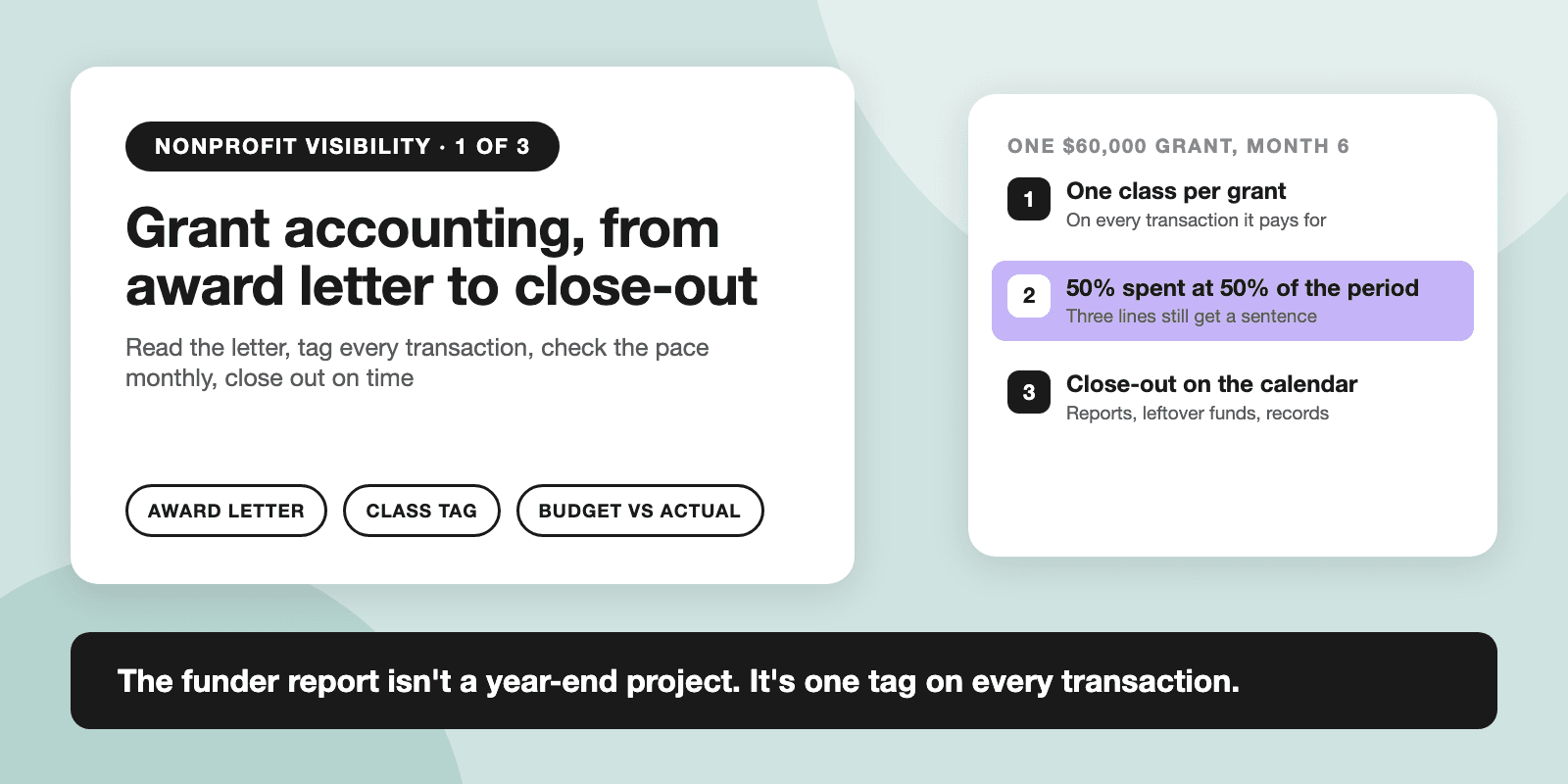
The award letter is the best email of the quarter. Then the money lands in the same checking account as everything else, and six months later the program officer writes back with one polite question: “How much of our $60,000 have you spent, and on what?”
If answering takes a weekend with bank statements, the problem isn’t effort. The grant was never given its own label when the money started moving.
This guide walks through five steps of grant accounting that turn that question into a two-minute answer. It follows one illustrative $60,000 foundation grant from the award letter to close-out, and the free grant financial report template does the math for you.
Grant accounting is tracking each grant’s money separately, from the award letter to the final report, so you can show the funder exactly what their money paid for. It isn’t a second set of books. It is the same books, with every grant-funded transaction marked so it can be pulled out on demand.
It has three jobs: record the grant correctly when it arrives, tag every expense the grant pays for, and report spending against the budget the funder approved. If you’re still preparing to apply, start with grant-ready accounting. This guide picks up after the money is awarded.
Before you record anything, read the award letter for three things: what the money is for, whether you must do something before you’re entitled to it, and when reports are due. The first two decide how the grant is recorded. The third goes on your calendar.
The rule that sorts this out is ASU 2018-08, the accounting standard for nonprofit grants and contributions. In short, a grant is conditional only when it has both a barrier (something measurable you must do first) and a right for the funder to take the money back or not pay. A restriction on how you spend it is not a condition.
“This grant supports the after-school program.”
Purpose restriction
Record the full grant as revenue now, with donor restrictions. Release it to net assets without donor restrictions as you spend it on the program.
“For use in calendar year 2027.”
Time restriction
Revenue now, with donor restrictions, released when the 2027 period begins.
“Paid once 40 students are enrolled. Funds are returned if enrollment isn’t reached.”
Conditional: barrier plus right of return
No revenue yet. Money received early is a refundable advance, a liability, until the barrier is met.
“Return any unspent funds at the end of the grant.”
Right of return, no barrier
Not conditional on its own. Record it by its purpose or time restriction, and plan for the leftover balance at close-out.
Cost-reimbursement grants, where the funder pays only after you spend on allowable costs, are commonly treated as conditional, with revenue recorded as the allowable costs are incurred. When a letter is unclear, write down how you read it and why. Your auditor will ask.
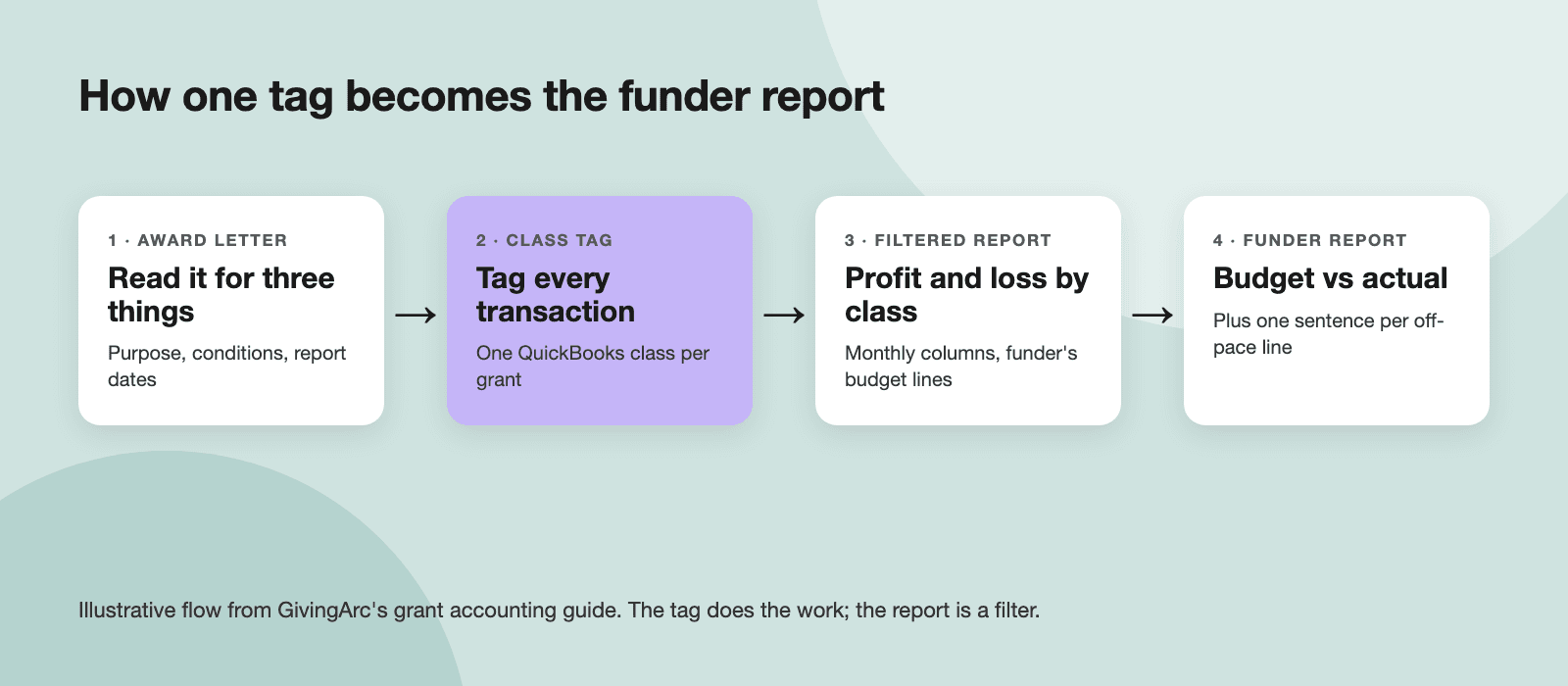
Give every grant its own class in QuickBooks, and put that class on every transaction the grant pays for. A class works like a luggage tag: the suitcase flies on the same plane as everyone else’s, but it comes off at the right carousel. The grant’s expenses sit in your normal accounts, and the tag lets you pull them out in one report.
Here is the shift that saves the most time: the funder report isn’t a year-end project. It is what you get for free when every transaction carries the grant’s tag. The second half of the setup is a map from the funder’s budget lines to your accounts, so the report speaks the funder’s language.
| Funder’s budget line | Your QuickBooks account | Class on every transaction |
|---|---|---|
| Program staff salaries | Salaries and wages | After-School · Foundation 2026 |
| Payroll taxes and benefits | Payroll taxes; Employee benefits | |
| Program supplies | Program supplies | |
| Participant transportation | Travel and transportation | |
| Evaluation consultant | Contract services | |
| Administration | Allocated share of rent, accounting, and insurance (Step 4) |
Two accounts can feed one budget line, as payroll taxes and benefits do here. Write the map down once and keep it with the award letter.
Our guide to grant tracking in QuickBooks covers the class setup and which QuickBooks plans include classes. If donors also restrict gifts outside of grants, the fund tracking register keeps every restricted balance in one place, and restricted vs unrestricted funds explains the release entry you record as restricted money is spent.
Once a month, compare the percent of each budget line you have spent with the percent of the grant period that has passed. It works like a fuel gauge on a road trip: halfway through the drive, you’d expect about half a tank. A line far above or below that pace isn’t wrong, but it needs one sentence of explanation before the funder asks.
Here is the $60,000, 12-month example at month 6, when 50% of the period has passed. The template flags any line more than 15 points away from that pace.
| Budget line | Budget | Spent to date | % spent | Pace (mark = 50%) | Explanation |
|---|---|---|---|---|---|
| Program staff salaries | $36,000 | $18,000 | 50% | On pace | |
| Payroll taxes and benefits | $7,200 | $3,600 | 50% | On pace | |
| Program supplies | $6,000 | $4,900 | 82% | Bought the year’s curriculum kits in month 1. | |
| Participant transportation | $4,800 | $1,100 | 23% | Field trips are scheduled for the fall term. | |
| Evaluation consultant | $1,200 | $0 | 0% | Evaluation starts in month 9, as planned. | |
| Administration (approved by the funder) | $4,800 | $2,400 | 50% | On pace | |
| Total | $60,000 | $30,000 | 50% | On pace overall |
Illustrative figures. Dark bars are lines more than 15 points from pace. Total spending is exactly on pace, but three lines still get a sentence.
Those three sentences are the whole funder report for this month. Some funders ask for budget changes in writing before you move money between lines. Federal agencies, for example, can restrict moving money between direct cost categories once the moves add up to, or are expected to add up to, more than 10% of the total approved budget including cost share. That rule applies when the federal share of the award is above the simplified acquisition threshold, a dollar line set in federal purchasing rules (2 CFR 200.308). Check your agreement before the gap grows.
Want this report every month without building it?
We tag grants as we keep your books, so the budget vs actual comes out of the monthly close.
When one cost serves more than one program, split it with a basis you can show, and use the same basis every month. A staff member who spends 60% of her time on the grant program needs timesheets or a time study that shows it. Shared rent can follow square footage. The basis matters more than the exact method, because it is what an auditor tests.
If your funder caps administration, the cap is in the grant agreement, so read it rather than assuming. On federal awards, an organization without a negotiated rate may charge a flat overhead rate, called the de minimis rate, of up to 15% of its modified total direct costs, a defined base of direct spending (2 CFR 200.414(f)). Our indirect cost rate calculator works out your actual rate, which can be higher. If you’re building the next proposal, the grant budget template lays out these lines the way funders expect.
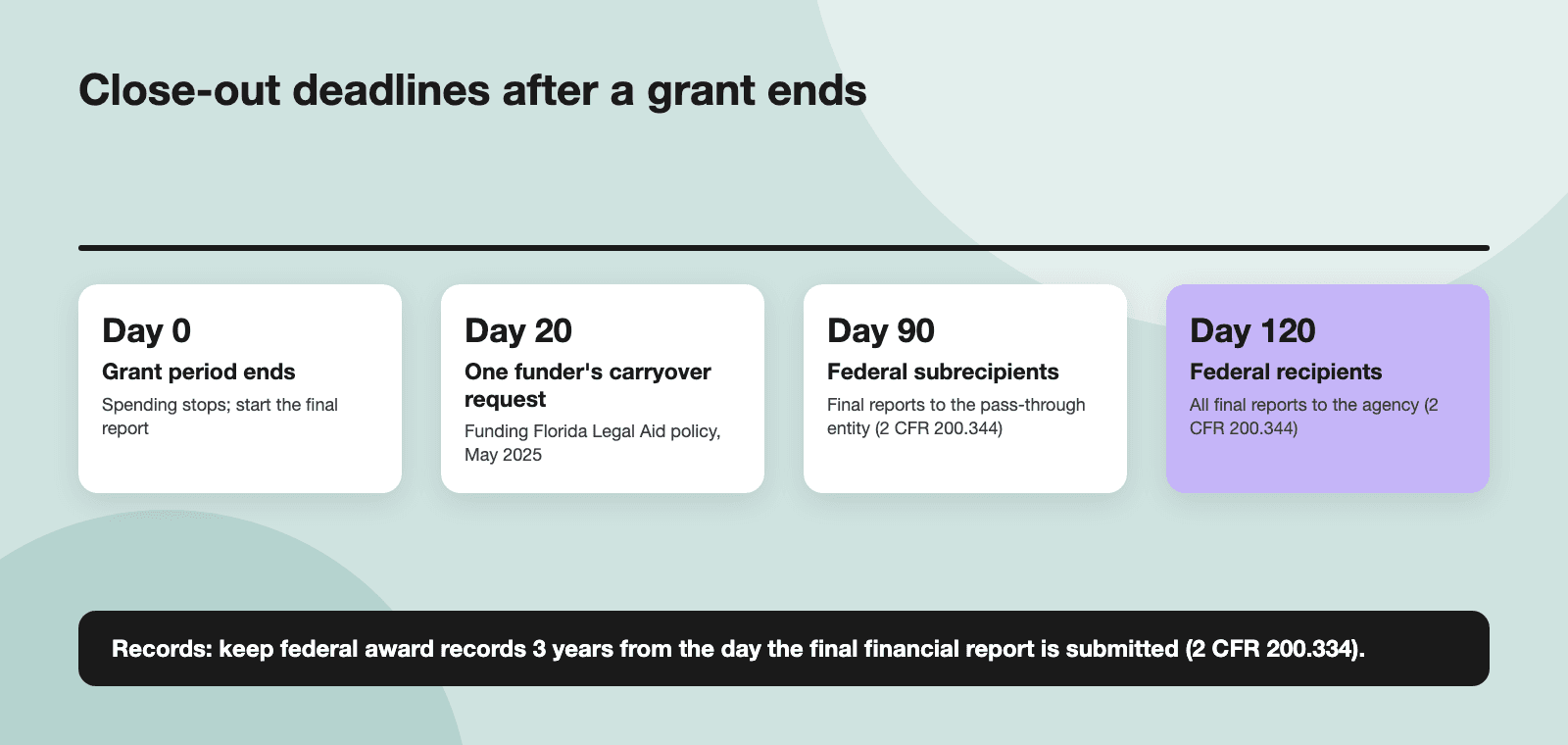
Close-out is the last report plus three decisions: what to do with any money left, which restrictions to release, and how long to keep the records. Each has a deadline, so put them on the calendar on the day the grant starts.
Say the example grant ends with $58,700 spent, leaving $1,300. What happens next depends on the agreement. One published policy, from Funding Florida Legal Aid, requires returning unspent funds above $25,000 or 10% of the grant, whichever is less. A grantee can ask to keep them, in writing, within 20 days of the grant’s end, and the funder decides. For a $60,000 grant, 10% is $6,000, so a $1,300 balance would sit under that line. Your funder’s rule may be different.
Close-out checklist
Auditors check that each grant’s revenue matches its award letter and that each expense charged to it has support. Expect them to pick a sample of grant expenses and ask for the invoice, the approval, and how it was split if it was shared. Clean tags and a written allocation basis turn that request into a printout.
Once you spend $1,000,000 or more in federal awards in a year, you need a Single Audit, which covers your financial statements and how you followed the rules for your federal awards (2 CFR 200.501). Our nonprofit audit requirements guide covers that line and the state and foundation thresholds, and the grant audit checklist lists what to have ready.
We tag every grant as we keep your books, so the budget vs actual report comes out of the monthly close instead of a scramble. Our monthly bookkeeping starts at $300 a month. Active grants add $75 a month for one to three, $175 for four to seven, $350 for eight to ten, and $500 for eleven or more, and restricted fund tracking adds $100. The pricing page has the full table.
Grant spending also shows up where your board sees it, in the one-page board financial report. Whether we keep your books or you do, the free grant financial report template gives you the same budget vs actual and close-out math used in this guide.
Questions about recording, tracking, and closing out a nonprofit grant.
Grant accounting is tracking each grant’s money separately, from the award letter to the final report, so you can show the funder what their money paid for. It has three parts: recording the grant correctly, tagging every related expense to it, and reporting spending against the approved budget.
Yes, if it is a gift with no condition, and often earlier: an unconditional grant is revenue when it is promised, even before the cash arrives. Under ASU 2018-08, a grant is conditional only when it has both a barrier you must clear and a right for the funder to take the money back or not pay. A purpose or time restriction alone does not delay revenue. A grant that pays you for services delivered to the funder is an exchange and follows different rules.
Create a class for each grant and put that class on every transaction the grant pays for. Then match each line of the grant budget to an account, so a profit and loss report filtered by that class lines up with the funder’s budget categories.
It depends on the grant agreement. Some funders let you keep a small balance, some require a written carryover request, and some want the money back. One published policy, from Funding Florida Legal Aid, requires returning unspent funds above $25,000 or 10% of the grant, whichever is less, unless a carryover request is approved.
For federal awards, three years from the date you submit the final financial report, under 2 CFR 200.334. Foundations set their own terms in the grant agreement, and your own document retention policy may ask for longer. Keep whichever period is longest.
Win the grant. We’ll keep it reportable.
Grants tagged as they happen in your monthly bookkeeping, with budget vs actual ready when the funder asks.
GivingArc provides bookkeeping, Form 990 preparation, and nonprofit-specialized accounting for small and mid-size 501(c)(3) organizations across the US. The grant in this guide and all of its figures are illustrative. General information, not accounting, tax, or legal advice. Reviewed by Min Kim, CPA.
