
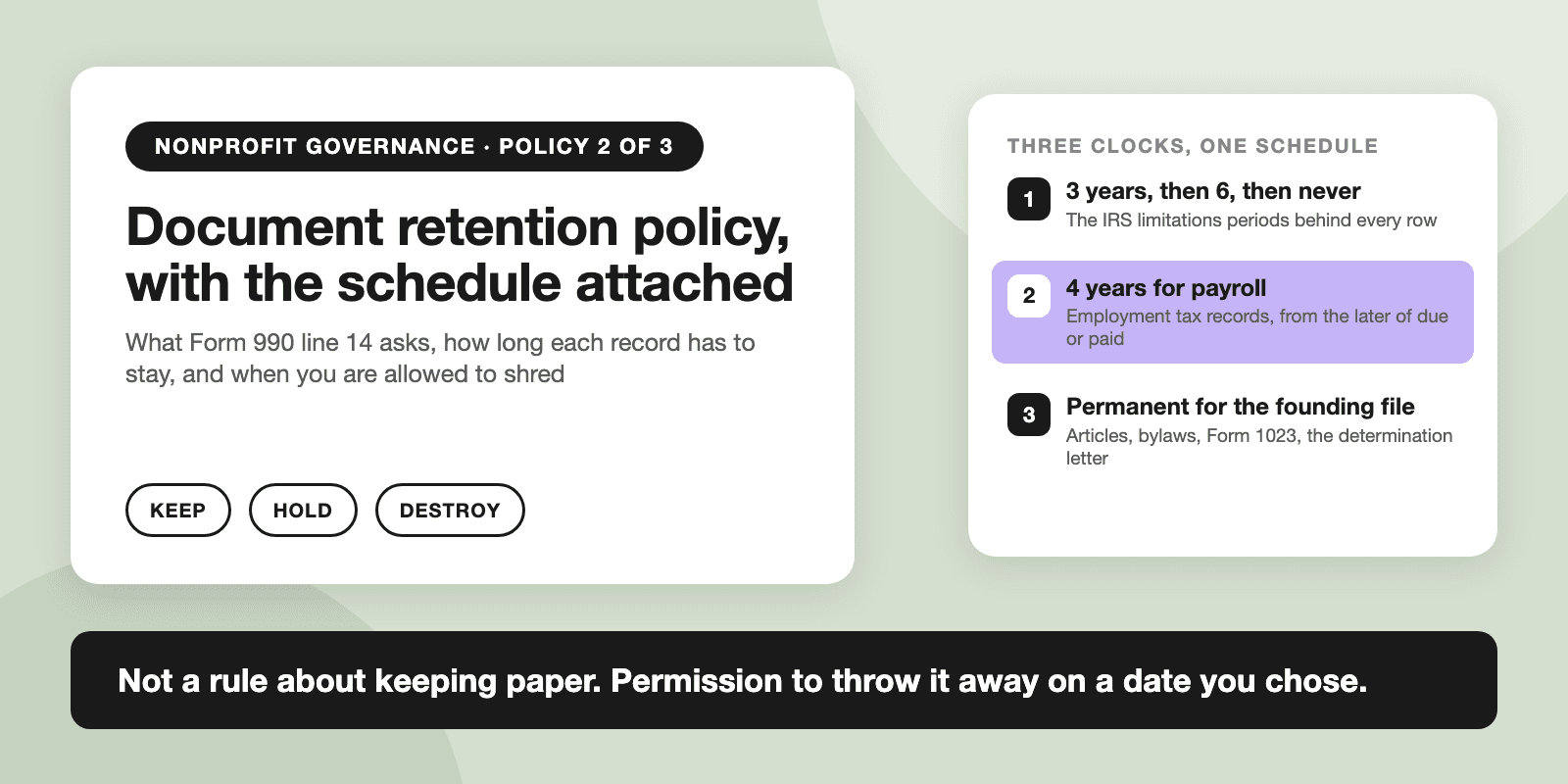
Picture the closet. Banker’s boxes labeled by year in three handwritings, a filing cabinet whose bottom drawer has not opened since the last move, and a shared drive with a folder called “OLD” inside a folder called “old.” Nobody throws any of it away, because nobody knows what is safe to throw away, so the organization stores everything forever and still cannot find the 2019 grant file when the auditor asks. Then Form 990 line 14 asks whether there is a written document retention and destruction policy. No.
This is the nonprofit document retention policy we would want that board to adopt, and it is mostly a schedule. The article explains what Form 990 line 14 asks and why the instructions mention a federal crime, lays out the handful of clocks behind every retention period (three years, four, six, never), and gives you the policy as an editable file with a retention schedule attached: twenty-four record classes, each with its period, the date it counts from, and the rule it comes from, plus hold and destruction logs. A retention policy is not a rule about keeping paper. It is permission to throw things away on a date you chose in advance.
Key Takeaways
Line 14 of Form 990 Part VI reads, in full: “Did the organization have a written document retention and destruction policy?” It sits in Section B, which the form itself introduces as requesting “information about policies not required by the Internal Revenue Code,” two lines below the conflict of interest policy questions and one line below the whistleblower policy. The instructions define the thing in one sentence: a document retention and destruction policy “identifies the record retention responsibilities of staff, volunteers, board members, and outsiders for maintaining and documenting the storage and destruction of the organization’s documents and records.” Responsibilities, people, storage, destruction, documentation. A list of how long to keep things is not enough on its own; the policy has to say who does what.
The same paragraph then does something the rest of Part VI does not: it cites a criminal statute. “While the federal Sarbanes-Oxley legislation generally doesn’t pertain to tax-exempt organizations,” the instructions say, “it does impose criminal liability on tax-exempt as well as other organizations for (1) retaliation against whistleblowers that report federal offenses, and (2) destruction of records with the intent to obstruct a federal investigation. See 18 U.S.C. sections 1513(e) and 1519.” Section 1519 covers anyone who “knowingly alters, destroys, mutilates, conceals, covers up, falsifies, or makes a false entry in any record, document, or tangible object” with intent to impede a federal matter, and carries up to 20 years. That is why a retention policy has a destruction half and a hold clause. Shredding on schedule is ordinary housekeeping; shredding to keep something from an investigator is the felony. The instructions add the sentence every small organization should underline: “an organization is required to keep books and records relevant to its tax exemption and its filings with the IRS.” That duty exists whether or not there is a policy, and whether or not the organization files the full Form 990.
“A document retention and destruction policy identifies the record retention responsibilities of staff, volunteers, board members, and outsiders for maintaining and documenting the storage and destruction of the organization’s documents and records.” Instructions for Form 990 (2025), lines 13 and 14. Four duties, one policy.
Who is responsible
Staff, volunteers, board members, and outsiders, which for a small organization means the bookkeeper, the payroll service, and the CPA who holds the workpapers. The policy names a records officer and gives everyone else a duty to file, not to decide.
Where records are stored
One official location per record class, readable for the whole retention period, backed up and checked. The IRS’s own 2008 governance paper adds that the policy “should include guidelines for handling electronic files” and cover “backup procedures, archiving of documents, and regular check-ups of the reliability of the system.”
When and how records are destroyed
On the schedule, by a named method, by a named person, and never while a hold is in effect. Destruction is a governed act, which is the only way it can also be a safe one.
How all of it is documented
The schedule itself, a destruction log, and a hold log. The documentation is what a board can point to when someone asks why the 2016 receipts are gone and the 2016 minutes are not.
Two notes on who gets asked. Form 990-EZ has no governance section, so line 14 never appears on it, but the 990-EZ instructions carry the same recordkeeping rule as the full form, and the IRS’s recordkeeping page for exempt organizations says that “even if 990-N is filed, or no return is filed, records must be maintained showing activities conducted, income received and expenses incurred.” A policy adopted by the board before the end of the tax year, applying to the organization as a whole, earns the “Yes”; a parent organization’s policy does not count for a subsidiary unless the subsidiary’s own board adopted it.
Retention schedules look like long lists of unrelated numbers. They are not. Almost every row is one of four clocks, and once you know the clocks you can build the row for a record nobody has listed yet. The master rule is in Treasury Regulation 1.6001-1(e): records “shall be retained so long as the contents thereof may become material in the administration of any internal revenue law.” The Form 990 instructions translate that into a floor: records that support an item of income, deduction, or credit “must be kept for a minimum of 3 years from the date the return is due or filed, whichever is later.”
3years
Records behind the return
From the later of the due date or the filing date. Six years if omitted income exceeds 25% of the gross income shown on the return. No limit for a fraudulent return, or for a year with no return at all (IRC 6501). Same three-year clock for federal award records, counted from the final financial report (2 CFR 200.334).
4years
Employment tax records
Forms 941 and 940, W-2s, W-4s, payroll registers, deposit records, “at least 4 years after the date that the tax becomes due or is paid, whichever is later.” Records for the 2021 sick-leave and employee retention credits: at least 6 years.
1to 5 years
Employment records that are not tax
FLSA payroll records 3 years, time cards 2; Form I-9 three years after hire or one year after separation, whichever is later; personnel files one year federally, four in California; Equal Pay Act wage-differential records 2; OSHA logs 5.
∞
Permanent
Publication 4221-PC names them: the exemption application, the determination letter, articles and bylaws with amendments, and board minutes. The application and the IRS’s letters about it are open to public inspection with no time limit; each annual return for three years from its due date including extensions.
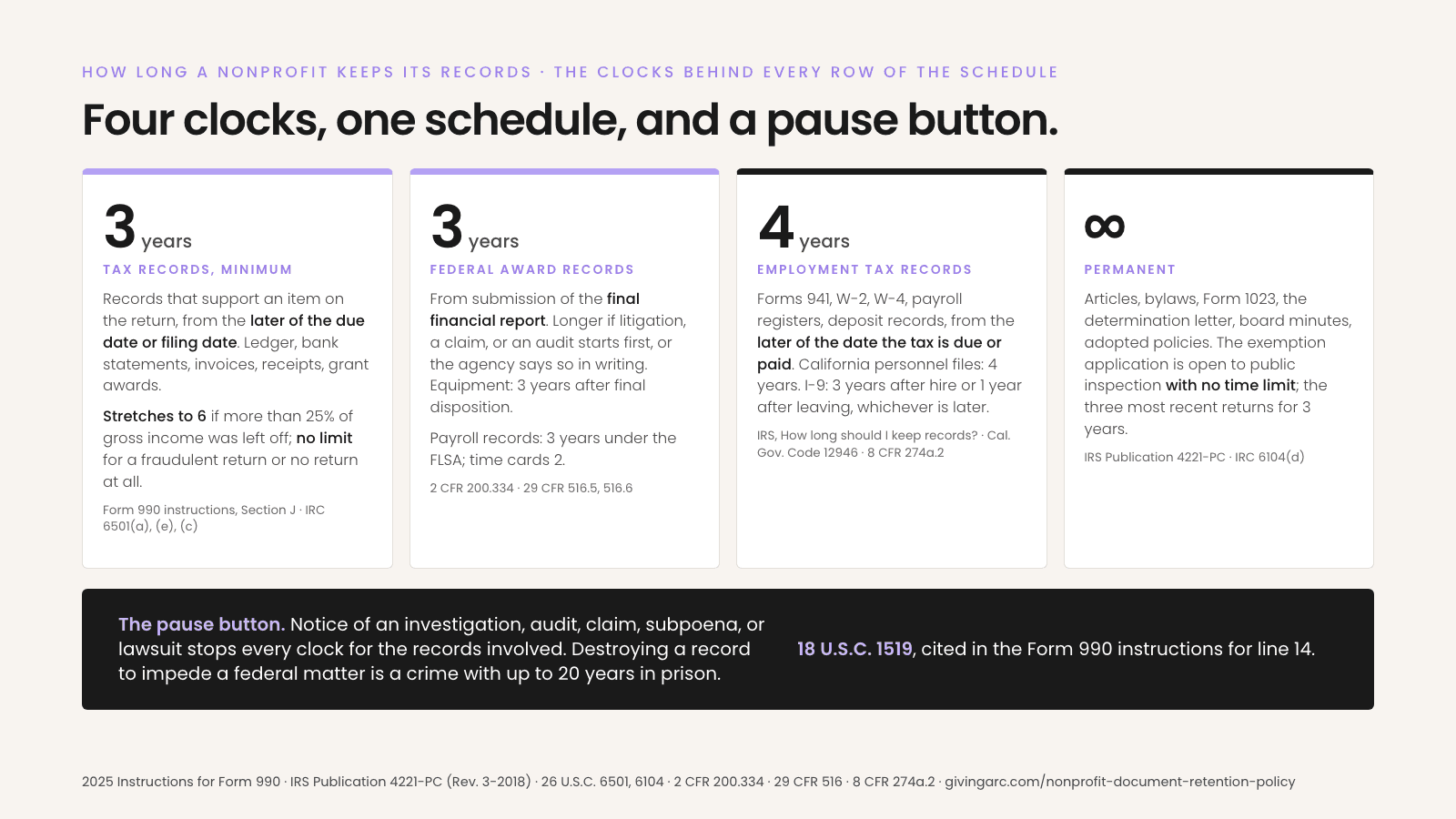
You will read elsewhere that the IRS requires nonprofits to keep financial records for seven years. It does not. The IRS’s own list of limitation periods has a seven in it, for claims involving worthless securities or bad debts, and a six for the 25% omission case, and an “indefinitely” for unfiled and fraudulent returns. Seven years is a reasonable policy period precisely because it covers the six-year window with a year to spare, and our schedule uses it for the accounting records. It is a choice the board makes, and the schedule labels it as one, which matters when a funder or an auditor asks where the number came from.
Three clocks that are not the IRS’s deserve their own sentences. Federal awards: under 2 CFR 200.334, the recipient “must retain all Federal award records for three years from the date of submission of their final financial report,” and the agency or pass-through entity “may not impose any other record retention requirements” beyond the listed exceptions, the first of which is that records “must be retained until all litigation, claims, or audit findings involving the records have been resolved and final action taken” when any of those starts inside the three years. Equipment bought with federal money: three years after final disposition. And the agency’s rights of access “are not limited to the required retention period of this part but last as long as the records are retained,” so a file kept for ten years can be requested in year ten. (The section has been numbered 200.334 since the 2020 revision of the Uniform Guidance; the 2024 revision kept the number and changed “final expenditure report” to “final financial report.”) Public inspection: under IRC 6104(d), the exemption application and the IRS’s letters about it must be available to anyone who asks, with no expiration, and each annual return for three years from its due date including extensions, or from actual filing if later. Donors: Publication 1771 tells the organization what a written acknowledgment must say and does not prescribe how long the organization keeps its copy, which is why that row of the schedule is a policy choice, and why it matches the accounting records.
The schedule in the download has twenty-four rows in seven groups. Each row carries the record class, examples, the period, the date the period counts from, the authority in the words of the statute or IRS page, and a status column that says whether the period is a legal minimum or the organization’s own longer choice. The counting date is the column people skip and should not: three years from a 2024 return’s filing date in May 2025 is May 2028, not January 2027, and four years for a payroll tax means four years from when the tax was due or paid, not from the pay date. Here is the schedule condensed.
| Record class | Retain for | Counted from, and the rule |
|---|---|---|
| Corporate and governance | ||
| Articles, bylaws, Form 1023, determination letter, EIN and state exemption letters | Permanent | Publication 4221-PC lists them as permanent; the application and IRS letters are open to public inspection with no time limit (IRC 6104(d)). |
| Board and committee minutes, resolutions, adopted policies, conflict of interest statements | Permanent | Publication 4221-PC; New York N-PCL 621(a) and California Corporations Code 6320 require minutes to be kept. |
| Forms 990, 990-EZ, 990-N confirmations, 990-T, state returns, with schedules and workpapers | Permanent (copies) | Open to public inspection for three years from the due date including extensions, or from actual filing if later (IRC 6104(d)(2); IRS public disclosure page); a 501(c)(3)’s 990-T if filed after August 17, 2006. The instructions say to keep copies of filed returns. |
| Audited financial statements, audit reports, management letters | Permanent | Policy. In California, registered organizations at $2,000,000 or more in gross revenue (excluding government funds the agency requires an accounting for) must make audited statements available within nine months of year end (Gov. Code 12586(e)). |
| Tax and accounting | ||
| General ledger, bank statements, canceled checks, invoices, receipts, expense reports, grant awards | 7 years (policy); 3 legal | From the later of the return’s due date or filing date. Three years under IRC 6501(a), six under 6501(e), no limit under 6501(c). |
| Property and equipment records, depreciation, disposals; deeds | Life of asset + 7 | Until the period of limitations expires for the year of disposition (IRS). Deeds permanent. |
| Employment tax records: 941, 940, W-2, W-4, payroll registers, deposits, 1099 copies, W-9s, Form 945 | 4 years | From the later of the date the tax is due or paid (IRS). Sick-leave and employee retention credit records: 6 years. |
| Donors and gifts | ||
| Acknowledgment copies ($250 or more), quid pro quo disclosures (over $75), gift logs | 7 years (policy) | From the end of the gift year. Publication 1771 sets the contents, not a donee retention period; the copies support contribution revenue on the return. |
| Noncash gifts over $5,000: Form 8283 Section B copy, appraisals, Form 8282 filings | 7 years after disposition | Form 8282 instructions: keep a copy of Section B; file Form 8282 within 125 days of disposing of the property within three years of receipt. No filing if the item was certified at $500 or less on Form 8283, or was consumed or distributed for the organization’s exempt purpose. |
| Restricted gift, endowment, pledge, and bequest files | Permanent while restricted, then 7 | Policy. From release or full expenditure of the restriction. |
| Employment | ||
| Payroll and wage records (FLSA); time cards and schedules | 3 years; 2 years | 29 CFR 516.5 and 516.6, from the last date of entry. California Labor Code 1174(d): three years; EDD: four. |
| Form I-9 | Hire + 3 or exit + 1 | Whichever is later (8 CFR 274a.2(b)(2)(i)(A)). USCIS recommends a separate file. |
| Personnel and hiring records | 1 year federal; 4 years CA | 29 CFR 1602.14 and 1627.3(b)(1) from the record or action; until final disposition if a charge is filed. California Gov. Code 12946(a): four years. |
| OSHA 300 log, 300A summary, 301 reports (if required) | 5 years | Following the end of the calendar year the records cover (29 CFR 1904.33). |
| Grants | ||
| Federal award records: financial, supporting, statistical, subrecipient files, reports | 3 years | From submission of the final financial report (2 CFR 200.334); longer if litigation, a claim, or an audit starts first, or the agency says so in writing. Equipment: 3 years after final disposition. Indirect cost proposals: 3 years from submission, or from the end of the year covered if not submitted for negotiation. |
| Foundation and other grant files | 7 years after final report (policy) | Or longer if the agreement requires; a grantor may require more than the IRS does (Publication 4221-PC). |
| Contracts, insurance, state | ||
| Contracts and leases; insurance policies and claims | 7 years after expiration; policies permanent | Policy. The IRS notes that insurers and creditors may require records longer than the IRS does. |
| California state tax and payroll: FTB support, sales and use tax, EDD | 4 years | Rev. & Tax. Code 19057(a) (FTB may assess within four years of filing); 18 CCR 1698(i); EDD DE 44. |
| California welfare exemption claims (BOE-267, BOE-267-A) and Organizational Clearance Certificate | Permanent (policy) | No statutory retention period. Claims are filed with the county assessor annually, generally by February 15, and only an organization holding a valid Organizational Clearance Certificate from the BOE can be granted one. |
The “policy” rows are where organizations differ, and the spreadsheet is built to be edited there. A church with no employees deletes the OSHA row; an organization with a federal award adds the grant’s own terms to the notes column; a New York organization keeps its IRS extension requests for three years because the Charities Bureau says so. What no one should edit downward is a row marked legal. The longer period always wins, and when a record fits two rows, it lives under the longer one.
The accounting rows of this schedule are filed for you when we keep the books. Every month closes with the statements, reconciliations, and support in one dated folder, so the seven-year clock starts on a file that already exists. Bookkeeping from $300 a month; Form 990 preparation from $1,500 per return ($1,800 without our bookkeeping).
See pricing →Three files. The policy is nine sections in an editable Word document: purpose, scope, definitions, responsibilities, storage and electronic records, the schedule and destruction, holds, compliance, and review, with an adoption block and editing notes for federal awards, New York, and California that you delete before the vote. The schedule is a spreadsheet with three sheets: the schedule itself, a hold log, and a destruction log. The PDF holds the policy and the schedule for the board packet. There is no email gate.
Nonprofit document retention policy template
Editable, no email required. Sources checked September 2026. Template only, not legal advice.
DOCX
Document Retention and Destruction Policy
Nine sections, bracketed fields, hold clause, board adoption block, editing notes for federal awards, New York, and California.
Download .docxXLSX
Schedule A: record retention schedule
Twenty-four record classes with period, counting date, authority, and legal-or-policy status, plus a hold log and a destruction log.
Download .xlsxPolicy and schedule pack
Both documents in one file for reading, printing, and the board packet.
Download PDFSix edits, then the vote. One: the organization’s name and the titles in brackets, especially the records officer, who in a small organization is usually the executive director, and the person who issues holds. Two: the storage locations in section 5: the board portal or minute book, the accounting system and document folder, the donor database, the personnel file, the grant folders. Write down where things actually are, not where they should be. Three: the policy periods in Schedule A, if the board wants something other than seven years for the accounting rows. Four: the destruction window in section 6 (the template says ninety days after a period expires). Five: the review cadence in section 9. Six: delete the editing notes, and delete the OSHA and federal award rows if they do not apply, or leave them with a note that they are dormant.
Then adopt the policy and the schedule together, by motion, in the minutes, before the end of the tax year you want to answer “Yes” for. If the board is adopting the conflict of interest policy at the same meeting, this one takes ten more minutes, and the first entry in the destruction log can be the closet.
Section 7 of the policy
The hold: every clock stops for the records involved
A hold is a written instruction from the executive director, with the board chair and counsel where appropriate, naming the matter and the records covered. It goes to every person and every outside provider holding those records, it is entered in the hold log, and it is released only in writing. From the moment a matter is reasonably anticipated, nothing on the list is destroyed, whether or not its period has expired.
What triggers one
Without a policy, records still get destroyed. It happens when the closet is full, when the office moves, when a laptop is wiped, or when a well-meaning volunteer decides the 2015 box cannot possibly matter. That is the version of destruction the Form 990 instructions worry about, because it is undocumented and it can coincide with an inquiry. The policy replaces it with a boring version. A period expires. The records officer confirms that no hold covers the records. Paper is shredded rather than recycled; electronic records are deleted from the active system and, where the organization reasonably can, from backups; anything with personal information is destroyed so it cannot be reconstructed. Then the log gets a line.
Destruction log, sheet 3 of the schedule: one line per batch (sample entries)
| Date | Record class (Schedule A row) | Date range | Format and method | Carried out by | Approved by | Hold log checked |
|---|---|---|---|---|---|---|
| Jan 15, 2027 | 5. Books of account and supporting documents | FY2018 (return filed May 2019) | Paper, shredded on site; PDF scans deleted from the finance drive and backup | Office manager | Executive director | Yes, no open holds |
| Jan 15, 2027 | 13. Form I-9, separated employees | Separated before Jan 2026, hired before Jan 2024 | Paper, shredded | Office manager | Executive director | Yes |
The two sample lines are illustrations of how a batch is recorded, not events. A log entry is what turns “we threw it out” into “we followed our policy on the date it said,” which is the sentence you want available when someone asks.
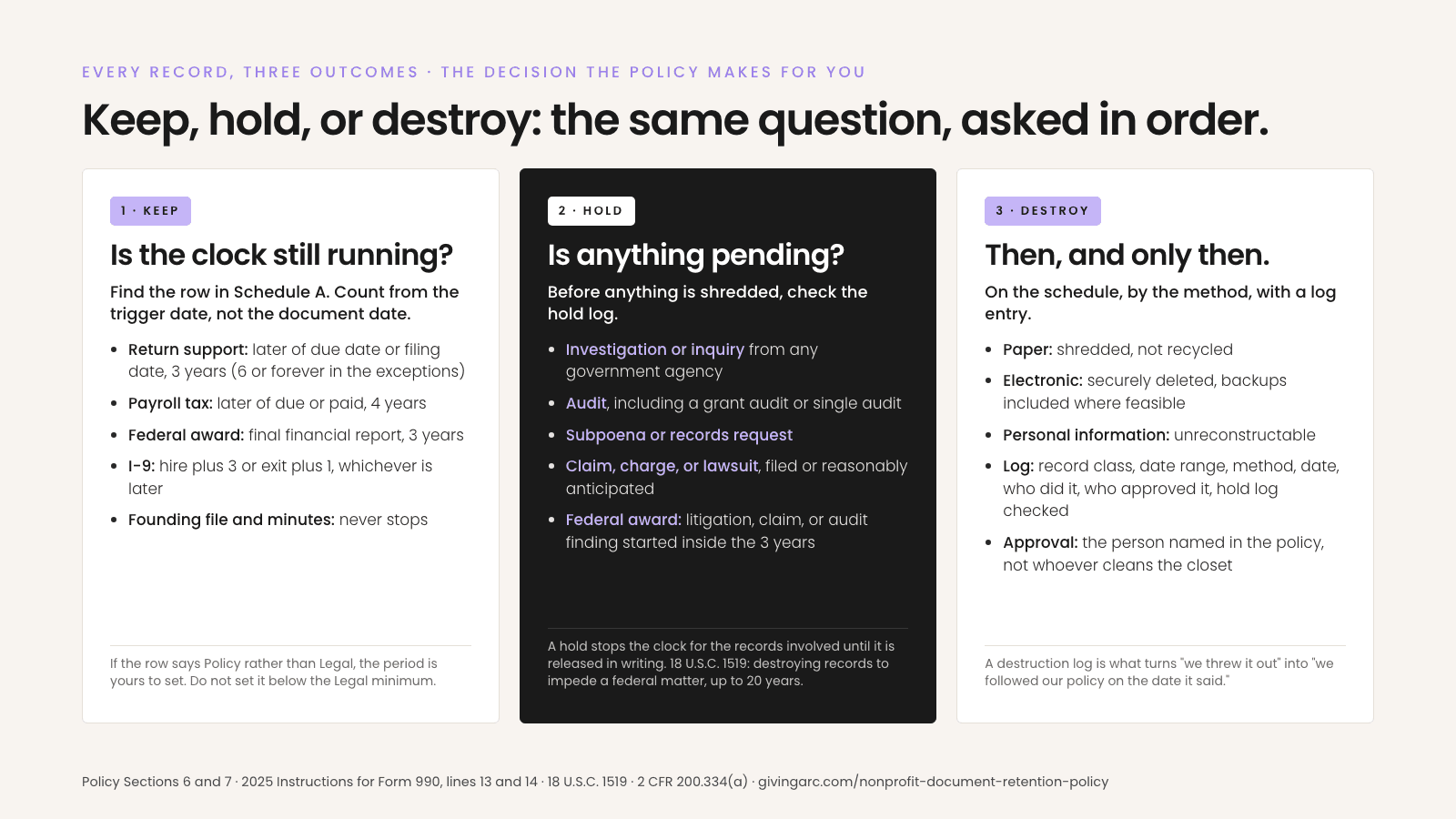
Electronic records deserve two rules of their own. First, the inbox is not a record system. An email that documents a decision, a payment, or a promise is a record, and the policy asks the person who has it to file it into the folder where the official record lives, because a retention period cannot be applied to a mailbox that also holds lunch orders. Second, scanning is allowed for almost everything, and the schedule says when it is not. New York’s N-PCL 621(a) allows minutes and books “in any other form capable of being converted into written form within a reasonable time,” and California’s Corporations Code 6320(b) allows “any other form capable of being converted into clearly legible tangible form”; Form I-9 may be kept on paper, electronically, or as a scan of the signed original under 8 CFR 274a.2; the IRS accepts records kept in an electronic storage system that stays legible and readable for the whole retention period (Rev. Proc. 97-22). Where a grant agreement or an insurer wants originals, the note column says so.
New York
No policy statuteThe Not-for-Profit Corporation Law requires a conflict of interest policy for every corporation and a whistleblower policy for those with twenty or more employees and more than $1 million in revenue; it does not require a document retention policy. What it does require, in section 621, is that every corporation keep “correct and complete books and records of account and minutes of the proceedings of its members, board and executive committee” at its office, in written form or a form convertible to writing, with inspection rights for members. The Attorney General’s Charities Bureau lists “creating an appropriate records retention policy” among the internal controls it expects a board to have, and separately asks organizations that request IRS filing extensions to keep those requests for at least three years.
California
No policy statute, several clocksCorporations Code 6320 requires “adequate and correct books and records of account,” minutes of members, board, and committees, and a membership record, in written or convertible form; section 6334 gives every director “the absolute right at any reasonable time to inspect and copy all books, records and documents of every kind.” Employment clocks run longer here than under federal law: Labor Code 1174(d) requires payroll records for at least three years, Government Code 12946 requires applications and personnel records for four years (SB 807, effective January 1, 2022), and the EDD requires payroll records for four years, eight if the organization takes the position that it is not a subject employer.
Tax clocks: the Franchise Tax Board may assess within four years after a return is filed (Rev. & Tax. Code 19057), sales and use tax records must be kept at least four years (18 CCR 1698), and welfare exemption claims (BOE-267 or 267-A) are filed with the assessor annually, generally by February 15, and only an organization holding a valid Organizational Clearance Certificate from the BOE can be granted one, so the file is permanent in practice. Organizations registered with the Attorney General that have $2 million or more in gross revenue, excluding government grants and contracts for which the agency requires an accounting, must have audited statements available for public inspection within nine months of year end (Gov. Code 12586(e)), in the manner prescribed for the Form 990.
Everywhere
Funders and insurersThe IRS’s own advice is the right closing note: when records are no longer needed for tax purposes, “do not discard them until you check to see if you have to keep them longer for other purposes,” because “your insurance company or creditors may require you to keep them longer than the IRS does.” Grant agreements are the most common source of a longer period. Read them once, write the period into the notes column, and have counsel in your state read the policy before the board votes.
Every full Form 990 we prepare starts with a questionnaire, and the governance section asks line 14 in the IRS’s words, right after the conflict of interest and whistleblower questions. The answer has to be true as of the end of the tax year, so a board that adopts the policy in March for a December year answers “No” for that return and “Yes” for the next one, and can say so on Schedule O. For organizations whose books we keep, the accounting rows of the schedule are the least of the work: each month closes with the statements, the reconciliations, and the supporting documents in one dated folder, the year is handed to whoever prepares the return, and the W-9s and 1099 copies sit with the payroll-tax records on their four-year clock. The donor acknowledgment copies, the determination letter and the rest of the founding file, and the audit workpapers each have a row, which means that when the auditor asks for the 2019 grant file, the question is which folder, not which closet.
Bookkeeping starts at $300 a month and Form 990 preparation is priced per return, from $1,500 for the full form and from $500 for a 990-EZ when we keep your books ($1,800 and $600 for the return alone), with a fixed quote before work begins; the pricing page shows the rest. The rest of the governance file is covered in its own guides: the founding documents, the grant records a funder expects, the bookkeeping requirements the records support, and the internal controls that decide who touches which record. The whistleblower policy, line 13, is the third guide in this series.
A schedule the auditor can read, and a closet you can empty.
Our bookkeeping files the accounting rows every month, and our Form 990 preparation asks the line 14 question before the return is signed.
Common questions from boards adopting a nonprofit document retention policy for the first time.
Not by federal tax law. Form 990 Part VI Section B says it asks about policies not required by the Internal Revenue Code, and neither New York nor California requires one by statute. What the law does require is the records themselves: every exempt organization must keep books and records sufficient to show its income, receipts, and disbursements and to substantiate its Form 990 (Treasury Regulation 1.6001-1(c)), and state corporation laws require minutes and books of account. The policy is how an organization proves it meets those duties and decides what it may discard.
Keep copies of the returns themselves permanently; the IRS says to keep copies of filed returns, and each return must be available for public inspection for three years from its due date including extensions, or from actual filing if later. The records that support a return must be kept at least three years from the later of the due date or the filing date, six years if omitted income exceeds 25% of the gross income shown on the return, and indefinitely if no return was filed or the return was fraudulent. Our schedule sets seven years for the accounting records to cover the six-year case with a margin.
Not as an IRS requirement. The IRS’s list of limitation periods runs three years for most records, six years when omitted income exceeds 25% of the gross income shown on the return, seven years only for claims involving worthless securities or bad debts, four years for employment tax records, and indefinitely for unfiled or fraudulent returns. Seven years is a common policy choice because it covers the six-year window, and a retention schedule should label it as a policy period rather than cite it as law.
For most records, yes, if the electronic copy is complete, legible, and stays readable for the whole retention period. New York allows minutes and books of account in any form convertible to written form, California in any form convertible to clearly legible tangible form, Form I-9 may be kept electronically or as a scan of the signed original under 8 CFR 274a.2, and the IRS accepts electronic records. Keep originals where a grant agreement, an insurer, or a specific law requires them, and treat the inbox as a place records pass through, not where they live.
A hold is a written instruction that suspends the schedule for specified records when an investigation, audit, subpoena, claim, or lawsuit is pending or reasonably anticipated. In the template, the executive director issues it, with the board chair and counsel where appropriate, sends it to everyone holding the records including outside providers, logs it, and releases it only in writing when the matter is resolved. Destroying records to obstruct a federal matter is a crime under 18 U.S.C. 1519, which is why the hold starts at anticipation, not at service.
GivingArc provides bookkeeping, Form 990 preparation, and nonprofit-specialized accounting for small and mid-size 501(c)(3) organizations across the US. The policy and schedule above are templates and are not legal advice; retention periods are as stated in the cited sources on the date checked, and grant agreements, insurers, and state law can require longer. Have counsel in your state review them before adoption. Sources checked September 2026. Reviewed by Min Kim, CPA.