
If a grant deadline landed on your desk next week, could you produce a current financial statement, a board-approved budget, and a clear program budget without a scramble? For most small nonprofits, the honest answer is “not quite” — and that’s okay. Grant-ready accounting isn’t a test you pass or fail. It’s a short list of habits and documents you can build one piece at a time.
Here’s the reassuring part: you don’t need to be big, audited, or perfectly organized to win grants. You need to show a funder that your books are current, your budgets are honest, and you can keep their money separate and accounted for. Every item below is something a two-person team can put in place. This guide walks the readiness checklist step by step — and points you to the deeper how-to for each one so you’re never stuck.
Still looking for the right funders to apply to? Start with our funding guide for small nonprofits. This article is about getting your accounting ready before you hit submit.
Key Takeaways
It helps to know what’s happening on the other side of the application. A program officer takes your request to their own board and, in effect, vouches for you. So they read your financial readiness as a signal: clean, current books say these people can steward funds and report back honestly.
They’re not screening for size — they fund small nonprofits all the time. They’re screening for whether you know where your money comes from, where it goes, and how you’d track theirs separately when it arrives. That’s learnable, and the rest of this article is the practical path to get there.
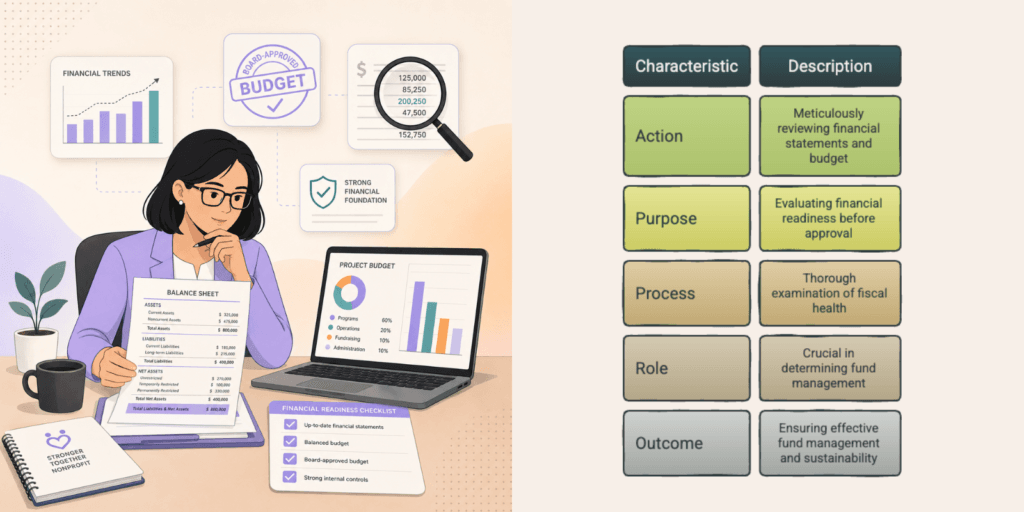
Everything else rests on one habit: bookkeeping that’s current and reconciled, with statements you can pull on demand. Concretely, “ready” looks like bank and credit card accounts reconciled every month, transactions categorized consistently rather than cleaned up the night before, and a Statement of Financial Position and Statement of Activities you can generate in minutes.
If you’re behind, don’t let that stop you from starting — most growing organizations catch up in stages. Pick the deeper guide that matches where you are:
This week’s step: reconcile last month, and confirm you can export both statements. If you can, you’ve cleared the biggest bar.
Funders usually want two budgets, and mixing them up is one of the most common stumbles. One describes the whole organization; the other zooms in on just the work you’re asking them to fund. Our free grant budget template builds the second one in the SF-424A categories, with fringe, indirect costs, and match calculated for you.
Organization-wide budget
Every expense and revenue source for the year
Answers the funder’s question: Is the organization behind this stable enough to deliver?
Program budget
Just the costs and income for the funded work
Answers: Does this specific plan hold together? Include a fair share of overhead.
Build the program budget honestly, including a fair share of the overhead that makes the work possible (a portion of rent, insurance, admin time). Underpricing your own program to look lean is a quiet way to lose money on a grant you win. If the funder is federal, run our free indirect cost rate calculator to find your actual rate before you accept the 15% de minimis rate. And make sure the budget is board-approved — funders look for that, and it signals healthy governance. Practical starting points: our budget format guide and free budget template.
Most grant money is restricted: given for a specific purpose, to be used only for that purpose and reported on. So you need to be able to show, at any moment, how much of your cash is committed and how much is flexible.
Picture a library: every book belongs to the library, but the catalog tells you exactly which shelf each one sits on. Restricted fund tracking is your catalog — the money may sit in one bank account, but your books always know which dollars belong to which purpose. You don’t need an existing grant to prove you’re ready; you need a system that can separate restricted dollars (usually fund or class tracking in your accounting software). Set it up now and your first grant report becomes a five-minute export instead of a year-end untangling.
Not sure your books would survive a funder’s second look? We can set up your fund tracking and statements the right way before you apply.
Request a quote →Internal controls sound like big-institution territory, but the core idea is simple: no single person can move money without anyone else knowing. A funder knows a staff of three can’t separate every duty — they just want to see you’ve built reasonable checks for your size. A few that work for small teams:
These protect the organization and protect your staff from suspicion if anything ever goes wrong. The full set of small-team safeguards is in Internal Controls: Simple Safeguards Every Small Nonprofit Needs.
Keep these in one folder so you’re never assembling them under deadline pressure:
Funders rarely tell you why you weren’t selected, so it helps to know what quietly raises doubt:
None of these are about being small or new. They’re about being unprepared — which is the one thing fully within your control.
Work through these before your next application. Start with what you can today and add the rest over the next few months — a short list you actually finish beats a perfect one that scares you off.
Grant-ready checklist
If you can check most of these, your accounting is already telling funders the right story. Two free starting points if you want a head start: our financial health checklist and fund tracking register.
Most leaders we work with didn’t start their nonprofit to spend evenings reconciling accounts — and the books quietly became the thing standing between them and the funding to grow. That’s the gap we close.
GivingArc helps small and growing nonprofits get their accounting grant-ready: clean monthly bookkeeping, statements you can hand to a funder without flinching, restricted fund tracking set up correctly from the start, and the budgets and documents that make applications smoother. You can build this in stages, and you don’t have to do it alone.
Get your accounting grant-ready before the next deadline.
GivingArc handles the bookkeeping and accounting — plus Form 990 prep — so your numbers earn a funder’s trust.
Common questions from small nonprofits preparing their finances before a grant application.
It means your books are current and reconciled, you can produce financial statements on demand, your annual and program budgets are board-approved and honest, and you have a way to track restricted funds separately. Together these show a funder your organization can be trusted to steward and report on their money.
Usually not for foundation grants. Many funders accept internal financial statements and your Form 990. Some larger government grants do require an audit, review, or compilation, so check each funder’s requirements. Even without an audit, clean books and a board-approved budget go a long way.
Most ask for recent financial statements, your current board-approved annual budget, a program budget for the funded work, and your most recent Form 990. An audit or review may be required for larger grants. Keeping these in one folder means you can respond to any application quickly.
You don’t need an existing grant to be ready. Set up fund or class tracking in your accounting software now, so the structure exists before the money arrives. That way your first grant report is a quick export rather than a year-end effort to untangle commingled spending.
Yes. Funders fund small nonprofits constantly and don’t expect a large finance team. They look for reasonable controls for your size, such as having someone other than the bookkeeper review the monthly reconciliation and the board see statements regularly. Readiness is about good habits, not headcount.
GivingArc provides bookkeeping, Form 990 preparation, and nonprofit-specialized accounting for small and mid-size 501(c)(3) organizations across the US. This article is educational and not a substitute for advice from your own accountant or auditor. Reviewed by Min Kim, CPA.