
Key Takeaways
Your executive director runs a program on Tuesday morning, meets a donor at lunch, and spends the afternoon on payroll and the board packet. That salary is one line in QuickBooks. At year-end, the 990 preparer asks how much of that salary was program, how much was management, and how much was fundraising.
If the honest answer is a guess, the guess goes into a public document. The 990 is public, so funders, donors, and rating sites can all see that split.
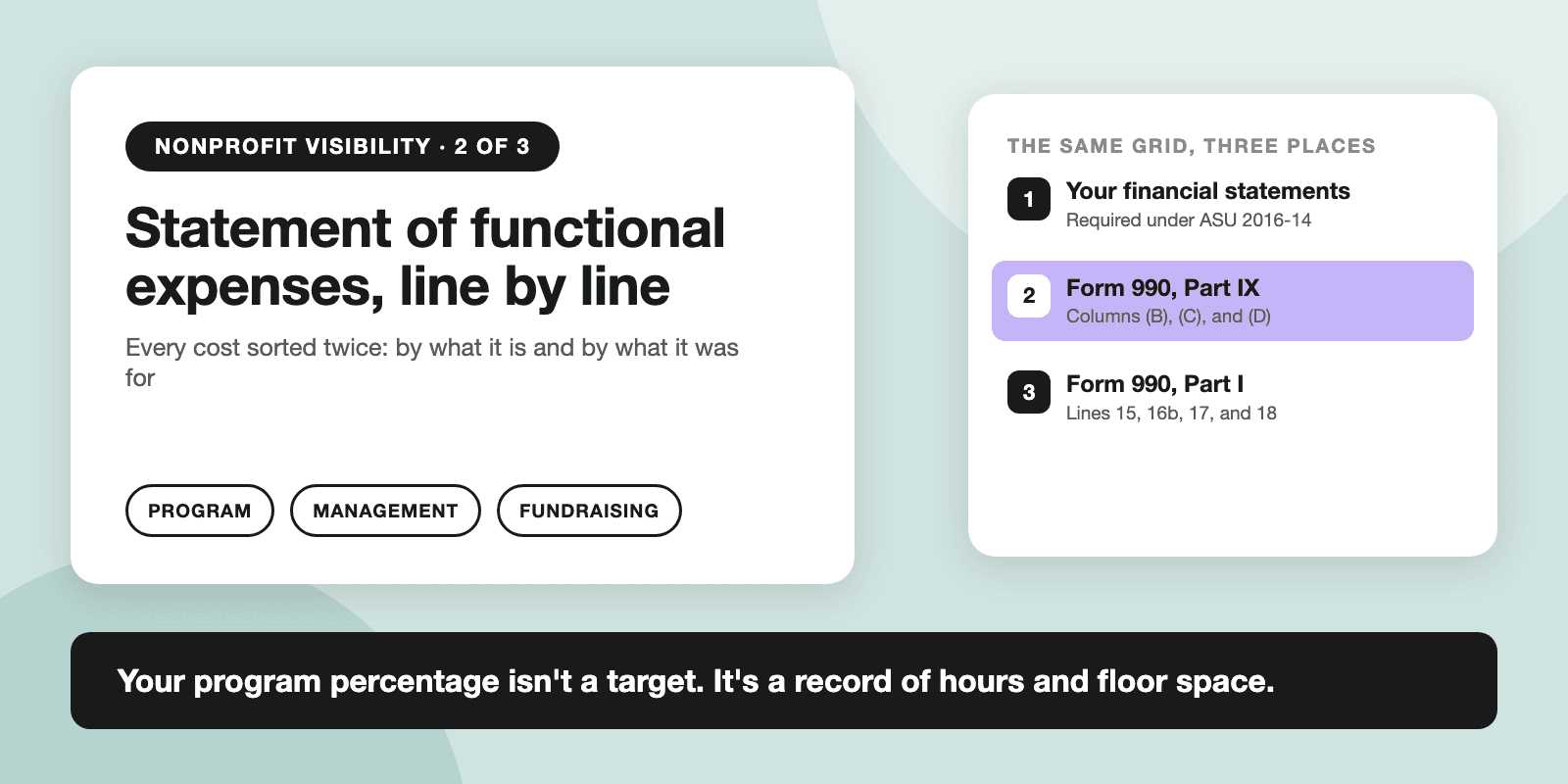
This guide shows how the statement of functional expenses works, line by line, using one illustrative $586,500 organization. It maps every row to Form 990 Part IX, and the free statement of functional expenses template does the splitting for you.
A statement of functional expenses is a grid that shows every expense twice: down the side by what it is, and across the top by what it was for. The rows are natural categories, such as salaries, rent, and supplies. The columns are functions: program services, management and general, and fundraising.
Think of sorting a year of household receipts twice. Once by what you bought, groceries or gas or rent, and once by who it was for. Each receipt lands in one cell, and both totals add up to the same number.
Under GAAP, ASU 2016-14 requires every nonprofit to present this analysis in one place: on the statement of activities itself, as a separate statement, or in the notes. It also requires you to disclose how you allocate costs. Our guide to reading nonprofit financial statements shows where it sits among the other statements.
Program services are the work of your mission, management and general is running the organization as a whole, and fundraising is asking for contributions. The Form 990 instructions define all three, and the definitions below follow them.
Part IX, column (B)
Program services
Activities that carry out your exempt purpose.
Examples: program staff, program supplies, the share of rent for program space, and costs to win a contract to deliver a specific service a funder asked for.
Part IX, column (C)
Management and general
Running the organization as a whole.
Examples named by the IRS: board meetings, general legal, accounting and auditing, general liability insurance, office management, HR, the annual report.
Part IX, column (D)
Fundraising
Asking for contributions, gifts, and grants.
Examples: appeal letters, donor meetings, grant proposals for services to the general public, and indirect event costs. A fundraising event’s direct costs go to Part VIII instead.
Two details are easy to miss. Writing a grant proposal, restricted or unrestricted, to fund services to the general public is fundraising, but the cost of securing a contract to deliver a service the funder specifically needs is program. A person who works in more than one function is split, not rounded. In the IRS example, an employee spends 40% of their time on fundraising and 60% on programs. Their salary is reported 40/60, not 100% program.
Here is a full statement of functional expenses for an illustrative organization with $586,500 in expenses, with the Form 990 Part IX line for every row. Each row adds across to its total, and each column adds down. The basis column says how the row was split.
| Your account | Part IX line | Basis | Program | Management and general | Fundraising | Total |
|---|---|---|---|---|---|---|
| Executive director salary | 5 | Executive director’s time records | $28,500 | $52,250 | $14,250 | $95,000 |
| Staff salaries | 7 | Staff time records | $221,000 | $20,800 | $18,200 | $260,000 |
| Employee benefits | 9 | Follows salaries | $26,707 | $7,819 | $3,474 | $38,000 |
| Payroll taxes | 10 | Follows salaries | $18,976 | $5,556 | $2,468 | $27,000 |
| Accounting and audit fees | 11c | Direct: management | – | $18,000 | – | $18,000 |
| Program supplies | 13 | Direct: program | $42,000 | – | – | $42,000 |
| Donor appeal printing and postage | 13 | Direct: fundraising | – | – | $9,000 | $9,000 |
| Software and IT support | 14 | Staff count | $9,600 | $1,200 | $1,200 | $12,000 |
| Rent and utilities | 16 | Square footage | $45,000 | $9,000 | $6,000 | $60,000 |
| Travel | 17 | Direct, by trip | $7,000 | – | $1,000 | $8,000 |
| Board meeting costs | 19 | Direct: management | – | $1,500 | – | $1,500 |
| Depreciation | 22 | Square footage | $7,500 | $1,500 | $1,000 | $10,000 |
| General liability insurance | 23 | Direct: management | – | $6,000 | – | $6,000 |
| Total (Part IX, line 25) | 25 | $406,283 | $123,625 | $56,592 | $586,500 | |
| Share of total | 69% | 21% | 10% | 100% |
Illustrative figures. Splits: executive director 30 / 55 / 15 and staff 85 / 8 / 7 from time records; rent and depreciation 75 / 15 / 10 from square footage; software 80 / 10 / 10 from staff count. Benefits and payroll taxes follow the combined salary split. Two accounts feed line 13, which is normal.
Notice what drives the result. Salaries and their benefits and taxes are 72% of this budget, so the time records decide most of the split. Rent is the next biggest lever. Everything else is either clearly one function or too small to move the totals.
Here is the shift that makes this easier: your program percentage isn’t a number you set at year-end. It is a record of where people’s hours and your floor space went. Write the bases down in January, and the statement in December builds itself. That is also why the template asks for bases first and amounts second.
Split each shared cost with a basis that matches what drives it, write the basis down, and use it the same way every year. The IRS says that if your accounting system doesn’t allocate expenses, you can use any reasonable method, but you must report accurately and document the method in your records.
It works like roommates splitting rent by room size. Nobody argues about the result, because everyone can see the floor plan. Your basis is your floor plan.
Salaries, benefits, payroll taxes
Time records
Timesheets coded by function, or a time study over a few representative weeks, repeated when someone’s job changes. Benefits and taxes follow the same split.
Rent, utilities, depreciation
Square footage
Measure the space each function uses. Shared rooms, like a kitchen, follow the split of everything else.
Software, phones, IT support
Staff count
Count people by the function they mostly work in, or use the salary split if staff cross functions often.
Audit, board, appeals, supplies
Direct
If a cost clearly belongs to one function, put it there. No formula needed. In the example, six of thirteen rows are direct.
Keep a one-page allocation memo with each basis, the numbers behind it, and the date. Under GAAP the method is disclosed in your financial statements, so your auditor will ask for this page. Do your federal grants charge indirect costs? The indirect cost rate calculator uses the same thinking for a different purpose. Our grant accounting guide shows how to document shared costs for funders.
Rather not build the split yourself?
When we prepare your 990, we check each allocation basis before Part IX is filled in.
Form 990 Part IX is a statement of functional expenses with fixed rows: lines 1 through 24 are the natural categories, and columns (B), (C), and (D) are the three functions. Section 501(c)(3) and 501(c)(4) organizations must complete all four columns. Other exempt organizations must complete column (A), the total, and may complete the rest.
Your accounts won’t match the 990 lines one to one, so map them once. In the example, program supplies and donor appeal postage both go to line 13, office expenses. Rent and utilities go to line 16, occupancy. Board meeting costs go to line 19. Then Part IX feeds the summary on page 1 of the Form 990:
| Part I line | Pulls from Part IX | Example |
|---|---|---|
| 15 Salaries, other compensation, employee benefits | Column (A), lines 5–10 | $420,000 |
| 16b Total fundraising expenses | Column (D), line 25 | $56,592 |
| 17 Other expenses | Column (A), lines 11a–11d and 11f–24e | $166,500 |
| 18 Total expenses | Must equal column (A), line 25 | $586,500 |
Lines 13, 14, and 16a of Part I (grants, member benefits, professional fundraising fees) are zero in this example. Line 16b is reported on its own and isn’t added into line 18.

One Part IX rule is easy to miss: report each expense on its own line 1 through 23 when one fits, and use line 24, other expenses, only for what doesn’t. Our step-by-step Form 990 guide walks through the rest of the return.
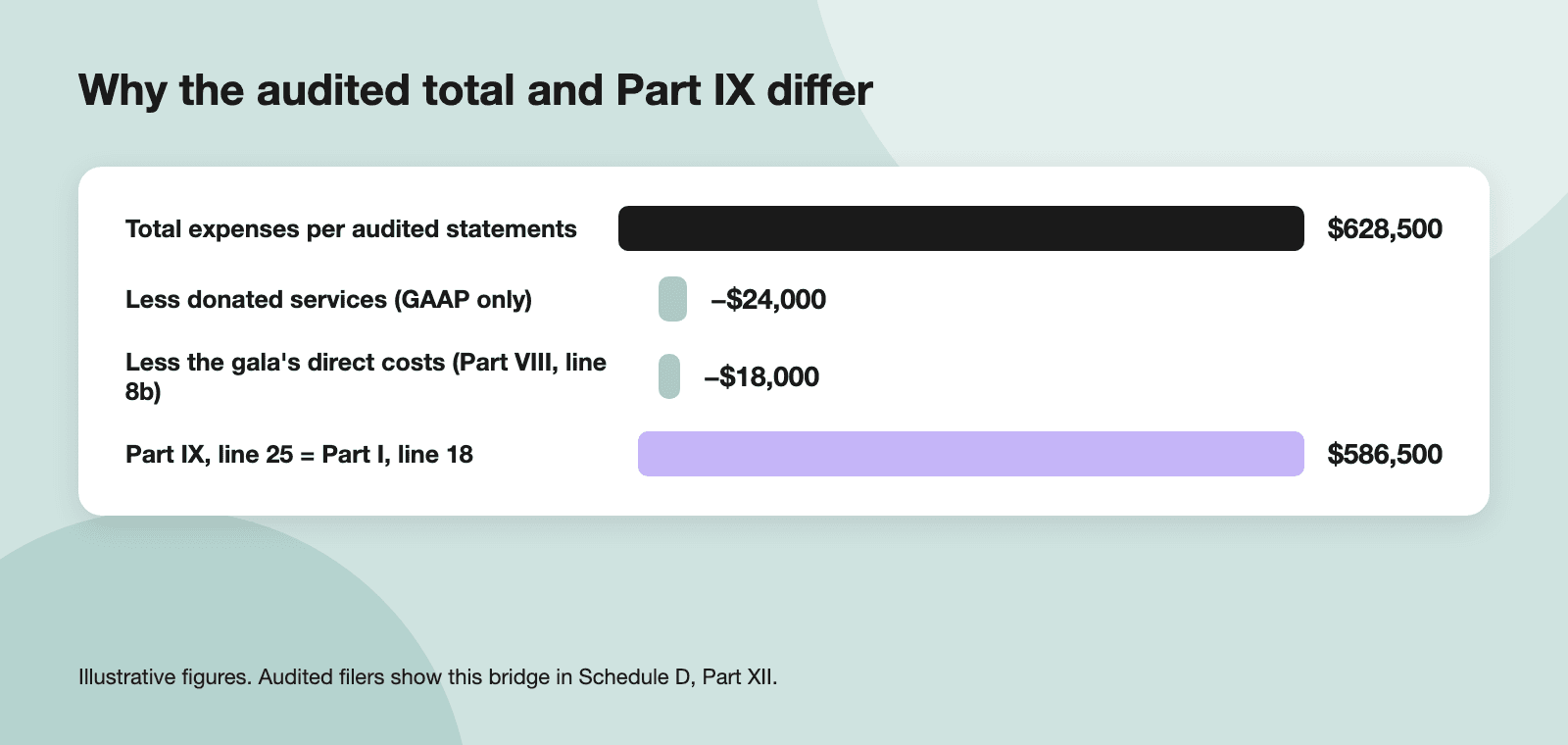
Your audited statement of functional expenses and Part IX can both be right and still show different totals, because each leaves out different things. Part IX excludes any amount reported on Part VIII lines 6b, 7b, 8b, 9b, or 10b, which are costs the 990 subtracts from the related revenue instead. It also leaves out donated services and use of facilities, which GAAP may require you to record.
From audited total to Part IX (illustrative)
Organizations that answer yes to Part IV, line 12a (separate audited financial statements) show this bridge in Schedule D, Part XII, which has its own line for donated services and use of facilities.
Event costs need the most care. The gala’s direct costs, such as the venue and dinner, go to Part VIII, line 8b, while indirect costs, such as advertising for the event, stay in Part IX, column (D). Our Schedule G guide and fundraising event accounting guide follow one gala through both places.
Six slips are easy to catch before you sign: one-column salaries, zero fundraising, event costs in Part IX, line 24 as a catch-all, a changing basis, and no memo. Each is a rule in the Form 990 instructions or a question your auditor will ask.
The whole executive director in one column
If they run programs or meet donors, part of the salary belongs there. The IRS example says a 60/40 job is reported 60/40.
Zero fundraising with contributions on Part VIII
If staff wrote appeals, wrote grant proposals, or met donors, part of their time is fundraising.
Event direct costs in Part IX
Venue, food, and auction items for a fundraising event go to Part VIII, line 8b, not to column (D).
Line 24 as a catch-all
Anything that fits lines 1–23 belongs there. If line 24e, or other fees for services on line 11g, passes 10% of total expenses, list those expenses on Schedule O.
A new basis every year
Changing the method without a reason makes year-over-year percentages meaningless. Change it when the facts change, and note why.
No memo behind the numbers
The IRS requires the method to be documented. Without the memo, the split is an opinion.
The split also feeds the program expense ratio that funders and our financial ratios guide use, so a clean Part IX helps beyond the return. More return-level slips are in common Form 990 mistakes. And if the split stays hard because your accounts are too coarse, the nonprofit chart of accounts template sets up accounts that map to Part IX lines from the start.
When we keep your books, every transaction carries its function, so Part IX comes from the monthly close instead of a year-end estimate. We set up the allocation bases with you, keep the memo current, and use the same split in your board reports and audit schedules.
Form 990 preparation runs $1,800 to $3,000 for a full Form 990, or from $1,500 when we kept the books for that year. Monthly bookkeeping starts at $300 a month. The pricing page has every number. Either way, the free statement of functional expenses template gives you the same grid, bases, and Part I tie-out used in this guide.
Questions about functional expenses, allocation, and Form 990 Part IX.
A statement of functional expenses is a grid that shows every nonprofit expense twice: by what it is (salaries, rent, supplies) and by what it was for (program services, management and general, or fundraising). Form 990 asks for the same grid in Part IX.
If you follow GAAP, yes in substance: since ASU 2016-14, every nonprofit must show expenses by both nature and function in one place, either on the statement of activities, as a separate statement, or in the notes. On the tax side, 501(c)(3) and 501(c)(4) organizations that file the full Form 990 must complete all four columns of Part IX. Form 990-EZ has no functional columns, but 501(c)(3) and 501(c)(4) filers must still report each program’s expenses in Part III.
Management and general covers running the organization as a whole rather than a program or a fundraising effort. The Form 990 instructions list board meetings, general legal services, accounting and auditing, general liability insurance, office management, human resources, and the annual report. The executive director’s salary is split by time if part of it goes to programs or fundraising.
Pick a reasonable basis for each shared cost, write it down, and use it every year. Salaries follow time records, rent and depreciation follow square footage, and software can follow staff count. The IRS allows any reasonable method but requires you to document it, and under GAAP the method is disclosed in your financial statements.
Part IX and the audited statement leave out different things. Part IX excludes donated services and use of facilities, and it excludes direct costs that the 990 nets against revenue in Part VIII, such as the direct costs of a fundraising event. Organizations that answer yes on Part IV, line 12a (separate audited financial statements) explain the difference in Schedule D, Part XII.
A Part IX you can explain, line by line.
Functions tagged in your monthly bookkeeping, with the allocation memo ready when your 990 preparer or auditor asks.
GivingArc provides bookkeeping, Form 990 preparation, and nonprofit-specialized accounting for small and mid-size 501(c)(3) organizations across the US. The organization in this guide and all of its figures are illustrative. Form references are to the 2025 Form 990 and its instructions. General information, not accounting, tax, or legal advice. Reviewed by Min Kim, CPA.
