📥 Free Download
Nonprofit Indirect Cost Rate Calculator (Excel) with the 15% De Minimis Rule
Enter one year of costs, and the workbook computes your indirect cost rate on the modified total direct cost (MTDC) base federal awards use, sets it next to the 15 percent de minimis rate under 2 CFR 200.414(f), and shows what the difference is worth on one proposed grant. Built on the 2024 Uniform Guidance definitions, including the $50,000 subaward cap.
Download Excel Calculator →
+ Worked Example PDF
Format: Excel + PDF
Excel Tabs: 3
PDF Pages: 1
Updated: September 2026
XLS+PDF
Indirect Cost Rate Calculator Pack
3 tabs + 1 page · ~100 KB · 100% free · No signup required
Why the de minimis rate is a floor, not a fact about you
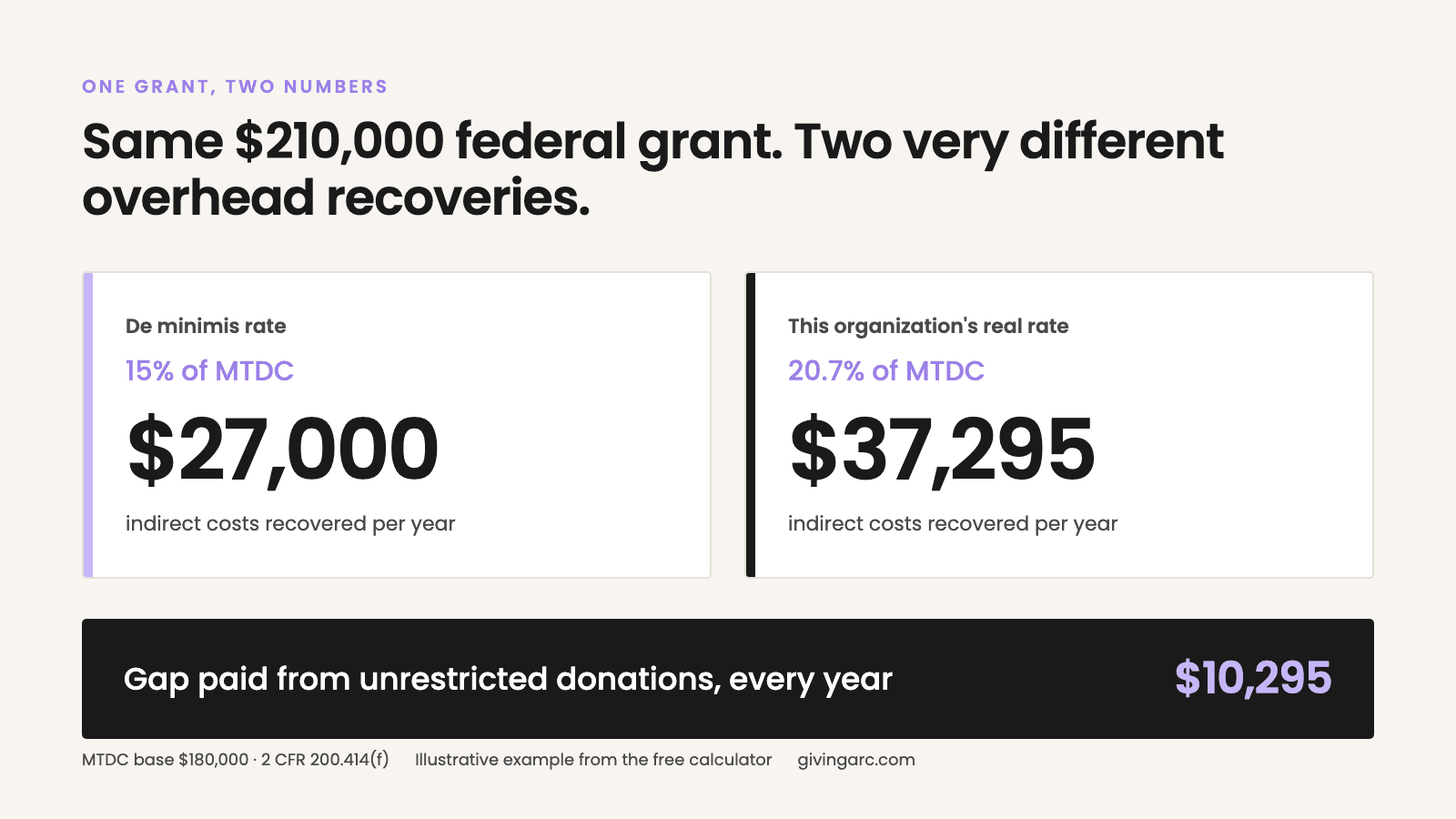
If nobody at a small nonprofit has ever calculated the real indirect rate, the organization ends up charging whatever the funder suggests. The de minimis rate exists for that situation: 15% of MTDC, no proposal, no documentation. It is a reasonable floor. It says nothing about what it actually costs to run your organization. An organization whose real rate is 22 percent and charges 15 gives away 7 points of every federal dollar, year after year, without ever deciding to. This calculator produces the missing number, then puts it next to 15 percent so the decision to negotiate, or not, is made with the gap in front of you.
What’s Inside the Calculator
Excel · Tab 1Inputs
- Indirect cost pool by line, with where each figure comes from
- Unallowable costs to remove, with the 2 CFR 200 section for each
- Direct costs by category, flagged as in or out of MTDC
- One row per subaward; the first $50,000 counts automatically
- Yellow cells only, one fiscal year
Excel · Tab 2Results (calculates itself)
- Allowable indirect cost pool
- Total direct costs and MTDC, with every exclusion shown
- Your rate on an MTDC base and on a total-direct-cost base
- Side-by-side with the 15 percent de minimis rate and a plain reading of the gap
- One proposed grant budget: indirect dollars at 15 percent and at your rate
PDF · 1 PageWorked Example + Instructions Tab
- A filled-in sample organization at a 20.7 percent rate
- Illustrative figures, not drawn from any client
- MTDC, equipment, and de minimis definitions quoted from 2 CFR 200.1 and 200.414
- When a negotiated rate is worth the proposal
- The three-month first-proposal deadline from Appendix IV
How the rate is calculated
The workbook follows the simplified allocation method in 2 CFR 200 Appendix IV, which fits organizations whose programs all draw on the same administrative core. Appendix IV allows any equitable base; the workbook uses MTDC because 2 CFR 200.414(f) applies the de minimis rate to MTDC, so the two rates can be compared directly. Four steps, in the order the tabs run.
Step 1Pool allowable indirect costs
Add up what runs the whole organization
Management, finance, HR, administrative occupancy, insurance, audit. Then remove fundraising, lobbying, entertainment, fines, and bad debts, which federal rules do not allow in the pool.
Step 2MTDC the federal base
Build the base the rate applies to
Direct salaries, fringe, supplies, services, travel, and the first $50,000 of each subaward, as defined in 2 CFR 200.1. Equipment, capital, rent, participant support, patient care, and tuition stay out.
Step 3÷ pool divided by base
Your actual rate, next to 15 percent
The Results tab reads the gap in one sentence: above 15, a negotiated rate could recover more; at or below, the de minimis rate already does.
Step 4$ on one grant
What the gap is worth
Enter a proposed grant budget. The tab shows indirect dollars at 15 percent and at your rate, and the total request under each, so the negotiation decision is a dollar figure.
Who This Calculator Is For
ED
Executive Directors
Who have been told 15 percent is generous and have no number of their own to answer with.
GW
Grant Writers
Who need the indirect line on the next federal budget to be defensible, and the MTDC exclusions applied correctly.
BK
Bookkeepers
Who are asked once a year what the rate is and would rather run a workbook than rebuild the analysis.
TR
Treasurers
Who want to know whether the organization is subsidizing its federal programs from unrestricted dollars.
How to Use This Calculator
Step 1
Pull one year of functional expenses
Your Statement of Functional Expenses is the source. The management and general column seeds the indirect pool; program columns seed the direct base.
Step 2
Fill the yellow cells
Pool, unallowables, direct costs by category, one row per subaward. A cost goes in exactly one place; the tab says so at the bottom.
Step 3
Read the Results tab
Your MTDC rate, the de minimis rate, and a one-line reading of the gap. Then enter one proposed grant to see the gap in dollars.
Step 4
Decide, and keep the workbook
If a negotiated rate is worth it, the Inputs tab is the skeleton of the proposal. If not, you have the number for every foundation conversation.
Frequently Asked Questions
Is this really free?
Yes. No email address, no signup, no gate. Download either file directly.
What is the de minimis indirect cost rate for nonprofits in 2026?
Up to 15 percent of modified total direct costs (MTDC). Under 2 CFR 200.414(f), a recipient or subrecipient that does not have a current federal negotiated indirect cost rate may elect a de minimis rate of up to 15 percent of MTDC. The rate needs no documentation to justify it, may be used indefinitely, and once elected must be applied to all federal awards until the organization chooses a negotiated rate. The 15 percent figure applies to awards issued on or after October 1, 2024, and to some earlier awards where the agency chose to apply the 2024 revision early; awards still under the previous rule use 10 percent, so check the award terms.
What counts in modified total direct costs (MTDC)?
All direct salaries and wages, applicable fringe benefits, materials and supplies, services, travel, and up to the first $50,000 of each subaward. MTDC excludes equipment, capital expenditures, charges for patient care, rental costs, tuition remission, scholarships and fellowships, participant support costs, and the portion of each subaward above $50,000. The definition is in 2 CFR 200.1; the calculator applies it line by line.
How do I calculate my nonprofit’s actual indirect cost rate?
Divide your allowable indirect costs by a direct cost base. Under the simplified allocation method in 2 CFR 200 Appendix IV, you separate the year’s costs into direct and indirect, remove unallowable costs such as fundraising, lobbying, and entertainment from the indirect pool, then divide the pool by the base. The calculator uses an MTDC base because that is the base federal awards apply the rate to, and shows a total-direct-cost rate alongside it for comparison.
Should we use the de minimis rate or negotiate a rate?
Compare your actual MTDC rate with 15 percent. If your rate is at or below 15 percent, the de minimis rate recovers as much with no proposal to prepare. If it is well above 15 percent and you hold or expect federal awards, a negotiated indirect cost rate agreement (NICRA) with your cognizant agency lets you recover the actual rate; a first-time proposal is due no later than three months after the effective date of the award (Appendix IV, C.2). The calculator shows the dollar gap on one grant so the decision is about numbers rather than habit.
Can a funder make us use a rate lower than 15 percent?
For federal awards, no. 2 CFR 200.414(f) says federal agencies and pass-through entities may not require a rate lower than the negotiated rate or the elected de minimis rate unless a federal statute or regulation requires it. The de minimis rate does not apply to cost-reimbursement contracts issued directly by the federal government under the FAR. Private foundations are not bound by 2 CFR 200 and set their own indirect cost policies, which is why knowing your actual rate matters in those conversations too.
Does the calculator work if we only receive foundation grants?
Yes. The rate itself is about your organization, not about who funds it. Knowing that your real indirect rate is 20 or 25 percent is the fact you need when a foundation offers 10 percent for overhead, and the Results tab shows what any given rate is worth in dollars on a proposed budget.
Related Resources