
The invitation usually arrives politely. “Could you join us for the first twenty minutes? The board has a few questions about the financials.” Then it becomes a standing item. Then it becomes the reason the board meeting cannot start until the accountant’s calendar clears. We have sat in enough of those twenty minutes to know what happens in them, and this post is about the document that causes them: the nonprofit board financial report, and the one-page version of it that a board can read on its own.
Key Takeaways
Someone asks why cash went down when the statement of activities shows a surplus. Someone asks what “with donor restrictions” means, and whether it is good news. The treasurer, who read the packet on the train, tries to answer and looks at the accountant. The executive director, who has been living inside these numbers all month, ends up explaining them anyway, which is the thing the invitation was supposed to prevent.
None of this is a failure of the board. A board is supposed to be made of people who know the community, the mission, the donors, the law, the schools, the clinic. It is not supposed to be made of people who can read a statement of financial position cold. And it is not a failure of the accountant, who produced exactly the reports accountants produce.
It is a failure of the document. The board was handed a report written for the person who made it, and then the person who made it had to come to the meeting to translate. The meeting is the translation fee.
Free for nonprofits · not only our clients
A board report that needs no translator, free.
If your nonprofit keeps its own books in QuickBooks Online, we will turn your monthly QuickBooks reports into the same board dashboard our bookkeeping clients get: cash and months on hand, the year so far, restricted funds, and what changed from last month. We are opening it to a small number of nonprofits first.
The dashboard shows the numbers from your own books as you send them; they are not audited.
How the dashboard works, from the monthly close to the board packet (1:00).
Start from what the board is there to do. The board carries the legal responsibility for the organization, which is why the same fifteen minutes of financials appears at every meeting. Propel Nonprofits’ guidance on board financial communication says it plainly: “Financial reports should be on the agenda at every board meeting.” The same guidance sets four tests for the information those reports carry: accurate, timely, in context, and appropriate to the reader. On that last point it is blunt: “No one-size-fits-all financial report exists. Reports must be designed to communicate information specific to the organization’s current circumstances in a format that matches the knowledge level and role of board members.”
Read that sentence again with the meeting in mind. The format is supposed to match the reader. When it does not, the reader gets matched to the format instead, and that is done by inviting someone to explain. The report has a job, and the job is not “contain the numbers.” The numbers already exist in the accounting system. The job is to let a thoughtful non-accountant answer four questions without help: Are we okay this month? Are we on plan, and which lines drove the gap? Is anything restricted, owed, or overdue that changes what we can spend? Is there a decision the board needs to make, or is this for information only?
There is also an annual layer the monthly report should set up rather than spring on the board. The Form 990 instructions for Part VI ask whether a complete copy of the final return was given to every voting board member before filing, and ask the organization to describe on Schedule O the process, if any, used to review it. Federal tax law does not require the board to review the return, but the answer is disclosed on the form, and most boards would rather say yes. A board that reads a plain monthly report all year is not startled by the 990 at filing time. A board that has been nodding through slides is.
Here is the analogy we use with new clients. A lab report from a doctor’s office lists your result in one column and the normal range in the next. The normal range is what makes the number readable. Without it, “137” is a fact; with it, “137, normal range 135 to 145” is a sentence a patient can act on. Most board packets are a column of 137s.
So the report we build has three things on every line: the number, the comparison that gives it meaning, and one plain-language line about what changed. It fits on one page, and the full financial statements sit behind it as attachments for the treasurer and anyone who wants them.
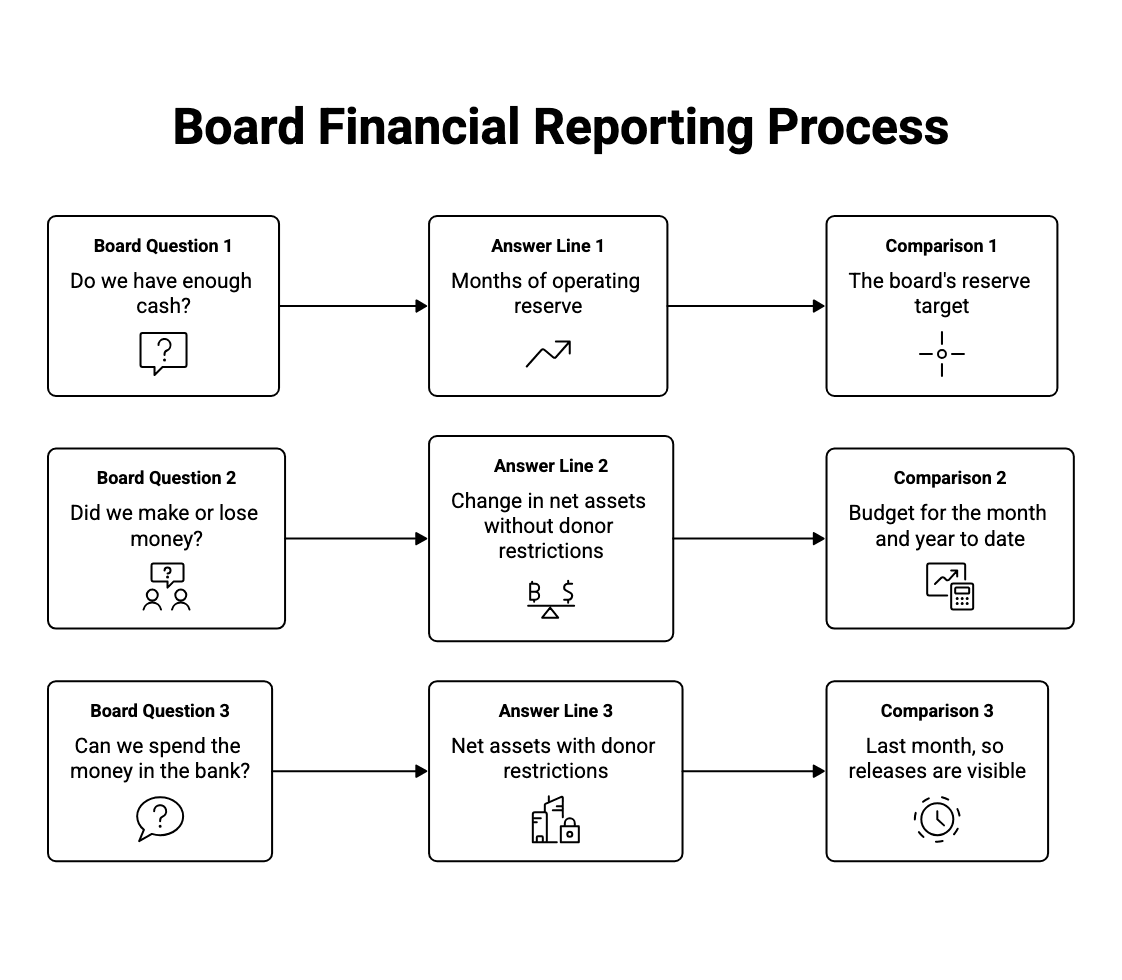
| The question a board member asks | The line that answers it | The comparison that makes it readable |
|---|---|---|
| “Do we have enough cash?” | Cash, and months of operating expenses on hand | The same figure last month, and the board’s reserve target |
| “Did we make or lose money this month?” | Change in net assets without donor restrictions | The budgeted change for the month and year to date |
| “Why is revenue off?” | The top three revenue lines against budget | Timing (a grant paid late) versus a real shortfall |
| “Can we spend the money in the bank?” | Net assets with donor restrictions, and what each restriction is for | Last month, so releases are visible |
| “Is anyone waiting to be paid, or waiting to pay us?” | Payables over 30 days; receivables and pledges over 60 days | The same lines last month |
Five questions boards ask, and where the answer lives on the page.
Below the table, three or four sentences of narrative. Not a memo, not a paragraph per line item. “Cash fell because the county reimbursement due in March arrived in April; it is now in. Program expenses ran over budget in one line, the summer camp supplies, and are within budget year to date. No decision needed this month.” That paragraph is the part the board actually reads, and it is the part most packets leave out.
If your organization already produces the four core statements, our guide to reading nonprofit financial statements explains where each of these lines comes from, and the financial ratios guide covers the reserve and liquidity figures in the first row. If you want to see the page laid out with your own numbers before you build it, the Board-Ready Financial Dashboard is a tool we built for exactly that moment.
You are the treasurer. The packet arrives Thursday for a Tuesday meeting.
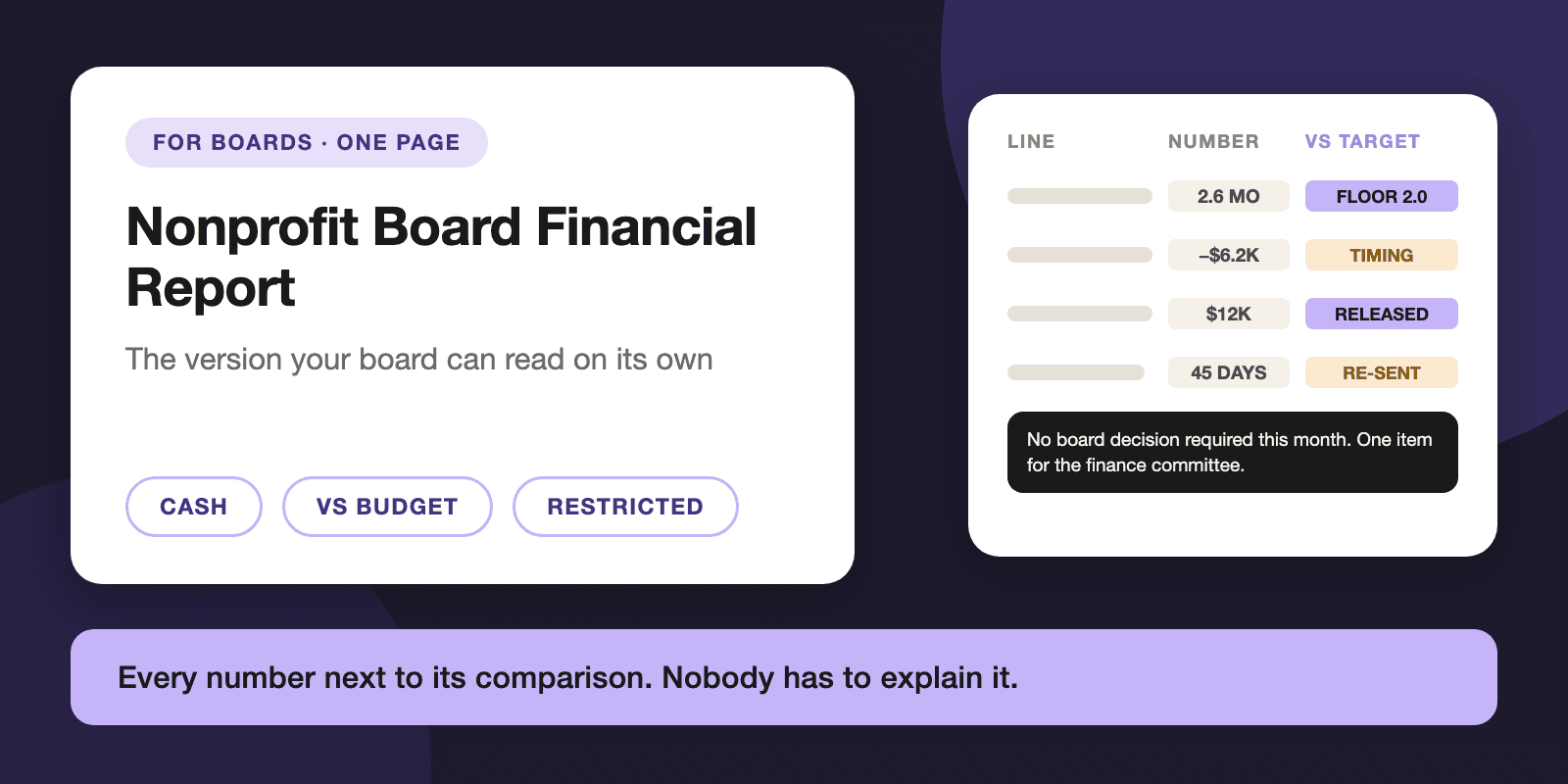
You open it on your phone. The first page says cash is $84,000, which is 2.6 months of expenses, down from 3.1 last month and above the board’s floor of two months. Under it, one line: “The decrease is the annual insurance premium, paid in full in August as planned.” You already know the first question the chair will ask, and the answer is on the page.
The second block shows the month came in $6,200 under budget on revenue. The narrative says the fall appeal mailed a week later than planned, so gifts are landing in September, and September’s early results are attached. You decide that is a timing note, not a problem, and you notice that you decided it yourself.
The third block lists two restricted grants and what each is for, with $12,000 released this month for the after-school program. The last block says one printer invoice is 45 days overdue because the wrong address was on it, and it is being re-sent. At the bottom: “No board decision required. One item for the finance committee: the reserve target has not been revisited since 2023.”
You have read the entire financial report in four minutes. At the meeting, the financial item is spent on the reserve target, which is a policy question, which is what boards are for. The accountant is not in the room. Nobody noticed.
The figures above are illustrative, not a client’s. What is real is the shape: every number sits next to the thing it should be compared with, and every surprise has its one-line explanation before anyone has to ask.
This is the question we are asked most, and our answer is a question back: what would the accountant be there to do?
If the answer is “explain the report,” then the report needs to change, not the attendance list. Attendance treats the symptom. It also has a cost that compounds: an hour of the accountant’s time each month, an hour of the director’s time preparing them, and, where the firm bills for it, an attendance fee on the invoice. Some firms offer board meeting attendance as a service, and that is a reasonable thing to buy for the meetings that need it. Our comparison of nine nonprofit bookkeeping services notes the one that lists it.
There are legitimate reasons to have the accountant in the room: an audit is coming and the board should hear the plan directly; the organization is deciding whether it can afford a second location; a restricted grant has a compliance problem. Those are events, not months. For the other ten meetings a year, a report the board can read on its own, plus a way to ask a question and get a written answer before the meeting, does the job better than a guest.
That written channel matters more than it sounds. A board member who can email “why did payroll jump in July?” on Friday and read the answer on Sunday walks into Tuesday’s meeting informed. The same board member, saving the question for the meeting, gets a live answer that half the room did not follow and no one wrote down. Questions answered in writing become a record. Questions answered in a meeting become a memory.
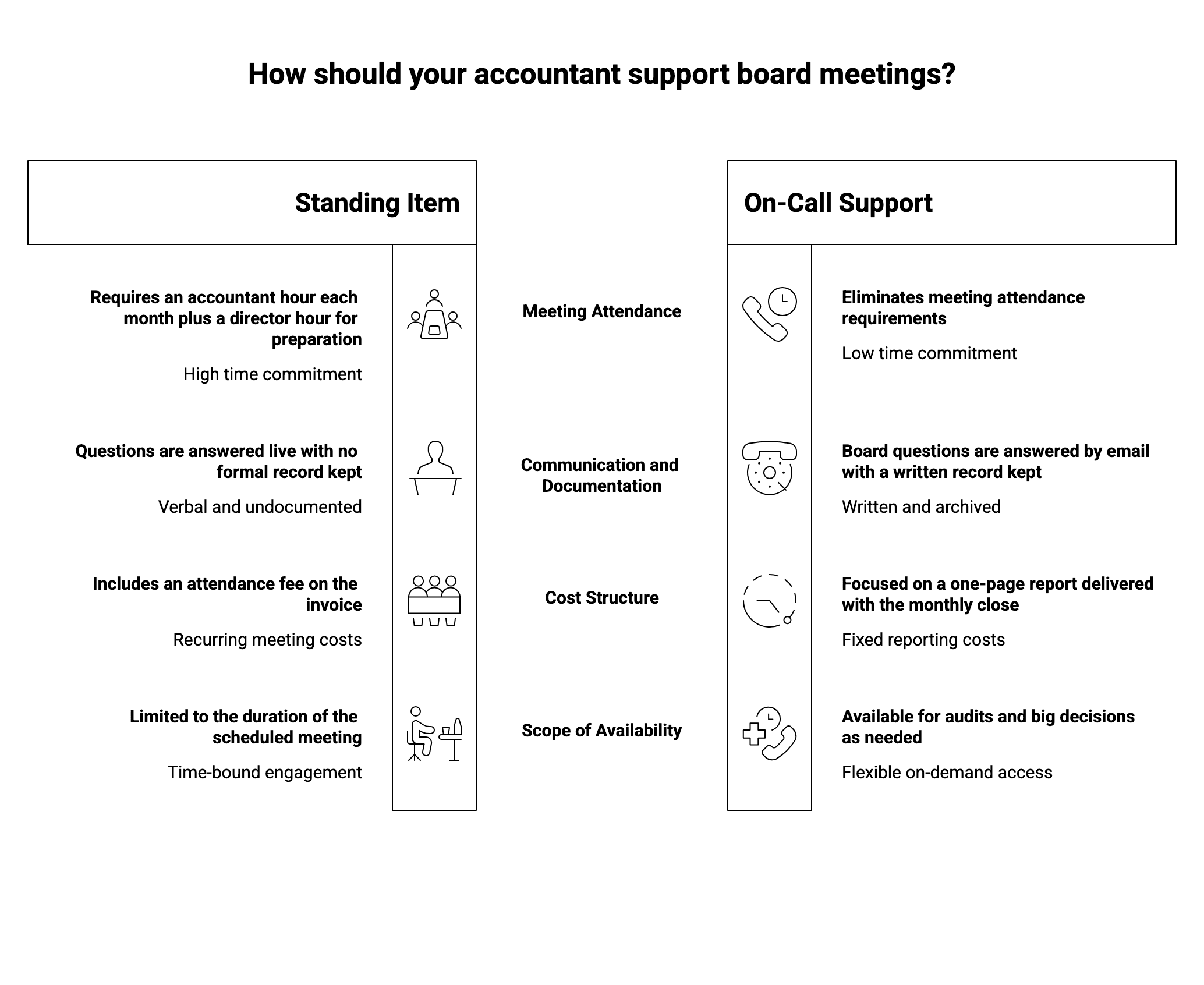
We build this report for every bookkeeping client, at every plan level, starting at $300 a month. It is delivered as a PDF to the executive director with the monthly close, and board questions are answered by email, in writing, by the team that keeps the books.
Two practical notes on how it is produced, because boards ask. The narrative is drafted with AI tools, but only after donor names and any personal information have been removed from what the tool sees, and every report is reviewed by your accounting team before it goes out. Organizations that prefer that nothing be sent to an outside AI service can have the report produced on a local model that never leaves our systems; the formatting is simpler and the content is the same.
The point of all of it is the same on both sides of the engagement: fewer hours. No accountant hour at the meeting, no director hour spent explaining, and no attendance fee. Our pricing page lists the full monthly table with a calculator, and the bookkeeping service page lists everything else the monthly rate covers.
You do not need our service to fix the report. If your bookkeeper or treasurer produces the packet today, start with this and add as the organization grows. The free board financial report template (Excel plus a one-page sample PDF) has the five sections below already laid out.
Put one page on top
Cash and months of reserve, actual versus budget for the month and year, restricted balances, anything overdue. Nothing else on that page.
Add the comparison column
Every number gets the figure it should be compared with: last month, budget, or the board’s own target. A number without its range is not readable.
Write three sentences
What changed, why, and whether a decision is needed. If it takes more than four, the page is trying to do the treasurer’s job.
Open a written question channel
One email address, a promise of an answer before the meeting, and the answers pasted into next month’s report.
Move the accountant to on-call
Invite them for audits, big decisions, and problems. Notice how many months go by without needing to.
A short report the board reads every month beats a complete packet it stops opening. Start with the page; add the attachments only when someone asks for them. If you are still deciding who should produce the report in the first place, our post on what a nonprofit treasurer does covers the volunteer side, and the bookkeeper vs accountant vs CPA guide covers the paid side.
Want the board to read the numbers without you in the room?
GivingArc includes a monthly board-ready report and written answers to board questions in every bookkeeping plan, from $300 a month. See the full price table or talk to us.
Questions treasurers and executive directors ask about board financial reporting.
At minimum: cash and months of operating reserve, the month’s and year’s actual results against budget, net assets with donor restrictions and what each restriction is for, anything overdue in payables or receivables, and a short narrative saying what changed and whether a decision is needed. The full financial statements go behind it as attachments.
At every board meeting. Propel Nonprofits’ board communication guidance states that financial reports should be on the agenda at every meeting and that information should reach the board within two or three months at the latest. Monthly, delivered with the close, is the practical standard for small and mid-size organizations.
Only for events: an upcoming audit, a major financial decision, or a compliance problem. If the accountant is attending every month to explain the report, the report is written for the wrong reader. A board-ready report plus written answers to board questions covers the ordinary months, without an attendance fee.
The treasurer’s report is the treasurer’s spoken or written summary and recommendation to the board. The board financial report is the document it is based on. When that document is written for non-accountants, the treasurer’s report gets shorter, because the board has already read the page.
Federal tax law does not require the board to review the Form 990. It does require the organization to disclose, on Form 990 Part VI, whether a complete copy of the final return was provided to every voting member of the governing body before filing, and to describe on Schedule O the review process, if any. A board that reads a plain financial report all year is prepared for that review rather than surprised by it.
GivingArc provides bookkeeping, Form 990 preparation, and nonprofit-specialized accounting for small and mid-size 501(c)(3) organizations across the US. The sample month above is illustrative and not drawn from any client. Sources are linked where cited, as checked on September 3, 2026. Reviewed by Min Kim, CPA.