
Key Takeaways
You spend weeks on a grant proposal: the story, the budget, the outcomes. Meanwhile, the program officer can open your last three Forms 990 in under a minute, for free, without asking you.
That isn’t a threat. It’s a chance to make your case in a document you control, as long as you treat the 990 as more than a tax form to file and forget.
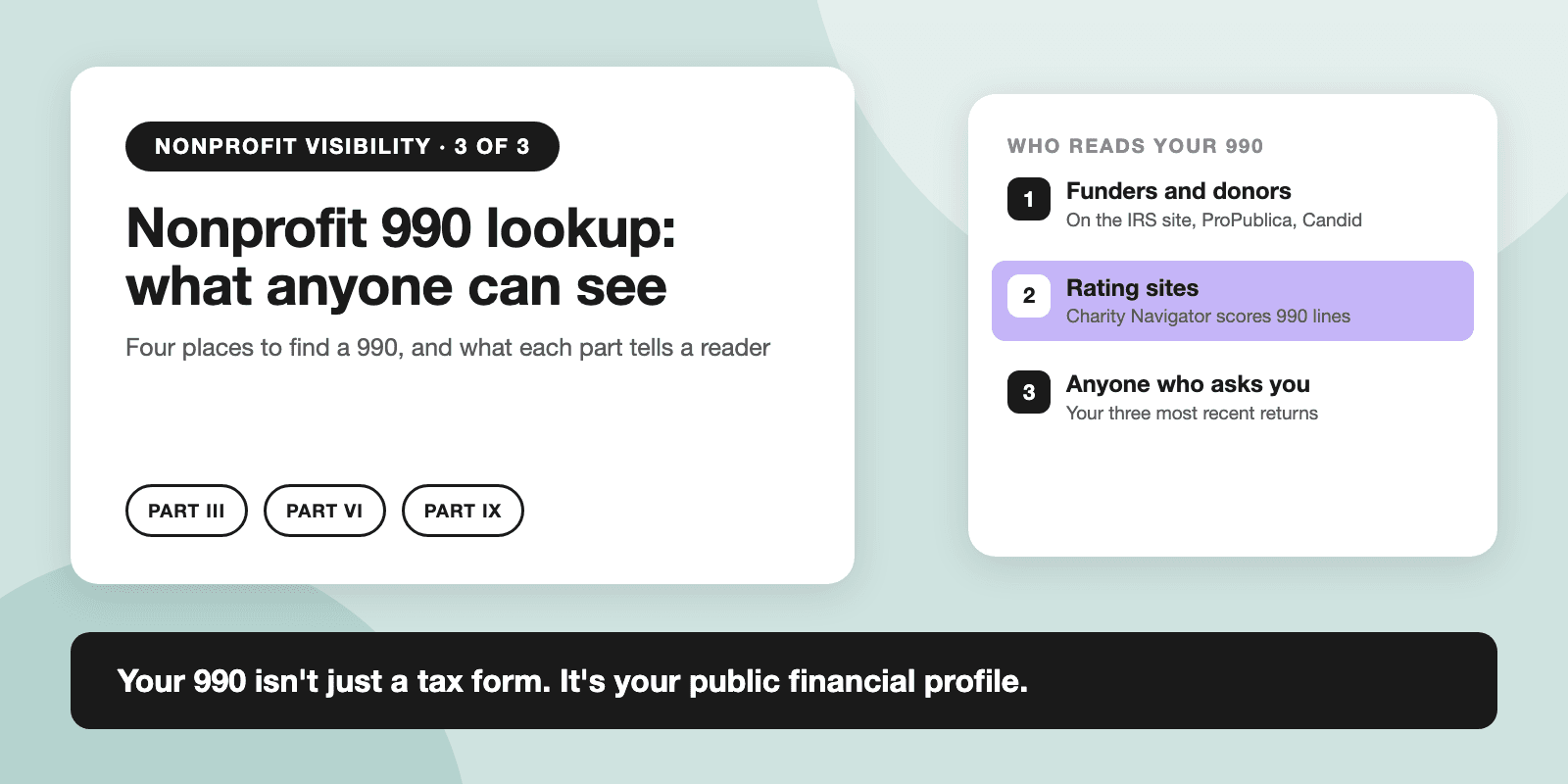
This guide covers both sides of a nonprofit 990 lookup: where to find any organization’s 990, and what a funder, donor, or rating site sees when they find yours. It ends with a 10-minute check you can run on your own return before you file.
Search the organization’s name or EIN in the IRS Tax Exempt Organization Search or ProPublica’s Nonprofit Explorer, both free, or on Candid. If a return isn’t there, ask the organization: it must provide copies of its recent returns.
| Where | What you get | How far back |
|---|---|---|
| IRS Tax Exempt Organization Search | Images of Forms 990, 990-EZ, 990-PF, and 990-N, plus 990-T for 501(c)(3)s, straight from the IRS | Returns filed since January 2018 |
| ProPublica Nonprofit Explorer | Revenue, expenses, and executive pay by year, links to full 990s, and, for nonprofits that had a federal Single Audit, the audit report from the Federal Audit Clearinghouse | Summary data from returns processed since 2012 |
| Candid (formerly GuideStar) | A profile with a Form 990 tab you can filter by year, plus anything the nonprofit added itself. A free login shows more detail; full profiles and unlimited 990 downloads are paid features. | Varies by profile |
| The organization | Copies of its own returns, on request | Three years from the due date or filing date, whichever is later |
Checked October 2026. Search by EIN when names are similar; it is the nine-digit number on the first page of every 990.

The organization’s duty comes from the federal disclosure rules in IRS Publication 557. It must let people inspect its returns and must provide copies of its three most recent annual returns. It doesn’t have to mail copies if it makes them widely available, for example by posting them on its website.
The public copy is the whole return with every schedule and attachment, minus the names and addresses of contributors. Think of it as a storefront window: you don’t choose who walks by, but you do choose what’s arranged in it.
Public
Not public (public charities)
The contributor rule has one big exception: private foundations must disclose their contributors. For a public charity, the names and addresses come out of the public copy, and the amounts stay in unless they would identify the donor. Your preparer should produce a separate public copy so you never hand out the one filed with the IRS.
Here is how to read Form 990 the way a funder does: start with five parts: the Part I summary, Part III programs, Part VI governance, Part VII compensation, and the Part IX expense columns. Together they answer the basic questions a funder or donor is likely to ask: what you do, how big you are, who runs you, what they’re paid, and where the money goes.
ProPublica’s Nonprofit Explorer puts revenue, expenses, and executive pay on the first screen, so Part I and Part VII numbers show up before anyone opens the full return. Our guide to reading nonprofit financial statements covers the audited statements that sit behind these numbers.
Charity Navigator reads Part IX, line 25, Part X, lines 16 and 26, and a set of yes/no answers in Part VI and Part XII, so you can see the raw material of your rating before you file. The table maps the main 990-based metrics to the lines they read, grouped by Charity Navigator’s own sections, from its Rating Methodology Guide, checked in October 2026. Some metrics apply only to larger, donor-funded charities.
| Charity Navigator metric | Form 990 source | Applies to |
|---|---|---|
| Accountability & Finance | ||
| Program expense ratio | Part IX, line 25: column (B) ÷ column (A), three-year average | All sizes |
| Liabilities to assets | Part X, line 26 ÷ line 16, most recent year | All sizes |
| Working capital | Part X, lines 27 + 28 ÷ average Part IX, line 25, column (A) | Donor-funded, revenue over $2 million |
| Fundraising efficiency | Average Part IX, line 25, column (D) ÷ average Part VIII, line 1h | Donor-funded, revenue over $2 million |
| Audited or reviewed financials | Part XII, lines 2a and 2b | Revenue over $1 million (above $2 million, an audit on line 2b) |
| Audit oversight committee | Part XII, line 2c | Donor-funded, revenue over $2 million |
| No diversion of assets | Part VI, line 5 | All charities |
| Document retention policy | Part VI, line 14 | All charities |
| Website on the return; 990 on your website | Item J on page 1; Part VI, line 18 (“Own website”) | All charities |
| No loans to or from insiders | Part IV, line 26 (and Part X, line 5 or 22) | Donor-funded, revenue $2 million or more |
| Leadership & Planning | ||
| Independent board | Part I, lines 3 and 4 (voting and independent members) | All charities |
| Board minutes kept | Part VI, line 8a | All charities |
| 990 given to the board before filing | Part VI, line 11a | Donor-funded, revenue $2 million or more |
| Culture & Compensation | ||
| Conflict of interest policy | Part VI, line 12a | All sizes |
| Whistleblower policy | Part VI, line 13 | See the guide |
| CEO pay process | Part VI, line 15a | Donor-funded, revenue over $50 million |
Source: Charity Navigator Rating Methodology Guide, linked from its Accountability & Finance page, checked October 28, 2026. Charity Navigator says it updates the guide on a rolling basis.
Two lessons fall out of this table. First, the program expense ratio is only as good as your Part IX split, which our statement of functional expenses guide walks through line by line. Second, several governance points are yes/no answers on Part VI, so a missing policy is visible from the outside. The fix is to adopt the policy, not to change the answer. Our nonprofit financial ratios guide covers the ratios themselves, and our document retention policy guide covers one of the policies.
To be rated, a charity must be a U.S. 501(c)(3) public charity. It needs at least three e-filed Forms 990 received within six years. At least two of the four most recent must be the full Form 990, and the most recent can’t be a 990-EZ, 990-N, or 990-PF.
Want your 990 checked the way a funder reads it?
When we prepare your 990, we check Part III, Part VI, and the Part IX split before it’s filed.
In Form 990 Part III, describe each of your three largest programs with specific numbers: who you served, how much, and what changed. The Form 990 instructions ask for specific measurements, naming clients served, days of care provided, and sessions or events held, plus the program’s objective.
Part III works like the back cover of a book. A reader who never opens the rest still leaves knowing what it’s about. Here is what the rules require:
Line 1 is your mission as adopted by your board. Lines 4a through 4c cover your three largest programs measured by expenses, not counting donated services. For 501(c)(3) and 501(c)(4) organizations, each program’s expenses come from the program column of Part IX, and any revenue the program itself earns is listed too. For the 2025 tax year, the instructions say to leave the code box blank.
Before
“We provide educational programs for youth in our community.”
Expenses: $312,400
After
“After-school tutoring for students in grades 3 to 8 at two school sites. 142 students attended 4,960 tutoring sessions during the year. Of the students who attended at least 30 sessions, 81% moved up at least one reading level on the district’s spring assessment. Longer-term goal: every participant reading at grade level by grade 6.”
Expenses: $312,400 · Grants: $0 · Revenue: $0
Illustrative example. It continues the organization from our statement of functional expenses guide: program services of $406,283 in Part IX, column (B), split between tutoring ($312,400) and a family literacy program ($93,883) on line 4b.

Pull the counts from records you already keep, such as attendance logs and intake forms, and use the same definitions every year so the numbers compare. If exact figures aren’t available, the instructions allow reasonable estimates. A program report you already send to a funder is a good starting draft; our grant accounting guide shows how the money side of that report is built.
Before you sign, open your return the way a stranger would and check these eight things. It takes about ten minutes, and each item maps to a line someone outside will read.
Public-view check
For the filing itself, the Form 990 filing checklist lists what to gather, and common Form 990 mistakes covers errors that are easy to catch. If your Part XII answer depends on whether you need an audit, our nonprofit audit requirements guide has the federal, state, and foundation thresholds.
When we prepare your 990, we read it the way a funder will before it’s filed, not just the way the IRS will. That means a Part III with real numbers, Part VI answers that match your actual policies, a Part IX split with a written basis, and a public copy with Schedule B names removed.
Form 990 preparation runs $1,800 to $3,000 for a full Form 990, or from $1,500 when we kept the books for that year. The pricing page has every number. If you’d like to do the expense split yourself first, the free statement of functional expenses template builds Part IX and checks that it matches Part I.
Questions about finding, reading, and preparing a public Form 990.
Search the organization’s name or EIN in the IRS Tax Exempt Organization Search, which shows Form 990-series returns filed since January 2018. ProPublica’s Nonprofit Explorer also shows 990s for free, and Candid shows profiles with a free login. You can also ask the organization, which must provide its three most recent annual returns on request unless it posts them online.
Not for public charities. Schedule B lists major contributors for the IRS, but an exempt organization other than a private foundation doesn’t have to disclose contributors’ names and addresses, so the public copy leaves them out. Private foundations must disclose them.
The IRS Tax Exempt Organization Search covers returns filed since January 2018. ProPublica’s summary data goes back to returns processed in 2012. The organization itself must provide each return for three years from its due date or filing date, whichever is later.
Charity Navigator rates only U.S. 501(c)(3) public charities that meet its filing rules. The charity must have at least three e-filed Forms 990 received within six years, at least two of the four most recent must be the full Form 990, and the most recent can’t be a 990-EZ, 990-N, or 990-PF. Organizations that don’t qualify can still be listed and add information through its Nonprofit Portal.
Divide program service expenses by total expenses, both from Part IX, line 25: column (B) over column (A). Charity Navigator averages that ratio over the three most recent fiscal years. The program column depends on how you split shared costs, so a written allocation basis is what makes the number defensible.
Your 990 is your public profile. Let’s make it read well.
Form 990 preparation that checks Part III, Part VI, and Part IX the way funders and rating sites read them.
GivingArc provides bookkeeping, Form 990 preparation, and nonprofit-specialized accounting for small and mid-size 501(c)(3) organizations across the US. The Part III example and its figures are illustrative. Form references are to the 2025 Form 990 and its instructions; third-party sites and methodologies were checked in October 2026 and can change. General information, not accounting, tax, or legal advice. Reviewed by Min Kim, CPA.
