

Key Takeaways
When it comes to nonprofit tax compliance, missing your Form 990 deadline in 2026 can cost your organization far more than just penalty fees—it could jeopardize your tax-exempt status entirely. As we work with nonprofits across the country, we’ve seen too many organizations scramble at the last minute or, worse, miss their filing deadlines altogether because they weren’t properly prepared.
The 2026 filing season brings familiar deadlines but also presents an opportunity for your nonprofit to get ahead of the game. Whether you’re a small community organization filing Form 990-N or a large nonprofit dealing with the complexities of the full Form 990, understanding your specific deadline and planning accordingly can save your organization significant stress and money.
The basic rule for Form 990 deadlines remains consistent: your return is due on the 15th day of the fifth month after your organization’s fiscal year ends. For most nonprofits operating on a calendar year basis, this means May 15, 2026, is your critical deadline.
The trap is assuming every nonprofit follows the same timeline. The most common version: an organization with a June 30 fiscal year-end expects to file in May like everyone else, when their Form 990 was due November 16, 2026 (since November 15 falls on a Sunday).
Here’s how the 2026 deadlines break down based on fiscal year endings:
Fiscal Year End
Dec 31, 2025
May 15, 2026
Most common — calendar year orgs
Fiscal Year End
Mar 31, 2026
Aug 17, 2026
Adjusted to next business day
Fiscal Year End
Jun 30, 2026
Nov 16, 2026
Adjusted to next business day
Fiscal Year End
Sep 30, 2026
Feb 16, 2027
Adjusted to next business day
*Extended to the next business day when the 15th falls on a weekend
According to IRS guidelines, if the 15th falls on a weekend or holiday, the deadline extends to the next business day. We always recommend checking these dates early in your planning process and marking them clearly in your organizational calendar.
The key to staying compliant is knowing your organization’s exact fiscal year. We recommend reviewing your IRS determination letter and recent tax returns to confirm these dates. If you’re uncertain about your fiscal year or need assistance with deadline planning, our Form 990 filing services team can help clarify your specific requirements.
e-Postcard
Gross Receipts
≤ $50,000
Small nonprofits with minimal revenue. Simple 8-question online form.
Short Form
Gross Receipts
$50K – $200K
Assets under $500K. Condensed 4-page version with key financial data.
Full Form
Gross Receipts
≥ $200,000
Or assets of $500K+. Comprehensive 12-page return with 16 schedules.
Private Foundation
Required For
All Foundations
Private foundations regardless of size. Includes investment and grant data.
Not all Form 990s are created equal, and neither are their requirements or deadlines. The type of return your organization must file depends primarily on your gross receipts and total assets, and each variant has specific considerations for 2026.
Organizations with gross receipts of $50,000 or less typically file Form 990-N, the electronic postcard. For calendar year organizations, this means a May 15, 2026, deadline. What makes Form 990-N unique is that extensions are not available—you must file by your original deadline or risk losing your tax-exempt status.
We recently worked with a small neighborhood watch organization that missed its 990-N filing three years in a row simply because they didn’t realize they had a filing requirement. The reinstatement process cost them both time and money that could have been avoided with proper planning. Pro tip: Set a recurring calendar reminder for April 1st each year to start your 990-N process.
Organizations with gross receipts between $50,000 and $200,000, and total assets under $500,000, generally file Form 990-EZ. These organizations follow the same deadline schedule as the full Form 990, with calendar year filers due May 15, 2026. Unlike Form 990-N, 990-EZ filers can request extensions through Form 8868.
Organizations with gross receipts of $200,000 or more, or total assets of $500,000 or more, must file the complete Form 990. Calendar year organizations face the May 15, 2026, deadline, with extension options available. The full Form 990 requires significantly more detail—we typically budget 40-60 hours for preparation, depending on organizational complexity.
Private foundations follow the same timeline and the same daily penalty schedule, and the IRS can also assess a personal penalty on the people responsible if a return is not filed after a written demand.

Filing an extension can provide crucial breathing room for organizations that need additional time to prepare their returns. The good news is that requesting an extension is straightforward and doesn’t require justification—though in my experience, having a good reason helps you stay organized.
Form 8868 provides an automatic six-month extension for most Form 990 filers. For calendar year organizations with a May 15, 2026, original deadline, filing Form 8868 extends the deadline to November 16, 2026 (since November 15 falls on a Sunday). This extension must be filed by your original deadline—you cannot file for an extension after the original due date has passed.
Filing for an extension makes sense whenever you are waiting on year-end financial statements, board meeting minutes, or other critical documentation. Organizations whose annual audit runs into late summer often extend as a matter of routine — it prevents rushed filings and the errors that come with them.
The initial six-month extension through Form 8868 is automatic—the IRS will grant it as long as you file the form on time. In rare circumstances, organizations can request an additional extension beyond the initial six months, but this requires demonstrating reasonable cause and is not automatically granted. Additional extensions beyond the automatic six months are rare in practice and granted only for genuinely exceptional circumstances.
Remember that an extension to file is not an extension to pay any taxes owed. If your organization owes unrelated business income tax (UBIT) or other federal taxes, payment is still due by the original deadline to avoid interest and penalties. Need help calculating potential UBIT? Our nonprofit bookkeeping services can ensure accurate tracking throughout the year.
The penalties for missing Form 990 deadlines extend far beyond monetary fines—though those can be substantial enough on their own. Understanding these consequences helps illustrate why proper deadline management is crucial for your organization’s long-term health.
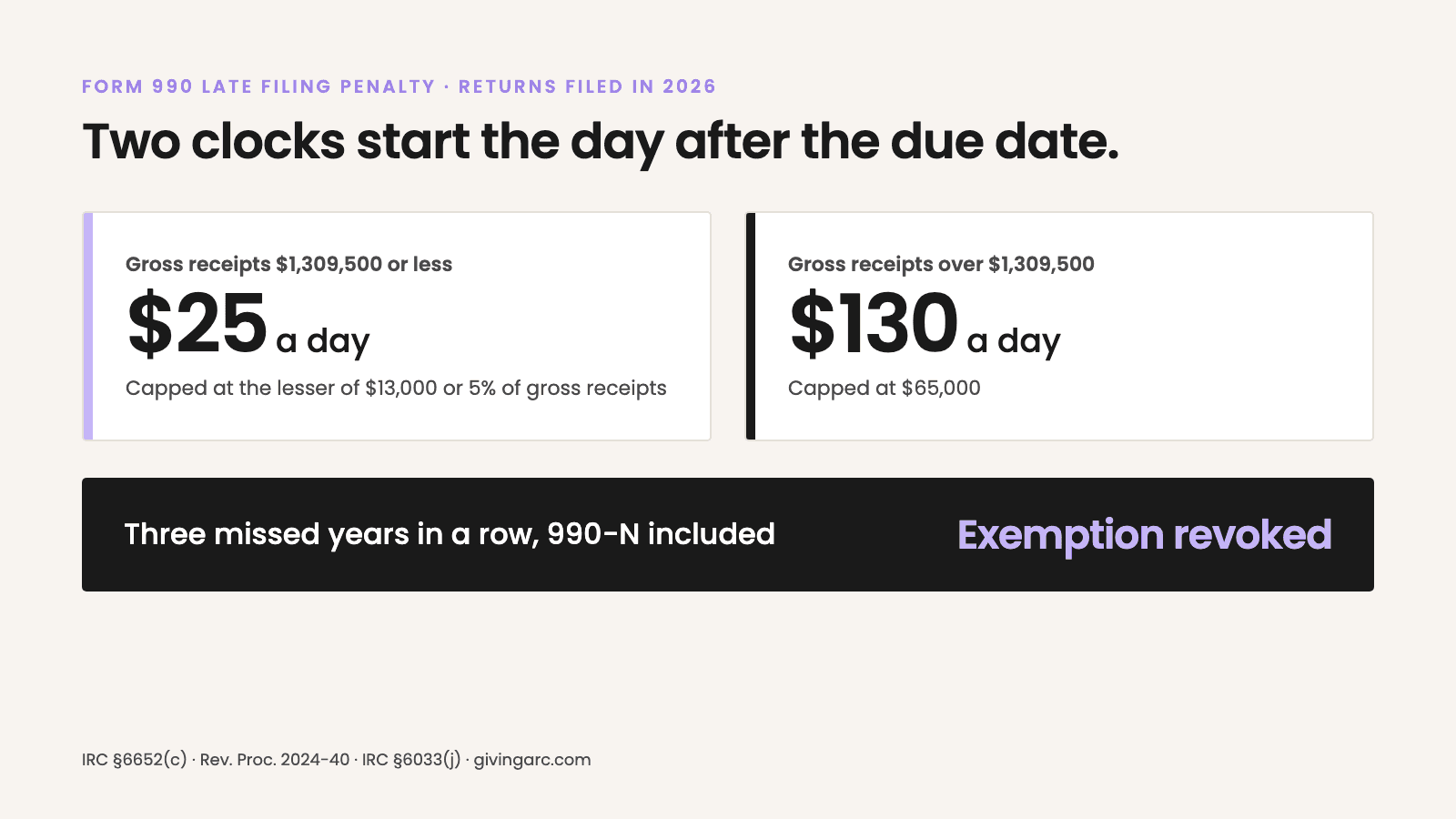
The IRS imposes daily penalties for late Form 990 filings, and these add up quickly. For returns required to be filed in 2026, organizations with gross receipts of $1,309,500 or less pay $25 per day, up to the lesser of $13,000 or 5% of gross receipts. Organizations with gross receipts over $1,309,500 pay $130 per day, up to $65,000 (Rev. Proc. 2024-40). If the IRS demands the return in writing and it still is not filed, the people responsible owe $10 per day personally, up to $6,500 per return.
The arithmetic adds up fast. An organization with $300,000 in gross receipts that files 60 days late owes $1,500. A full year late is $9,125, still under the $13,000 cap. Filing late with a written reasonable-cause statement attached can lead the IRS to abate the penalty, but that is at the IRS’s discretion.
Perhaps more concerning than monetary penalties is the automatic revocation process. Organizations that fail to file for three consecutive years automatically lose their tax-exempt status. This revocation is published by the IRS and becomes public record, potentially damaging relationships with donors, grantmakers, and community partners.
Reinstating tax-exempt status requires filing Form 1023 or 1023-EZ and paying associated fees (currently $600 or $275, respectively), essentially going through the original exemption application process again. The reinstatement is typically effective from the date of application, meaning the organization operates as a taxable entity during the gap period—a nightmare scenario we’ve helped several organizations navigate.
State-level consequences can be equally severe. Many states tie their charitable registration and solicitation permits to federal tax-exempt status, meaning organizations could lose the ability to fundraise legally while their federal status is under review. The National Council of Nonprofits maintains excellent state-by-state compliance resources.

Electronic filing requirements continue to expand, and understanding these mandates is crucial for compliance in 2026. Under the Taxpayer First Act, every Form 990, 990-EZ, and 990-PF must be filed electronically; the old asset-based threshold no longer applies. Form 990-N has always been electronic only.
Because the return must be e-filed, confirm well before the due date that your software or preparer can transmit it and that the IRS has accepted the submission. An accepted e-file acknowledgment is your proof of timely filing.
Organizations filing electronically must also ensure their software meets IRS requirements and that all required schedules and attachments are properly formatted. Third-party software providers may have their own submission deadlines that are earlier than the IRS deadline, adding another layer of timing considerations. If you’re feeling overwhelmed by the technical requirements, our team can help navigate the e-filing process smoothly.
Successful Form 990 preparation starts months before the filing deadline. Organizations that begin preparation in January for calendar year filings give themselves ample time to gather documentation, review financial statements, and address any complications that arise. The organizations that start early sleep better at night.
We recommend working backward from your filing deadline to create a comprehensive preparation timeline. For a May 15, 2026, deadline, your timeline might look like this:
This timeline allows for unexpected complications—audits that run late, board meetings that need to be rescheduled, or complex transactions that require additional research. Remember Murphy’s Law: if something can go wrong during tax season, it probably will!
Form 990 preparation requires extensive documentation beyond basic financial statements. Key documents include board meeting minutes, conflict of interest policies, compensation arrangements for key employees, and detailed program service accomplishment descriptions. The FASB nonprofit standards provide guidance on proper documentation practices.
One habit streamlines filing more than any other: keep a dedicated “Form 990 file” throughout the year. Whenever board meetings occur, policies are updated, or significant transactions take place, the relevant documents go straight into it. Come preparation time, everything is organized and accessible.
Many organizations benefit from professional assistance with Form 990 preparation, particularly as forms become more complex and penalties for errors increase. When selecting professional help, consider preparers with specific nonprofit expertise and experience with organizations similar to yours in size and complexity.
Professional preparers can also help identify potential issues before they become problems. Compensation reporting is a frequent example: errors caught early in the preparation process can prevent intermediate sanctions exposure and excise taxes that would otherwise surface much later.
If you’re considering professional assistance, contact preparers early in the year to discuss your organization’s specific needs and establish a preparation timeline that works for your schedule. Good preparers book up quickly during tax season!
Federal Form 990 filing is just one component of nonprofit compliance. Most states have their own registration and reporting requirements that often tie to federal filing deadlines, but may have different due dates or additional requirements.
California organizations, for example, must file Form 199 with the state, typically due on the same date as the federal return. However, California has its own extension process and penalty structure—and let me tell you, the California Attorney General’s office doesn’t mess around with late filings. We work with many California nonprofits to coordinate their federal and state filings, ensuring both requirements are met efficiently.
States participating in the Unified Registration Statement (URS) system may allow organizations to satisfy multiple state requirements through a single filing, but each state still maintains its own deadline and fee structure. Organizations soliciting donations in multiple states need to track requirements for each jurisdiction where they’re registered. Our compliance checklist can help you stay organized.
Attorney General reporting requirements vary significantly by state. Some states require detailed financial reporting beyond the federal Form 990, while others accept the federal return as sufficient. We always recommend reviewing state-specific requirements early in your preparation process to avoid last-minute complications.

We’ve identified several strategies that consistently lead to smoother filing processes and fewer complications. These are practical steps, not theory.
One of the most frequent errors we encounter is inconsistent reporting between related schedules. Form 990 includes numerous cross-references between different sections, and discrepancies can trigger IRS inquiries or processing delays. We always recommend completing schedules in a logical order and double-checking that totals match across related sections. A simple Excel reconciliation can save you from embarrassing math errors!
Another common mistake involves program service reporting. Many organizations struggle to clearly articulate their program accomplishments or fail to provide sufficient detail about how their activities further their exempt purposes. We encourage clients to think of this section as an opportunity to showcase their impact rather than just a compliance requirement. Your Form 990 is public—make it work for you!
Governance reporting continues to challenge many organizations, particularly around board oversight and conflict of interest policies. The IRS places significant emphasis on governance practices, and inadequate responses in this area can lead to follow-up inquiries. If you answered “No” to having a conflict of interest policy, make 2026 the year you implement one.
Despite best intentions, some organizations find themselves approaching deadlines with limited preparation time. If you’re in this situation (and trust me, we’ve all been there), focus on accuracy over perfection. It’s better to file an accurate return with basic program descriptions than to miss the deadline entirely while crafting perfect narratives.
Consider filing for an extension if you’re within a week of your deadline and haven’t completed preparation. The six-month extension provides valuable breathing room and reduces the risk of errors caused by rushing. An extension costs nothing and carries no penalty; a late return does.
For organizations facing immediate deadline pressure, prioritize gathering accurate financial information first, then focus on governance and program reporting. Financial accuracy is crucial for compliance, while narrative sections, though important, are less likely to result in penalties if simplified.
We also recommend having backup plans for filing day. If you’re filing electronically, have paper filing materials prepared in case of technical difficulties. If you’re mailing a paper return, use certified mail or a reliable courier service to ensure timely delivery—and keep those receipts!
If you would rather hand the return off: GivingArc prepares Form 990-EZ from $500 and Form 990 from $1,500 per return when we keep your books, or $600 and $1,800 for the return alone. The pricing page lists what each return includes, and the how we work page describes the process.
Get a free custom quote tailored to your organization — no obligation.
Calendar year nonprofits must file their Form 990 by May 15, 2026. This deadline applies to Form 990, 990-EZ, and 990-N filings for organizations with fiscal years ending December 31, 2025.
Yes, most organizations can request an automatic six-month extension by filing Form 8868 by their original deadline. This extends the filing deadline to November 16, 2026, for calendar year filers (November 15 is a Sunday). However, Form 990-N filers cannot request extensions.
Missing the deadline results in daily penalties: $25 per day for most organizations (capped at the lesser of $13,000 or 5% of gross receipts) or $130 per day, up to $65,000, for organizations with gross receipts over $1,309,500, for returns filed in 2026. Missing three consecutive years results in automatic loss of tax-exempt status.
No, deadlines depend on your organization’s fiscal year end. The filing deadline is always the 15th day of the fifth month after your fiscal year closes. Organizations with different fiscal year ends will have different 2026 deadlines.
Yes. Under the Taxpayer First Act, all Form 990, 990-EZ, and 990-PF returns must be filed electronically, regardless of size. Form 990-N has always been electronic only. Private foundations filing Form 990-PF must also file electronically, regardless of size.
Form selection depends on your gross receipts and assets: Form 990-N for gross receipts ≤$50,000; Form 990-EZ for gross receipts between $50,000-$200,000 and assets <$500,000; Form 990 for larger organizations; and Form 990-PF for private foundations.
Form 990 compliance doesn’t have to be overwhelming, but it does require careful planning and attention to detail. The 2026 filing season presents an opportunity to establish strong preparation habits that will serve your organization well in future years. Whether you’re managing the process internally or working with professional preparers, starting early and staying organized remains the key to successful, stress-free filing.
Remember that Form 990 preparation is more than just a compliance exercise—it’s an opportunity to reflect on your organization’s accomplishments, evaluate your governance practices, and demonstrate transparency to stakeholders. Organizations that approach the process strategically often find valuable insights that inform their operational and strategic planning. Some of my favorite client moments have come from board members reading their organization’s Form 990 and truly understanding their impact for the first time.
Don’t risk penalties or jeopardize your tax-exempt status by waiting until the last minute. Whether you need comprehensive preparation support or just want to ensure you’re on the right track, our team at GivingArc has the expertise and experience to guide your organization through the 2026 filing season successfully. Visit our nonprofit accounting resources for additional tools and guides, or contact us today to discuss your specific Form 990 preparation needs. Our team brings 23 years of collective nonprofit accounting experience to every return we prepare.