

Key Takeaways
Most Form 990 errors are ordinary ones: the wrong form version, a missing schedule, a compensation figure that left out benefits. As we enter 2026, these form 990 common mistakes to avoid aren’t just paperwork problems—they’re compliance landmines that can cost your organization thousands in penalties, damage donor trust, and in worst-case scenarios, threaten your tax-exempt status. Our team at GivingArc has seen firsthand how preventable errors can spiral into major organizational crises, which is why we’re sharing the most critical mistakes nonprofits make on their Form 990 filings and, more importantly, how to avoid them.
Whether your organization files a simple 990-N or navigates the complexities of a full Form 990 with multiple schedules, understanding these common pitfalls will save you time, money, and stress. We’ll walk you through real scenarios we’ve encountered—yes, including that memorable case where a board treasurer accidentally reported the executive director’s salary as $2 million instead of $200,000—and provide practical guidance based on our 23+ years of nonprofit accounting experience. For comprehensive support with your Form 990 preparation, explore our professional filing services designed specifically for nonprofits like yours.
Choosing 990-N, 990-EZ, or full 990 incorrectly based on gross receipts or assets.
Amended return + $20–$105/day
Miscalculating 15th-day-5th-month rule or filing extensions after original deadline.
Up to $56,000 annual max
Treating government contracts as contributions; skewing public support calculations.
Jeopardizes charity status
Excluding benefits, misidentifying key employees, missing comparability data.
Intermediate sanctions
Missing foreign bank account reports when aggregate balance exceeds $10K.
$12,921 per account/year
Missing or incomplete Schedule A, B, O attachments; blank explanations.
IRS inquiry triggers
The cost of a single Form 990 error is rarely limited to fixing the form. The IRS doesn’t just impose financial penalties; the consequences cascade into areas that can affect the whole organization.
Late filing penalties start at $20 per day for small nonprofits (gross receipts under $1,096,633) and jump to $105 per day for larger organizations, with maximum penalties reaching $56,000 annually as of 2026. But financial penalties are just the beginning. I’ve watched organizations scramble through IRS examinations that consumed hundreds of staff hours and required expensive professional representation—all stemming from preventable filing errors.
Beyond immediate consequences, Form 990 errors damage the public trust that nonprofits depend on. These documents are publicly available through platforms like GuideStar and Charity Navigator, and donors, grantmakers, and watchdog organizations scrutinize them closely. Inconsistencies or obvious errors signal poor governance and financial management, making it harder to secure funding and community support.

The form selection rules are straightforward but frequently misunderstood. Organizations with gross receipts normally less than $50,000 can file the simple Form 990-N (e-Postcard). Those with gross receipts less than $200,000 and total assets less than $500,000 may file Form 990-EZ. All other nonprofits must file the full Form 990. Yes, the IRS did simplify these thresholds in recent years, but confusion persists.
The confusion often arises around the word “normally.” The IRS looks at your organization’s gross receipts over a rolling average, not just the current year. A nonprofit that receives a large one-time grant might suddenly find itself required to file a more complex form for several years running. We always tell clients: when in doubt, file the longer form. It’s better to provide too much information than too little.
Private foundations face even more complex requirements with Form 990-PF. We’ve seen foundations struggle particularly with the balance sheet completion requirements in Part II, where columns for beginning-of-year and end-of-year values must reconcile perfectly. One foundation client memorably described their first attempt at Form 990-PF as “like doing taxes in a foreign language while blindfolded.”
The minimum distribution requirements for private foundations are particularly unforgiving. Private foundations must distribute approximately 5% of their investment assets annually for charitable purposes, and errors in calculating this requirement can result in excise taxes that compound over time. The calculation involves a 13-month average of asset values, adjusted for various factors—it’s complex enough that even experienced accountants double-check their work.
For detailed guidance on form selection and requirements, the IRS provides comprehensive form selection tools that we recommend all nonprofits review annually. Don’t rely on last year’s assumptions—requirements change.
The “15th day of the fifth month” rule sounds simple until you’re actually calculating it. Your Form 990 is due on the 15th day of the fifth month after your fiscal year ends. For calendar year nonprofits, that’s May 15th. It’s easy to assume a June 30th fiscal year end means an October 15th deadline, when it’s actually November 15th.
Extensions provide an additional six months but must be filed before the original deadline using Form 8868. We always recommend filing for an extension even if you think you’ll complete the return on time—it provides crucial breathing room if complications arise. However, extensions don’t extend the deadline for any taxes owed, such as unrelated business income tax. That payment is still due on the original deadline.
State filing requirements add another layer of complexity. In California, for example, nonprofits must also file Form 199 or 199N with the Franchise Tax Board, often with different deadlines. Many states now require electronic filing, which catches some organizations off guard. Our nonprofit bookkeeping services include deadline tracking to prevent these common oversights.
When your organization undergoes an independent audit, the Form 990 must reconcile with your audited financial statements. We’ve seen nonprofits struggle with this reconciliation, particularly around net asset classifications and revenue recognition timing differences. One CFO described it as “trying to make two different languages say the same thing.”
The implementation of ASU 2016-14 changed net asset classifications from three categories to two, and many organizations still struggle with properly reporting this on Form 990. Similarly, the revenue recognition changes under ASU 2018-08 created new challenges in distinguishing contributions from exchange transactions. Organizations following FASB accounting standards must ensure their Form 990 accurately reflects these standards while remaining compliant with IRS requirements.
Cash versus accrual accounting differences also create consistency issues. While smaller nonprofits may maintain their books on a cash basis for simplicity, Form 990 generally requires accrual basis reporting for organizations over certain thresholds. This translation requires careful attention to accounts receivable, accounts payable, prepaid expenses, and deferred revenue. If this sounds overwhelming, you’re not alone—our guide to nonprofit accounting basics can help clarify these concepts.
Schedule A determines your organization’s public charity classification—arguably the most important aspect of your tax-exempt status after the exemption itself. One of the most consequential errors here is calculating the public support test using gross receipts from fundraising events rather than the adjusted amounts the schedule calls for. Repeated across several years, that miscalculation can put public charity status at risk and require corrective filings.
The public support test requires careful calculation of what counts as “public support” versus other income. Investment income, unrelated business income, and unusual grants require special treatment. Contributions from any single source exceeding 2% of total support over five years must be excluded from the numerator (though included in the denominator). Many organizations struggle with the facts and circumstances test alternative when they fall slightly short of the mathematical thresholds.
Supporting organizations face even more complex Schedule A requirements. The distinctions between Type I, Type II, and Type III functionally integrated and non-functionally integrated organizations aren’t just academic—they determine operational requirements, prohibited activities, and annual payout obligations. We’ve seen supporting organizations inadvertently jeopardize their status through seemingly minor operational changes.
Schedule B lists contributors giving $5,000 or more during the tax year. While this schedule isn’t publicly disclosed on most state databases, it must be filed with the IRS and may be requested by state regulators. We’ve seen organizations mistakenly believe they can omit Schedule B entirely to protect donor privacy—a costly assumption.
The balance between donor confidentiality and regulatory transparency requires careful navigation. Anonymous donations must still be reported (you can list “anonymous” instead of the donor’s name), and the total must reconcile with your books. Organizations receiving cryptocurrency donations or complex gifts often struggle with proper Schedule B reporting and valuation.
Schedule O provides space for explanations that don’t fit elsewhere on the form, and we consider it one of the most underutilized tools in Form 990 compliance. Think of it as your opportunity to tell your story and prevent misunderstandings. Organizations often leave it blank, missing opportunities to explain unusual transactions or provide context for their financial position.
We always recommend using Schedule O liberally. Did revenues spike due to a one-time bequest? Explain it. Did you change accounting methods? Detail the transition. Did your building burn down, resulting in insurance proceeds? definitely explain that (yes, we’ve seen it). For example, if your organization received a $500,000 bequest that dramatically increased assets, Schedule O should explain this windfall to prevent questions about sudden wealth or changed operations.
Common omissions in Schedule O include explanations of related party transactions, details about shared employees with affiliated organizations, and clarifications about program service accomplishments that don’t fit in the character-limited boxes on Page 2. Comprehensive disclosure in Schedule O demonstrates transparency and can prevent time-consuming IRS inquiries.
Executive compensation reporting has become increasingly scrutinized, and errors here can trigger intermediate sanctions penalties that make regular penalties look friendly. The most common version of this error is entirely innocent: an organization reports base salary alone, leaving out health insurance, retirement contributions, and allowances such as a car or housing. Reportable compensation ends up understated by tens of thousands of dollars with no intent to hide anything.
The definition of “key employees” versus “highest compensated employees” confuses even experienced preparers. Key employees hold significant responsibilities similar to officers or directors, regardless of their title or compensation. The five highest compensated employees (beyond officers, directors, trustees, and key employees) earning over $100,000 must be listed separately. We’ve seen organizations list their receptionist as a “key employee” because they held the office keys—that’s not what the IRS means!
Total compensation includes far more than base salary. Insurance premiums, retirement plan contributions, expense allowances, club memberships, and even certain volunteer benefits must be included. The IRS expects organizations to demonstrate reasonable compensation through comparability data—simply saying “it seems fair” won’t cut it. For guidance on establishing reasonable compensation, the Independent Sector provides valuable benchmarking resources.
Form 990 asks about three critical governance policies: conflict of interest, whistleblower protection, and document retention. We’re continually surprised by how many well-run nonprofits check “no” to having these policies simply because they’ve never formalized their practices in writing. One board chair told us, “We’ve always handled conflicts appropriately—we just never wrote it down.” Unfortunately, the IRS wants to see it in writing.
A proper conflict of interest policy must address financial interests, family relationships, and outside business relationships that could influence decision-making. It should require annual disclosure statements, specify recusal procedures, and document how conflicts are resolved. Having a policy gathering dust in a binder isn’t enough—it must be actively implemented with signed annual statements from all covered persons.
Whistleblower policies became standard after high-profile nonprofit scandals, yet many smaller organizations still lack them. The policy should protect individuals reporting suspected wrongdoing from retaliation and provide clear, confidential reporting channels. Document retention policies help organizations systematically manage records while ensuring compliance with legal requirements—particularly important given the seven-year lookback period for many IRS examinations.
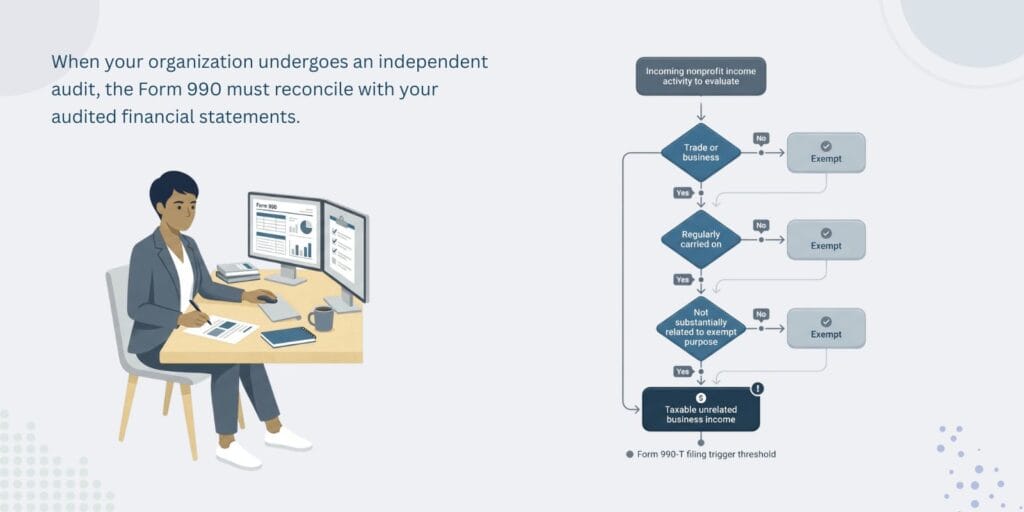
The three-part test for unrelated business income examines whether an activity is: (1) a trade or business, (2) regularly carried on, and (3) not substantially related to furthering the organization’s exempt purpose. All three elements must be present for income to be considered UBI. The “substantially related” test is where organizations often stumble—the relationship must be substantial, not just tangential.
Common sources of overlooked UBI include advertising revenue (not sponsorship acknowledgments), debt-financed property income, and certain corporate sponsorship arrangements that provide substantial benefits to sponsors. The $1,000 gross income threshold for filing Form 990-T catches many organizations off guard—it’s gross income, not net, so expenses don’t reduce the filing requirement.
Organizations with $1,000 or more in gross unrelated business income must file Form 990-T in addition to their regular Form 990. This creates coordination challenges, as the UBI reported on Line 18 of Form 990 must match exactly with Form 990-T. We’ve seen organizations file different numbers on each form, triggering automated IRS notices.
Form 990-T operates like a corporate tax return, complete with quarterly estimated tax payment requirements if the annual tax exceeds $500. Many nonprofits are surprised by underpayment penalties when they treat Form 990-T as an annual filing without considering quarterly obligations. The separate UBIT “silo” rules implemented in 2018 further complicate matters by requiring organizations to calculate tax separately for each unrelated trade or business.
For current guidance on UBIT issues, the IRS UBIT resources provide detailed examples and explanations. Don’t assume last year’s treatment remains correct—UBIT rules evolve regularly.
Nonprofits operating internationally face a maze of additional reporting requirements. An organization holding emergency response funds across several countries has to navigate both FBAR (Report of Foreign Bank and Financial Accounts) filing and proper Form 990 disclosure. Many operate internationally for years without realizing these requirements exist.
The FBAR requirement applies to any U.S. person (including nonprofits) with foreign financial accounts exceeding $10,000 in aggregate at any point during the year. This means if your accounts total $10,001 for even one day, you must file. The penalties for non-filing are severe—up to $12,921 per account per year for non-willful violations in 2026. These penalties can quickly exceed the account balances themselves.
Foreign activities create additional Form 990 reporting requirements in Part IV and Schedule F. Organizations must report foreign investments, foreign offices, foreign employees, and international grant-making activities. Each category has specific thresholds and reporting requirements that interact with other federal filing obligations.
Making grants to foreign organizations requires choosing between expenditure responsibility and equivalency determination procedures. Each approach carries specific documentation requirements that must be properly reflected on Form 990. We’ve seen organizations make six-figure international grants with nothing more than an email agreement—a practice that would make any experienced nonprofit attorney lose sleep.
Expenditure responsibility requires pre-grant inquiries, written agreements specifying use of funds, periodic reporting from recipients, and segregated accounting for granted funds. You must maintain records showing the recipient used funds exclusively for the intended charitable purposes. Equivalency determination involves obtaining detailed documentation to establish that the foreign recipient would qualify as a public charity if organized in the United States—a complex process requiring expert guidance.
Anti-terrorism compliance adds critical requirements through Executive Order 13224 and the USA PATRIOT Act. Organizations must screen grant recipients against the Specially Designated Nationals list maintained by OFAC and implement risk-based due diligence procedures. Failure to comply can result in frozen assets and criminal penalties.
Normal Range
< 5%
Expected year-over-year variation. Document briefly.
Review Required
5 – 10%
Verify with source documents and note in Schedule O.
Full Investigation
> 10% or $10K
Mandatory deep review and full explanation required.
Preventing Form 990 errors starts with robust internal controls long before tax season. We recommend implementing a year-round compliance calendar that tracks key dates, required documentation, and responsible parties. The best prepared Form 990s we see come from organizations that treat compliance as an ongoing process, not an annual scramble.
Create a comprehensive review checklist that includes internal consistency checks, prior year comparisons, and reconciliation to source documents. Significant variances (we use 10% or $10,000 as triggers) should be investigated and documented. This process catches data entry errors and classification mistakes before they become filing problems. One client calls it their “paranoia checklist”—but healthy paranoia prevents unhealthy IRS notices.
Board involvement shouldn’t be limited to signing off on the completed return. Best practice includes providing board members with a draft at least two weeks before filing, conducting a thorough review at a board meeting, and documenting questions and explanations in meeting minutes. We’ve seen board members catch errors that professionals missed simply because they know the organization’s operations intimately.

The decision between professional preparation and in-house filing requires an honest assessment of your organization’s complexity and staff capabilities. Organizations with gross receipts exceeding $750,000, international activities, unrelated business income, or complex related entity structures almost always benefit from professional preparation. But even smaller organizations often find that professional preparation pays for itself through error prevention and strategic insights.
Consider the true cost of in-house preparation: staff time (often 40-80 hours for a full Form 990), software costs, update training, and the risk of errors. Correcting a mistake after the fact — staff hours plus any penalty — can easily cost more than professional preparation would have in the first place.
Professional preparers provide more than just form completion—they offer strategic insights about compliance trends, governance improvements, and opportunities for better financial presentation. When evaluating providers, look for nonprofit specialists with current knowledge and a track record of preventing problems, not just fixing them. Our team at GivingArc combines decades of nonprofit-specific expertise with a genuine understanding of mission-driven organizations. We catch the issues that generalist accountants miss.
Ready to ensure your 2026 Form 990 filing avoids these common pitfalls? Contact our expert team to discuss your organization’s specific needs and learn how our comprehensive filing services protect nonprofits from costly mistakes while presenting your mission in the best possible light.
Form 990 compliance doesn’t have to be a source of annual anxiety. The mistakes we’ve outlined—from choosing the wrong form to botching UBIT calculations—are entirely preventable with proper preparation and professional guidance. As the compliance landscape continues evolving in 2026, having experienced nonprofit accounting support becomes not just valuable but essential for organizational health.
GivingArc prepares Form 990 returns for small and mid-size 501(c)(3) organizations — from first-time 990-EZ filers to organizations with more complex reporting requirements.
Whether you need comprehensive Form 990 preparation, a second-opinion review of your current processes, or ongoing nonprofit accounting support, we’re genuinely here to help. Visit our nonprofit accounting resources for additional guidance, explore our blog for timely insights, or contact our team today to discuss your specific Form 990 needs. Our team brings 23 years of collective nonprofit accounting experience to every return we prepare. Don’t let form 990 common mistakes to avoid derail your mission—let’s tackle them together.