
Schedule O is the last page of the Form 990, and it is blank when you get there. After twelve parts of boxes and numbers, the return hands you an empty sheet and says: explain. For a treasurer finishing the return at the kitchen table, that blank is either a relief or a trap. It is a relief if you know that the IRS requires exactly two things on it from every filer and that both can be answered in a paragraph. It is a trap if you leave it empty, paste last year’s text without reading it, or use it to explain something the return never asked about. This page is the short version of what belongs there.
Key Takeaways
The Schedule O instructions put it in one sentence: all organizations that file Form 990, and certain organizations that file Form 990-EZ, must file Schedule O. It is the return’s free-text area. Every other part of the 990 is a checkbox, a number, or a short field; Schedule O is where the organization writes the sentences that those answers require. The reframe, if you want one, is that Schedule O is the only place on the return where you get to use sentences, and it is worth using them well, because it is the part of the return that says, in the organization’s own words, whether anyone looked at the return before it went out. How the return as a whole fits together is on our step-by-step Form 990 guide.
Three rules apply to everything written on it. Identify clearly the specific part and line of Form 990 or 990-EZ that each response relates to. Use as many continuation sheets as needed; there is no length limit. And do not include any Social Security number, because Schedule O, like the rest of the return, is made available for public inspection.
The Form 990 instructions for Part VI and the Schedule O instructions say that at a minimum, Schedule O is required to answer Form 990 Part VI lines 11b and 19. There is no “not applicable” for these two. An organization that leaves them blank has filed an incomplete return.
How the Form 990 was reviewed before filing
Line 11a asks whether a complete copy of the return was provided to every voting member of the governing body before it was filed. Line 11b asks you to describe, on Schedule O, the process the organization uses to review the return. If there is no process, say so; the instructions ask for a description of the process, or the absence of one, not a good answer.
This line states whether the board saw the return or only the signature page.
How governing documents, the conflict of interest policy, and financial statements are made available
Describe whether and how the organization makes these three items available to the public: on a website, on request, or not at all beyond what the law requires. “Not made available” is an acceptable answer for the documents the law does not require you to disclose; the return only requires that the answer be true.
Pair it with what the law does require: the exemption application and the last three returns, on request.
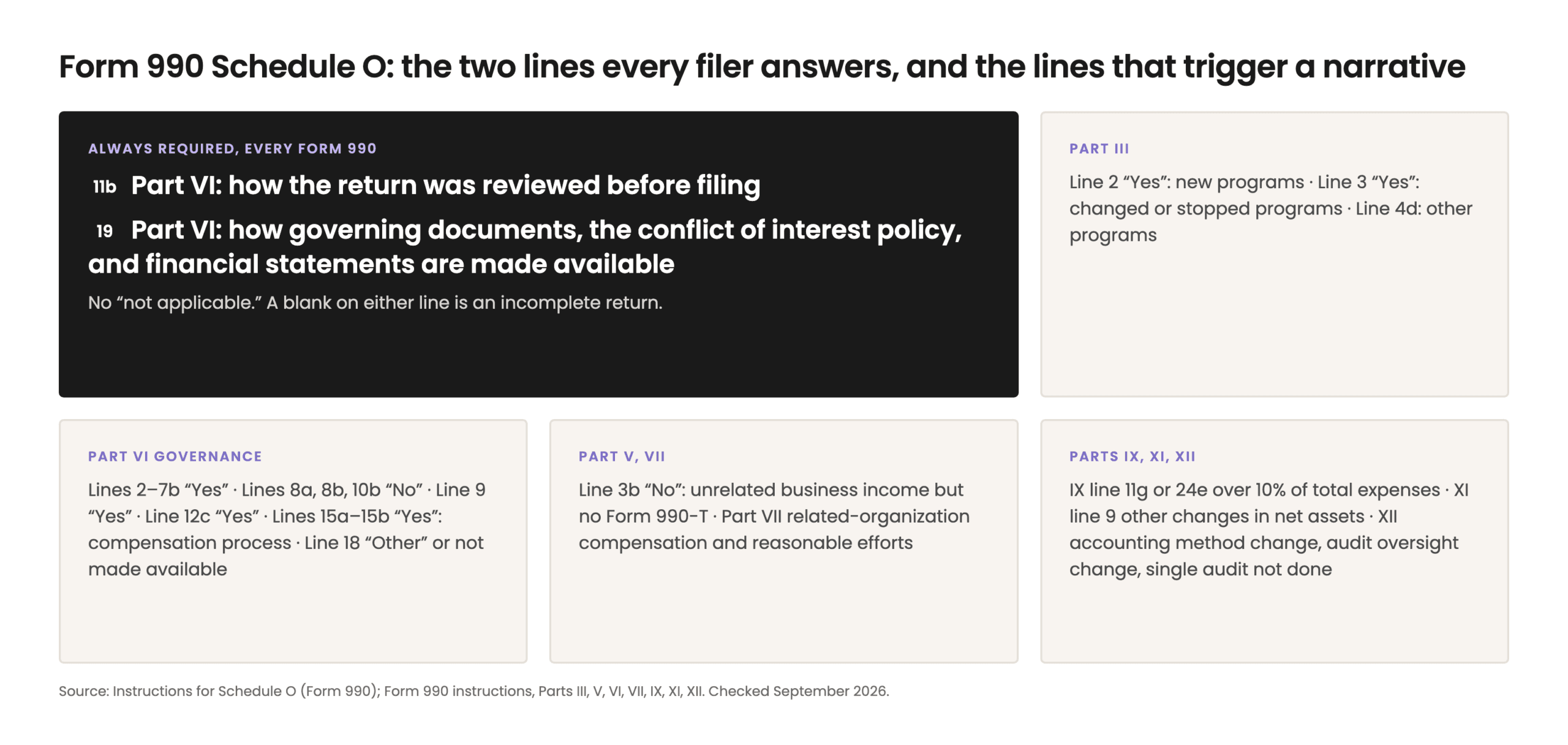
Everything else on Schedule O is conditional. A particular answer on the return sends you to Schedule O for an explanation, and the instructions list those lines part by part. The grid below is that list for Form 990, grouped so that a preparer can walk the return once and know what needs writing.
Line 2 “Yes”: describe new significant program services. Line 3 “Yes”: describe program changes or discontinuations. Line 4d: describe other program services not listed in 4a through 4c.
Line 3b “No” (had unrelated business income but did not file Form 990-T): explain. Line 13a, whether “Yes” or “No”, and line 14b “No”: explain.
Line 1a: material differences in voting rights, or delegation of board authority to an executive committee. Lines 2 through 7b “Yes”: family or business relationships among officers, delegation of management to a company, significant changes to governing documents, diversion of assets, members or stockholders, persons who elect board members, decisions requiring outside approval. Lines 8a, 8b “No”: meetings not documented contemporaneously. Line 9 “Yes”: an officer, director, trustee, or key employee who cannot be reached at the organization’s mailing address.
Line 10b “No”: chapters or affiliates without written policies. Line 11b: the return review process (always). Line 12c “Yes”: how the conflict of interest policy is monitored and enforced. Lines 15a and 15b “Yes”: the process for setting the compensation of the top official and of other officers and key employees, including comparability data and contemporaneous documentation, the positions it was used for, and the year it was last undertaken.
Line 18: why the “Other” box was checked, or why the organization did not make its Forms 1023, 1024, 1024-A, 990, or 990-T publicly available. Line 19: governing documents, conflict of interest policy, and financial statements (always).
Explanations about compensation from related organizations, and a description of reasonable efforts made to obtain information the organization could not get.
Line 11g other fees for services and line 24e other expenses: itemize on Schedule O when the amount exceeds 10% of total expenses on line 25.
Part XI line 9: other changes in net assets. Part XII line 1: a change in accounting method, or a description of an “other” method; line 2c: a change during the year in the audit oversight process or the auditor selection process; line 3b “No”: a required federal single audit that was not undertaken.
The pattern is visible once it is laid out. Each trigger is a “Yes” or a “No” that the checkbox alone cannot explain. Schedule O is where the organization says what actually happened, in its own words.
We write Schedule O with you, not for you.Our Form 990 preparation includes a short governance interview each year so the 11b, 15, and 19 narratives describe what your board actually did.
See Form 990 preparation →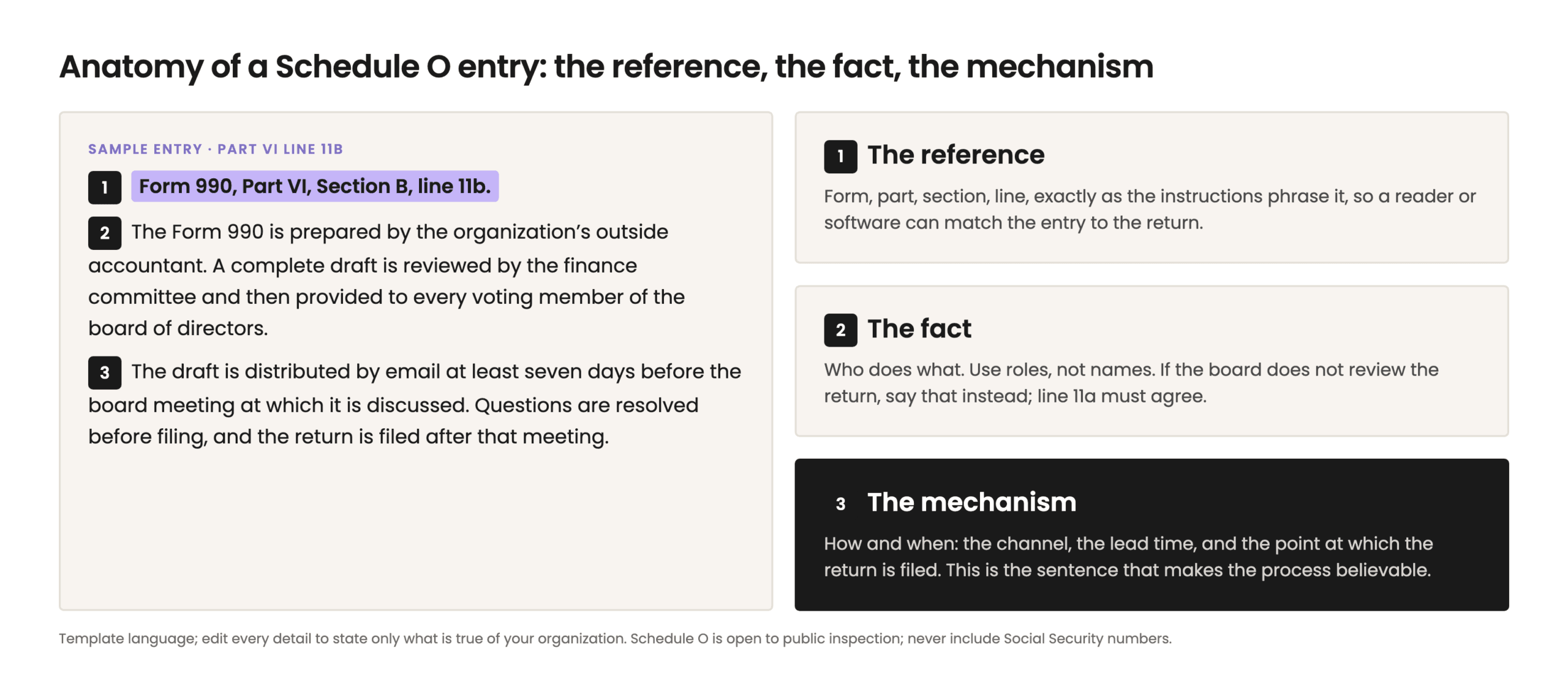
A good Schedule O entry has three parts: the reference, the fact, and the mechanism. “Form 990, Part VI, Section B, line 11b” is the reference. “The full return is reviewed by the finance committee and then by the full board” is the fact. “The treasurer distributes the draft by email at least one week before the board meeting at which it is approved, and the return is filed after that meeting” is the mechanism. Keep the reference exactly as the instructions phrase it so that software and readers can match it to the line. The three templates below are starting points; change every detail that is not true of your organization, and delete any sentence you cannot stand behind.
Template
Form 990, Part VI, Section B, line 11b: return review process
The Form 990 is prepared by [the organization’s outside accountant / the executive director and treasurer]. A complete draft is provided to [the finance committee] for review, and then to every voting member of the board of directors by [email] at least [seven] days before the board meeting at which the return is discussed. Questions raised by board members are resolved before filing. The return is filed after [the board has approved it / the review period has ended].
If the board does not review the return, write that instead: “The return is reviewed by the executive director and treasurer before filing; it is not reviewed by the full board.” Line 11a must agree with what you write here.
Template
Form 990, Part VI, Section B, lines 15a and 15b: compensation process
The compensation of the executive director is set by [the board of directors / the executive committee], none of whose members have a conflict of interest with respect to the decision. The board reviews compensation data for comparable positions at organizations of similar size and mission, obtained from [a published nonprofit salary survey / a compensation consultant], and documents its decision and the data relied on in the minutes at the time the decision is made. This process was last undertaken in [year]. The organization has no other officers or key employees who receive compensation. [Or: the same process is used for the following positions: …]
The three elements the instructions ask about are independent approval, comparability data, and contemporaneous documentation, plus the positions covered and the year the process was last used. If one is missing, say which; do not describe a process you did not follow.
Template
Form 990, Part VI, Section C, line 19: public availability of documents
The organization makes its Form 1023 and its three most recent Forms 990 available for public inspection on request, as required by law, and posts its Form 990 on [its website / GuideStar by Candid]. Its articles of incorporation, bylaws, and conflict of interest policy are [posted on its website / available on request / not made available to the public]. Its audited financial statements are [posted on its website / available on request / not made available].
The documents the law requires you to disclose are the exemption application and the last three returns; see our determination letter guide. Governing documents, the conflict of interest policy, and financial statements are disclosed voluntarily, and line 19 only asks you to say what you do.
For program service changes on Part III lines 2 and 3, one factual paragraph each: what was started or stopped, when, and why in a sentence. For Part IX lines 11g and 24e, a short itemized list with amounts that add to the line total. For anything involving a “Yes” to a governance question, such as a family relationship among officers on line 2, state the relationship plainly, for example that two board members are married to each other; the instructions want the fact, not a defense of it.
Leaving 11b or 19 blank
These two are required from every Form 990 filer. A blank is an incomplete return, and an incomplete return can be treated as not filed, with the daily late-filing penalty running from the due date. See our Form 990 deadline and penalty page.
Text that contradicts the checkboxes
A line 11a “No,” meaning the board did not receive the return, next to an 11b narrative describing full board review. Read the narrative against the answers it explains before filing.
Rolling last year’s text forward unread
For example: the committee named in 11b was dissolved, the website in line 19 moved, or the salary survey in 15a is out of date. Every sentence on Schedule O is a statement about this year.
Using it for other schedules
The instructions say not to use Schedule O to supplement responses to questions in other schedules. Schedule A explanations go on Schedule A Part VI, Schedule D on its Part XIII, and so on.
Missing the part and line reference
A paragraph that does not say which line it answers cannot be matched to the return by a reader or by software. Start every entry with the form, part, and line.
Forgetting it is public
No Social Security numbers, no home addresses that do not need to be there, no personnel detail beyond what the line requires. Schedule O is posted with the rest of the return.
Form 990-EZ has no equivalent of the Form 990’s Part VI governance section, so the two always-required lines do not apply. Schedule O is still attached whenever a 990-EZ line asks for a description or explanation. The instructions list them, and they are the lines where the short form runs out of room.
Form 990-EZ lines that use Schedule O
Line 8 other revenue, line 10 grants and similar amounts paid, line 16 other expenses, line 20 other changes in net assets: describe or itemize.
Line 24 other assets and line 26 total liabilities: describe.
Line 31 other program services: describe.
Line 33 “Yes” significant activity changes, line 34 “Yes” changes to governing documents, line 35b “No”: why unrelated business gross income of $1,000 or more was not reported on Form 990-T, line 44d “No”: explain.
Whichever form you file, the finished Schedule O is worth reading once as a stranger would. If the narratives describe an organization whose board sees the return, sets pay with data, and knows where its bylaws are, the schedule has done its job. If they describe an organization that does none of that, the honest schedule is still the right one to file, and the next board meeting has its agenda. Our nonprofit compliance checklist covers the governance items that, once in place, make these paragraphs easy to write every year.
A return the board has actually read, with a Schedule O that says so.
Our Form 990 preparation starts at $500 for a 990-EZ and $1,500 for a full Form 990, every schedule included, and our bookkeeping clients get the return built from books we already keep. Prices are on the pricing page.
Common questions about Form 990 Schedule O, Supplemental Information.
Yes. Every organization that files Form 990 must file Schedule O, because Part VI lines 11b and 19 always require a narrative answer there. Form 990-EZ filers attach it only when a line on the short form asks for a description or explanation. Form 990-N filers do not file schedules.
Describe what actually happens. The instructions ask for the organization’s review process, and a truthful description that only the executive director and treasurer review the return before filing is a complete answer. Make sure line 11a, which asks whether every voting board member received a copy before filing, agrees with it.
No. The instructions say to use as many continuation sheets of Schedule O as needed. Each entry must identify the specific part and line of the return it responds to, and the schedule must not include any Social Security numbers because it is open to public inspection.
No. The instructions say not to use Schedule O to supplement responses to questions in other schedules. Each schedule that needs explanations has its own supplemental part, such as Schedule A Part VI, and the explanation belongs there.
Yes. Schedule O is part of the Form 990 and is made available for public inspection with the rest of the return, including through the IRS Tax Exempt Organization Search and third-party databases. Write it for a reader outside the organization and leave out personal identifiers that the line does not require.
GivingArc provides bookkeeping, Form 990 preparation, and nonprofit-specialized accounting for small and mid-size 501(c)(3) organizations across the US. The sample Schedule O language is a template, not a description of any client, and must be edited to state only what is true of your organization. Sources are linked where cited, as checked on September 7, 2026. Reviewed by Min Kim, CPA.