
The question usually arrives sideways. A board member who runs a business asks, half joking, whether the parking-lot rental is “taxable or something.” Or the bookkeeper flags a line called “advertising revenue” and asks where it goes. Nobody at the table set out to run a business. The organization just found a sensible way to cover a cost, and now there is a form with a letter after the number, and the letter is T. We have sat through enough of these conversations to know the worry underneath them: did we do something wrong? Almost always, no. Form 990-T is not a penalty. It is what happens when a tax-exempt organization earns money the way a taxable one does, and the rules for it are more forgiving than most people expect.
Key Takeaways
Start with the reframe that makes the rest of this easier. Tax exemption is not a reward for being good. It is an arrangement: the public forgoes tax on your income because that income funds a purpose the public values. When an exempt organization earns money the way a taxable business does, in a way that has nothing to do with that purpose, it is briefly standing in the taxable world, next to businesses that pay tax on the same activity. Unrelated business income tax, UBIT, is the price of standing there. It is not a judgment on the activity. Think of a public library that runs a café. The books are free because that is what a library is for. The coffee costs money because the café is competing with the coffee shop across the street, and nobody thinks the library has done something wrong by selling coffee.
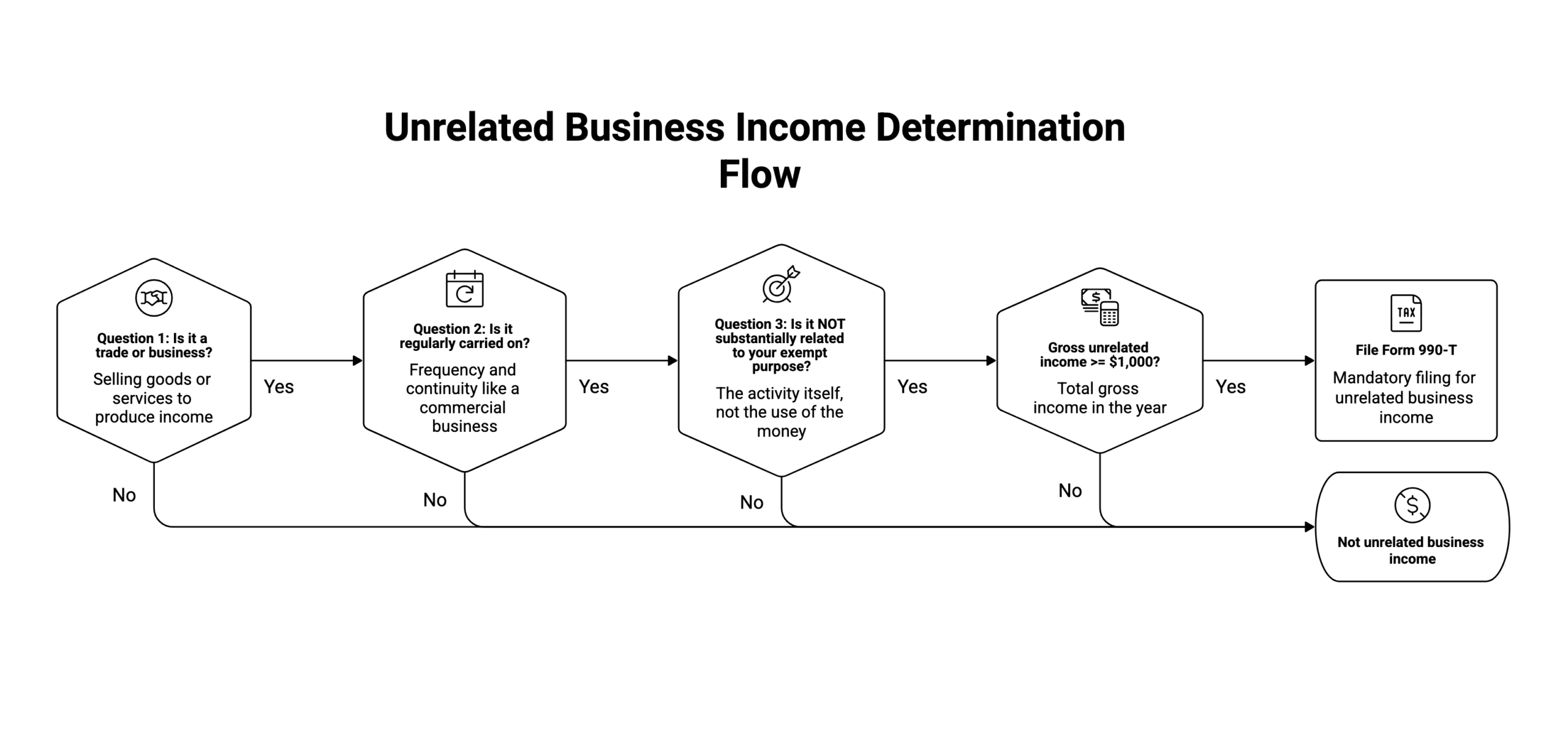
The IRS defines unrelated business income with a three-part test. Income is unrelated business income only if all three are true.
Part 1
It is a trade or business
Any activity carried on to produce income from selling goods or performing services. A newsletter with paid ads is one; so is a consulting contract.
Part 2
It is regularly carried on
Frequency and continuity comparable to a commercial operation. Publication 598 contrasts a sandwich stand run for two weeks at a state fair, not regularly carried on, with a commercial parking lot operated every Saturday, which is.
Part 3
It is not substantially related
The activity itself does not contribute importantly to your exempt purpose. Needing the money is not a relationship. A museum café that keeps visitors in the galleries is related; a youth organization’s commercial miniature-golf course is not.
The third part is where most of the judgment lives. The test is about the activity, not the use of the proceeds. A thrift store run by an animal shelter does not become “related” because the profits feed the animals. What matters is whether running the store itself advances the mission. This is the part people find unfair at first, and it is also the part that keeps the rule honest: if “we spend it on the mission” were enough, every business a charity could think of would be tax-free, and the bookstore next door would have a legitimate complaint.
Before you run any activity through the test, check whether Congress already took it off the table. The Internal Revenue Code excludes several activities and several kinds of income outright, and they cover much of what small organizations actually do. The IRS summarizes them on its exceptions and exclusions page; the statute is section 512.
Activities excluded from “unrelated trade or business”
Income excluded by “modification”
One important caveat cuts across the passive-income group: income from debt-financed property, such as rent on a building you bought with a mortgage, can be pulled back into unrelated business income in proportion to the debt. Publication 598 covers the computation.
Read that list against your own revenue and most of the fear goes out of the room. Interest on reserves: excluded. The gala, run once a year by volunteers: excluded twice over. The used-book sale: excluded. What remains is a shorter list, and it is usually the same handful of things, which we get to below.
The trigger is gross, not net. Under the Form 990-T instructions, an organization exempt under section 501(a) must file if it has gross income of $1,000 or more from a regularly conducted unrelated trade or business during the year. Gross means before operating expenses; the instructions net out only cost of goods sold first. An organization that took in $4,000 of advertising revenue and spent $3,800 producing the newsletter still files, even though the arithmetic below will show little or no tax. The return is separate from, and in addition to, the Form 990, 990-EZ, or 990-PF you already file. It does not replace them, and filing the e-Postcard does not excuse it.
Trigger
$1,000 or more of gross unrelated business income in the tax year.
Due date
15th day of the 5th month after year end for most exempt organizations (May 15 for a calendar year). Certain employee benefit trusts, such as IRAs, file by the 15th day of the 4th month.
Extension
Form 8868, filed by the original due date. It extends the time to file, not the time to pay.
Method
Electronic filing is required for organizations and trusts described in section 511.
Estimates
If the year’s tax is expected to be $500 or more, quarterly estimated payments are required, like any corporation.
Late
The failure-to-file penalty is 5% of the unpaid tax per month or part of a month, up to 25%, plus interest. A return more than 60 days late also carries a minimum penalty, so file even when the tax is small.
If you are already tracking the Form 990 calendar, the 990-T rides on the same date, and the common Form 990 mistakes guide covers the UBIT reporting errors that show up on the main return. Our Form 990 deadline guide covers the extension mechanics and what happens when the due date lands on a weekend.
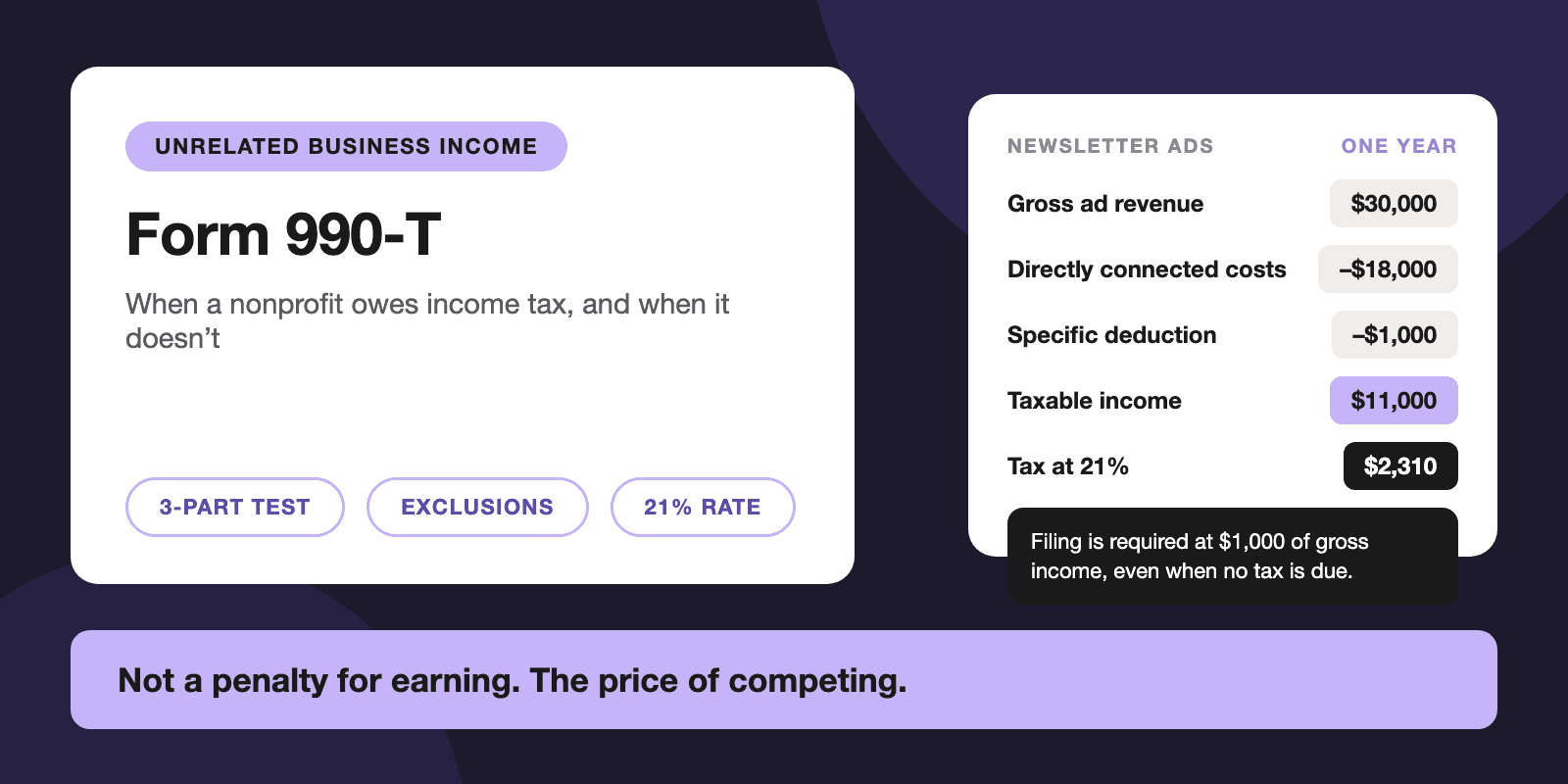
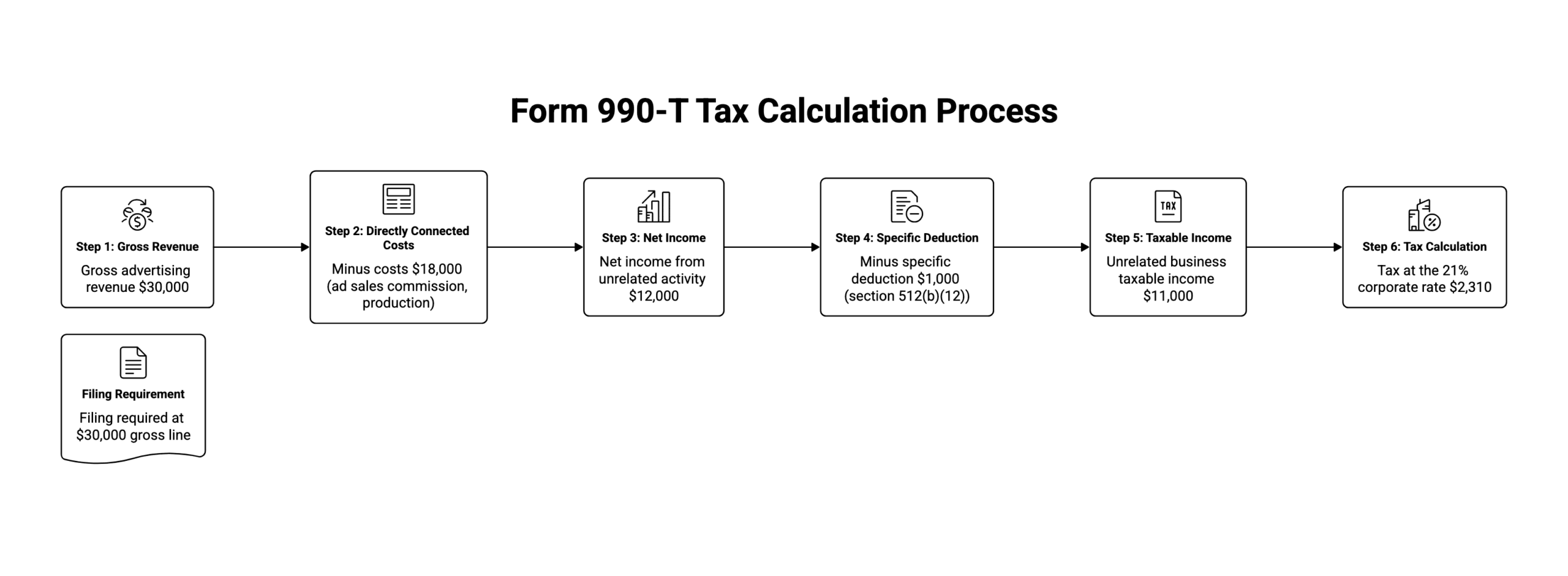
Unrelated business taxable income is the gross income from the activity, minus the deductions directly connected with it, minus a $1,000 specific deduction, allowed once per return rather than once per business, under section 512(b)(12). For a nonprofit organized as a corporation, the result is taxed at the flat 21% corporate rate. Trusts use the trust rate schedule. Here is what that looks like for a plausible small-organization year: a community organization that sells advertising space in its printed and emailed newsletter.
Two things about that example. First, the deduction only counts costs that are directly connected with the unrelated activity. The share of the editor’s time spent selling ads counts; the editor’s time writing program updates does not. Reasonable allocation is allowed and expected, and this is where clean bookkeeping earns its keep: if the newsletter’s costs are already tracked by function, the 990-T is a report, not a reconstruction. Second, notice that the filing was required at the $30,000 gross line regardless of how the costs came out. An organization with $30,000 of ad revenue and $30,000 of directly connected costs owes nothing, and still files.
One rule that took effect for tax years beginning after 2017 and still surprises people: if you have more than one unrelated business, each is computed separately on its own Schedule A, identified by a two-digit NAICS code, and under section 512(a)(6) a loss from one cannot offset a profit from another. The taxable income of each business “shall not be less than zero.” A profitable newsletter and a money-losing merchandise line are two silos, and the newsletter pays tax as if the merchandise did not exist.
Not sure whether a revenue line is unrelated? Send us the description and the amount. Our Form 990 team runs the three-part test and tells you in writing whether a 990-T is needed, before anyone prepares one.
Ask the question →These five revenue lines are the ones that raise the question in small organizations. Here is how each one usually resolves. The word “usually” is doing real work: facts change answers, and Publication 598 is the reference when yours are unusual.
The sponsorship line deserves one more sentence because it is the one that quietly flips. You open the sponsorship agreement your development director signed in a hurry, and next to the logo placement it says the sponsor’s members get a discount and the newsletter will run a quarter-page describing the product. That is no longer an acknowledgment; that is an ad. The fix is not to refuse the money. It is to write the agreement so that what you promise is what section 513(i) excludes, and to keep the two kinds of payment in separate accounts when a package includes both.
It does not mean your exemption is in danger. The regulations under section 501(c)(3) say plainly that an organization may operate a trade or business, even as a substantial part of its activities, if that business is in furtherance of its exempt purposes and it is not organized or operated for the primary purpose of carrying on an unrelated business (Treas. Reg. §1.501(c)(3)-1(e)(1)). The test is proportion and purpose, considering all the circumstances. A newsletter ad program alongside a full slate of programs is nowhere near that line. An organization whose unrelated business has become the main thing it does has a different conversation ahead, and it is a conversation about the mission, not about the form.
It does mean the return is public. For a 501(c)(3), a Form 990-T filed after August 17, 2006 is subject to the same public inspection rules as the Form 990 (IRS public disclosure rules). Anyone can ask for it, and the organization must provide it. In practice this is a reason to describe the activity clearly rather than a reason to avoid filing.
It does not settle state tax. Many states impose their own tax on unrelated business income and require a state return alongside the federal one. The rules and forms vary by state, so this is a question for your preparer, not something we can answer generically here. And it does not mean you did anything wrong. Filing a 990-T is evidence that someone read the revenue carefully. The organization to worry about is the one that has never asked the question. If you are still on the broader question of what taxes a nonprofit does and does not pay, start with do nonprofits pay taxes and come back to this page for the 990-T mechanics.
You do not need a UBIT policy. You need an annual habit that takes about an hour, done with the year-end close, and a chart of accounts that makes it possible. If your revenue lines are lumped into “other income,” fix that first; a chart of accounts that separates sponsorship from advertising and program fees from unrelated services does most of this work automatically.
Step 1
List every revenue line that is not a gift, grant, or program fee
Sponsorships, advertising, rentals, merchandise, services to outsiders, investment income. If the list is empty, you are done for the year, and you should write that down.
Step 2
Apply the exclusions first
Volunteer-run, donated goods, convenience of members, sponsorship acknowledgment, passive income. Strike those lines. Note why, in one sentence each.
Step 3
Run the three-part test on what is left
Trade or business, regularly carried on, not substantially related. Be honest on the third part; “we need the money” is not a relationship.
Step 4
Add up gross income from what survived
$1,000 or more means a Form 990-T, filed electronically by the 990 due date. Under $1,000 means no return, and a note in the file explaining the number.
Step 5
Track directly connected costs all year
Set up the expense accounts or classes now so the deduction is a report, not a reconstruction. It is the difference between paying tax on $11,000 and paying it on $29,000 for the same activity.
Step 6
Fix the agreements, not just the books
Rewrite sponsorship language to acknowledgment only. Separate any advertising into its own contract and account. Add a services clause to rentals only if you mean it.
A short review you actually run every year beats a thorough one you keep postponing. When the annual answer is “nothing survived Step 2,” the value of the hour is being able to say so with a straight face when a funder or an auditor asks.
Form 990-T prepared with the 990, not bolted on after
Our Form 990 preparation includes the unrelated-business review every year, and our bookkeeping keeps the directly connected costs separated so the deduction is ready when the return is. Prices are on the pricing page.
Common questions from small nonprofits deciding whether Form 990-T applies to them.
Yes, if gross income from the unrelated business was $1,000 or more for the year. The filing requirement is measured at the gross level, before expenses and before the $1,000 specific deduction. An organization can file a Form 990-T that shows zero tax due, and many do.
A qualified sponsorship payment is not, as long as the sponsor receives only the use or acknowledgment of its name, logo, or product lines. The payment becomes advertising, and taxable, when the message includes qualitative or comparative language, price information, or an inducement to buy. Write the agreement as an acknowledgment and keep any advertising in a separate contract and account.
For an exempt organization organized as a corporation, unrelated business taxable income is taxed at the flat 21% corporate rate. Exempt trusts use the trust rate schedule. The income is computed after directly connected expenses and a $1,000 specific deduction.
No. Since 2018, section 512(a)(6) requires each separate unrelated trade or business to be computed on its own, and the taxable income of each cannot be less than zero. A profitable activity is taxed on its own result even if a different unrelated activity lost money in the same year. Each business is reported on its own Schedule A to Form 990-T.
Not by itself. The 501(c)(3) regulations allow an organization to operate a trade or business, even as a substantial part of its activities, if that business furthers its exempt purposes and the organization is not organized or operated for the primary purpose of carrying on an unrelated business. Paying UBIT on a side activity is the system working as designed. The risk arises only when the unrelated business becomes the organization’s main activity.
GivingArc provides bookkeeping, Form 990 preparation, and nonprofit-specialized accounting for small and mid-size 501(c)(3) organizations across the US. The worked example is illustrative and not drawn from any client. Federal rules only; state unrelated business taxes vary. Sources are linked where cited, as checked on September 7, 2026. Reviewed by Min Kim, CPA.