
Imagine this: a foundation is ready to fund you. Due diligence is almost done — then their grants manager asks for a certificate of good standing and proof of current charitable registration. You go looking, and discover a state renewal that quietly lapsed fourteen months ago. Nobody did anything wrong, exactly. Something just didn’t get renewed, because nothing reminded anyone to renew it.
Here’s the reframe that makes nonprofit compliance make sense: it isn’t a test you pass once. It’s a subscription you renew with filings — federal, state, and internal — except no one sends you a renewal reminder, and the cancellation notice is automatic. Miss the IRS filing three years running and your tax-exempt status is revoked without a hearing. Miss a state renewal and your right to fundraise there can lapse just as quietly.
If you are in California, the state renewals that lapse quietly are the RRF-1 and the Secretary of State statement — our California filing calendar.
The fix isn’t more anxiety — it’s a list and a calendar. Below is a practical nonprofit compliance checklist for small and mid-size 501(c)(3)s: the annual filings at the federal and state level, a month-by-month calendar you can adapt to your fiscal year, and a free lookup tool for finding your state’s official agencies. Start with what applies to you and add rows as you grow.
Key Takeaways
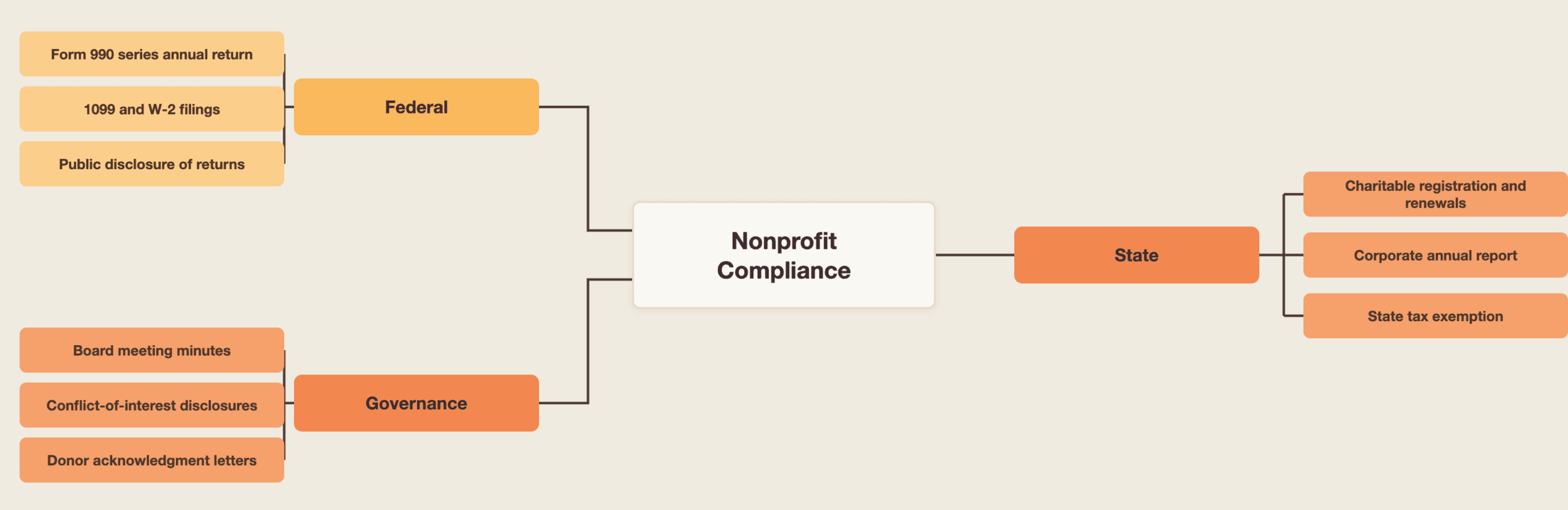
Nonprofit compliance is the set of recurring filings and practices that keep a 501(c)(3) in good standing with the IRS, with each state where it operates or fundraises, and with its own governing documents. In practice it runs on three layers:
Here’s the core list. Not every row applies to every organization — a volunteer-run group with no payroll skips the W-2 line — so treat it as a menu: keep what applies, delete what doesn’t, and add state-specific rows once you’ve looked yours up in the next section.
Annual compliance checklist
| Item | When | Notes |
|---|---|---|
| Form 990 / 990-EZ / 990-N | 15th day of 5th month after FYE | Which version depends on size — see 990-EZ vs 990. Three straight misses = automatic revocation |
| 1099-NEC forms | January 31 | For contractors above the reporting threshold ($2,000 for payments after 2025) — collect W-9s before the first check, not in January |
| W-2s and payroll filings | January 31 | If you have employees; payroll tax deposits run all year |
| Donor acknowledgment letters | Ongoing; year-end batch in January | Written acknowledgment for every gift of $250+ per IRS Pub 1771 |
| Charitable solicitation renewal | Varies by state | Renews on each state’s own schedule (annual in many) — write your date in the calendar below |
| Corporate annual report | Varies by state | Secretary of State filing that keeps the legal entity alive — separate from everything above |
| Public disclosure readiness | Ongoing | Your three most recent 990s and exemption application must be available on request |
| Board minutes & COI disclosures | Every meeting / annually | Minutes are permanent records; annual conflict-of-interest statements are what auditors and grantmakers ask for first |
Lists tell you what; calendars make it happen. Here’s a nonprofit compliance calendar for a December 31 fiscal year end — shift the 990 row if your year ends differently, and add your state dates once you’ve looked them up.
Compliance calendar (Dec 31 fiscal year end)
| When | What |
|---|---|
| January | The heavy month: 1099-NECs and W-2s out by January 31 (February 1 in 2027, since the 31st falls on a Sunday); year-end donor acknowledgment batch; kick off the books close for the year just ended |
| Feb–April | Finish the close; gather 990 materials (or send them to your preparer); schedule the audit if you’ve crossed a state threshold |
| May 15 | Form 990 series due (990 and 990-EZ can extend six months via Form 8868 — calendar the new date the same day; the 990-N has no extension, so just file it) |
| Your state dates | Charitable solicitation renewal + corporate annual report — look them up once (next section), write them here, done forever |
| Every month | Reconcile accounts and record gifts — the monthly close is what makes every filing above painless |
| Once a year | Board reviews this whole list, collects COI disclosures, and confirms every row still has an owner |
The federal layer is at least uniform — one IRS, one deadline formula. The state layer is where organizations quietly slip, because it’s three separate obligations with three separate agencies, and every state runs its own show. About 40 states require charitable solicitation registration before you fundraise there, per the National Council of Nonprofits (DC has its own licensing rule) — and renewals recur on each state’s schedule. Corporate reports go to the Secretary of State on a different cycle. And if your revenue crosses your state’s audit threshold — $2 million in California, above $1 million in New York — an independent audit joins the list; see our nonprofit audit requirements guide for the state-by-state picture.
The hard part has never been doing these filings — it’s finding the right agency and the current official form. That’s exactly the problem this free tool solves:
Free tool
Compliance Resource Finder
A searchable directory of official compliance resources — IRS forms, state charity regulators, registration portals, and filing guidance — filterable by jurisdiction (federal plus 11 states and growing) and topic. Every entry links straight to the official agency source with a note on what you’ll find there. Free, no sign-up. Built by our sister organization connectNPO, which is why we can vouch for how it’s maintained.
Open the Compliance Resource Finder →Bookmark it, or share the link with your treasurer and board — it’s the “look your state up once” step from the calendar above.
One more state-layer reminder while you’re in there: your federal determination letter doesn’t automatically exempt you from state taxes — several states want their own short application. We cover that step (and the rest of year one) in how to become a nonprofit organization.
The subscription cancels itself
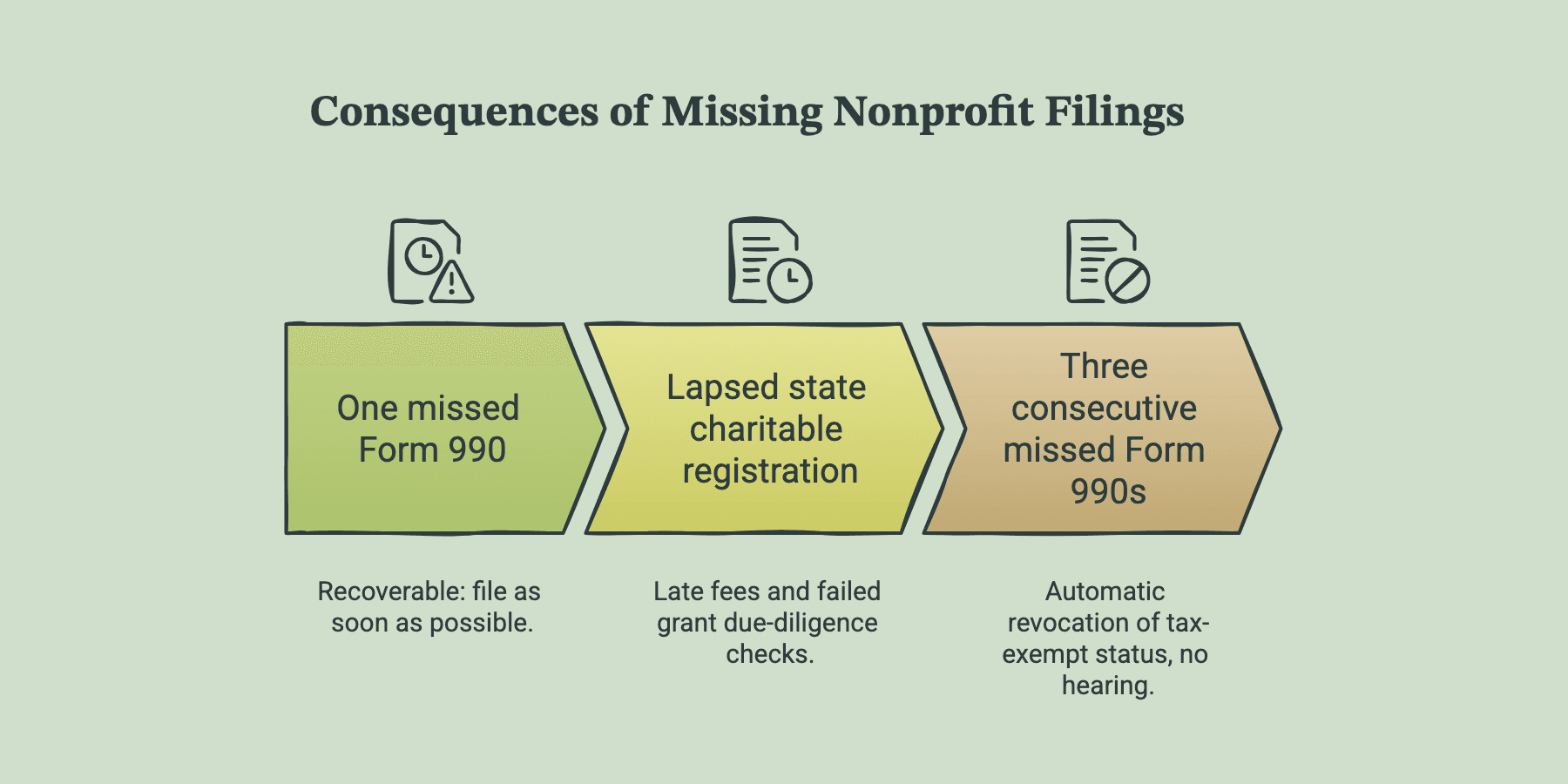
Three consecutive years without a Form 990 filing and the IRS automatically revokes exempt status — no hearing, no discretion. When the rule was first enforced in June 2011, the IRS reported revoking the status of approximately 275,000 organizations in a single sweep. The IRS believed the vast majority were already defunct — but the sweep also caught legitimate small organizations that had simply missed the new filing rule.
State-side, a lapsed solicitation registration can bring late fees and, more practically, a failed grant due-diligence check — funders often verify good standing before they wire money. Reinstatement paths exist for all of it, but every one costs more time and money than the renewal would have.
If you’re reading this list and realizing a filing may already be late: don’t panic, and don’t wait. Late is recoverable; three-years-late is a different animal. Start with the specific deadline in question — our guides to the Form 990 deadline and filing the 990 step by step cover the federal side, and the finder above gets you to the right state office.
Most compliance failures share one root cause: the obligation lived in one person’s head. The fix is boring and reliable — turn the checklist into a system with three properties:
Every row has an owner
A name, not a committee. For most small organizations that’s the treasurer or the bookkeeper — and “our accountant handles it” only counts if they’ve confirmed it in writing.
Every date lives on a shared calendar
With a reminder 30 days out — enough time to gather documents, not just to panic. Extensions get calendared the day they’re filed.
The books stay current
Nearly every filing on this list is downstream of the ledger. Clean monthly books make the 990 an export and the audit a formality — that’s the whole thesis of our bookkeeping guide.
And remember the adaptive rule from the top: start with the rows that apply today, add rows as you grow (first employee, first out-of-state donor campaign, first year above your state’s audit threshold), and review annually. A short list that runs every year beats a perfect list that overwhelms everyone into avoidance.
Want the federal rows handled for you? GivingArc keeps small nonprofits’ books current and files the 990 — so the subscription renews on time, every year.
Form 990 service →Common questions from EDs and treasurers building a nonprofit compliance checklist.
Three layers: federal filings (the annual Form 990 series, 1099s and W-2s, public disclosure of returns), state obligations (charitable solicitation registration and renewals, corporate annual reports, state tax exemptions), and governance practices (board minutes, conflict-of-interest disclosures, and written acknowledgments for donations of $250 or more).
The Form 990 series, due the 15th day of the 5th month after your fiscal year ends — May 15 for calendar-year organizations. It’s the only routine filing whose repeated absence ends your tax-exempt status: three consecutive missed years triggers automatic revocation.
One or two missed years is recoverable — file as soon as possible. After three consecutive missed years, exempt status is automatically revoked and donations stop being deductible until you’re reinstated. The IRS offers reinstatement paths, including a streamlined one for small organizations (those eligible for the 990-N or 990-EZ) that act within 15 months, but every path costs more than filing on time would have.
About 40 states plus DC require registration before soliciting their residents. In practice, most small organizations register in their home state first and expand as their donor base does — state regulators’ guidance focuses on where you actively target donors, not every state a check happens to arrive from. Confirm specifics with each state’s charity official.
One named person per checklist row — typically the treasurer or bookkeeper for filings and the board secretary for governance items — with the full list reviewed by the board once a year. The failure mode isn’t bad intentions; it’s obligations living in one person’s head with no calendar behind them.
Compliance that renews itself starts with books that close monthly.
GivingArc handles bookkeeping and Form 990 preparation for small and mid-size 501(c)(3)s.
GivingArc provides bookkeeping, Form 990 preparation, and nonprofit-specialized accounting for small and mid-size 501(c)(3) organizations across the US. This article is general information, not legal or tax advice — requirements vary by state. The Compliance Resource Finder is operated by connectNPO, GivingArc’s sister organization. Reviewed by Min Kim, CPA.