
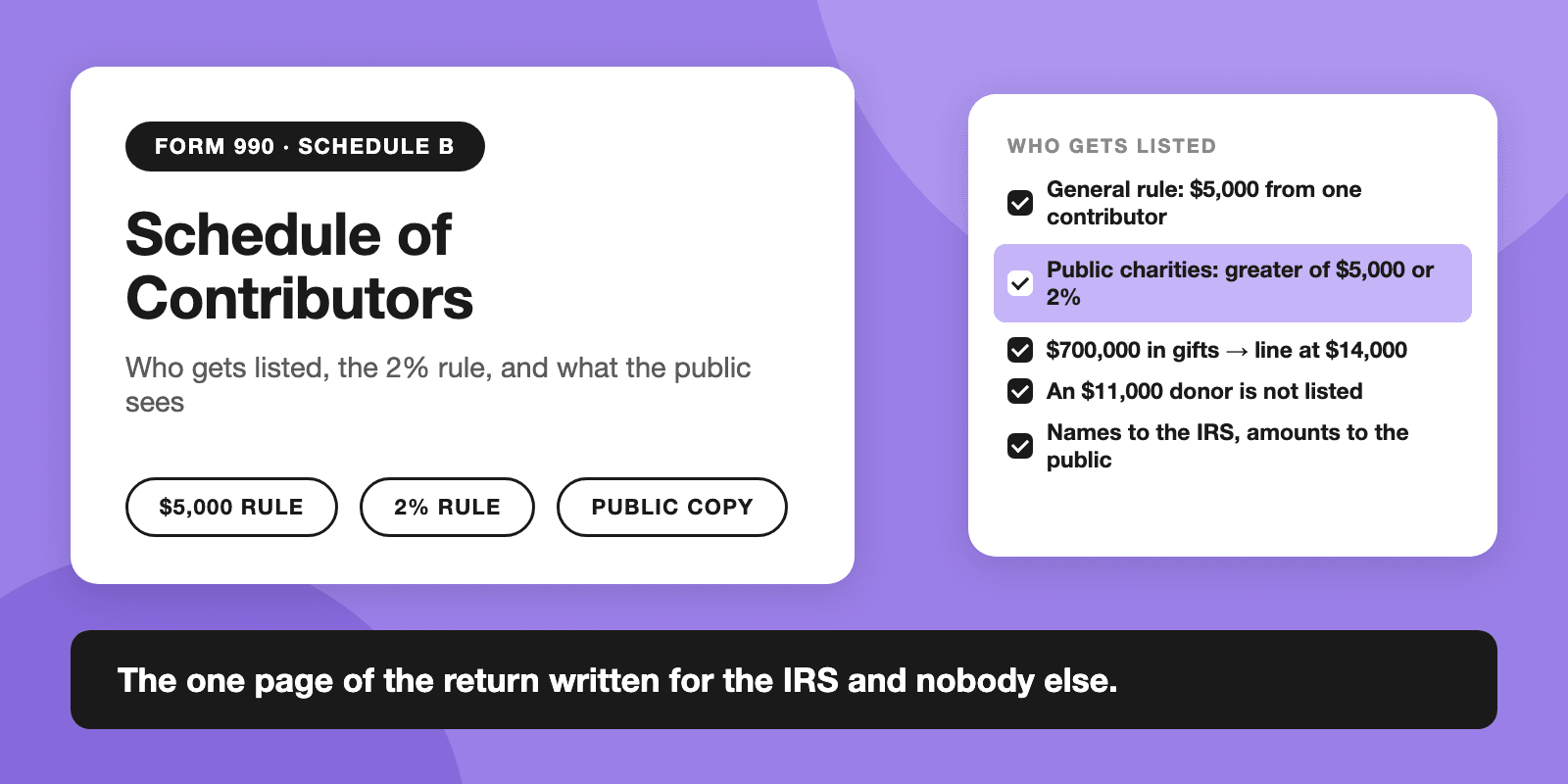
The question arrives at the board meeting where the Form 990 is being approved, from the member who reads everything. “This schedule lists our biggest donors by name and address. Does that go on the internet?” Everyone looks at the treasurer. The honest answer is “mostly no, with exceptions,” and the exceptions are worth knowing before a major donor asks. Schedule B is short, it is built from records you already keep, and it is worth understanding before someone asks about it in a room full of people.
Key Takeaways
The Schedule B instructions start from the assumption that every organization filing a Form 990, 990-EZ, or 990-PF attaches the schedule, unless it certifies that it does not meet the filing requirement. The certification is a checkbox: “No” on Form 990 Part IV line 2, or checking the box on Form 990-EZ line H or Form 990-PF Part I line 2. Answer “Yes” and the schedule is required. Form 990-N filers do not file Schedule B at all, because the e-Postcard has no schedules. Whether you are a 990-EZ or a full 990 filer is on our Form 990-EZ vs. 990 page; Schedule B applies to both the same way.
Check
Which return are you filing?
Form 990, 990-EZ, or 990-PF: Schedule B may apply. Form 990-N: it never does.
Check
Did any one contributor reach the threshold?
$5,000 under the general rule, or the greater of $5,000 or 2% of contributions under the special rule for public charities that pass the 33⅓% test.
Result
Yes to both: attach Schedule B
Otherwise answer “No” on Part IV line 2 and file without it. Keep the contributor totals that support the “No” in the workpapers.
Who counts as a contributor is broader than “a donor.” The instructions define a contributor as an individual, fiduciary, partnership, corporation, association, trust, or exempt organization, and add that organizations described in sections 509(a)(2), 170(b)(1)(A)(iv), and 170(b)(1)(A)(vi) must also report governmental units as contributors. A city grant of $25,000 to a public charity goes on Schedule B alongside the family foundation and the major donor. Contributions include money, securities, and any other property, and exclude fees for services, so program fees and contract revenue never count toward the threshold.
Unless a special rule applies, Part I lists every person who contributed $5,000 or more, in money or other property, during the tax year. The total is aggregate: the instructions say to include all separate and independent gifts of $1,000 or more when determining a contributor’s total, and that gifts of less than $1,000 may be disregarded. A donor who gave $2,000 in March and $3,500 in December reaches $5,500 and is listed. A donor who gave $4,500 once and $800 later does not reach the threshold, because the $800 gift may be left out of the count.
Timing follows the books. An organization on the accrual method that reports a pledge of noncash property on Form 990 Part VIII line 1g must count that pledge toward the contributor’s total, even if the property has not arrived. This is one reason the schedule is best produced from the general ledger rather than from the donor database alone; the two must agree, and the return reports the ledger.
Here is the reframe. Schedule B is the one page of the return you write for the IRS and nobody else. Everything else on the Form 990 is a public document. Schedule B, for a public charity, is not published, and its whole purpose is to let the IRS see whether an organization is genuinely publicly supported or quietly dependent on a few people. That purpose explains the special rule: the larger and more broadly supported you are, the higher the bar for a single donor to be worth listing.
Watch: how the two percent limit works on the Schedule A public support test (video).
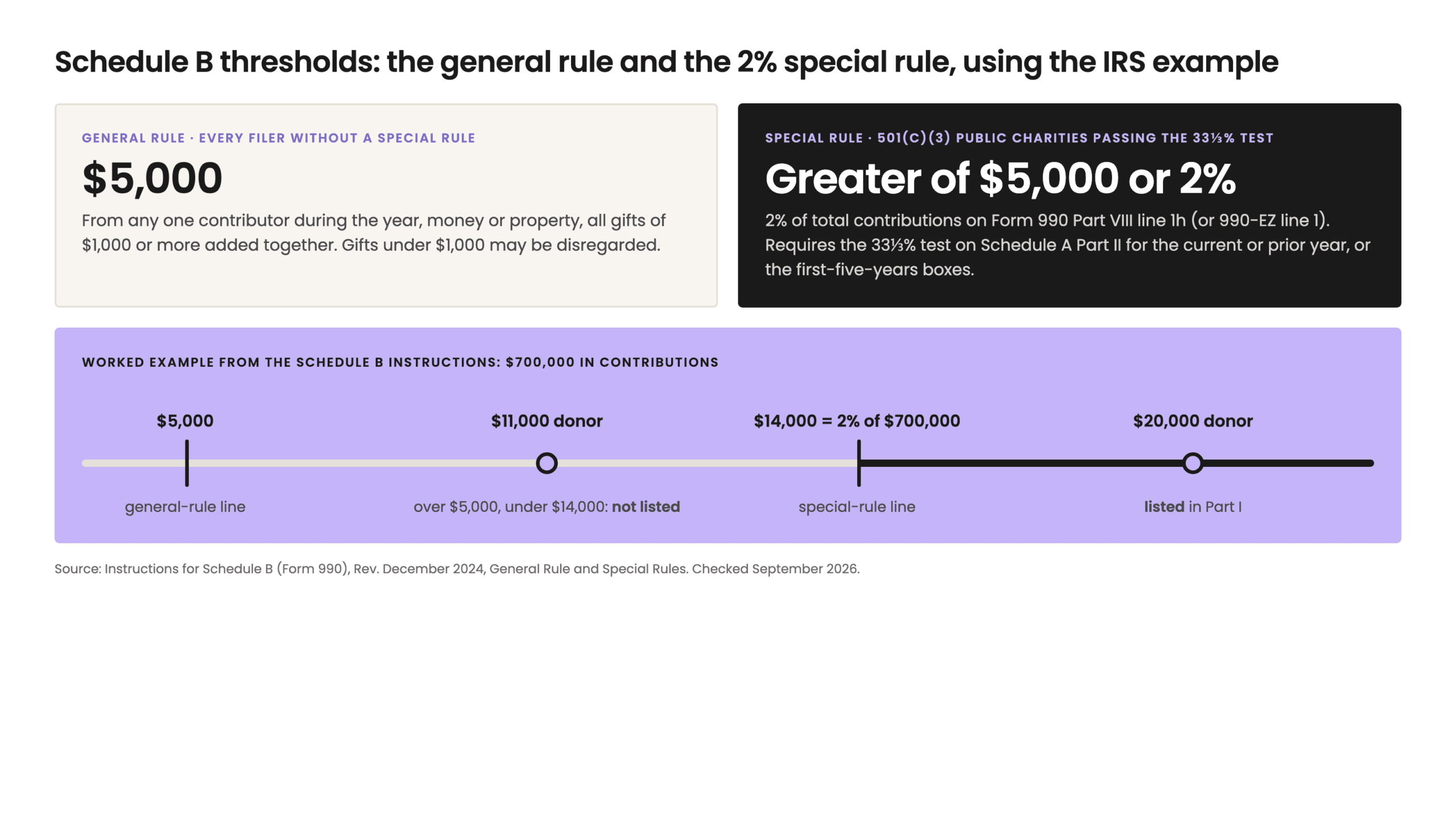
General rule
$5,000
From any one contributor, money or property, aggregated for the year
Applies to every filer not covered by a special rule, including public charities that do not meet the 33⅓% test.
Example. Contributions of $700,000. Every contributor at $5,000 or more is listed, including one who gave $11,000.
Special rule: 501(c)(3) public charities
Greater of $5,000 or 2%
Of the amount on Form 990 Part VIII line 1h, column (A), or Form 990-EZ line 1
Only for organizations that meet the 33⅓% support test under sections 509(a)(1) and 170(b)(1)(A)(vi), shown on Schedule A Part II for the current or prior year, or that check the Schedule A boxes as a 170(b)(1)(A)(vi) organization in their first five years.
Same example, from the instructions. 2% of $700,000 is $14,000. Only contributors above $14,000 are listed. The $11,000 donor is not, even though $11,000 is more than $5,000.
Two things the special rule does not do. It does not apply to 509(a)(2) organizations, the ones whose public support comes largely from program fees, even though they are public charities; they use the general rule. And it does not remove the schedule entirely. A public charity with $700,000 in contributions and one $50,000 gift still files Schedule B, listing that one donor. The public support test itself, and which section your organization falls under, is worked through on our Form 990 Schedule A page; the box you check there is the box that unlocks this rule. Fundraising events are reported on a different schedule; our Form 990 Schedule G guide walks through one gala line by line.
A third threshold exists for a narrow group. Section 501(c)(7), (8), and (10) organizations, social clubs and fraternal societies, that received contributions for exclusively religious, charitable, or similar purposes must complete Parts I through III for each person whose such gifts totaled more than $1,000 during the year. If that is not you, Part III stays blank.
Part I is a numbered list. Each contributor gets a line with four columns, and the instructions are specific about what goes in each. The schedule may be duplicated as many times as needed; number each page of each part, for example “Page 2 of 5, Part II.”
Consecutive: the first contributor is No. 1, the second No. 2, and so on across pages. The same number is used again in Part II for that contributor’s noncash gifts.
501(c)(3) organizations and section 527 organizations enter the contributor’s name, address, and ZIP code. Enter “anonymous” only if the organization genuinely does not know the donor’s identity. Other exempt organizations enter “N/A” in place of the name and address.
The contributor’s total for the tax year, all gifts combined, using the $1,000-gift aggregation rule above.
Check all that apply. Person: cash given directly, which includes checks, cards, wires, and electronic transfers. Payroll: an employee’s cash gift forwarded by an employer; report the employer’s name and the total unless you know a particular employee gave enough to be listed. Noncash: any property other than cash, which also requires Part II.
For each noncash contributor: a description of the property, its fair market value, and the date received, which is reported once the donor has fully given up use of the property. If the value cannot be readily determined, use an appraised or estimated value. The same description and value belong on Schedule M and support any Form 8283 the donor asked you to sign; see our in-kind donations guide for the valuation side.
One small rule with a large consequence: do not include contributors’ Social Security numbers anywhere on Schedule B, because the schedule may be made public. There is no field that asks for one, and the instructions say it explicitly anyway.
Schedule B is a report from your donor ledger. GivingArc’s Form 990 preparation pulls contributor totals straight from the books we keep, so the schedule, Schedule A, and your acknowledgment letters all say the same number.
See Form 990 preparation →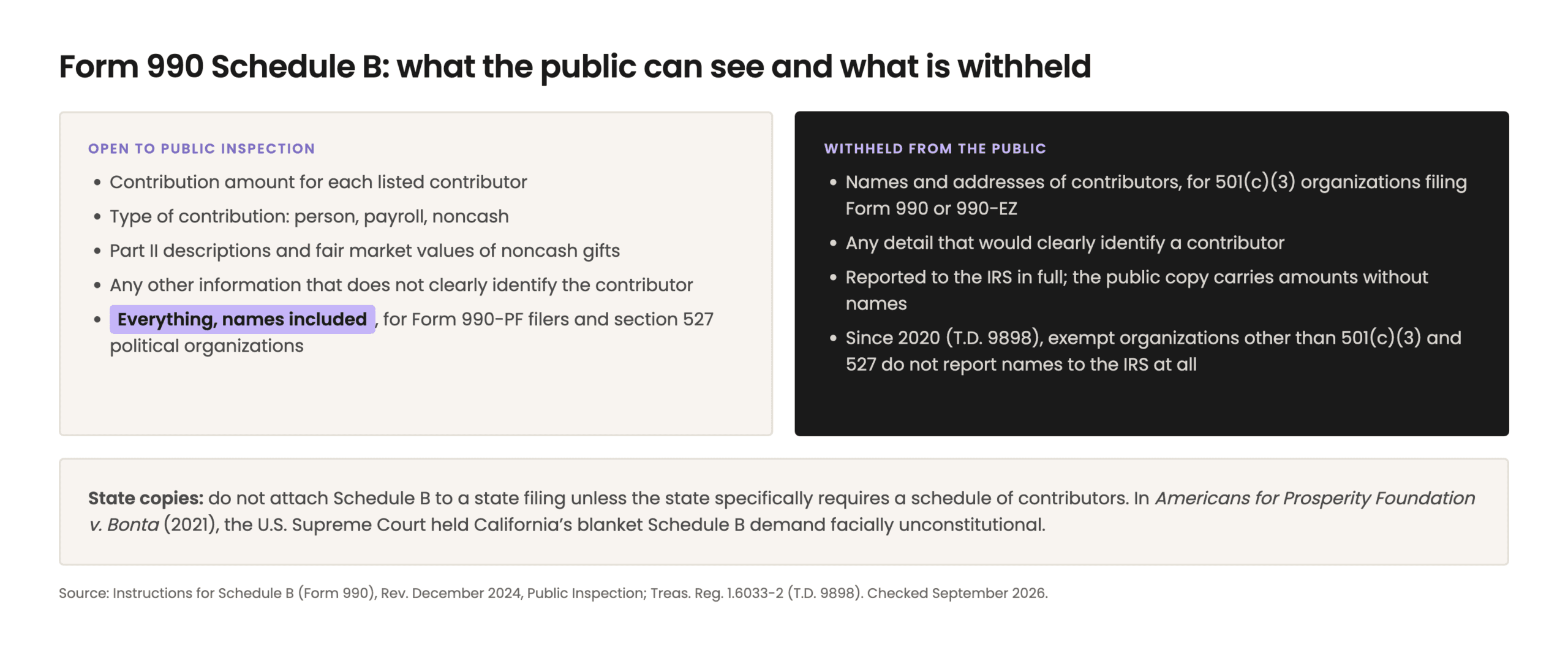
Back to the board member’s question. The Form 990 is a public document, and so is Schedule B, with one carve-out that matters. For organizations filing Form 990 or 990-EZ other than section 527 political organizations, the names and addresses of contributors are not required to be made available for public inspection. Everything else on the schedule is: the amounts, the descriptions of noncash gifts, and any other information, unless it clearly identifies the contributor. Two kinds of filers get no carve-out. Schedule B is fully open to public inspection for private foundations filing Form 990-PF and for section 527 political organizations.
Open to public inspection
The public copy you hand out, or that a database posts, should carry the amounts with names and addresses removed.
Withheld from the public
State copies: the instructions say not to include Schedule B in a state filing unless the state specifically requires a schedule of contributors, because a state that does not require it may inadvertently post it.
Who reports names to the IRS at all changed in 2020. Under final regulations issued as T.D. 9898 and reflected in Treasury Regulation section 1.6033-2, only 501(c)(3) organizations, including nonexempt charitable trusts and nonexempt private foundations, and section 527 organizations must report contributor names and addresses on Schedule B. Every other exempt organization, a 501(c)(4) social welfare group or a 501(c)(6) trade association for instance, reports the amounts and enters “N/A” for names, keeping the identities in its own records in case the IRS asks. For a 501(c)(3), nothing changed: the names go to the IRS, and the IRS does not release them.
State demands for Schedule B are a separate story, and the answer since 2021 is narrower than it used to be. In Americans for Prosperity Foundation v. Bonta, the U.S. Supreme Court held that California’s requirement that charities file their unredacted Schedule B with the state attorney general as a condition of registering to solicit was facially unconstitutional under the First Amendment. If a state registration form asks for Schedule B, check that state’s current instructions rather than assuming the old requirement still stands, and follow the IRS caution above about what to attach.
Nothing on Schedule B is new information. It is a re-sort of the year’s contribution revenue by donor, filtered by a threshold. It becomes painful when contribution income lives in a donor database that was never reconciled to the general ledger, so that the treasurer ends up with two lists that disagree and no way to tell which one the return should follow. The fix is upstream, in how contributions are recorded all year, not in April.
Have this ready before the return is started
A contributions-by-donor report that ties to Part VIII line 1h
Total of all donors equals the ledger’s contribution revenue for the year. If it does not, reconcile before ranking anyone.
Each gift tagged as cash, payroll, or noncash
Column (d) is a checkbox per contributor, but you can only check it if the gift was coded at entry. Workplace giving and payroll platforms need the employer recorded as the contributor.
Noncash gifts with description, date received, and value
Same figures that go on Schedule M and that supported any donor’s Form 8283. The gift acceptance policy should already say who values what.
Governmental grants coded as contributions, not program revenue
For 509(a)(1) and 509(a)(2) organizations, a government grant that is a contribution goes on Schedule B once it clears the threshold. Fees for services do not.
The Schedule A conclusion for the year
Whether you passed the 33⅓% test decides whether the 2% special rule applies. Prepare Schedule A first, then Schedule B.
Acknowledgment letters that match
A donor listed at $11,000 on Schedule B should hold receipts totaling $11,000. Our acknowledgment letter guide and receipt templates cover what each letter must contain.
Then the schedule is a sort: sort the report by total, draw the line at the threshold that applies, number the contributors, and carry the noncash ones to Part II. The same sorted list answers the next board question too, the one about how dependent the organization is on its top three donors, which is a better conversation to have on purpose than because a schedule forced it.
One donor ledger. Schedule A, Schedule B, and every receipt from the same numbers.
Our bookkeeping records every gift by donor, form, and restriction as it arrives, and our Form 990 preparation starts at $500 for a 990-EZ and $1,500 for a full return, schedules included. Prices are on the pricing page.
Common questions about Form 990 Schedule B, the Schedule of Contributors.
No. Answer “No” on Form 990 Part IV line 2, or check the box on Form 990-EZ line H, which certifies that the organization does not meet the Schedule B filing requirement, and file the return without the schedule. Keep the contributor totals that support the answer in your workpapers. Form 990-N filers never file Schedule B.
For a 501(c)(3) public charity filing Form 990 or 990-EZ, no. The names and addresses of contributors are reported to the IRS but are not required to be open to public inspection; the amounts and noncash descriptions are. Schedule B is fully public for private foundations filing Form 990-PF and for section 527 political organizations.
A 501(c)(3) that meets the 33⅓% public support test under sections 509(a)(1) and 170(b)(1)(A)(vi) lists only contributors whose gifts of $5,000 or more exceed 2% of the contributions reported on Form 990 Part VIII line 1h or Form 990-EZ line 1. The IRS example: with $700,000 in contributions, the threshold is $14,000, so a donor who gave $11,000 is not listed. The organization must show on Schedule A that it met the 33⅓% test for the current or prior year, or be in its first five years and check the corresponding boxes.
Yes, when the grant is a contribution. Organizations described in sections 509(a)(2), 170(b)(1)(A)(iv), and 170(b)(1)(A)(vi) must report governmental units as contributors when a grant that counts as a contribution reaches the threshold. Payments that are fees for services are not contributions and do not count.
A 501(c)(3) may enter “anonymous” in the name and address column only if it genuinely does not know the donor’s identity. A donor who asked not to be publicly recognized is not anonymous for this purpose; the organization knows the name and reports it, and the IRS keeps it out of the public copy. Only exempt organizations other than 501(c)(3) and 527 organizations enter “N/A” for names.
Only if the state specifically requires a schedule of contributors. The IRS instructions say not to include Schedule B in a copy of the return filed with a state that does not require it, because the state might inadvertently make it public. In 2021 the U.S. Supreme Court held in Americans for Prosperity Foundation v. Bonta that California’s blanket demand for unredacted Schedule B was unconstitutional, so check the current instructions for each state where you are registered.
GivingArc provides bookkeeping, Form 990 preparation, and nonprofit-specialized accounting for small and mid-size 501(c)(3) organizations across the US. The board-meeting scenario and dollar examples are illustrative; the $700,000 example is taken from the IRS Schedule B instructions. Sources are linked where cited, as checked on September 7, 2026. Reviewed by Min Kim, CPA.