
Somewhere on your kitchen table right now, there’s probably a notebook with a name circled in it. Maybe a mission statement you’ve rewritten four times, and a text from a friend who said, “I’d donate to that.” What there isn’t — yet — is a clear picture of what actually stands between that notebook and a real, legal nonprofit organization.
Here’s the part almost nobody tells you at this table: the IRS determination letter everyone is chasing looks like a finish line. It’s actually a birth certificate — proof that your organization exists, not proof that it can walk. And like any birth certificate, it arrives with the obligations of being alive: filings that come due every year, whether or not anyone reminds you.
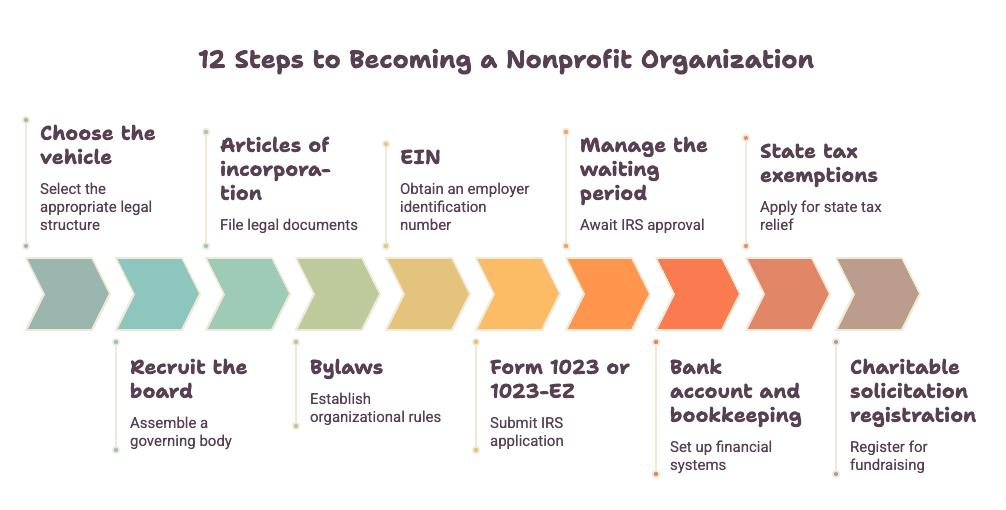
To become a nonprofit organization in the US, you incorporate at the state level, apply to the IRS for 501(c)(3) tax-exempt status using Form 1023 or 1023-EZ, and then keep that status through annual federal and state filings. Below, we walk through how to become a nonprofit organization in 12 steps — including the five that happen after approval, which most guides skip entirely.
Key Takeaways
“Nonprofit” and “501(c)(3)” are not the same thing, and the difference shapes every step below. A nonprofit corporation is a legal entity you create under state law — it exists the day your state accepts your articles of incorporation. A 501(c)(3) is a federal tax status the IRS grants to qualifying nonprofits, and it’s what makes donations tax-deductible and exempts the organization from federal income tax.
So you become a nonprofit twice. First at the state capitol, then with the IRS. Skipping the second half leaves you with a corporation that can’t offer donors a deduction and still owes federal income tax — a distinction we unpack in do nonprofits pay taxes. And completing the second half without understanding the ongoing obligations is how new organizations lose their status as quickly as they got it.
Most guides give you eight or ten steps that end at “apply for tax-exempt status.” Ours has 12, because five of them happen after the IRS says yes — and those five are where new organizations actually stumble.
This is the step every checklist skips, and it can save you a year of paperwork. If your idea is a short-term project, an experiment, or something you want to test before committing, you may not need your own 501(c)(3) at all — you can operate under an existing one through fiscal sponsorship. The sponsor extends its tax-exempt status to your project, receives donations on your behalf, and typically keeps an administrative fee — commonly in the 5–10% range of project revenue, according to the Fiscal Sponsor Directory’s survey of 376 sponsors.
Form your own 501(c)(3) if…
You’re building something permanent, expect to hire staff or apply for grants directly, want full control of the mission, and can commit to annual filings for as long as the organization lives.
Consider fiscal sponsorship if…
You’re testing an idea, running a time-limited project, or want to fundraise now while your own IRS application is pending. A 5–10% fee is often cheaper than a year of your own compliance overhead.
A nonprofit has no owners — it’s governed by a board that holds the mission in trust. Most states expect at least three directors (Texas, for example, requires three by statute), while a minority of states allow a single director. Whatever your state’s minimum, there’s a practical reality: the IRS application asks about family and business relationships among your officers and directors, and a board made up entirely of relatives invites closer scrutiny. Three unrelated people who genuinely care about the mission is the sturdier starting point — and one of them should be willing to serve as treasurer, a role with real duties we outline in nonprofit treasurer duties.
Incorporation happens at your state’s Secretary of State (or equivalent), and it’s cheaper than most founders expect: $8 in Kentucky, $25 in Texas, $30 in California. The catch isn’t the fee — it’s the language. To pass the IRS’s organizational test later, your articles must contain two specific provisions, and states don’t require them, so their standard forms often leave them out.
Two clauses your articles must contain
1. Purpose clause
“Said corporation is organized exclusively for charitable, religious, educational, and scientific purposes… under section 501(c)(3) of the Internal Revenue Code…”
2. Dissolution clause
“Upon the dissolution of the corporation, assets shall be distributed for one or more exempt purposes within the meaning of section 501(c)(3)…”
The IRS publishes suggested language in Publication 557 — copy it nearly verbatim. Amending your articles after a rejection costs another state filing fee and weeks of delay.
Bylaws are your internal rulebook — how directors are elected, how meetings are called, who signs checks. They aren’t filed with the state, but if you’ve adopted them, the IRS asks you to upload a current copy with your Form 1023. Adopt a conflict-of-interest policy at the same board meeting: the application asks whether you have one, and it’s the document that lets you answer questions about paying board members or hiring a founder without raising flags.
An Employer Identification Number is your organization’s federal tax ID — you’ll need it to open a bank account and to file the exemption application itself. Apply online at IRS.gov in a matter of minutes. It is always free; any site charging for an EIN is a middleman. One quirk: the online system issues one EIN per responsible party per day, and the session times out after 15 minutes of inactivity, so have your incorporation details in front of you.
Form 1023-EZ is the express checkout lane at the grocery store. It’s faster and cheaper — but only if your cart is small enough, and some items aren’t allowed in the lane at all. Both forms are filed electronically through Pay.gov, and both end at the same place: a determination letter.
Form 1023-EZ EXPRESS LANE
Form 1023 FULL APPLICATION
Fees are current per the IRS user fee schedule, and processing figures come from the IRS’s Where’s My Application page, which updates monthly. One honest caution about the express lane: the EZ eligibility worksheet asks you to project three years of gross receipts. If you already have a funder promising more than $50,000 a year, filing the EZ anyway isn’t a shortcut — it’s an attestation problem.
Picture a small food-security nonprofit incorporated in September. The founders file their Form 1023 in October and settle in to wait out the 191-day queue. The following May 15 — while the application is still pending — their first Form 990-N comes due. Nobody told them, because every guide they read ended at “submit your application.”
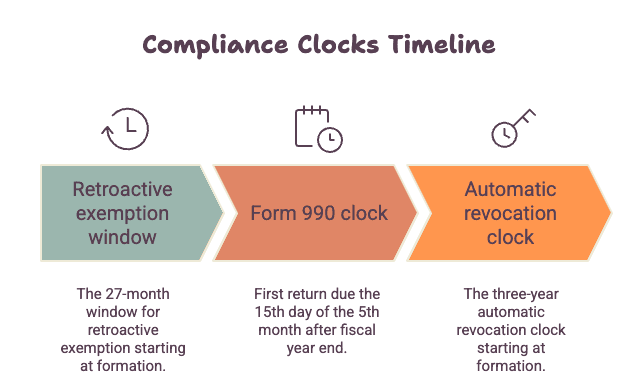
Three clocks start at formation — not at approval
The 27-month clock. File your application within 27 months of the end of your formation month and your exemption is retroactive to day one. File later, and it generally starts only from your filing date.
The Form 990 clock. Your first annual return is due the 15th day of the 5th month after your first fiscal year ends — even if the IRS hasn’t ruled on your application yet.
The revocation clock. Miss the annual filing three years in a row and exempt status is automatically revoked — no hearing, no warning letter required.
The revocation clock isn’t theoretical. When the three-year rule was enforced for the first time in June 2011, the IRS revoked the exempt status of roughly 275,000 organizations in a single announcement — most of them small nonprofits that simply didn’t know an annual filing existed. That’s the quiet lesson of the waiting period: the filing habit that keeps you alive starts now, not after the letter arrives.
There’s good news in the waiting period too. You can accept donations while your application is pending — and per the IRS’s guidance on pending applications, those contributions become tax-deductible for your donors once you’re approved, because the exemption reaches back to your formation date under the 27-month rule. Be transparent with donors that status is pending, keep a record of every gift, and start issuing proper donation acknowledgment letters from the very first check.
The determination letter deserves its spot on the office wall. Frame it — then read the fine print of your new life. Here are the five steps that separate organizations still standing at year three from the ones that end up on the revocation list.
Open a dedicated bank account in the organization’s name the week your EIN arrives — commingling nonprofit money with a personal account is the original sin of new organizations, and it’s miserable to untangle later. Then give every dollar a category before the dollars start moving: a simple nonprofit chart of accounts, a bookkeeping tool you’ll actually open, and a habit of recording gifts when they arrive. If a donor ever restricts a gift to a specific purpose, that restriction follows the money — the heart of fund accounting. Our first-90-days bookkeeping setup guide walks through this step in detail.
The federal letter does not automatically exempt you from state taxes. Most states run a separate — usually short — process: California accepts a short Form 3500A with your federal determination letter attached; Texas has you file with the Comptroller for franchise and sales tax exemption. Check your own state’s revenue department, because leaving this step undone means paying state taxes a 501(c)(3) doesn’t owe.
This is the most commonly missed legal requirement in the sector: about 40 states plus DC require charities to register with a state agency before asking that state’s residents for donations, according to the National Council of Nonprofits. “Asking” includes your website’s donate button under longstanding state-regulator guidance, though in practice most small organizations start by registering in their home state and expand as their donor base does. Registration is typically inexpensive (California’s initial registration is $50) — but it renews every year, which is why it belongs on the calendar in step 11.
Don’t aim for a perfect list — aim for a short one you’ll actually run. Start with the rows below (shown for a December 31 fiscal year end), then add or remove rows as your organization grows. A five-line calendar you check monthly beats a 40-line masterpiece you avoid opening.
Starter compliance calendar (Dec 31 fiscal year end)
| When | What |
|---|---|
| Monthly | Reconcile the bank account; record and acknowledge donations |
| January 31 | Year-end donor acknowledgment letters out; 1099-NEC forms due if you paid contractors (collect W-9s before the first check, not in January) |
| May 15 | Form 990 series due (15th day of the 5th month after fiscal year end) |
| State dates | Charitable solicitation renewal + corporate annual report (varies by state — look yours up once, write it here) |
| Anytime | Board meets and minutes get written — your future auditor, grantmaker, and 990 preparer will all ask for them |
Which version you file depends on size: gross receipts normally $50,000 or less means the 990-N e-Postcard (eight questions, a few minutes); under $200,000 in receipts and $500,000 in assets means the 990-EZ; above that, the full Form 990. We compare them in 990-EZ vs 990 and break down preparation costs in what Form 990 filing costs.
Here’s the mindset shift that makes the first one painless: a Form 990 isn’t a project you research in April — it’s an export of books you kept all year. If step 8 happened, your first 990 is an afternoon. If it didn’t, it’s an archaeology dig through twelve months of bank statements. Imagine next May: instead of hunting for receipts, your treasurer opens the bookkeeping file, runs two reports, and the return practically fills itself in. That’s not a fantasy — it’s just what books-first organizations experience every spring.
Starting a nonprofit and dreading year one? We set up books, file first 990s, and keep new 501(c)(3)s off the revocation list — so founders can stay founders.
See how we help →Doing it yourself, becoming a nonprofit organization typically costs a few hundred dollars in government fees — the wide ranges you see quoted online mostly come from adding attorneys or filing services on top.
Typical DIY government fees
Realistic total: roughly $300–$700 depending on your state and which IRS form you qualify for. Optional extras — a commercial registered agent, an attorney’s review, a filing service — sit on top of that.
On timing: incorporation takes days to a few weeks depending on the state; the IRS decision takes about three weeks to roughly six months depending on the form (per the mid-2026 figures above — and one in five full applications takes longer). Plan your first fundraising push accordingly — and remember that thanks to the 27-month rule, the wait costs your donors nothing if you’re approved.
One more planning note: exemption doesn’t mean money appears. Before the paperwork is done, it’s worth understanding how nonprofits actually make money — because the organizations that thrive treat revenue design as seriously as legal design.
Becoming a nonprofit organization is genuinely doable without a lawyer, without a consultant, and mostly without drama: five steps of preparation, two forms, and a waiting period you can put to work. The founders who struggle aren’t the ones who found the paperwork hard — they’re the ones who treated the determination letter as a diploma instead of a birth certificate, and discovered the annual obligations only when a notice arrived.
So frame the letter. Celebrate with your board. And then open your compliance calendar and your books — because the organization you’re building deserves to still exist in year three.
Common questions from founders becoming a nonprofit organization for the first time.
In government fees, typically $300–$700 doing it yourself: state incorporation runs $8–$30 in states like Kentucky, Texas, and California, the EIN is free, the IRS charges $275 for Form 1023-EZ or $600 for Form 1023, and home-state charitable registration adds $0–$50 or so. Attorneys and filing services add to that but aren’t required.
State incorporation takes days to a few weeks. For the IRS decision, as of mid-2026 the agency issues 80% of Form 1023-EZ determinations within about 22 days and 80% of full Form 1023 determinations within about 191 days. If you file within 27 months of forming, approval is retroactive to your formation date.
One person can drive the paperwork, but not own the result — a nonprofit has no owners, and most states expect at least three board members (a minority allow one). Because the IRS application asks about family and business ties among directors, a board of three unrelated people is the practical standard for a smooth approval.
Yes — a 501(c)(3) can pay its founder reasonable compensation for actual work, approved by the board under a conflict-of-interest policy. What it can never do is distribute profits: no dividends, no bonuses tied to surplus, and no assets going to insiders when the organization dissolves.
Yes. You can accept donations while your application is pending, and if the IRS approves you — retroactive to formation under the 27-month rule — those earlier gifts become tax-deductible for your donors. Tell donors your status is pending, keep a record of every gift, and issue acknowledgment letters from the start.
New 501(c)(3)? Start year one with clean books.
GivingArc handles bookkeeping and first Form 990s for new and small nonprofits — so the letter on your wall stays valid.
GivingArc provides bookkeeping, Form 990 preparation, and nonprofit-specialized accounting for small and mid-size 501(c)(3) organizations across the US. This article is general information, not legal or tax advice — formation requirements vary by state. Reviewed by Min Kim, CPA.