

Key Takeaways
Nonprofit accounting (formally known as not-for-profit accounting) is a specialized system of financial reporting designed for entities that operate for purposes other than to provide goods or services at a profit. While commercial accounting focuses on net income and the “bottom line” for the benefit of owners and investors, nonprofit accounting focuses on stewardship and mission fulfillment for the benefit of donors, grantors, creditors, and the public.
The principal source of these requirements is FASB ASC 958, which defines a not-for-profit entity (NFP) by three distinguishing characteristics:
1. Receiving significant resources from providers who do not expect a commensurate pecuniary return.
2. Operating for purposes other than profit.
3. The absence of ownership interests like those found in business entities.
Key elements that define nonprofit accounting include:
Under current standards (specifically ASU No. 2016-14), NFPs are required to provide three general-purpose financial statements:
• Statement of Financial Position: Similar to a balance sheet, it provides a financial selfie or snapshot of assets, liabilities, and net assets at a point in time.
• Statement of Activities: Similar to an income statement, it reports the change in net assets rather than net income, showing how the NFP fulfilled its mission over a period of time.
• Statement of Cash Flows: Reports the cash effects of operating, investing, and financing activities.
Because NFPs lack traditional equity like common stock or retained earnings, they report net assets, which are categorized based on the existence or absence of donor-imposed restrictions:
• Net Assets Without Donor Restrictions: Resources the NFP can use at its discretion, though they may still be subject to board-designated limits (internal earmarks set by the governing board).
• Net Assets With Donor Restrictions: Resources subject to stipulations from external donors that specify a particular purpose (e.g., a specific program) or a specified time (e.g., resources that can only be used next year).
A unique requirement of nonprofit accounting is the analysis of expenses by both function and nature in a single location (often a matrix-style statement).
• Functional Classification: Groups expenses by their purpose, such as program services (activities that fulfill the mission) and supporting activities (management, general, and fundraising).
• Natural Classification: Groups expenses by the type of economic benefit received, such as salaries, rent, electricity, and depreciation.
Nonprofit accounting involves complex rules for recognizing revenue from contributions. NFPs must distinguish between:
• Exchange Transactions: Reciprocal transfers where each party receives “commensurate value” (e.g., a government buying research for its own use).
• Contributions: Nonreciprocal transfers where the donor expects no return. These are further divided into conditional contributions (which require a barrier to be overcome before the NFP is entitled to the assets) and unconditional contributions (which are recognized immediately).
NFPs are required to provide qualitative and quantitative information in their notes regarding their liquid resources. This explains how the NFP manages its financial assets to meet cash needs for general expenditures within one year of the balance sheet date.
Think of nonprofit accounting as a selfie (the Statement of Financial Position) and a travel log (the Statement of Activities and Cash Flows) of a mission-driven journey. The log doesn’t just show if you have money left in your wallet; it shows every donor exactly which landmarks (programs) you visited and whether you followed the specific directions (donor restrictions) they gave you for the trip.

Bookkeeping is primarily concerned with the general recordkeeping of an organization’s daily transactions, such as processing payroll or maintaining a checkbook. In an NFP environment, this involves using account coding in the general ledger to capture expenses based on their natural classification, such as salaries, rent, and utilities. Smaller NFPs may operate purely on a cash basis, which allows them to prepare financial statements in the same manner as they maintain their checkbooks, avoiding the complexities of year-end accruals or depreciation. Bookkeepers may also maintain subsidiary ledgers to track specific details, such as the face amount of promises to give or the use of donor-restricted funds.
The Role of Nonprofit Accounting
Nonprofit accounting (reporting under GAAP or FASB ASC 958) is a higher-level system designed to communicate an NFP’s mission fulfillment and stewardship to external resource providers. Unlike commercial accounting, which focuses on the “bottom line” of net income, nonprofit accounting reports the change in net assets to show how an NFP’s activities relate to its purpose.
Key distinctions provided by the sources include:
| Feature | Bookkeeping | Nonprofit Accounting |
|---|---|---|
| Primary Focus | Often, the cash-basis for ease of preparation. | Communicating mission fulfillment and financial position to the public. |
| Methods | Maintaining checkbooks, general ledgers, and subsidiary ledgers. | Applying complex standards like FASB ASC 958 and ASU No. 2016-14. |
| Reporting | Natural classifications (e.g., utilities, salaries). | Functional classifications (e.g., program vs. supporting activities). |
| Basis | Often, the cash basis is used for ease of preparation. | Primarily accrual-basis (GAAP) for a faithful representation of performance. |
Think of bookkeeping like the engine temperature and fuel gauges on a car’s dashboard; it tells the driver if they have the resources and mechanical health to keep moving right now. Nonprofit accounting is like the GPS and travel log for the whole trip; it shows the donors who paid for the gas exactly how far the car traveled toward its destination and confirms that the driver followed the specific route they were hired to take.
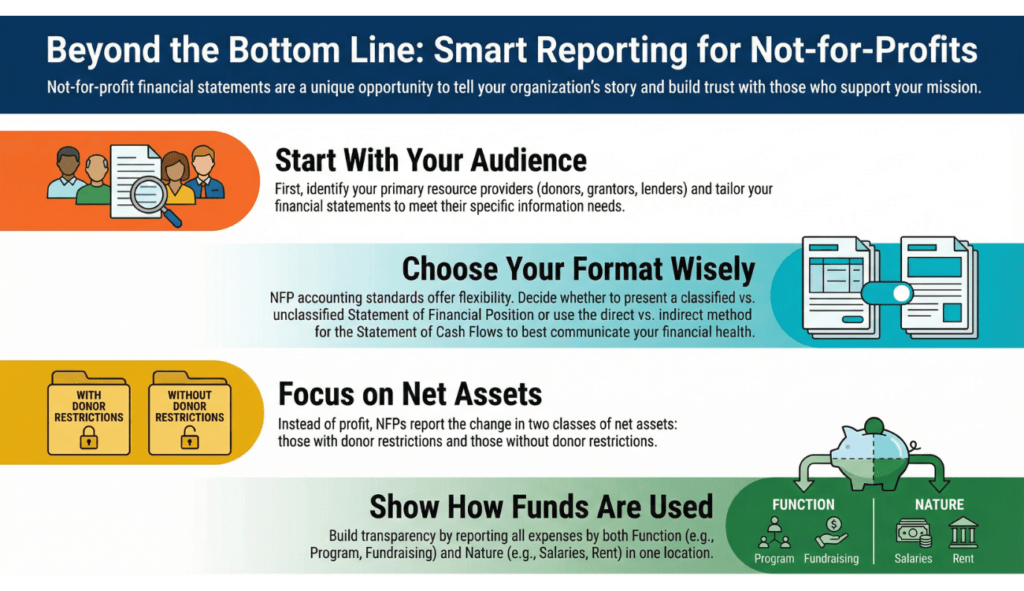
Not-for-profit entities (NFPs) allocate expenses by grouping them according to the purpose for which they were incurred, a process known as functional expense classification. This system distinguishes between program services (activities fulfilling the mission) and supporting activities (management and general, and fundraising).
The following details the methods and rules used to navigate these allocations:
The allocation process begins with the organization’s natural expenses (e.g., salaries, rent, or utilities).
• Direct Assignment: When a natural expense is specifically identifiable with a single function, such as travel costs for a specific program, it is assigned directly to that function.
• Indirect Allocation: When natural expenses benefit multiple functions—such as a building housing both program staff and fundraisers—they must be allocated using a rational and systematic basis.
The sources identify several objective methods for dividing shared costs:
• Time and Effort Studies: Used primarily for personnel, including the CEO and IT staff. If a CEO spends time directly overseeing a research program and other time cultivating donors, their compensation is split between those functions based on these studies.
• Square Footage: Used for building-related expenses like depreciation, maintenance, utilities, and insurance based on the space occupied by each department.
• Headcount or Machine Count: Sometimes used to allocate information technology or other administrative costs.
Special rules apply when an activity, such as a direct mail campaign, serves both a fundraising and a programmatic purpose. These are considered joint activities. To allocate any of these costs to program services, the NFP must meet three criteria:
• Purpose: The activity must call for a specific action by the audience that helps fulfill the NFP’s mission (beyond just donating money or becoming educated about a cause).
• Audience: The audience cannot be selected solely based on their likelihood to contribute.
• Content: The material must support program or management functions, such as fulfilling a specific management responsibility.
If any of these three criteria are not met, 100% of the joint costs must be reported as fundraising.
NFPs are required to disclose the specific methods they use to allocate costs in the notes to the financial statements. This transparency is critical because NFPs face significant pressure to report high program-expense ratios to appear more favorable to donors and rating websites. Consequently, auditors closely review the reasonableness of these allocation plans to ensure they are not being used to minimize fundraising costs artificially.
Think of an NFP’s total budget as a large pizza. The natural classification is the ingredients (dough, sauce, cheese). The functional allocation is how you slice the pizza to serve different tables. Program services are the slices given to the hungry people you were hired to feed (your mission). Fundraising slices are what you trade to people in the kitchen to keep more ingredients coming in. Management slices are what the cook eats to stay energized to manage the whole shop. You have to be honest about who ate which slice, or the people paying for the pizza will think you’re feeding more hungry people than you actually are.
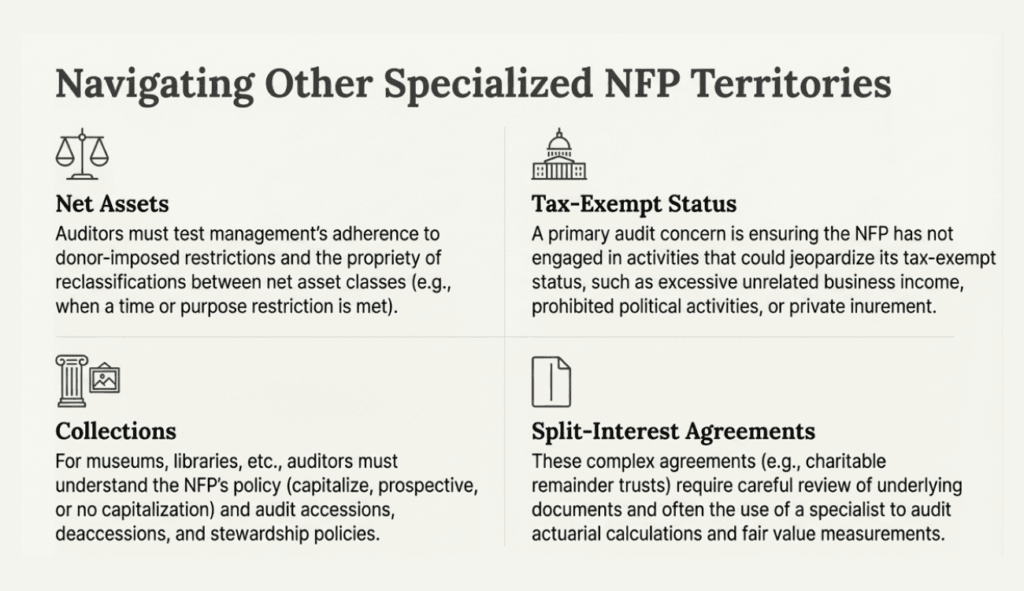
Donor-imposed restrictions have a profound impact on a not-for-profit (NFP) entity’s financial reporting, as they impose distinct stewardship responsibilities on management to ensure resources are used as stipulated by the provider. These restrictions drive how an NFP categorizes its equity, recognizes its revenue, and discloses its financial health.
The following sections detail how these restrictions affect specific reporting areas:
The most immediate effect of donor restrictions is the division of an NFP’s equity into two mutually exclusive classes on the Statement of Financial Position:
• Net Assets Without Donor Restrictions: Resources free of donor-imposed stipulations.
• Net Assets With Donor Restrictions: Resources subject to donor stipulations that specify a particular use (purpose restriction) or a specific future date (time restriction). Some restrictions are perpetual in nature, such as an endowment where the principal must be maintained forever.
• Statement of Financial Position: NFPs must report the total amounts for both classes of net assets. While restrictions usually apply to the net assets (equity) rather than specific assets (like cash), assets restricted for long-term purposes must be reported separately from those available for current use.
• Statement of Activities: This statement must report the change in net assets for both restricted and unrestricted classes. Revenue from restricted contributions is recognized immediately in the “With Donor Restrictions” class unless the NFP meets the restriction in the same period and elects a simultaneous release policy.
• Statement of Cash Flows: If a cash contribution is restricted for long-term purposes (e.g., building a facility or starting an endowment), the cash inflow is reported as a financing activity rather than an operating activity.
When a donor-imposed restriction is satisfied—either because the specific purpose was fulfilled or the required time has passed—the NFP must report a reclassification of net assets. This is presented on the Statement of Activities as “Net assets released from restrictions,” showing a simultaneous increase in one class and a decrease in the other.
NFPs are required to provide quantitative and qualitative disclosures regarding the availability of their financial assets to meet cash needs for general expenditures within one year. Donor restrictions often make financial assets unavailable for general use, which must be clearly explained so that creditors and donors can assess the NFP’s true liquidity.
• Underwater Endowments: If the fair value of a donor-restricted endowment falls below the original gift amount required to be maintained, the deficiency (the “underwater” amount) is reported as a loss within net assets with donor restrictions.
• Capital Assets: In the absence of explicit time stipulations, restrictions on gifts of long-lived assets (or cash to buy them) are typically considered to have expired when the asset is placed in service.
Imagine you have a compartmentalized wallet. When someone gives you money but tells you it can only be used for Tuesday’s lunch, you must put it in a specific pocket. Your Statement of Financial Position shows that while you have $50 total, $10 is locked in the Tuesday pocket.
Your Statement of Activities is like a logbook; the moment you buy that lunch on Tuesday, you record a “reclassification,” moving that $10 from the restricted pocket to the main part of your wallet to show the “instruction” has been followed and the money is now spent.
Donors care about the program-to-fundraising expense ratio because it serves as a critical metric for assessing an organization’s mission fulfillment and stewardship. Since not-for-profit entities (NFPs) do not have traditional profit indicators, resource providers look to functional expense classifications to determine how efficiently management is using resources to provide services.
Donors generally view program services expenses much more favorably than supporting activities like fundraising or management. A high ratio of program expenses suggests that a larger portion of a donor’s contribution is directly funding the mission rather than the costs of soliciting more money.
• Public Accountability and Worthiness: Resource providers use these ratios to decide whether an NFP is “worthy” of their support, putting significant pressure on organizations to report high program-to-fundraising ratios.
• Third-Party Ratings: Rating websites such as Charity Navigator and GuideStar allow donors to readily compare these ratios across different organizations with similar missions, creating a competitive environment for efficiency.
• Assessment of Performance: Because NFPs exist to fulfill a mission rather than generate net income, the relationship between resource inflows and program outflows is the primary way donors evaluate management’s performance.
• Financial Stewardship: Donors want evidence that managers have discharged their responsibilities for the efficient and effective use of the entity’s resources.
• Incentives and Risk: Auditors are aware that because donors prioritize these ratios, NFPs may have an incentive to improperly allocate costs, such as mislabeling fundraising expenses as program services, which increases the risk of material misstatement in financial reporting.
Analogy for Understanding: Think of a donor as a passenger hiring a boat to reach a specific destination (the mission). The donor is less interested in how much fuel is spent on the captain’s uniform or advertising for more passengers (supporting activities/fundraising) and is far more interested in how much fuel is used to actually power the engine toward the destination (program services). If they see too much fuel going toward finding new passengers rather than moving the boat, they will likely choose a different vessel for their next journey.
The distinction between an exchange transaction and a true contribution is determined by whether the resource provider receives commensurate value in return for the assets transferred. This classification is critical because it dictates which accounting standards apply: FASB ASC 606 for exchange transactions or FASB ASC 958-605 for contributions.
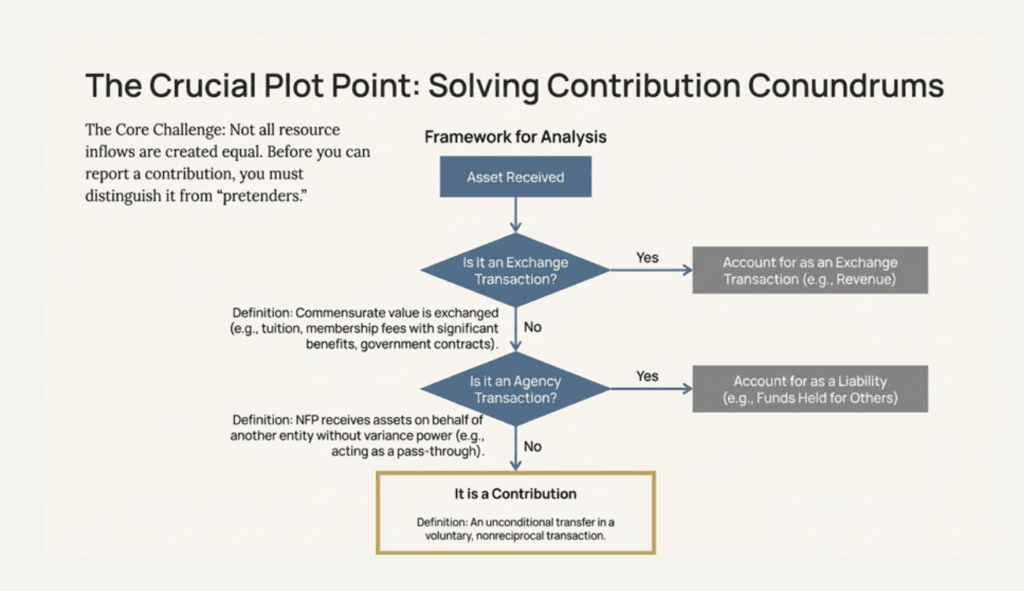
• Exchange Transactions: These are reciprocal transfers in which each party receives and sacrifices approximately commensurate value. In these cases, the direct benefit to the resource provider is the primary focus, while public benefits are secondary.
• True Contributions: These are nonreciprocal transfers that are voluntary and unconditional. The resource provider may receive value indirectly through a societal benefit, but this is not considered commensurate value.
Under ASU No. 2018-08, several clarifications were made to help NFPs distinguish between these two categories:
• Public Benefit vs. Provider Benefit: A benefit received by the general public (such as the publication of research findings) is not equivalent to commensurate value received by the resource provider. For example, a federal grant for research where the NFP retains the rights to findings and has permission to publish them is accounted for as a contribution.
• Mission Fulfillment: The “positive sentiment” a donor feels for acting as a philanthropist or the execution of a resource provider’s mission does not constitute commensurate value.
• Procurement vs. Grant: If a government agency provides funding for a specific study but retains all rights to the results, this is a procurement arrangement (an exchange transaction).
Even if the resource provider does not receive commensurate value, the transaction is not a contribution if it represents a payment on behalf of an identified customer for an existing exchange transaction. Common examples include:
• Medicare and Medicaid payments.
• Pell Grants or state/local government tuition assistance.
Bifurcation: Mixed Transactions
Transactions often contain elements of both an exchange and a contribution. In such cases, the NFP must bifurcate (split) the transaction:
• Memberships: If an NFP provides specific benefits (like an annual pass or newsletter) in exchange for dues, the portion representing the fair value of those benefits is an exchange transaction, while the residual amount is a contribution.
• Fundraising Events: For a ticket to a gala dinner, the fair value of the meal is an exchange transaction, and the amount paid above that value is a contribution.
• Bargain Purchases: If a donor sells a facility to an NFP at a price significantly below its fair market value, the transaction includes both an exchange (the payment) and an inherent contribution (the difference in value)
• An exchange transaction is like ordering the pizza: you give the shop $20, and they give you a pizza of roughly equal value; it is a direct, reciprocal trade.
• A true contribution is like a friend bringing a salad to your potluck: they give it voluntarily and expect nothing in return.
• Bifurcation is like a “charity bake sale”: you pay $50 for a single cupcake. $2 of that is an exchange for the actual cupcake you get to eat, but the remaining $48 is a true contribution to the cause.
Tax Form 990 is the annual information return that not-for-profit entities (NFPs) file with the IRS, serving as a primary tool for public accountability and transparency. While the sources focus largely on financial statement preparation and auditing, they highlight several critical ways the Form 990 intersects with an NFP’s financial reporting and oversight.
The Form 990 is a public record where NFPs must admit to significant financial irregularities. Specifically, Part VI, Section A, Question 5 asks organizations if they became aware of any significant diversion of the organization’s assets during the year. The sources provide real-world examples of large NFPs, such as the Field Museum of Natural History and the American Museum of Natural History, using their Form 990 filings to disclose fraud involving hundreds of thousands or even millions of dollars.
The IRS uses Schedule L of the Form 990 (Transactions with Interested Persons) to flag potential conflicts of interest. The sources note that both NFPs and their auditors must carefully compare the information disclosed in Schedule L with the NFP’s GAAP financial statements to ensure that any material related-party transactions are appropriately reported in both places.
The Form 990 is the primary vehicle for proving that an NFP is operating in accordance with its exempt purpose. The sources emphasize the following risks related to tax filings:
• Unrelated Business Income (UBI): If an NFP engages in activities unrelated to its mission, that income may be subject to taxation. Auditors review tax returns to identify potential liabilities or contingencies stemming from UBI that might need to be disclosed in the financial statements.
• Internal Controls: NFPs are expected to have effective internal controls to ensure that their tax returns are prepared and reviewed by knowledgeable personnel to avoid penalties or the jeopardy of their tax-exempt status.
• Donor Information: NFPs must use their filings and records to inform donors which portions of their contributions are tax-deductible; failure to maintain these standards can lead to material financial penalties.
As part of a standard audit, practitioners are encouraged to review the NFP’s tax returns and any correspondence with tax authorities. This review helps determine if the NFP is complying with all provisions of laws and regulations that could have a direct and material effect on the financial statements.
Think of the financial statements as a medical chart that tracks the NFP’s internal health (assets, liabilities, and expenses). In this scenario, Tax Form 990 is like a public health report; it uses the data from the chart but is written specifically for the public and the government to ensure the “patient” is actually helping the community as promised and hasn’t been “infected” by internal fraud or illegal business deals.
Based on the sources, the Form 990 serves as the primary annual information return that not-for-profit entities (NFPs) file with the IRS to provide public accountability and transparency. While there are several variations of this form used in the NFP sector, the sources specifically highlight the following:
• Standard Form 990: This is the comprehensive version used by larger NFPs to report on their activities, governance, and financial health.
• Form 990-EZ: Referred to as the “short form,” this is available to smaller organizations that meet specific gross receipt or total asset thresholds.
The sources emphasize that the specific schedules and sections within these forms are often more important for financial oversight than the form type itself:
• Part VI, Section A, Question 5: This specific section of the Form 990 is a public disclosure tool where an NFP must admit if it became aware of any “significant diversion of the organization’s assets” (such as fraud or embezzlement) during the year. For example, the Field Museum of Natural History and the American Museum of Natural History have used this section to disclose thefts and phishing incidents involving hundreds of thousands of dollars.
• Schedule L (Transactions with Interested Persons): Both the standard Form 990 and the 990-EZ utilize this schedule to report related-party transactions. This includes business involvements between the NFP and its management, board members, or their immediate family members.
• Unrelated Business Income (UBI): While not a separate 990 “type,” the sources note that NFPs must use their tax filings to report income from activities not related to their exempt purpose, which may be subject to taxation.
For organizations like private foundations, which are subject to the same general guidance regarding distinguishing contributions from exchange transactions, these filings are used to record grant payables and disclose commitments for conditional contributions. Auditors are encouraged to review these tax returns and any correspondence with tax authorities to identify liabilities or contingencies that may require disclosure in the GAAP-basis financial statements
Go deeper
This guide covers the framework. These step-by-step guides cover each piece in practice:
For-profit accounting focuses on net income for owners and investors; nonprofit accounting focuses on stewardship and mission fulfillment for donors, grantors, and the public. Nonprofits report changes in net assets rather than profit, classify net assets by donor restrictions, and must report expenses by both function and natural classification – none of which apply to for-profit reporting.
The Statement of Financial Position is the nonprofit equivalent of a balance sheet, reporting assets, liabilities, and net assets at a specific date. The key difference: instead of showing equity with line items like common stock or retained earnings, it shows net assets categorized as without donor restrictions and with donor restrictions – reflecting the nonprofit's accountability to donors rather than ownership claims.
Unrelated Business Income (UBI) is income from activities that are not substantially related to a nonprofit's exempt purpose, even if it funds mission work. UBI is subject to Unrelated Business Income Tax (UBIT) and must be reported on Form 990-T when gross UBI exceeds $1,000. Persistent or substantial UBI activity can also jeopardize tax-exempt status if it becomes a substantial part of operations.
Without donor restrictions means the nonprofit can use those resources at its discretion for any mission-aligned purpose, though the board may impose internal designations. With donor restrictions means the donor specified a purpose (e.g., a specific program) or time (e.g., next fiscal year) constraint. This two-category structure comes from FASB ASU 2016-14 and replaced the older three-tier system of unrestricted, temporarily restricted, and permanently restricted net assets.
Effective internal controls include segregation of duties (no single person handles authorization, recording, and custody); board oversight of financial reports; conflict-of-interest disclosures; whistleblower and document-retention policies; review of Form 990 by knowledgeable personnel before filing; and disclosure of any significant diversion of assets on Form 990 Part VI, Section A, Question 5. Inadequate controls can lead to penalties or loss of tax-exempt status.