

Every nonprofit gets gifts that don’t show up on a bank statement. A pro bono lawyer writes the contract. A print shop prints the gala invitations. Someone with empty office space hands over a key for the summer. None of it touches the checking account — and that’s exactly why it gets miscounted, mis-recorded, and sometimes missed entirely on both the books and the Form 990.
Here’s the simple frame. A $5,000 invoice that someone tears up in your face is still a $5,000 transaction. The donor gave it. You received it. Both of you are supposed to leave a paper trail. This guide walks through what counts as an in-kind donation, what doesn’t, how to record it correctly under current FASB rules, what to put on your Form 990 (and crucially, what not to), what to send the donor — and a free template you can use today.
Key Takeaways
An in-kind donation is a non-cash contribution your nonprofit receives in the form of goods, the use of facilities or utilities, or qualifying services — valued at what your organization would otherwise have to pay for the same thing. The accounting term used in U.S. GAAP is contributed nonfinancial assets; the IRS calls them noncash contributions on Form 990.
Common examples include:
Fitting this in with the rest of your books is easier if you have a clean nonprofit chart of accounts from the start — the fund accounting structure underneath determines how cleanly in-kind shows up in your financials.
The boundary trips up almost every small nonprofit. Under U.S. GAAP, the following are generally not recorded as in-kind donations:
A useful nuance: a volunteer’s reimbursable out-of-pocket expenses (mileage, supplies they bought) can sometimes be treated as a cash contribution when the volunteer signs them over — but the volunteer’s time still isn’t in-kind.
The simple rule: if you wouldn’t normally have written an invoice for it, it isn’t in-kind — and even when you would have, services have to clear a second test.
This is the part the older guides skip. Under FASB ASC 958-605, donated services are only recognized as in-kind contributions when they meet one of two specific criteria:
The service creates or enhances a nonfinancial asset
A contractor donates labor to construct a building, or a designer creates artwork your organization will own. The donated work adds value to something you keep on the books.
The service requires specialized skills, is provided by someone who has those skills, and would typically be purchased if not donated
A CPA donates tax preparation, an attorney handles your contract review, a registered architect drafts your space plan. Specialized skill plus “you’d have written a check for this” equals in-kind.
Practical translation: a CPA’s donated tax work qualifies. A friend who’s helpful with spreadsheets organizing your files generally doesn’t — even though both gave their time. Both criteria matter, especially the second one. Specialized skill alone isn’t enough; you also have to be the kind of organization that would otherwise pay for the work.
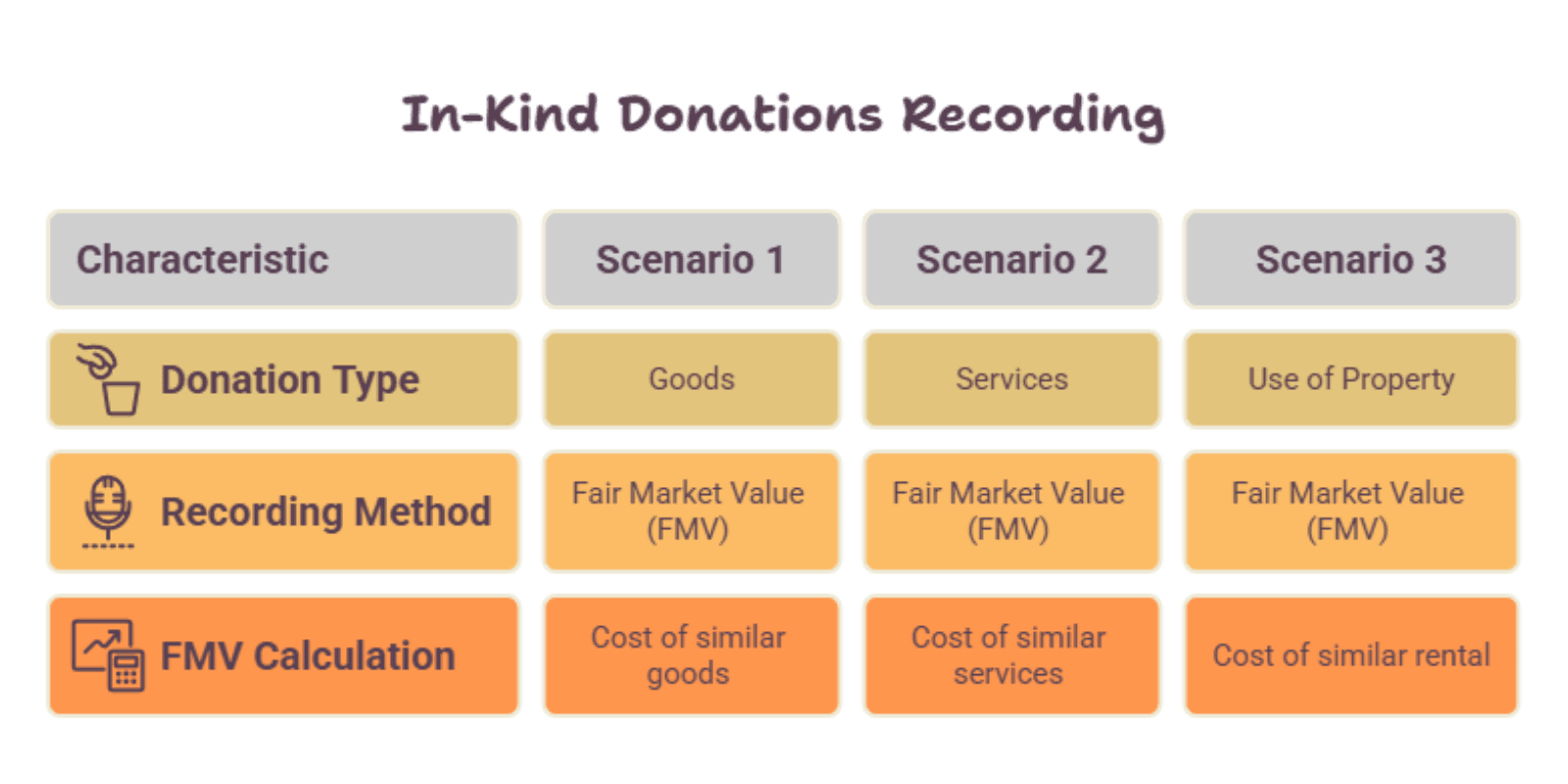
Whatever the category, in-kind donations are recorded at fair market value (FMV) — the amount your nonprofit would have paid for the same goods, services, or use, on the date received. Here’s how five common scenarios look on the books:
A CPA donates 5 hours of tax prep at $200/hour
Specialized skill, provided by a CPA, and you would have paid for it — qualifies under criterion B. FMV = $1,000.
A tech company donates 4 laptops, FMV $1,200 each
Goods kept and used become an asset. Total FMV = $4,800.
A donor provides a venue worth $2,500 for a gala
Use of facility is recognized over the period received. FMV = $2,500.
A board member donates 20 shares of stock, FMV $3,000 on the gift date
Record at fair value on the gift date; when sold, the difference is a realized gain or loss — the recorded gift never changes. (Stock is a financial asset, so it sits outside the ASU 2020-07 in-kind presentation line.)
A grocer donates food with an FMV of $1,800, distributed to clients the same month
Goods passed through to clients are expensed when distributed rather than capitalized. (If goods are held first, record an inventory asset at receipt, then move it to program expense as distributed.)
In each case, both sides of the entry hit at the same time, so the financials reflect the true value of support received without overstating cash. If you’re sorting out how this fits with restricted gifts, see restricted vs. unrestricted funds — in-kind gifts can also be donor-restricted in purpose or time.
If your auditor or 990 preparer mentioned “ASU 2020-07” and you nodded politely without knowing, this section is for you. It’s a real rule, it’s already in effect, and it changes how in-kind shows up on your audited statements.
FASB ASU 2020-07 — in effect
Effective for fiscal years beginning after June 15, 2021.
Applies to nonprofits that follow U.S. GAAP and receive contributed nonfinancial assets (goods, use of facilities, services that qualify, intangibles). It does not change the recognition rules — only how the items are presented and disclosed.
What ASU 2020-07 actually requires:
If your nonprofit follows GAAP for audits, grant reports, or sophisticated funders, this isn’t optional. Cleaning up in-kind tracking now — not at audit time — is much easier; the same principle applies as in avoiding bookkeeping mistakes generally and to audit preparation.
Not sure your in-kind is reported correctly on your audit or Form 990? GivingArc can review your current tracking against ASU 2020-07 and Schedule M expectations.
Get a quick review →Here’s a point that confuses experienced bookkeepers, let alone first-time treasurers: your audited financials and your Form 990 will not show the same in-kind revenue. The difference is intentional, and getting it backward is one of the more common 990 errors.
Audited financials (GAAP)
Services
Recognize if ASC 958-605 criteria are met
Goods
Recognize at FMV
Facility use
Recognize at FMV over period of use
Presentation
Separate line on statement of activities (ASU 2020-07)
Form 990 (IRS)
Services
Do NOT report on Part VIII line 1
Goods
Report on Part VIII line 1g (noncash)
Facility use
Do NOT report on line 1g (excluded, like services)
Schedule M
File if total noncash > $25,000 (or art / historical / qualified conservation, any amount)
The practical impact: a nonprofit that received $50,000 of pro bono legal work and $30,000 of donated office space will look bigger on its audited statements than on its 990 by $80,000 — because Form 990 instructions explicitly exclude both donated services and the donated use of facilities, equipment, or materials from Part VIII line 1g. That’s correct — not an error. Your auditor will reconcile the difference; just don’t try to “fix” the 990 by adding donated services or facility use to line 1. (For other 990 traps, see common Form 990 mistakes.)
Two paperwork rules sit on top of in-kind — one for you, one for the donor.
For the nonprofit — Form 990 Schedule M. File Schedule M when your total noncash contributions for the year exceed $25,000 (Form 990 Part VIII line 1g), or when you received any amount of art, historical treasures, similar assets, or qualified conservation contributions. Schedule M asks you to break down noncash gifts by category, count them, and describe how you determined FMV.
For the donor — the $250 acknowledgment. Under IRC §170(f)(8), a donor cannot claim a federal tax deduction for any single contribution of $250 or more without a contemporaneous written acknowledgment from your nonprofit. Your acknowledgment must describe the donation, state whether you provided any goods or services in return, and, if so, include a good-faith FMV of those goods or services. There’s no IRS form for this — a letter, email, or receipt is fine. The IRS lays it out in Publication 1771.
A few additional donor-side flags worth knowing:
None of this is the nonprofit’s tax problem — but your donors will ask, and a one-page acknowledgment template (below) handles 90% of it.
For every in-kind donation, keep the following on file:
Description of the goods or services received
Date(s) received or provided
Fair market value — and how you determined it (rate, invoice, market quote)
Donor name and contact
Whether the gift carried any donor-imposed restrictions
Written acknowledgment sent to donor (required at $250+, recommended for all)
Whether the item was sold, used in programs, or held — for ASU 2020-07 disclosure
Below is a one-page record you can copy into a Google Doc, Word, or Sheets and adapt to your organization. It doubles as the donor’s written acknowledgment when the donor signs and you keep a copy.
In-Kind Donation Record — fillable PDF
One page. Type directly into the form, print, or sign digitally. No email required — free download.
In-Kind Donation Record
Organization Name: __________________________
Donor Name: _______________________________
Contact Email: _____________________________
Description of Donation:
Date(s) Received: ___________________________
Type: ☐ Professional Services ☐ Goods / Equipment ☐ Facility / Space ☐ Other: __________
Fair Market Value (FMV): $__________________
How FMV was determined: ☐ Standard hourly rate ☐ Market quote ☐ Invoice / estimate ☐ Other: __________
Donor restrictions (if any): ___________________________
Donor Signature: ___________________________ Date: ___________________
For the donor’s side — the “contemporaneous written acknowledgment” that satisfies IRS Publication 1771 — this same form, signed and returned to the donor on your letterhead, generally does the job for gifts under $5,000. For larger goods donations, the donor may need a qualified appraisal and Form 8283 in addition.
If you’re setting up your books from scratch, our first 90 days of nonprofit bookkeeping guide pairs well with this article — and clean in-kind tracking makes your financial statements noticeably easier to read for the board.
If in-kind tracking has been a question mark on your books — missing entries, uncertain valuations, an upcoming audit, or simply not knowing how your 990 should handle it — GivingArc can review your current setup and put a clean, ASU 2020-07-compliant structure in place. We help with the bookkeeping, the Form 990, and the donor acknowledgments, so your in-kind story holds up to a funder, an auditor, or the IRS.
Make in-kind donations a quiet line on your books, not a yearly scramble
From monthly bookkeeping to Form 990 prep, GivingArc handles the in-kind side cleanly so your audit and your 990 agree on what should agree — and differ where they should differ.
If you would rather have the donation records kept for you: GivingArc’s monthly bookkeeping runs $300 to $1,950 per month depending on transaction and grant volume, and recording donations, including in-kind gifts, is part of the monthly close. Prices are on the pricing page; the how we work page describes what every plan includes.
Common questions from small nonprofits handling in-kind donations.
An in-kind donation is a non-cash contribution of goods, the use of facilities or utilities, or qualifying services, recorded at fair market value. Common examples include donated equipment, software, supplies, professional services such as legal or accounting work, and donated office or event space. Under U.S. GAAP, donated services qualify only when they create or enhance a nonfinancial asset, or require specialized skills your nonprofit would otherwise purchase.
Generally no. Ordinary volunteer time, board service, and event help do not qualify as in-kind contributions under U.S. GAAP. Only services that meet the ASC 958-605 criteria, requiring specialized skills and which the nonprofit would otherwise purchase, or services that create or enhance a nonfinancial asset, are recognized. Volunteer out-of-pocket expenses can sometimes be treated as a cash donation if the volunteer signs them over with documentation.
Record in-kind donations at fair market value, the amount your nonprofit would normally pay for the same goods, services, or use of property on the date received. For professional services use the donor’s standard billing rate; for goods use comparable market prices or a recent invoice; for facility use base the value on equivalent rental rates. Document how you arrived at the FMV, because ASU 2020-07 requires disclosure of valuation techniques and inputs.
Donated goods (tangible property transferred to the organization) are reported on Form 990 Part VIII line 1g as noncash contributions. Donated services and the donated use of facilities, equipment, or materials are excluded from line 1 by IRS instructions, even though they may appear in your audited financials under GAAP. Schedule M must be filed when total noncash contributions exceed $25,000, or when you receive art, historical treasures, or qualified conservation contributions of any amount.
ASU 2020-07 amends FASB ASC 958-605 to require nonprofits to present contributed nonfinancial assets as a separate line on the statement of activities and disclose them by category, including whether each was monetized or used, the nonprofit’s monetization policy, valuation techniques used, and any donor-imposed restrictions. It is effective for fiscal years beginning after June 15, 2021. Any nonprofit that follows U.S. GAAP for audits, grant reports, or funder requirements should comply.
Yes, for any single contribution of $250 or more. Under IRC §170(f)(8), the donor cannot claim a federal tax deduction without a contemporaneous written acknowledgment from your nonprofit. It must describe the donation, state whether you provided any goods or services in return, and include a good-faith FMV if so. There is no IRS form required, a letter or email is sufficient, and IRS Publication 1771 explains the requirements in detail.
GivingArc provides bookkeeping, Form 990 preparation, and nonprofit-specialized accounting for small and mid-size 501(c)(3) organizations across the US. This article is general information, not tax or legal advice. Reviewed by Min Kim, CPA.