

Key Takeaways
Choosing the right CPA for your nonprofit is one of the most consequential decisions a board can make. The wrong fit costs more than money — it costs audit findings, donor confidence, and sometimes tax-exempt status. With over 23 years of collective experience serving nonprofits across the country, our team has seen organizations thrive with the right financial partner and struggle for years with the wrong one.
This guide walks through everything that matters when evaluating a nonprofit CPA: the specialized expertise that separates qualified candidates from generalists, the signals that tell you it’s time to hire (or switch), realistic pricing expectations in 2026, red flags to avoid, and the specific questions to ask before you sign an engagement letter.
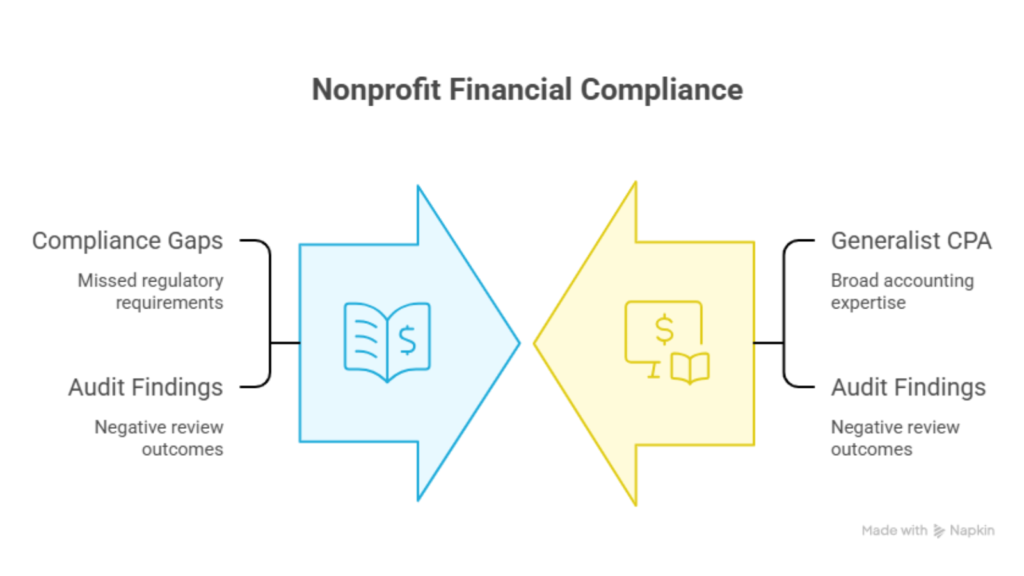
Nonprofit accounting is fundamentally different from for-profit accounting — different enough that hiring a generalist CPA, even an excellent one, frequently leads to compliance gaps and audit findings.
The technical differences start with FASB ASC 958, the accounting standard that governs not-for-profit entities. Under ASU 2016-14 (effective fiscal year 2018), nonprofits must classify net assets in two categories — “without donor restrictions” and “with donor restrictions” — which replaced the older three-category system most generalist CPAs trained on. They must also report expenses by both function (program services, management & general, fundraising) AND natural classification (salaries, rent, supplies) in a single matrix-style statement. This dual-classification doesn’t exist in for-profit reporting. Our nonprofit fund accounting basics guide walks through these classifications in detail.
Then there’s contribution accounting, which separates exchange transactions (where the donor receives commensurate value) from true contributions (nonreciprocal transfers). Conditional contributions require that a barrier be overcome before the nonprofit recognizes them. These rules trip up CPAs whose practice focuses on commercial entities.
On top of all that, nonprofit-specific tax compliance — Form 990 series, Schedule A through M, UBIT (unrelated business income tax), and state charitable registrations — requires familiarity that generalists rarely have. A generalist CPA filing Form 990 for the first time often takes two to three times longer than a specialized firm and is more likely to omit required schedules.
The result: hiring a non-specialized CPA often saves you nothing in cost while exposing your organization to compliance risk. Specialization isn’t a nice-to-have — it’s the baseline.
Several signals should prompt either initial hiring or evaluating whether to switch your current CPA.
$200K+ gross receipts, $500K+ assets, $1M+ federal awards (Single Audit), or state thresholds (CA $2M, NY $1M, PA $750K).
IRS correspondence you can’t decode, audit findings you don’t understand, or board questions you can’t answer confidently.
New federal or foundation grant, multi-state expansion, earned-revenue activities (UBIT exposure), or capital campaign.
Bookkeeper stretched thin, year-end close takes weeks, restricted-fund tracking gaps, or guessed expense allocations.
If three or more of these apply, the conversation isn’t “should we hire a CPA?” — it’s “how soon can we have one in place?”
Nonprofit CPAs typically offer services in four categories. Understanding what’s included at each level helps you scope the right engagement.
$150–$1,500/mo
Monthly reconciliations, fund tracking, payroll integration, and financial statements.
$500–$2,500 flat
Annual return (990, 990-EZ, or 990-N) plus required schedules and state filings.
$10K–$100K+
Single Audit, financial statement audit, audit-readiness, and schedule preparation.
$2,000–$8,000/mo
Strategic finance, board reporting, cash forecasting, and internal controls design.
Bookkeeping is the foundation. This includes monthly transaction categorization, bank and credit card reconciliations, fund tracking (separating restricted from unrestricted), payroll integration if needed, and monthly financial reports (Statement of Financial Position and Statement of Activities). A specialized nonprofit bookkeeper sets up class tracking in QuickBooks Online or proper fund segregation in a higher-end system, ensuring restricted funds are visible and traceable. See our 501(c)(3) bookkeeping requirements guide for the standards every nonprofit bookkeeper should follow.
Form 990 services cover the annual return appropriate to your size — 990-N, 990-EZ, or full Form 990 — along with required schedules (A for public charity status, B for major donors, M for noncash contributions, and so on). Some firms also handle California Form 199, New York CHAR500, and other state filings. Pricing for Form 990 preparation varies; see our Form 990 filing cost guide for current ranges.
Audit services apply to organizations subject to Single Audit, state audit thresholds, or grant-driven audit requirements. A specialized firm can either prepare your books for an external audit or perform the audit themselves — though both functions cannot be combined for the same client (independence rules). Audit prep includes reconciliation cleanup, schedule preparation, internal control documentation, and coordination with the auditor. Our nonprofit audit preparation checklist covers what to expect.
Advisory is the highest tier — strategic financial planning, board reporting, cash flow forecasting, internal controls design, executive director coaching on financials, and grant budgeting. For nonprofits with $1 million or more in revenue, this often replaces an in-house Director of Finance position at lower total cost. Some firms (including ours) bundle these services as a single monthly retainer; others charge separately. The structure matters — see Pricing below.
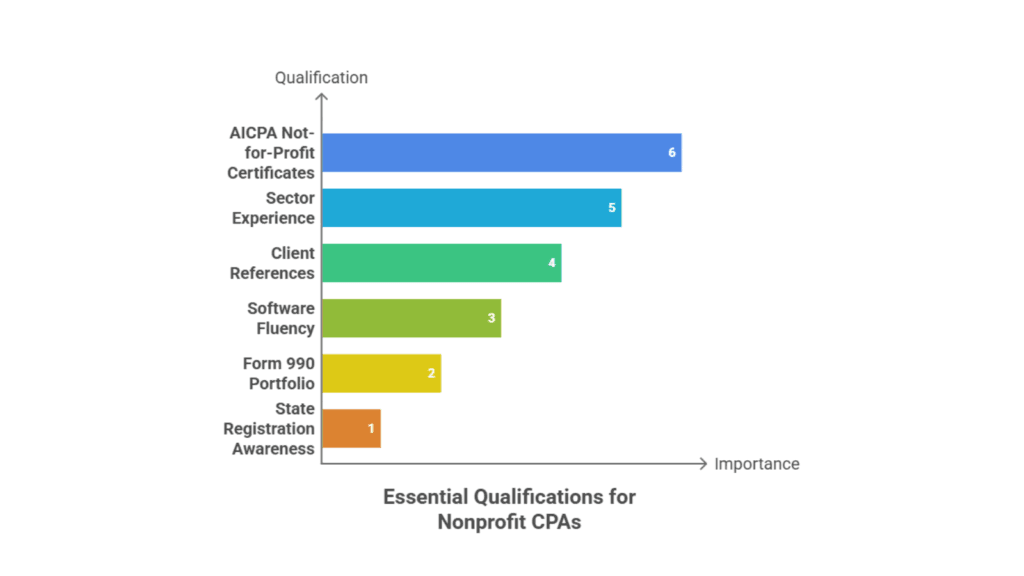
Beyond the basic CPA license, look for these markers of true nonprofit specialization.
What is not a meaningful credential: “We work with several nonprofits” without specifics, vague references to “decades of experience” without sector breakdown, or simply being a CPA in a city with many nonprofits.
Nonprofit CPA pricing varies widely. Understanding the structure helps you compare proposals fairly.
Hourly billing is common for project work (Form 990 preparation, audit support) and one-off advisory questions. Typical rates for nonprofit-specialized CPAs range from $150 to $400 per hour depending on seniority and geography. Hourly billing for routine bookkeeping is a red flag — see the next section.
Flat-rate billing applies to predictable scopes. Form 990 preparation typically runs $500 to $2,500 for a basic full Form 990, $400 to $1,500 for Form 990-EZ, and free or under $50 for Form 990-N. Audit support work is often quoted as a flat fee per audit cycle.
Monthly retainer is the cleanest structure for ongoing work. Based on our review of typical 2026 nonprofit accounting market rates, the following ranges represent what specialized firms commonly charge for bookkeeping:
These ranges assume your books are reasonably clean to start with. Cleanup of neglected books typically adds a one-time fee of $1,000 to $5,000 depending on backlog.
Bundled retainers are increasingly common and often the best value for organizations between $250,000 and $5 million in annual revenue. Expect $400 to $2,500 per month for a bundled retainer at this size, with the audit fee typically separate. Audit fees themselves run $10,000 to $100,000+ depending on complexity.
A few notes on what to expect: Geography matters less than it used to (remote service is now standard for most nonprofit accounting), but specialization premiums are real. A generalist may be 30 to 50 percent cheaper but typically isn’t worth the gap once you account for missed compliance issues, longer turnaround on routine items, and weaker advisory.
Most CPA firms do not publish pricing publicly because each engagement varies. We have published our bookkeeping retainer rates so you can benchmark any firm you are evaluating — including ours. Use the calculator below to estimate what you would pay GivingArc based on your organization’s size, transaction volume, and reporting complexity. Form 990 preparation and audit support are quoted separately.
Starting around $1,000/month
For $3M+ nonprofits with grants, audits,
and complex reporting needs.
We’ll send your tailored quote within 24 hours.
Prices apply to new clients. $3M+ nonprofits receive a custom quote within 24 hours. No hidden fees. Cancel anytime.
Watch for these warning signs during the evaluation process.
For routine bookkeeping. Flat-rate retainer should be standard.
A specialist names Schedule A, B, O, etc. without hesitation.
Should provide 3+ similar-size nonprofit clients you can call.
Below $1M revenue, QuickBooks Online is usually adequate.
AICPA standard. A firm that won’t sign one is a hard pass.
Independence violation. Cannot be the same firm.

Bring these questions to your initial consultations. The answers reveal more than any sales pitch.
A CPA who answers these clearly — without dodging or oversimplifying — is showing you what working with them will actually be like.
GivingArc specializes exclusively in nonprofit accounting. Our practice covers bookkeeping, Form 990 preparation, audit readiness, and outsourced finance for organizations from emerging 501(c)(3)s through $10M+ programs. We serve nonprofits nationwide remotely and are based in Los Angeles.
If the questions in this guide raised something you would like to explore, reach out for a free initial consultation. We will review your current situation and tell you honestly whether a specialized firm makes sense for your organization — and if so, what the engagement would look like.
Get a free custom quote tailored to your organization — no obligation.
A nonprofit CPA specializes in FASB ASC 958 (nonprofit accounting standards), Form 990 series filings, fund accounting with donor restrictions, functional expense reporting, and state charitable registrations. A regular CPA focuses on for-profit financial statements and corporate tax. Both hold the same license, but the practical knowledge differs significantly. Generalist CPAs handling nonprofit work often miss restricted-fund tracking, omit Form 990 schedules, or misclassify functional expenses — issues a specialist catches reflexively.
Pricing depends on services and organization size. Typical market rates in 2026 for specialized nonprofit firms: monthly bookkeeping $150–$1,500 (depending on complexity), Form 990 preparation $500–$2,500 flat fee for full Form 990, hourly advisory $150–$400/hour, and bundled retainers $400–$2,500/month for organizations between $250K and $5M in revenue. Larger organizations needing outsourced finance services typically pay $2,000–$8,000/month. Audit fees are separate ($10,000–$100,000+).
Common triggers include repeated late or rushed Form 990 filings, audit findings the current CPA does not address, board members not getting financial reports they can understand, missed state registrations, and generally feeling like you cannot ask basic questions without being charged. Also: when your organization grows past your current CPA’s bandwidth or expertise (for example, you cross the Single Audit threshold and they have never done one). Switching CPAs is straightforward if your books are clean — the new firm can transition typically within 60 to 90 days.
Most nonprofit accounting work is now done remotely, and specialization matters far more than geography. A remote CPA with deep nonprofit expertise will serve you better than a local CPA who handles two nonprofits per year. Exceptions: in-person presence may be valuable for board meetings, large organizations may want a CPA who can attend in person periodically, and organizations with paper-heavy operations may need local pickup. For most small-to-mid-size nonprofits, geography is no longer a real constraint.
Verify the lead CPA’s license is active and in good standing through your state board of accountancy website. Ask for AICPA Not-for-Profit Section membership and Not-for-Profit Certificates if claimed. Request three references from current nonprofit clients of similar size, and actually call them. Ask how many Form 990s the firm prepared last year. Review the engagement letter (the AICPA publishes standardized templates) before signing — it should specify scope, responsibilities, deliverables, fees, and payment terms.