
The email usually arrives on a weeknight. The treasurer, or the part-time bookkeeper, or the board member who has quietly done the books for six years, is stepping back. It is gracious and it gives notice, and it still lands like a small emergency, because the person leaving is the only one who knows where the QuickBooks login is, which grant the March deposit belonged to, and why the bank balance never quite matches the report.
Then the search starts, and it produces three kinds of answers that do not compare easily. A freelance bookkeeper who charges by the hour. A nonprofit bookkeeping firm with a monthly fee. And the option nobody advertises: do it yourself in QuickBooks Online and have an accountant look at it a few times a year. This guide is the comparison we would want in that inbox. It says what each option actually is, what the nonprofit-specific work looks like, what each costs on published numbers, and, because we are one of the firms, exactly when our own smallest plan is the wrong answer.
Key Takeaways
Here is the reframe that makes the rest of this guide simpler. You are not buying bookkeeping. You are buying a closed month: a bank account that has been reconciled, transactions that have been coded to the right program and the right fund, and a report the board can read before the meeting. Every option below can produce that. They differ in who is responsible for it, and in what happens when that person is not available.
Think of it the way a community garden handles watering. One gardener can drag the hose herself every evening. A neighbor can water when he is around. Or the beds can go on a timer that runs whether or not anyone remembers. All three keep the plants alive in a good week. The difference shows up in the week someone is away.
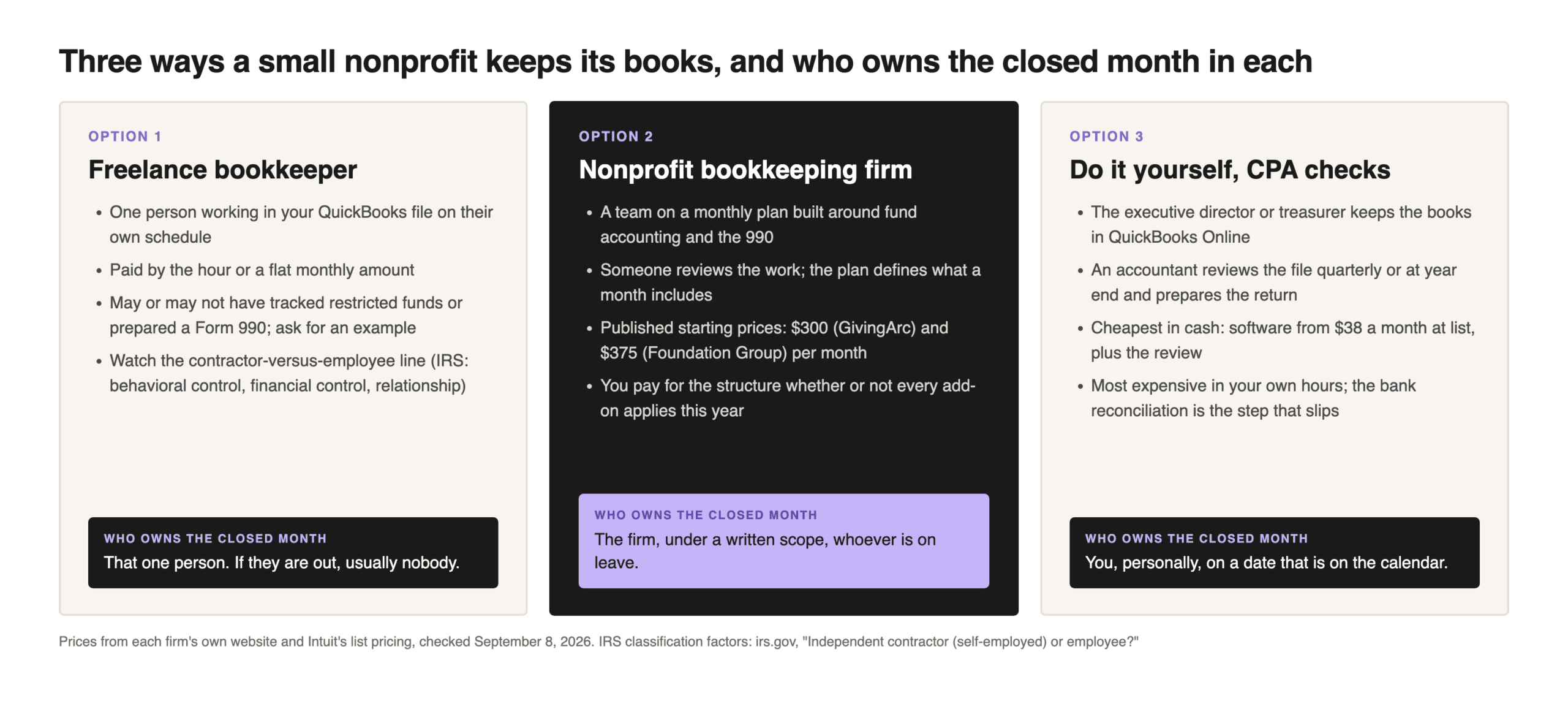
Freelance bookkeeper
One person, usually paid by the hour or a flat monthly amount, working in your QuickBooks file on their own schedule. May or may not have nonprofit experience; ask specifically about restricted funds and the Form 990.
Who owns the closed month: that one person.
Nonprofit bookkeeping firm
A team on a monthly plan, built around fund accounting and the 990. Someone reviews the work, and the plan defines what a month includes. You pay for that structure whether or not you use all of it.
Who owns the closed month: the firm, under a written scope.
Do it yourself, CPA checks
The executive director or treasurer keeps the books in QuickBooks Online, and an accountant reviews the file quarterly or at year end and prepares the return. Cheapest in cash, most expensive in your own hours.
Who owns the closed month: you, personally.
If you want the credentials side of this question, who a bookkeeper is versus an accountant versus a CPA, we cover that in a separate post. This one is about the form the arrangement takes, because that is what decides whether the books are still closed in the month the person is out.
Whoever you choose has to do three things a small-business bookkeeper never meets. Naming them now makes the cost comparison honest, because a lower price that leaves these out is not a lower price for the same work.
Two net asset classes. Under FASB ASU 2016-14, effective for fiscal years beginning after December 15, 2017, a nonprofit’s financial statements present net assets in two classes: with donor restrictions and without. In practice that means every restricted gift and every grant with a purpose or a period has to be tracked from the day it arrives until it is released. Our restricted versus unrestricted funds post walks through what that looks like in the books, and the fund accounting basics post covers the structure behind it.
Expenses by nature and by function. The same standard requires an analysis of expenses by both their natural classification, such as salaries or rent, and their functional classification: program, management and general, and fundraising. If your organization files the full Form 990, Part IX asks for the functional split line by line. That allocation has to be built into how transactions are coded all year, not reconstructed in April.
The right Form 990. The IRS filing chart sets the ladder: Form 990-N when gross receipts are normally $50,000 or less, Form 990-EZ when gross receipts are under $200,000 and total assets under $500,000, and the full Form 990 at or above either of those. Which return you file changes how much detail the books must carry, and the bookkeeper should know which rung you are on before the year starts. We explain the two thresholds in Form 990-EZ versus Form 990 and the small-organization notice in our Form 990-N guide.
A freelancer with for-profit clients can learn all of this. A firm built for nonprofits already does it as the default. Someone doing it themselves has to learn it while also running the organization. That is the real difference the price is paying for.
We will only use figures that are published somewhere you can check. That leaves gaps, and we would rather show the gaps than fill them with a plausible-sounding range.
Freelance bookkeeper. There is no authoritative benchmark for what freelance nonprofit bookkeepers charge. The closest public anchor is the wage floor: the Bureau of Labor Statistics reports a median of $24.36 per hour, or $50,670 per year, for bookkeeping, accounting, and auditing clerks as of May 2025. An independent bookkeeper prices above their own wage to cover software, taxes, and unbilled time, so treat that figure as the bottom of the range, not a quote. The number you actually need is hours per month multiplied by their rate, and for a small organization the hours depend on both how clean the file is and how many transactions run through it.
Nonprofit bookkeeping firm. Of the nine firms we compared in our published-price survey, six of the nine publish no figure at all. Foundation Group lists bookkeeping starting at $375 per month. Jitasa offers an instant quote for organizations under $500,000 in receipts rather than a listed figure on its service page. Our own price table runs from $300 to $1,950 per month, set by receipts, transaction volume, active grants, and restricted fund tracking, and the page prices eight example organizations so you can find the one that looks like yours.
Do it yourself. The cash cost is the software plus the accountant’s review. QuickBooks Online lists Simple Start at $38, Essentials at $85, Plus at $140, and Advanced at $340 per month, before promotions; Plus is the lowest tier that includes class and location tracking, which is how programs and funds are separated in the file, and eligible organizations can get it through TechSoup for an annual administrative fee instead. We cover the setup in QuickBooks for nonprofits. The accountant’s periodic review and the return are quoted separately; our pricing page lists the Form 990 preparation fees separately. The cost nobody invoices is the executive director’s evenings.
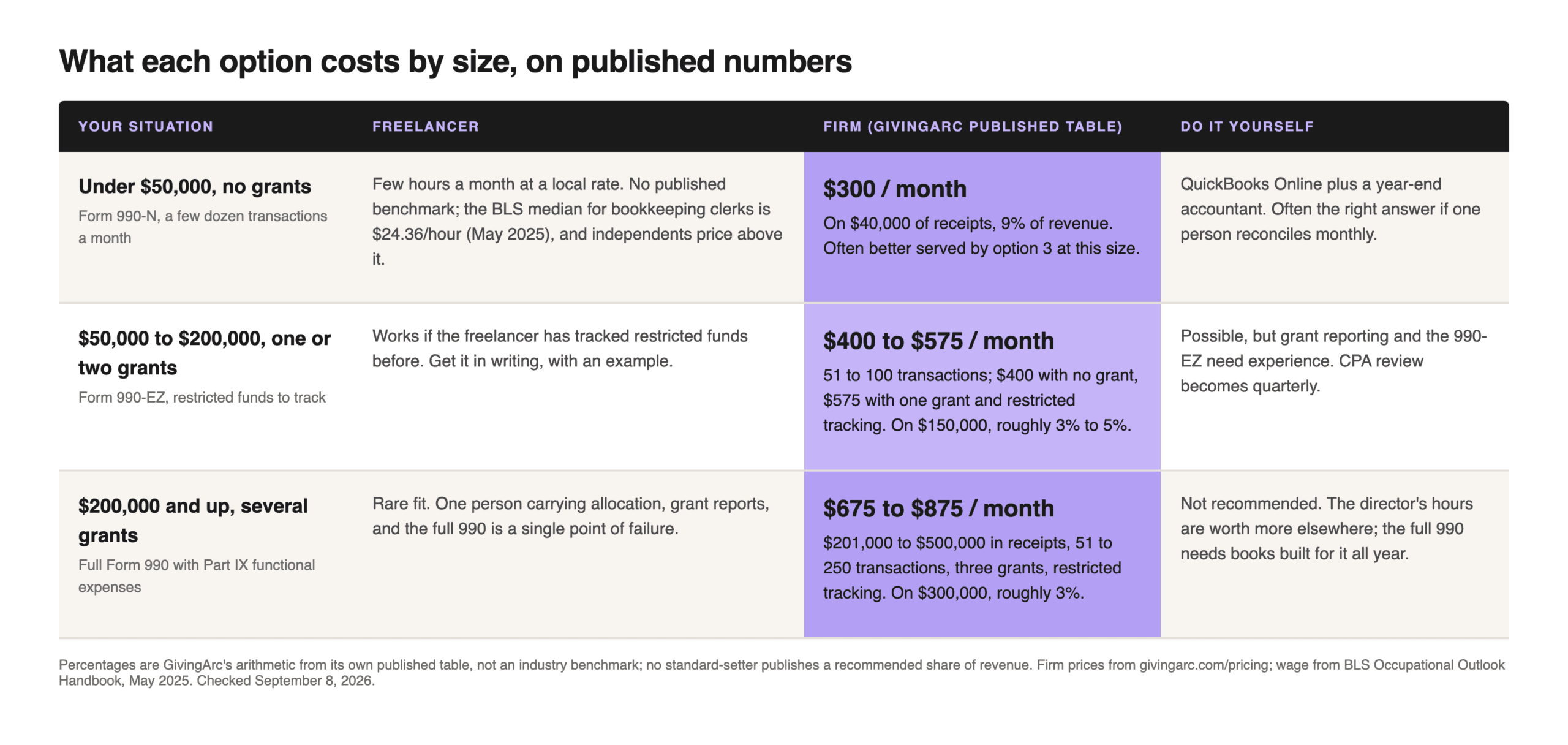
Hours are low; a few per month at a local rate. Ask for a flat monthly amount rather than open hours.
$300/month at our floor. On $40,000 of receipts that is 9% of revenue, which is why we say below that this band is often better served by option 3.
QuickBooks Online plus a year-end accountant. Often the right answer here if one person will actually reconcile monthly.
Works if the freelancer has tracked restricted funds before. Get that in writing, with an example.
$400/month in our table for 51 to 100 transactions with no grant, rising to $575 once one grant and restricted tracking are added. On $150,000 that is roughly 3% to 5% of revenue.
Possible, but the grant reporting and the 990-EZ now need someone who has done them. The CPA review becomes quarterly, not annual.
Rare fit. One person carrying functional allocation, grant reports, and the full 990 is a single point of failure at exactly the size where the board notices.
$675 to $875/month in our table for $201,000 to $500,000 in receipts, 51 to 250 transactions, three grants, and restricted tracking. On $300,000 that is roughly 3% of revenue.
Not recommended. The executive director’s hours are worth more elsewhere, and the full 990 needs books built for it all year.
Two notes on that table. The percentages are our arithmetic from our own published prices, not a benchmark; no standard-setter publishes a recommended share of revenue for bookkeeping, and anyone quoting one is estimating. And the freelance column has no dollar figures on purpose: the honest number depends on the person and the state of your file, so the useful move is to ask three freelancers for a flat monthly quote against the same description of your books.
Our price is on the page, not on a call.Pick your receipts, transactions, grants, and restricted funds on the pricing calculator and you have the monthly number before you talk to anyone. If it is not the right fit for your size, the table below says so.
Ask us which option fits →Since we are one of the firms, the fair thing is to say when our smallest plan is not the answer. Here is that box first, and then the decision steps.
Our $300 plan fits when
It does not fit when
Which Form 990 will you file this year?
Look at last year’s gross receipts and year-end assets against the IRS chart. A 990-N organization can run on option 3 if one person is reliable. A full Form 990 organization should not, because Part IX and the schedules need books built for them all year.
Do you have, or expect, a grant or restricted gift?
If yes, whoever keeps the books must have tracked restricted funds before, and you should ask for an example of a release-from-restriction entry they have made. A freelancer who can show one is a real option. A firm assumes it.
Who reconciles the bank if the bookkeeper is out for a month?
This is the question that separates the three options. With a freelancer, there is no backup unless the agreement names one. With a firm, it is the team under the scope. With option 3, it is you, and you should be honest about whether you will.
Can two different people see the money?
Whatever you choose, the person who records transactions should not be the only person who can move funds. A treasurer who reviews the reconciliation, or a second signer on the account, is the minimum, and our internal controls for small nonprofits post shows how to do it with three people.
Get the same quote from each option.
Write one paragraph describing your receipts, monthly transactions, grants, and the return you file. Send it to three freelancers, run it through two firms’ published tables, and price the software plus a CPA review. Compare the closed month each one promises, not just the number.
None of the three is wrong. Each one has a specific way of going wrong that is worth knowing before you sign anything.
A freelancer who works set hours in your office, uses your equipment, and has no other clients may not be a contractor in the IRS’s eyes. The IRS weighs three categories, behavioral control, financial control, and the type of relationship, and says no single factor decides it. If it is unclear, Form SS-8 asks the IRS to rule, and the IRS notes that can take at least six months. Keep the arrangement genuinely independent, in writing.
Monthly plans are built for the organization the firm expects, and add-ons for grants and restricted funds cost money whether or not this year has any. Ask what the plan includes month by month, whether the add-ons can be switched off in a year with no grants, and what the notice period is. Our in-house versus outsourced post has the questions to bring to that call.
The software is not the risk. The risk is that entering transactions feels like bookkeeping, and the monthly bank reconciliation, the step that actually catches errors, keeps slipping to next weekend. If you go this route, the reconciliation date goes on the calendar as a hard commitment, and the accountant’s review is scheduled in advance, not when the return is due. The pattern of what goes wrong is in our bookkeeping mistakes post.
Whichever option you choose, the handover is where organizations lose a month, and sometimes a year-end. Before the outgoing person’s last day, collect four things: administrator access to QuickBooks Online and the bank portal in the organization’s name, not theirs; the most recent reconciled month with the bank statement that matches it; the list of open grants and restricted gifts with their balances; and last year’s filed Form 990 with the workpapers behind it. A short chart of accounts printout and a fund tracking register, even a rough one, will save the new person their first two weeks.
Then set the first closed month as the goal. Not “get everything perfect,” but “the bank reconciles and the board gets a report.” A short list you actually run monthly beats a perfect list you avoid, and once that month closes, the next one is easier. If the organization has just outgrown its volunteer treasurer, that first month is also the moment the board learns what a readable report looks like; here is the one-page version we build every plan around.
Whichever of the three you choose, the books will get closed in a good month. Choose by asking who owns the closed month when the usual person is away, and the price question mostly answers itself.
A closed month, every month, with a report the board can read.
Our nonprofit bookkeeping starts at $300 a month with a written scope, restricted fund tracking as an add-on you can switch off, and the board report included, with the whole table published.
Common questions from small nonprofits choosing between a freelance bookkeeper, a firm, and doing it themselves.
Often in cash, not always in total. There is no published benchmark for freelance nonprofit rates; the U.S. median wage for bookkeeping clerks was $24.36 per hour in May 2025, and an independent bookkeeper prices above that. Firm plans start at $300 to $375 per month on published tables. The freelancer is cheaper when the file is clean and the hours are few, and more expensive when cleanup, grant tracking, or a Form 990 push the hours up.
Yes, and below about $50,000 in receipts with no grants it is often the right choice. The conditions are that one person reconciles the bank every month on a fixed date, a second person reviews it, and an accountant checks the file and prepares the return at least once a year. Once restricted grants or a full Form 990 arrive, the do-it-yourself option gets expensive in the executive director’s time.
No standard-setter publishes a recommended percentage, so treat any figure you see as an estimate. Using our own published table as one data point, a $150,000 organization pays $400 to $575 per month depending on grants and restricted tracking, roughly 3% to 5% of revenue, and a $300,000 organization with three grants and restricted tracking pays $675 to $875, roughly 3%. Below $50,000 the same floor price becomes a large share of the budget, which is why the do-it-yourself option matters there.
It depends on the whole relationship, not the label. The IRS looks at behavioral control, financial control, and the type of relationship, and says no single factor decides it. A bookkeeper with their own clients, their own software, and control over when the work is done is more likely a contractor; one who works set hours at your desk on your equipment is more likely an employee. If it is unclear, Form SS-8 asks the IRS for a determination, which the IRS says can take at least six months.
When receipts are under roughly $50,000 with no grants, because $3,600 a year is a large share of that budget and a careful volunteer treasurer with a year-end accountant is usually the better use of it. It also does not fit if you already have someone reliable who knows restricted funds, if what you need is cleanup of past years rather than a monthly plan, or if you want an accountant in the room at every board meeting. Our report is written for the board and questions are answered by email.
GivingArc provides bookkeeping, Form 990 preparation, and nonprofit-specialized accounting for small and mid-size 501(c)(3) organizations across the US. We are one of the firms described in this guide; competitor prices are quoted from those firms’ own websites and linked, as checked on September 8, 2026, and the share-of-revenue figures are our arithmetic from our own published table, not an industry benchmark. Reviewed by Min Kim, CPA.