
Every January the same small scene plays out in a small office. Someone opens last year’s receipts to reuse them, reads one properly for the first time, and feels a flicker of doubt: is this actually what the IRS wants, or is it just what we have always sent? The template came from a predecessor, or a search result, or a fundraising platform’s default. It looks official. It thanks the donor warmly. And it may be missing the one sentence that makes it a receipt instead of a thank-you note. This page is the donation receipt template we would hand you if you asked us that January question: a fillable PDF for a single gift, a Word pack with four versions for the situations that actually come up, and the short list of what each one has to say.
Key Takeaways
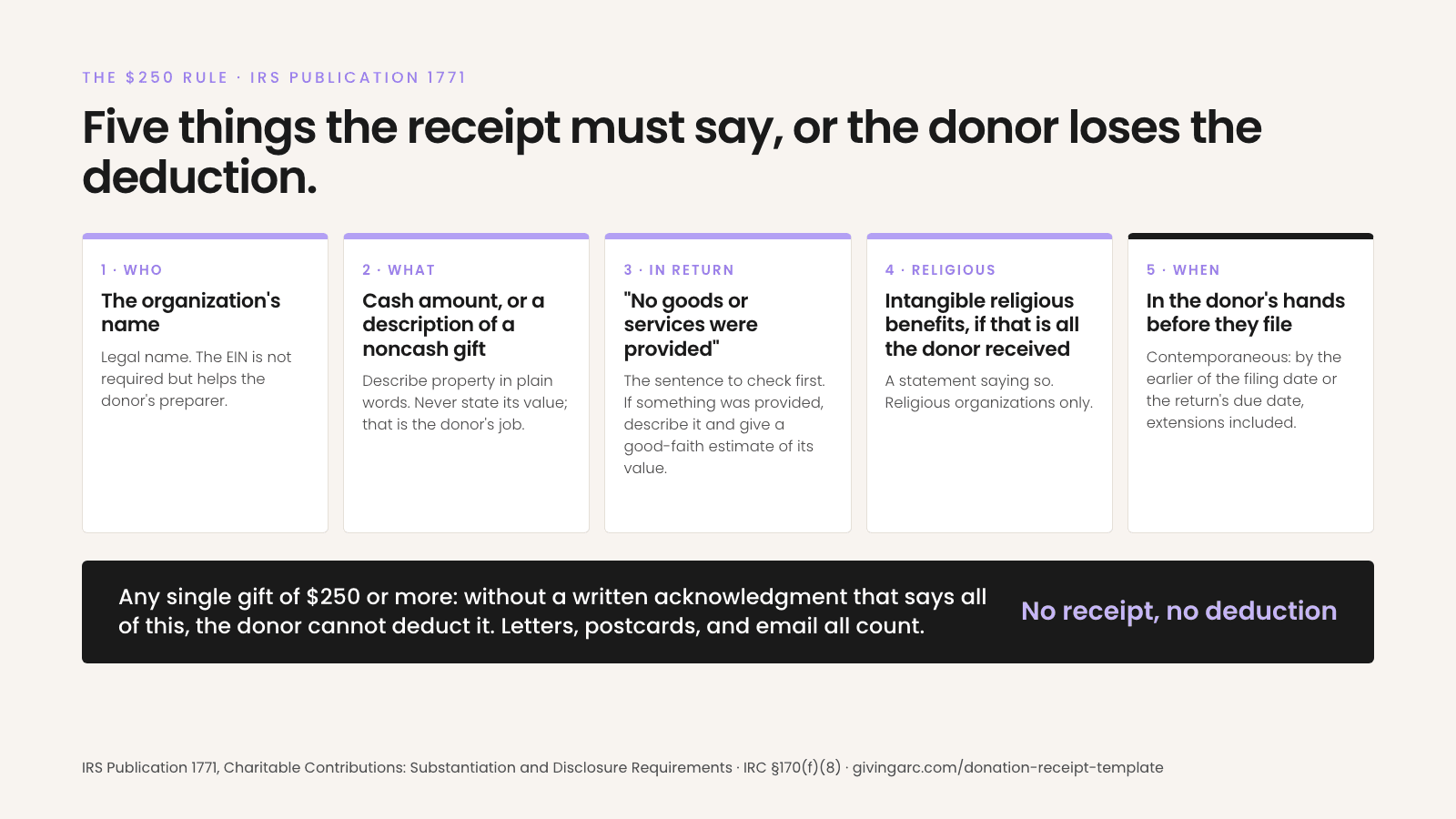
Here is the reframe that makes every template on this page make sense. A donation receipt is not written for the donor’s records. It is written for the day, years from now, when someone questions the donor’s return and asks for proof. Think of it as a passport stamp. The trip happened either way; the stamp is what proves you entered. The IRS puts the burden on the donor to hold that stamp, and it tells charities exactly what has to be on it. Publication 1771 is the source, and the list is short.
The written acknowledgment, per Publication 1771
Not required: the donor’s Social Security number or any IRS form. Publication 1771 says letters, postcards, or computer-generated forms with this information are acceptable, on paper or by email.
Two rules govern when the receipt matters. The donor cannot deduct any single contribution of $250 or more without a written acknowledgment that meets the list above, and the acknowledgment has to be contemporaneous: in the donor’s hands by the earlier of the date they file their return or the return’s due date including extensions. A receipt issued after that point is not a receipt for tax purposes, even if every word on it is right. That is the whole reason charities send acknowledgments in January rather than in April; the IRS notes that organizations typically send them no later than January 31 of the following year.
If this page is the template, our donation acknowledgment letter guide is the manual: the rules in more depth, the special cases for vehicles and stock and volunteer expenses, and how to turn the receipt into a letter a donor actually remembers. Use both. The receipt below is what has to be there; the letter is what you wrap around it.
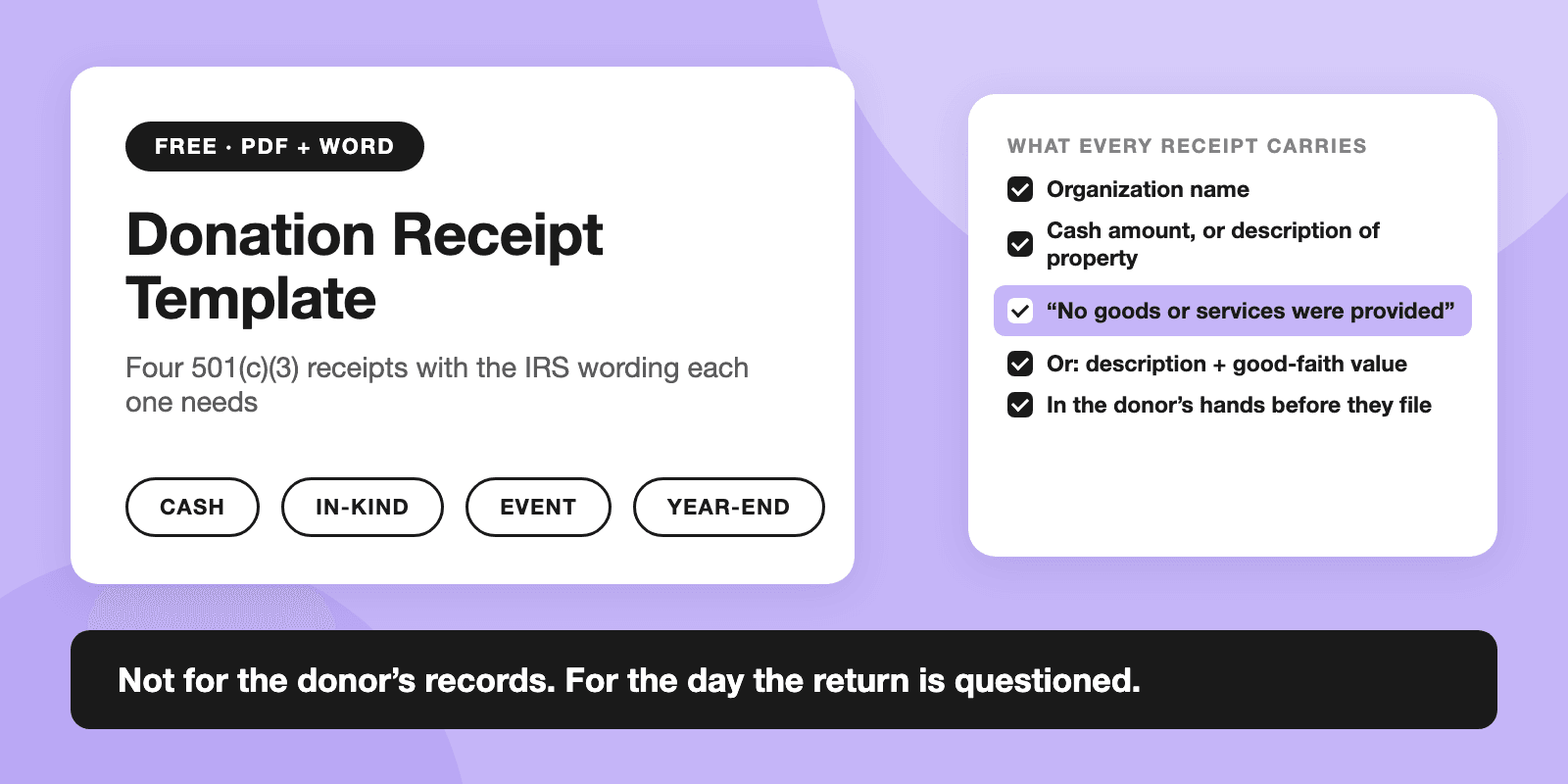
Two files, free, no email required. The fillable PDF is a one-page receipt you can complete in any PDF reader and send as a gift arrives; the checkboxes force the goods-or-services decision so it cannot be skipped. The Word pack holds four editable templates, one for each situation below, so you can drop them into your own letterhead or your donor software’s merge fields. A PDF copy of the pack is included for reading on a phone.
Donation Receipt, one gift, one page
Organization and donor details, cash amount or non-cash description, three checkboxes for the goods-or-services statement, signature line. Open, type, save, send.
Download the fillable receipt (PDF) →Letter size · 17 fields · no signup
Donation Receipt Template Pack, four versions
Cash gift, in-kind gift, event or quid pro quo receipt with the deductible-portion wording, and a year-end giving statement. Every bracket is a field to replace.
Download the Word pack (.docx) →Also as PDF · 4 templates · no signup
Both files say “template only, not tax advice” at the bottom, and mean it. The wording tracks Publication 1771 as of September 2026, but the facts of a gift change the right answer, and your state may add its own charitable-solicitation language. If you already record in-kind gifts, the in-kind donation record we published earlier is the intake form; the receipt here is what goes back to the donor.
The workhorse. Use it for checks, cards, and online gifts, for any amount. (Payroll-deduction gifts are substantiated differently, through the pledge card and the donor’s pay stub or W-2, as Publication 1771 describes.) The IRS requirement bites at $250, but a receipt for a $40 gift costs nothing and trains the habit; Publication 1771 also notes that separate gifts under $250 are not aggregated, so a donor who gives $100 a month twelve times needs bank records, not acknowledgments, for the deduction, and still deserves the receipt. Here is the core of Template 1 as it appears in the pack.
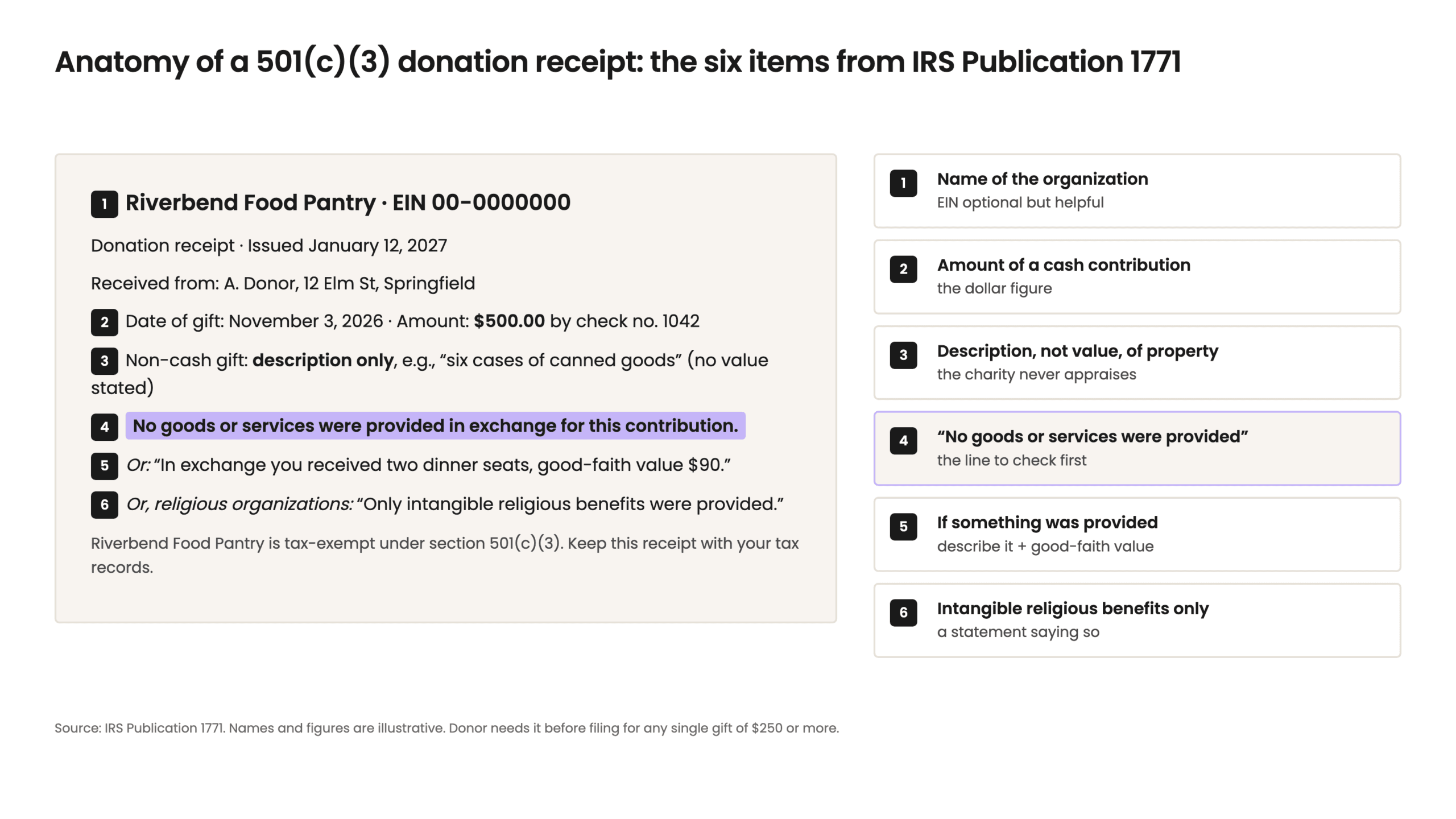
[Organization legal name] · EIN [00-0000000]
[Street address, City, State ZIP]
DONATION RECEIPT · Receipt no. [optional] · Date issued: [Month DD, YYYY]
Received from: [Donor full name], [Donor address]
Date of gift: [Month DD, YYYY] · Amount: $[0,000.00] · Method: [check no. / card / ACH]
No goods or services were provided in exchange for this contribution.
[Organization] is recognized by the IRS as tax-exempt under section 501(c)(3) of the Internal Revenue Code. Your contribution is deductible to the extent allowed by law. Please keep this receipt with your tax records.
Thank you for supporting [one line on what the gift makes possible].
[Name], [Title]
The highlighted sentence is the one to protect. It is easy to lose when a template gets “warmed up” by a well-meaning editor, and it is the sentence whose absence has cost real donors real deductions: in Durden v. Commissioner, a couple lost a deduction of more than $22,000 for gifts to their church because the church’s letter listed the gifts but never said whether anything was received in return, and the corrected letter arrived after they had filed. Every template in the pack carries the sentence in bold for that reason.
The in-kind receipt has one job the cash receipt does not: it must describe the property and must not value it. Publication 1771 lists “description (but not value) of non-cash contribution” as the required item, and valuation is the donor’s responsibility under the donor-side rules in Publication 561. A receipt that says “thank you for your donation of a laptop valued at $900” has done the donor’s appraisal for them, which is a favor the IRS does not want the charity doing.
Not this
“Thank you for your generous in-kind gift valued at $1,200.”
The charity has assigned a value, which the IRS says it should not do, and has said nothing about goods or services in return.
This
“Description of property received: twelve folding tables, used, good condition, and one Dell laptop, model XXXX. The organization has not assigned a value to this gift. No goods or services were provided in exchange for this contribution.”
Description, no value, the goods-or-services sentence, and a line reminding the donor that Form 8283 may be required when the deduction claimed for noncash property is more than $500.
Donated services, by the way, get a thank-you letter but not a deductible receipt: the value of a volunteer’s time is not deductible, though unreimbursed out-of-pocket expenses can be, with their own acknowledgment rules described in Publication 1771. The in-kind template in the pack is for property only, and says so.
Watch: why a receipt for donated services carries no dollar amount, and which list each in-kind gift belongs on (video).
Receipts are only as good as the gift record behind them. Our bookkeeping plans record every gift as it lands, with donor and restriction tagged, so January’s year-end statements are a report, not a reconstruction. Plans start at $300 a month; the full table is on the pricing page.
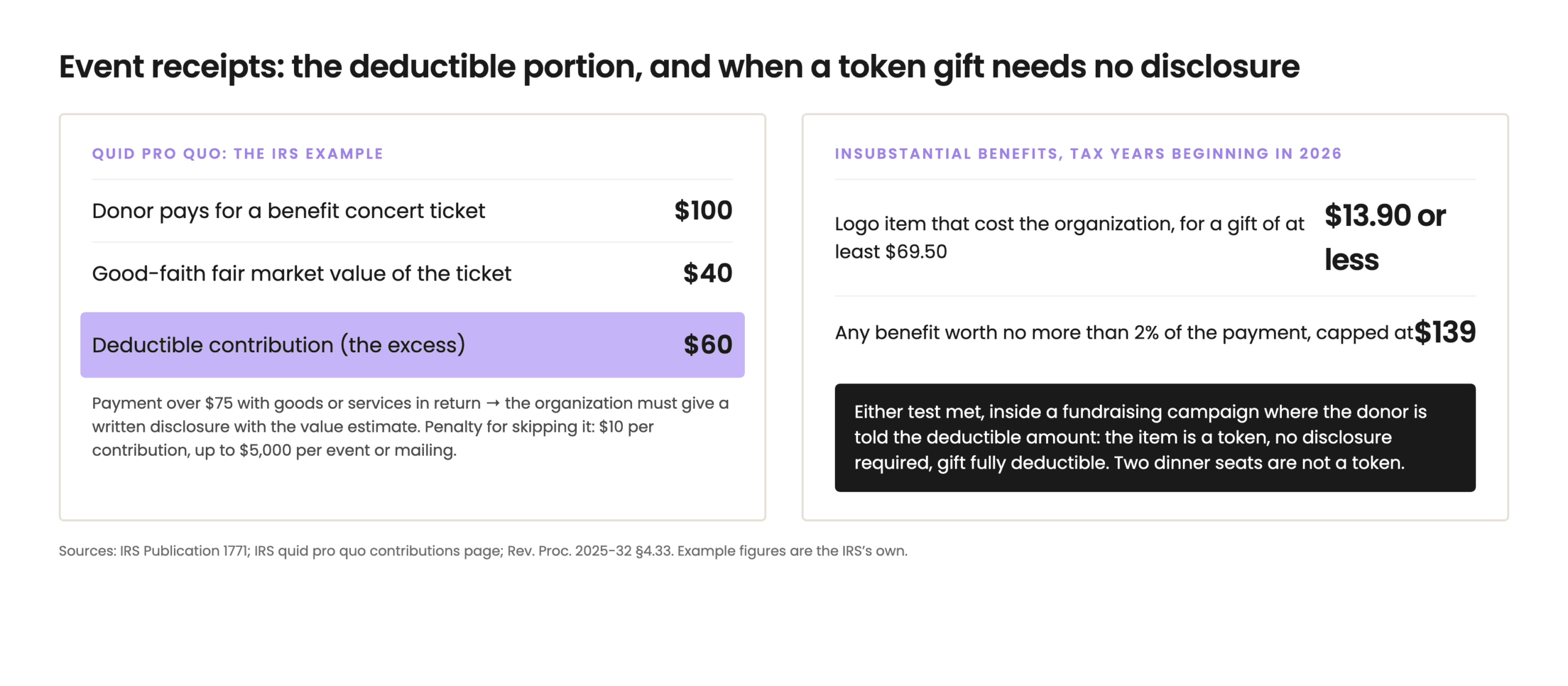
What every plan includes →Everything above is a rule about the donor’s deduction. This is the one receipt where the rule is about you. When a donor makes a payment of more than $75 that is partly a contribution and partly for goods or services, a gala seat, an auction item, a round of golf, the IRS calls it a quid pro quo contribution and requires the organization to provide a written disclosure statement. The statement must tell the donor that the deductible amount is limited to the excess of the payment over the fair market value of what they received, and it must give a good-faith estimate of that value. Skip it and the penalty lands on the charity: $10 per contribution, up to $5,000 per event or mailing, unless the organization can show reasonable cause.
Four exceptions keep this from swallowing every mug and tote bag. No disclosure is needed when the goods or services are of insubstantial value under the IRS’s indexed limits, when the payment is an annual membership of $75 or less that carries only the usual membership privileges, when only intangible religious benefits are provided, or when there is no donative element at all, such as a gift-shop sale. The insubstantial-value test has two forms, both tied to a fundraising campaign in which the organization tells the donor the deductible amount. For tax years beginning in 2026, Rev. Proc. 2025-32 sets the figures: logo items are tokens when together they cost the organization $13.90 or less and the donor gave at least $69.50, and any benefit is a token when its value is no more than 2% of the payment or $139, whichever is less. A logo mug that cost the organization under $13.90, sent for a $100 gift, is a token; two dinner seats are not. When in doubt, disclose; a disclosure that was not strictly required costs nothing, and a missing one has a price.
Publication 1771 allows one acknowledgment, such as an annual summary, to substantiate several gifts of $250 or more, and the January statement is that permission put to work. It is also the receipt that donors actually keep, because it arrives when they are gathering tax documents. The statement lists each gift with its date and amount so that every individual gift at the threshold is covered, totals them, and makes the goods-or-services statement once for the whole list, with any exceptions called out gift by gift.
Annual contribution statement, tax year 2026 (illustrative)
[Organization legal name] · EIN [00-0000000] · Donor: [name, address] · Issued January [DD], 2027
| Date | Description | Amount |
|---|---|---|
| 02/14/2026 | Cash gift, check no. 1042 | $250.00 |
| 06/03/2026 | Online gift | $500.00 |
| 10/18/2026 | Fall dinner payment (see note) | $300.00 |
| 12/29/2026 | Year-end gift | $1,000.00 |
| Total cash contributions | $2,050.00 | |
| Deductible portion after the dinner (see note) | $1,960.00 |
No goods or services were provided in exchange for any of the contributions listed above, except as follows: the 10/18/2026 payment included two dinner seats with a good-faith fair market value of $90; the deductible portion of that payment is $210.
Send it in January, every year, to every donor, before anyone has a chance to file. If your donor records live in a spreadsheet, that is a weekend; if they live in accounting software with donors tagged on each deposit, it is a report. Either way it is the single most valuable hour of donor communication the organization does all year, and our guide to the fiscal year-end close puts it on the same checklist as the 1099s.
Leaving out the goods-or-services sentence
The omission the Tax Court has refused to forgive. If nothing was given back, say so in those words.
Putting a dollar value on an in-kind gift
Describe the property. Valuation belongs to the donor; the charity that supplies a number has stepped into an appraisal it is not qualified to give.
Sending the year-end statement in March
Donors who filed in February hold a receipt that arrived too late to count. January is the deadline that matters, whatever the calendar says.
Treating an event payment as a plain gift
A $300 gala payment with $90 of dinner is not a $300 donation. Over $75, the disclosure is the organization’s legal obligation, not a courtesy.
Reissuing a “corrected” receipt after the donor files
It cannot cure the defect. The fix is upstream: a template that is right, used every time, from the first gift of the year.
Waiting for the $250 gift to start
Receipt every gift. The habit is what protects the large gift; a template only used occasionally is a template used wrong.
Start small if you must. Put the fillable receipt in the folder where gifts get recorded, use it for every gift for one quarter, and add the year-end statement in January. A short routine you actually run every week beats a perfect one you keep meaning to set up. Then, when you have a minute, read the acknowledgment letter guide for the second gift the receipt can earn you, and the gift acceptance policy for the gifts you should think twice about receipting at all.
Year-end statements that come out of the books, not out of a weekend
GivingArc bookkeeping tags every gift to its donor and restriction as it is recorded, and our Form 990 team reviews the receipting rules with you at year end. Prices are on the pricing page, no call required.
Common questions from small nonprofits using a donation receipt template.
No. Publication 1771 states there are no IRS forms for the written acknowledgment, and that letters, postcards, or computer-generated forms containing the required information are acceptable, on paper or by email. Any template that carries the organization’s name, the cash amount or a description of property, and the goods-or-services statement meets the requirement.
The IRS list of required items does not include the EIN; it requires the organization’s name. Including the EIN is common practice because tax preparers look for it and it removes any doubt about which entity issued the receipt. The templates on this page include it. The donor’s Social Security number is never required.
The written-acknowledgment requirement applies to any single contribution of $250 or more; below that, the donor can substantiate a monetary gift with a bank record or a receipt. Separate gifts under $250 are not added together to reach the threshold. Receipting every gift anyway is sound practice, because the habit is what protects the large gifts and because donors expect it.
Yes. Publication 1771 allows one contemporaneous written acknowledgment, such as an annual summary, to substantiate several contributions of $250 or more. The statement covers the gifts of $250 or more, carries the goods-or-services statement, and reaches the donor by the earlier of the filing date or the return’s due date including extensions; Publication 1771 does not prescribe a format, and listing each gift is the practical way to meet it. Sending individual receipts during the year and a statement in January is the common belt-and-suspenders approach.
If the payment was more than $75 and the item has more than insubstantial value, the organization must provide a written disclosure stating that only the excess of the payment over the item’s fair market value is deductible, with a good-faith estimate of that value; the penalty for skipping it is $10 per contribution up to $5,000 per event or mailing. Token items within the IRS’s indexed limits for tax years beginning in 2026, a logo item costing the organization $13.90 or less for a gift of at least $69.50, or benefits worth no more than the lesser of 2% of the payment or $139, do not trigger the disclosure, and the penalty does not apply where the organization shows reasonable cause. Template 3 in the pack carries the required wording.
GivingArc provides bookkeeping, Form 990 preparation, and nonprofit-specialized accounting for small and mid-size 501(c)(3) organizations across the US. The templates and the sample statement are illustrative and not tax or legal advice; the figures shown are not drawn from any client. Sources are linked where cited, as checked on September 7, 2026. Reviewed by Min Kim, CPA.