
The grant application is due Friday. The funder’s checklist asks for “a copy of your IRS determination letter,” and somewhere there is one. It arrived years ago, addressed to a founder who has since moved, and it was scanned once by a board member whose laptop has since died. Meanwhile a corporate donor is asking a different question: not “send us the letter,” but “are you still a 501(c)(3)?” Those are two different questions with two different answers, and this page covers both: what a 501(c)(3) determination letter actually says, how anyone can verify an organization’s status in a few minutes, and how to get a replacement when the original is in a drawer nobody can find.
Key Takeaways
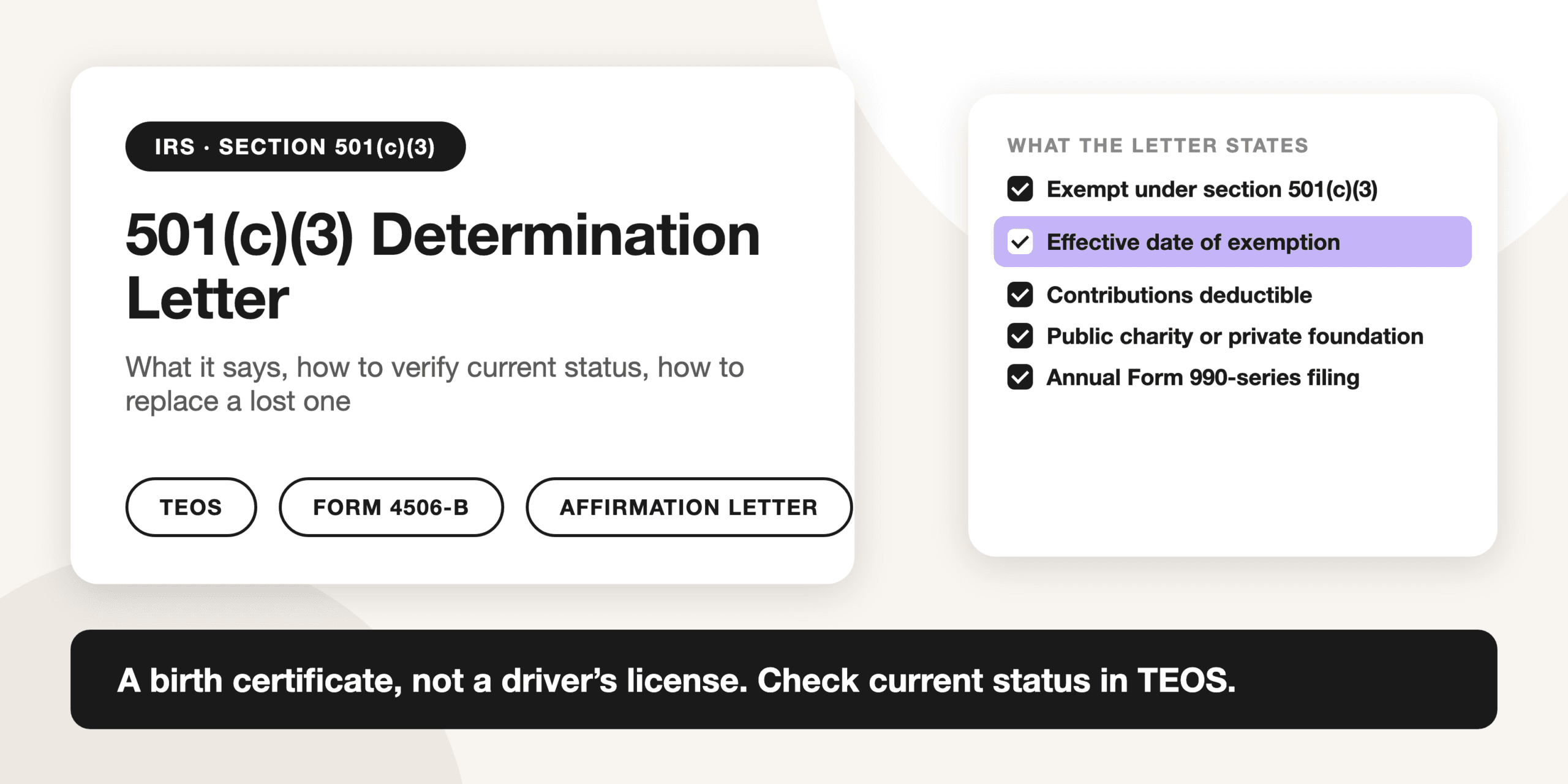
A determination letter is the IRS’s written answer to an application for recognition of exemption. For a charity, the application is Form 1023 or Form 1023-EZ, and the favorable answer is a letter recognizing the organization as exempt under section 501(c)(3). The IRS’s own dataset guide for the Tax Exempt Organization Search describes what the letter includes: the effective date of exemption, whether contributions to the organization are deductible, whether it is required to file a Form 990-series return or notice, and, for 501(c)(3) organizations, its foundation classification as a public charity or a private foundation. If the letter was issued on an application for reinstatement after automatic revocation, it also carries an addendum confirming that status was reinstated.
The subsection the organization applied under and was recognized under. This is the line that answers the question a grant application or a matching-gift form is asking.
The date exemption began. For an application filed within 27 months of formation, this is normally the formation date, so gifts received before the letter arrived are covered.
Whether donors may deduct contributions under section 170. It is the same fact the Pub. 78 data reports.
Public charity or private foundation, with the section that applies, such as 170(b)(1)(A)(vi) or 509(a)(2). This drives which public support test the organization reports on Schedule A and whether private foundations rules apply.
Whether a Form 990-series return or notice is required. Apart from churches and a few other statutory exceptions, a 501(c)(3) must file a Form 990-N, 990-EZ, or 990 every year, and the letter says so.
Here is the reframe. The determination letter is a birth certificate. It proves the organization was recognized as exempt on a certain date, and that fact never changes. It is not a driver’s license. It does not prove the organization is still in good standing today, because exemption can be lost after the letter is issued, and when exemption is revoked automatically the IRS mails a revocation notice, not a retraction of the old letter. When a donor or funder wants to know whether an organization is exempt right now, the letter is the wrong document. The license check is the IRS search tool, covered in the third section.
A new charity applies on Form 1023, or on the streamlined Form 1023-EZ if it qualifies. The Form 1023-EZ eligibility worksheet in the form’s instructions asks, among other questions, whether the organization projects gross receipts above $50,000 in any of its next three years, whether receipts exceeded $50,000 in any of the past three years, and whether total assets exceed $250,000. A “yes” to any of those means the full Form 1023. Both applications are filed on Pay.gov with a user fee that the IRS sets each year: $600 for Form 1023 and $275 for Form 1023-EZ at the time of this writing. The formation steps that come before the application, from articles of incorporation to the EIN, are on our how to become a nonprofit organization page.
The effective date is worth reading closely. Under the Form 1023 instructions, an organization that files within 27 months after the end of the month in which it was legally formed is generally recognized as exempt from its formation date. File later than that, and exemption generally runs from the date the application was filed, which leaves a gap during which the organization was not a 501(c)(3) and its donors’ gifts were not deductible. The 27-month window is the date to understand before you have a letter at all.
How long the wait is depends on the form and on the IRS’s current backlog. The IRS publishes the dates it is currently working on its Where’s my application for tax-exempt status page, and asks applicants not to call until their submission date falls inside the posted window. When we checked in early September 2026, that page, last updated by the IRS in June 2026, stated that the IRS issues 80% of Form 1023-EZ determinations within 22 days and 80% of Form 1023 determinations within 191 days. Those figures move; check the page rather than this paragraph.
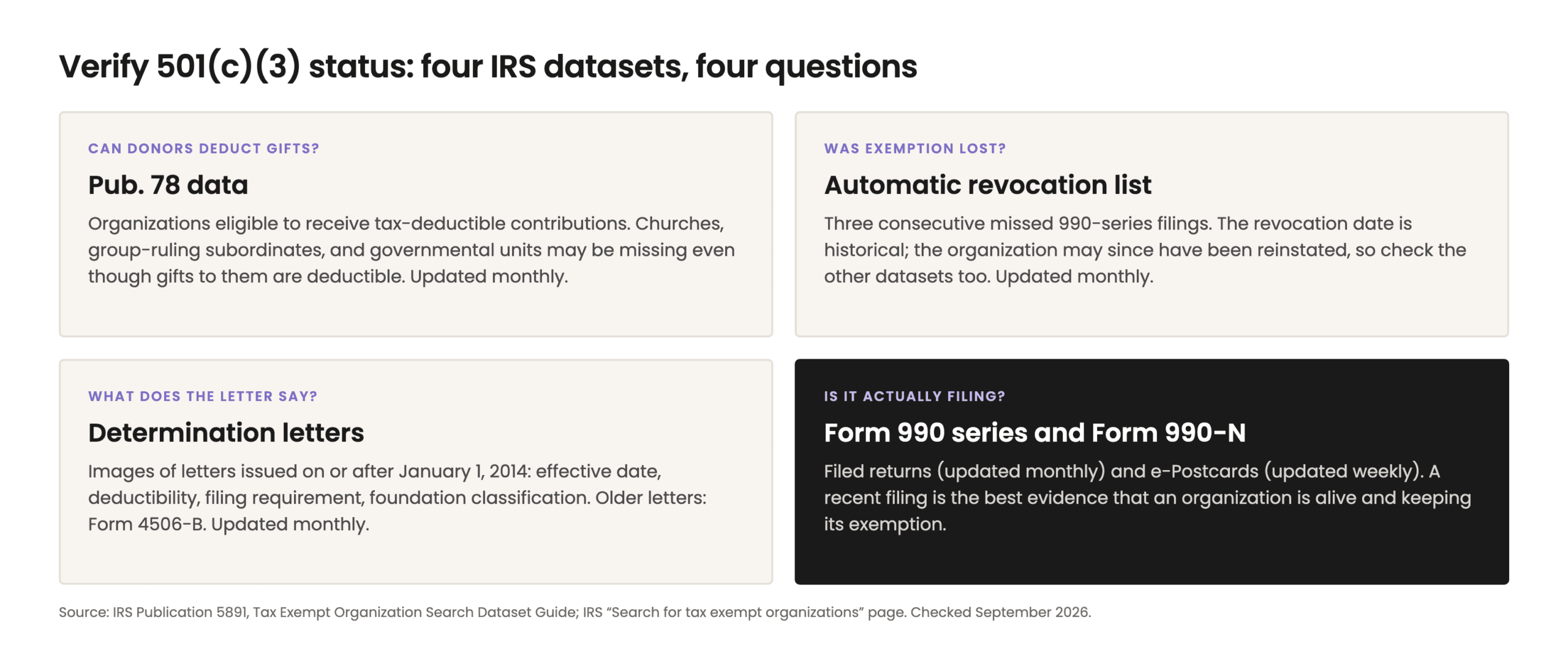
The Tax Exempt Organization Search, usually shortened to TEOS, is the IRS’s free public lookup. It is one search box in front of five separate datasets, and knowing which dataset answers which question is the whole skill. Search by name or EIN. The IRS’s search tips note that fields are not case-sensitive, the dash in an EIN is optional, a partial name works best inside quotation marks, and common words like “the” or “foundation” should be left out.
Question: can donors deduct gifts?
Pub. 78 data
The list of organizations eligible to receive tax-deductible contributions. This is the dataset that answers the deductibility question. Updated monthly, generally the second Tuesday.
Question: was exemption lost?
Automatic revocation list
Organizations whose exemption was revoked for three consecutive missed filings, with the effective date. The date is historical: an organization on the list may since have been reinstated, so check the other datasets too. Updated monthly.
Question: what does the letter say?
Determination letters
Images of letters issued on or after January 1, 2014, including reinstatement letters. Older letters are not here; see the replacement section below. Updated monthly, generally the second Wednesday.
Question: is it actually filing?
Form 990 series and Form 990-N
Images of filed Forms 990, 990-EZ, 990-PF, and, for 501(c)(3) organizations, 990-T, updated monthly, and the eight-item e-Postcard data, updated weekly. A recent filing is the best evidence that an organization is alive and keeping its exemption.
Update cadence, from the IRS dataset guide, is why a status check can be “wrong” for a few weeks. An organization approved on the 20th of the month will not appear in the Pub. 78 data until the next monthly posting, and its letter will not appear in the determination-letter dataset until the posting after that. The IRS search page shows the date of each dataset’s most recent posting; read that date before concluding that a brand-new organization does not exist.
A practical order for a grant officer or a donor: search by EIN, confirm the organization appears in Pub. 78 data with the deductibility code you expect, check that it is not on the revocation list with no later reinstatement, and open the most recent 990-series filing or e-Postcard to confirm it is current. For an organization checking on itself, the same four steps, once a year, are worth putting on the same calendar as the Form 990 deadline.
An empty search result is not a verdict. The IRS search page itself warns that some donees eligible to receive deductible contributions may not be listed in the Pub. 78 data, and there are several ordinary reasons an organization in perfectly good standing does not appear.
It is a church, or a church-affiliated organization
Churches are not required to apply for recognition. They can receive deductible gifts without a determination letter and without appearing in Pub. 78 data. A church may still apply voluntarily; see our church accounting guide for the filing side.
It is covered by a group ruling
Chapters, affiliates, and subordinates covered by a parent’s group exemption may not be listed individually. The IRS obtaining-copies page says subordinates should contact their central organization to confirm membership, and the central organization is the one that can confirm coverage under its group ruling.
It is a governmental unit
Public schools, state universities, and municipal entities can receive deductible contributions without being 501(c)(3) organizations, and they are generally not in the Pub. 78 data.
You searched a “doing business as” name
Pub. 78 data lists the legal name on the IRS record, not DBA names. Search by EIN, or by the name on the articles of incorporation, before deciding the organization is missing.
It was approved after the last data posting
Pub. 78 and determination-letter data post monthly. A letter dated this week is real even though the search does not show it yet; ask for the letter itself in the meantime.
Where does the letter live at your organization? Our bookkeeping clients keep the determination letter, the EIN notice, and the last three returns in one shared compliance folder we maintain, so a grant officer’s request is answered from one place.
See how the bookkeeping service works →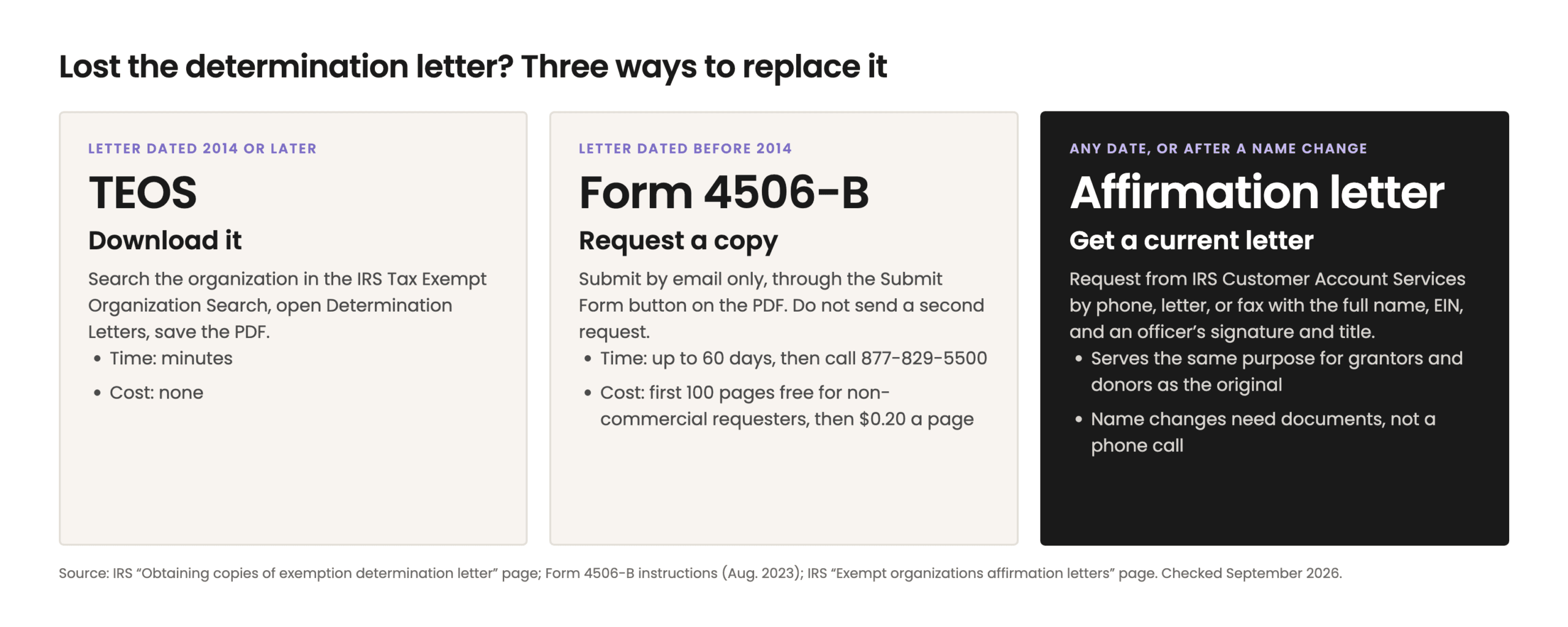
The IRS page on obtaining copies of an exemption determination letter lays out the options, and which one applies depends mostly on the letter’s date.
Download it from TEOS
Search the organization, open the Determination Letters result, and save the PDF. No request, no fee, no wait. This is the IRS’s own first recommendation.
Time: minutes. Cost: none.
Form 4506-B
Form 4506-B requests a copy of an exempt organization’s application or determination letter. The current instructions accept email submission only, through the Submit Form button on the PDF. The IRS obtaining-copies page says not to send a second request, because it can delay processing.
Time: up to 60 days, then call 877-829-5500. Cost: first 100 pages free for non-commercial requesters, $0.20 per page after; commercial users pay $0.20 per page from the first page.
Affirmation letter
A current letter from the IRS confirming exempt status, which the IRS says serves the same purpose for grantors and contributors as the original. Request it from Customer Account Services by phone, letter, or fax with the full name, EIN, and an officer’s signature and title, or check the affirmation letter box on Form 4506-B.
Best for: a letter that shows the current name and address, or a pre-2014 letter you need faster than a copy.
One caution from the Form 4506-B instructions: an organization requesting a copy of its own application receives only the version that is open for public inspection. Anything filed with the application that is not open to inspection, such as information identifying a contributor, is not included. For the determination letter itself that makes no difference, because the letter is a public document. Exempt organizations must make their application and their determination letter available for public inspection on request, along with their annual returns for three years from the later of each return’s due date, including extensions, or the date it was filed, which is one more reason to keep a clean copy where the office can find it.
The letter is a single piece of evidence that an organization was recognized as a charity. It is easy to treat it as more than that. Four limits are worth stating plainly.
It does not
Exempt you from state taxes
State income tax exemption, sales and use tax exemption, and property tax exemption are separate, state-level applications. A federal letter is an attachment to those applications, not a substitute for them.
Register you to fundraise
Charitable solicitation registration with a state attorney general or secretary of state is its own filing where required. The letter proves exemption; it does not license fundraising.
Keep you exempt
Exemption is automatically revoked for three consecutive years without a required 990-series return or notice. The letter in the drawer is unchanged on the day that happens; only the revocation list changes.
Excuse income tax on unrelated business
A 501(c)(3) can still owe tax on unrelated business income and may need to file Form 990-T. The letter recognizes exemption for the organization’s exempt purpose, not for everything it earns.
Three habits keep the birth certificate and the license in agreement. First, file the annual return or notice every year, on time, whichever form applies; our Form 990-EZ vs. 990 page sorts out which one. Second, report name and address changes. The IRS affirmation-letter page says an address change may be reported by phone, letter, fax, or Form 8822-B, that a name change needs supporting documents and cannot be made by phone, and that either change must also be reported on the next annual return even if it was reported separately. Third, keep the compliance file together: the determination letter, the EIN notice, the bylaws and conflict-of-interest policy, and the last three returns. Our nonprofit compliance checklist lists what belongs in that folder and how often each item is touched.
If exemption has already been lost, the letter does not need to be replaced; the status does. The IRS reinstatement procedures under Revenue Procedure 2014-11 require a new application and user fee, and a reinstated organization receives a new determination letter with the reinstatement addendum. That new letter, not the original, is the one to give funders from then on.
The letter is step one. The annual return is what keeps it true.
Our Form 990 preparation starts at $500 for a 990-EZ and $1,500 for a full Form 990, and our bookkeeping plans from $300 a month include the e-Postcard filing and the compliance folder. Prices are on the pricing page.
Putting the numbers where people look
A determination letter is easier to share when it has a permanent place on your website. Our sister practice, connectNPO, builds websites for small nonprofits that show what the money did: an Impact page with this year’s results, and a financials page with your latest Form 990 and statements, both brought up to date each year after the filing. You see the finished site before you pay for it; after that it is one plan, $180 a month.
See a sample financials page →
GivingArc and connectNPO are both run by Daybooks Web Solutions, LLC.
Common questions about 501(c)(3) determination letters and verifying exempt status.
Search the IRS Tax Exempt Organization Search by name or EIN. Confirm the organization appears in the Pub. 78 data, which lists organizations eligible to receive deductible contributions, check that it is not on the automatic revocation list without a later reinstatement, and open its most recent Form 990-series filing or e-Postcard. For letters issued on or after January 1, 2014, you can also open the determination letter itself.
No. The letter has no expiration date and is not reissued on a schedule. Exempt status can still be lost after the letter is issued, including through automatic revocation for three consecutive years of missed 990-series filings, so a funder who wants current status should check the IRS search tool rather than rely on the letter’s date.
If the letter was issued in 2014 or later, download it free from the IRS Tax Exempt Organization Search. If it is older, submit Form 4506-B by email through the button on the form and allow up to 60 days. As an alternative for any date, request an affirmation letter from IRS Customer Account Services or on Form 4506-B, which confirms current exempt status and serves the same purpose for grantors and donors.
The determination letter is the original IRS decision recognizing exemption, issued once in response to an application. An affirmation letter is a later letter from the IRS confirming that the organization is currently recognized as exempt, which an organization can request after a name or address change or when the original cannot be found. The IRS states that an affirmation letter serves the same purpose for grantors and contributors as the original.
It depends on the form and the current IRS workload. The IRS publishes the submission dates it is currently working on its Where’s my application for tax-exempt status page and asks applicants not to call until their date falls inside that window. When checked in early September 2026 the page reported that 80% of Form 1023-EZ determinations issue within 22 days and 80% of Form 1023 determinations within 191 days.
Yes. An exempt organization must make its exemption application, its determination letter, and its annual returns for three years from the later of each return’s due date, including extensions, or the date it was filed, available for public inspection on request. Letters issued on or after January 1, 2014 are also posted in the IRS Tax Exempt Organization Search, and anyone may request an older letter on Form 4506-B.
GivingArc provides bookkeeping, Form 990 preparation, and nonprofit-specialized accounting for small and mid-size 501(c)(3) organizations across the US. The opening scenario is illustrative and not drawn from any client. Sources are linked where cited, as checked on September 7, 2026. Reviewed by Min Kim, CPA.