
Most of Form 990 asks what your organization did last year. Schedule A asks something stranger: are you still the kind of organization you said you were?
And the answer isn’t about your programs, your impact, or your board. It’s arithmetic — a five-year rolling calculation of where your money came from. Public charity status doesn’t measure whether you do good work. It measures whether your support is broad. Which produces the counterintuitive fact at the center of this schedule: the single event most likely to threaten your public charity status is a very large gift. Your best fundraising news is the thing the test is designed to be suspicious of.
These Form 990 Schedule A instructions walk the form the way you actually fill it out: who files, how to pick your Part I line, how the public support test is computed (with a worked five-year example), what happens when one donor dominates, and what a failed test actually triggers. All references are to the 2025 form and its IRS instructions.
Key Takeaways
Schedule A has no deadline of its own. It’s an attachment: it goes in with your Form 990 or Form 990-EZ, on the same due date — the 15th day of the fifth month after your fiscal year ends — and it’s filed electronically along with the rest of the return.
Must attach Schedule A
Doesn’t file it
If you’re not sure which return you file in the first place, start with our comparison of Form 990-EZ vs Form 990 — the schedule follows the return, not the other way around.
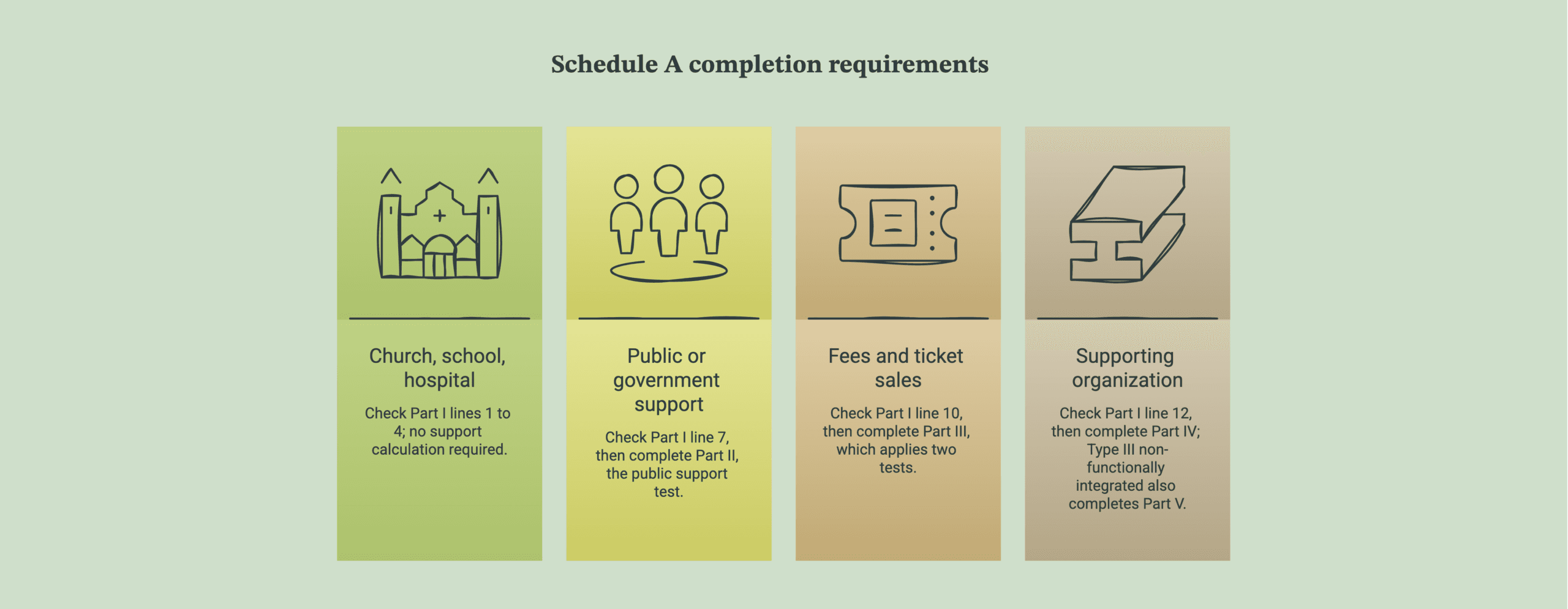
Part I asks you to check exactly one box explaining why you’re not a private foundation. There are twelve lines, and they split into two philosophies: some organizations qualify because of what they are, and the rest qualify because of where their money comes from.
Part I — the twelve reasons
| Line | Who checks it | Math required? |
|---|---|---|
| 1–4 | Churches, schools, hospitals and medical research organizations | None — status by category |
| 5 | Organizations that hold property for and support a college or university owned or operated by a governmental unit | Part II |
| 6, 9 | Governmental units, and agricultural research organizations operated with a land-grant college or a non-land-grant college of agriculture | None |
| 7 | The common one — organizations receiving a substantial part of support from the public or governmental units, under 170(b)(1)(A)(vi) | Part II |
| 8 | Community trusts | Part II |
| 10 | Organizations under 509(a)(2) — support from contributions plus fees for exempt-purpose activities | Part III |
| 11 | Organizations testing for public safety, under 509(a)(4) | None |
| 12a–12d | Supporting organizations — Type I, Type II, Type III functionally integrated, Type III non-functionally integrated | Part IV (and Part V for Type III non-FI) |
Two practical notes. First, the line you check should match the classification in your IRS determination letter — if your actual funding has drifted away from it over the years, that’s a conversation to have with your CPA before you file, not after. Second, if you’re within the first five years of your 501(c)(3) status, you check the box on Part II line 13 (or Part III line 14) and skip the rest of the support computation.
Part II is the calculation most organizations land on. It covers five years — the tax year you’re filing plus the four before it — and it asks one question: of all the support you received, how much came from a genuinely broad base?
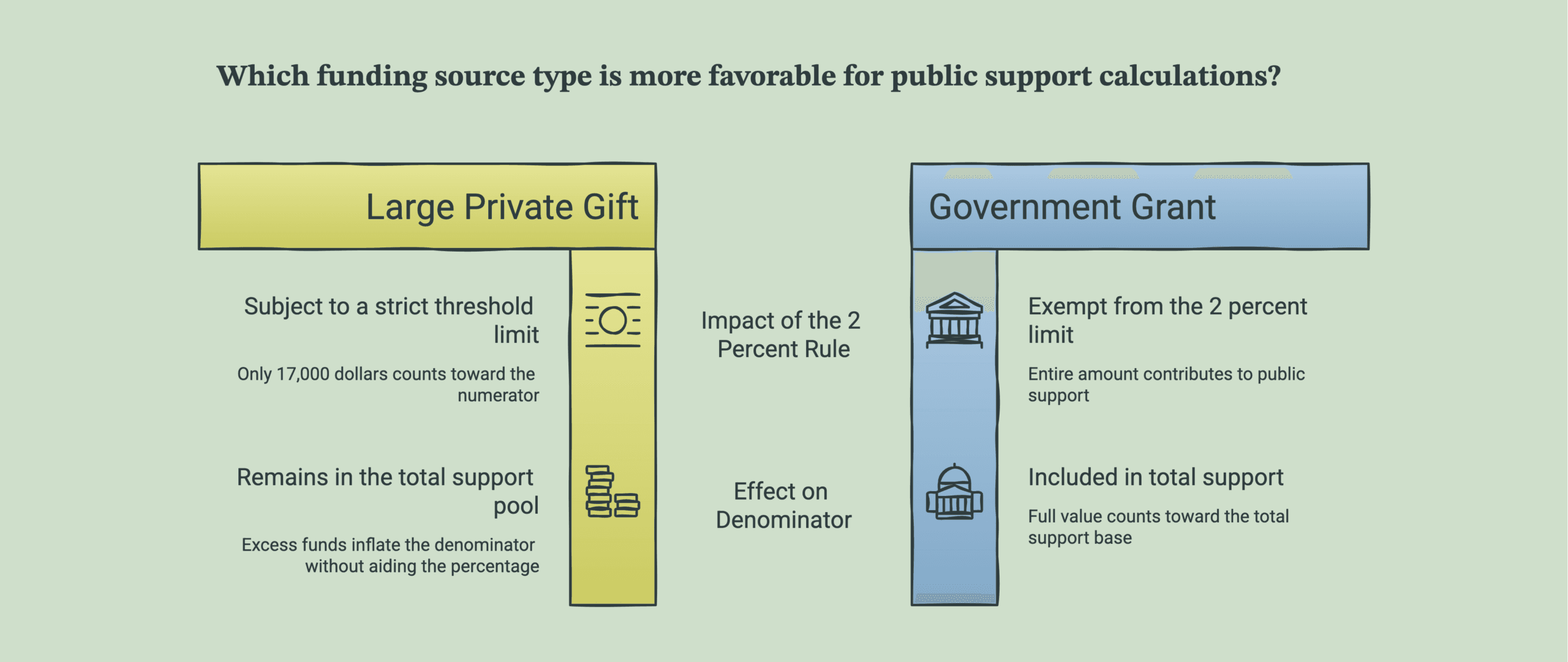
The engine of the whole thing is the 2% rule. Contributions from any one individual, trust, or corporation count toward public support only up to 2% of your five-year total support. Anything above that threshold gets subtracted from the numerator — but it stays in the denominator. That asymmetry is the point: one donor writing enormous checks increases your total support while adding almost nothing to your public support.
One detail that surprises people: related donors are treated as a single person. Contributions from a donor and from persons standing in the relationships described in section 4946(a)(1)(C) through (G) — family members as the Code defines them, plus corporations, partnerships, and trusts they largely control — are aggregated against the same 2% threshold, so a family that gives through several accounts still counts once.
Two important exceptions ride along with it. Grants from governmental units aren’t subject to the 2% cap. Neither are contributions from certain other publicly supported organizations — but read that carefully, because it isn’t every public charity, and assuming a foundation grant is uncapped is a common way to overstate public support.
Worked example — five-year totals
A community organization files Form 990 for 2025. Here are its combined 2021–2025 figures.
| Schedule A line | Amount |
|---|---|
| Gifts from many individual donors | $400,000 |
| Gifts from one family (five years combined) | $250,000 |
| City and county grants | $150,000 |
| Line 4 — total contributions | $800,000 |
| Line 8 — gross investment income | $20,000 |
| Line 10 — other income | $30,000 |
| Line 11 — total support | $850,000 |
| 2% of total support ($850,000 × 2%) | $17,000 |
| Line 5 — the family’s gifts above the threshold ($250,000 − $17,000). The city and county grants are governmental and aren’t capped. | $233,000 |
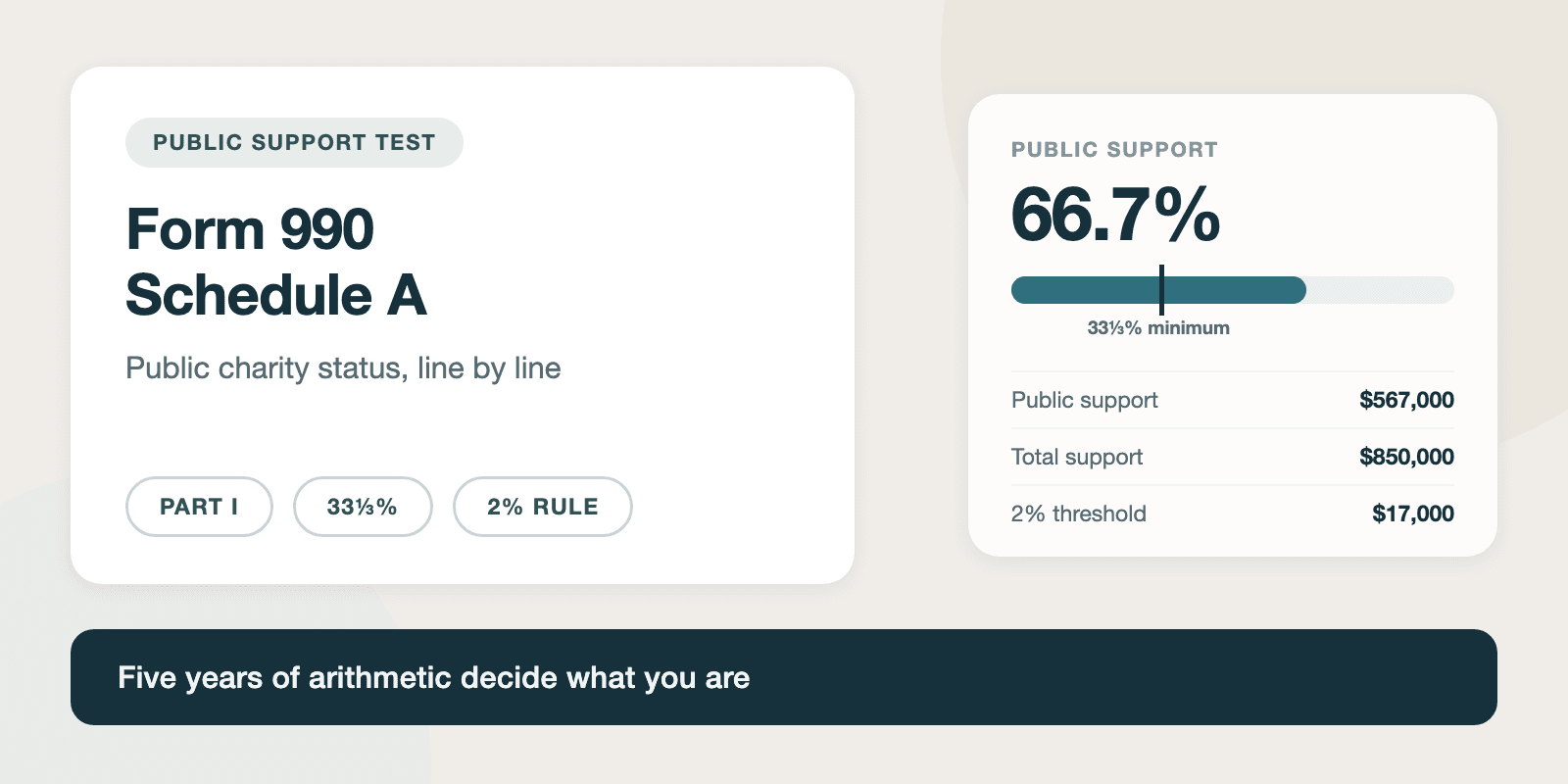
| Line 6 — public support ($800,000 − $233,000) | $567,000 |
| Line 14 — public support percentage | 66.71% PASS |
$567,000 ÷ $850,000 = 66.71%, comfortably above 33 1/3%. Note what the family’s generosity did: $250,000 of real money contributed $17,000 of public support and $250,000 of denominator.
If your percentage lands between 10% and 33 1/3%, you’re not automatically out. Line 17 opens the facts-and-circumstances test, which can preserve public charity status for an organization above 10% that also shows a continuous, genuine fundraising program aimed at the general public, a governing body representing broad community interests, and programs serving the public directly. It’s a real path — but it’s an argument you have to make and document, not a box you simply check.
If a meaningful share of your revenue is earned — tuition, tickets, program fees, service contracts — you likely checked line 10 and complete Part III instead. It’s built for organizations whose public comes to them as customers rather than only as donors, and it applies two tests. You have to pass both.
Test 1 — support above 33 1/3%
Contributions, membership fees, and gross receipts from exempt-function activities must normally exceed one-third of total support. Amounts from a disqualified person are excluded entirely — contributions and gross receipts alike (line 7a). The greater-of-$5,000-or-1% limit on line 7b is narrower: it applies only to the gross receipts lines, and it’s judged year by year against that year’s total support, unlike Part II’s five-year 2% cap.
Test 2 — investment income no more than 33 1/3%
Gross investment income plus net unrelated business income (from businesses acquired after June 30, 1975, less section 511 tax) must normally stay at or below one-third of total support. An organization that builds a large endowment relative to its program revenue can pass the first test and still fail here.
One recurring trap in Part III is membership dues. They count as support only to the extent members are paying to support the organization — if the dues buy admissions, merchandise, services, or use of facilities, they belong in the gross receipts lines instead. Getting your revenue categories right in the ledger first makes this a lookup rather than a reconstruction; that’s one of the quiet arguments for a well-built nonprofit chart of accounts.
Not sure which test you actually fall under? That answer lives in your determination letter and your revenue mix — both things we check before preparing a return.
Form 990 preparation →Here’s the scenario that sends organizations looking for Schedule A instructions in the first place. A donor who has been giving $5,000 a year leaves a bequest of $500,000. It is, by every ordinary measure, the best thing that happened to your organization this decade. Watch what it does to the arithmetic.
The same math, one big gift
A small organization’s five years: $80,000 from many individual donors, one $500,000 bequest, $20,000 of investment income. Total support is $600,000, so the 2% threshold is $12,000. The bequest counts toward public support only up to that $12,000 — the other $488,000 is subtracted from the numerator and stays in the denominator.
Public support: $580,000 − $488,000 = $92,000. Divided by $600,000 total support, that’s 15.33% — below 33 1/3%, though still above 10%, which keeps the facts-and-circumstances door open.
There’s also a specific relief valve built into the form: an unusual grant. The instructions describe these as substantial contributions or bequests from disinterested persons that are attracted by the organization’s publicly supported nature, unusual and unexpected in amount, and large enough to endanger public charity status. An unusual grant is excluded from both the numerator and the denominator — it leaves the calculation entirely rather than distorting it.
Fundraisers sometimes call this dynamic “tipping.” Worth knowing: the term doesn’t appear in the IRS instructions — it’s sector shorthand for the 2% mechanic above. The practical takeaways are the same either way. Flag transformational gifts before year-end so the unusual grant question gets asked while you still have options, and keep the ordinary donor base growing, because breadth is the only thing the test actually rewards. Our overview of how nonprofits make money covers the revenue-mix side of that.
The same large gift decides one more thing on the return: whether that donor is listed on Schedule B, where a public charity passing the 33⅓% test lists only contributors above the greater of $5,000 or 2% of contributions. For the schedule that reports galas and other fundraising events, see our Form 990 Schedule G guide.
This is the part that causes the most unnecessary panic, so read the form carefully. Line 16a says that if your current-year percentage reaches 33 1/3%, you qualify as publicly supported for this year and the following year. Line 16b is the backstop: if the prior year’s percentage reached 33 1/3%, you qualify for the current year — this year only. Lines 17a and 17b work the same way for the facts-and-circumstances test.
The structure creates a rolling cushion. A single weak year is normally caught by the prior year’s qualification. What ends public charity status is failing across consecutive years and not qualifying under any other Part I category — an organization that is also a church, a school, or a 509(a)(2) organization simply relies on that instead. Where nothing else applies, line 18 spells out the consequence: the organization is treated as a private foundation as of the beginning of that tax year for filing purposes, shouldn’t file Form 990, 990-EZ, or Schedule A for it, and instead files Form 990-PF checking “Initial return of a former public charity.”
Reclassification isn’t a penalty notice — it’s a change of regime. Private foundations face excise tax on net investment income, mandatory annual distributions, self-dealing restrictions, and less favorable deduction limits for their donors. That’s why the useful moment to look at Schedule A isn’t at filing time. It’s in the fall, while the year can still change, alongside the other items on your nonprofit compliance checklist.
Most Schedule A errors aren’t exotic. They’re transcription and classification problems, and every one of them is catchable in a fifteen-minute review. Start with these, then add your own rows as your organization’s revenue gets more complex.
Before you file
For the rest of the return, our step-by-step Form 990 guide walks the main form, and the common Form 990 mistakes guide covers the errors that show up across other schedules. If you’re still working backward from messy records, the real fix is upstream in your monthly bookkeeping — Schedule A is only as easy as your revenue coding.
Common questions from EDs and treasurers working through Form 990 Schedule A.
Every section 501(c)(3) organization that files Form 990 or Form 990-EZ attaches Schedule A, along with non-exempt charitable trusts under section 4947(a)(1) that aren’t treated as private foundations. Organizations that file only the Form 990-N e-Postcard do not file it, and private foundations file Form 990-PF instead.
It measures how broadly your organization is funded over a five-year period — the current tax year plus the four preceding years. Under Part II, public support divided by total support must normally reach 33 1/3%. Organizations funded substantially by fees for their exempt activities use Part III instead, which applies a support test above 33 1/3% together with a second test capping investment income and net unrelated business income at 33 1/3%.
In Part II, contributions from any one individual, trust, or corporation count toward public support only up to 2% of five-year total support. The excess is subtracted from the numerator but remains in the denominator, which is why a single very large gift can lower your public support percentage. Grants from governmental units are not subject to the 2% limit.
Not much, the first time. Meeting the test qualifies an organization for that year and the following year, so a single weak year is normally covered by the prior year’s calculation. Sustained failure, with no facts-and-circumstances test available, means the organization is treated as a private foundation as of the beginning of that tax year for filing purposes and files Form 990-PF instead, checking “Initial return of a former public charity.”
The instructions describe unusual grants as substantial contributions or bequests from disinterested persons that are attracted because of the organization’s publicly supported nature, unusual and unexpected in amount, and large enough to endanger public charity status. An unusual grant is excluded from both the numerator and the denominator of the support calculation rather than counted and capped.
No. Schedule A is an attachment to Form 990 or Form 990-EZ with no separate deadline of its own. It is filed electronically with the return, which is due the 15th day of the fifth month after the end of your fiscal year.
Know your public support percentage before the year closes, not after.
GivingArc handles bookkeeping and Form 990 preparation for small and mid-size 501(c)(3)s.
GivingArc provides bookkeeping, Form 990 preparation, and nonprofit-specialized accounting for small and mid-size 501(c)(3) organizations across the US. This article is general information, not legal or tax advice — public charity classification questions should be reviewed with your CPA. References are to the 2025 Schedule A (Form 990) and its IRS instructions. Reviewed by Min Kim, CPA.