
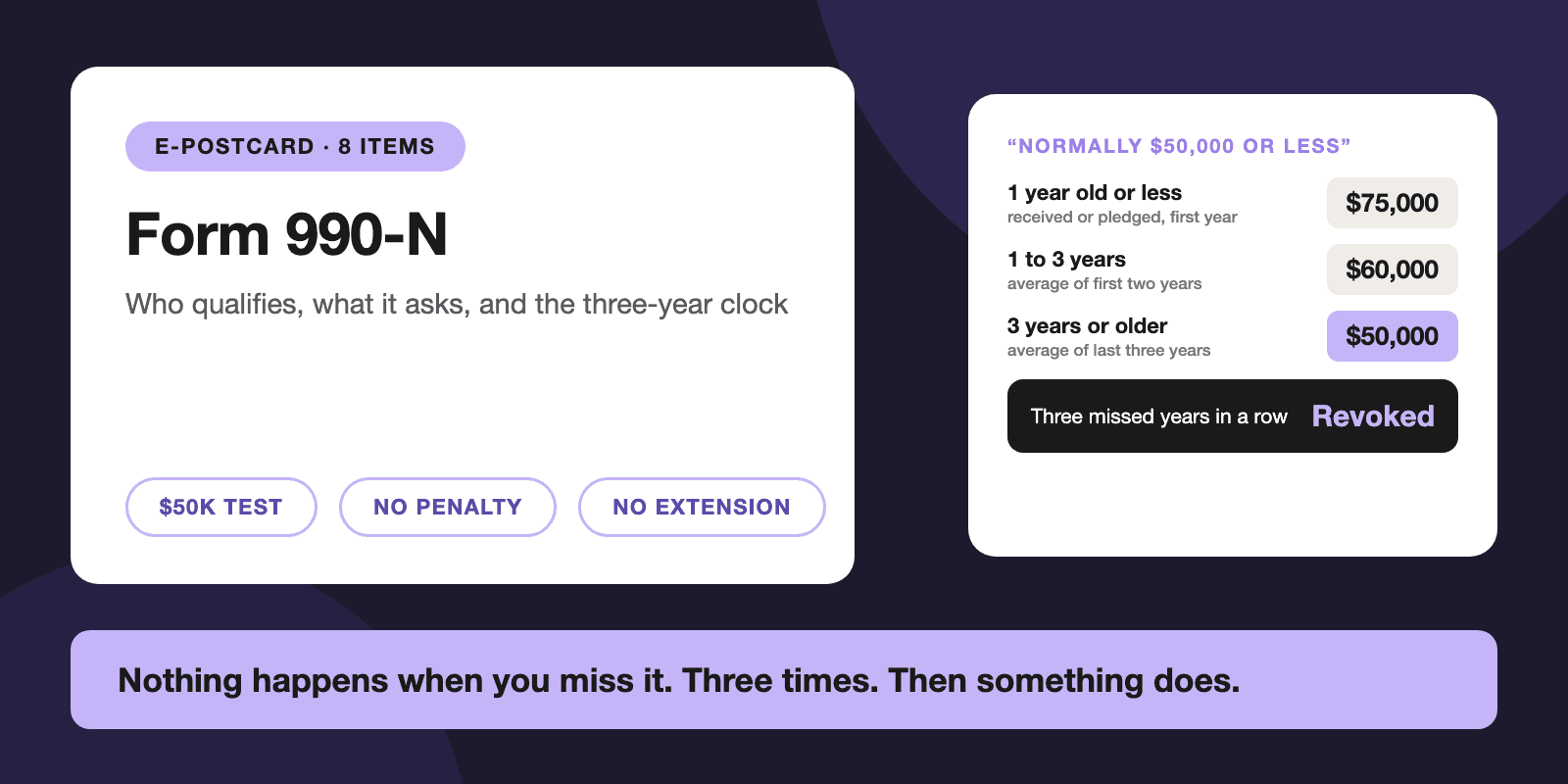
Nobody forgets to file a tax return that comes with a bill. The e-Postcard comes with nothing. No fee, no penalty, no form in the mail, and for a very small organization, often no one whose job it clearly is. So it gets filed in the first year by the founder who read the determination letter carefully, and then it gets remembered a little less each spring, until one year it is not remembered at all and nothing happens. That is the whole danger of Form 990-N: nothing happens, three times in a row, and then something does. The IRS revocation list is where careful, well-run little organizations discover the rule from the wrong end. This page is the other end, the one where you learn it in ten minutes and put it on a calendar.
Key Takeaways
Here is the reframe that makes the e-Postcard make sense. It is not a tax return. It does not report income, expenses, or a balance sheet. It is a pilot light: a small, cheap signal that tells the IRS your organization still exists and is still small. Keeping it lit costs almost nothing. Letting it go out three winters in a row means the furnace will not start, and relighting it takes a technician and a fee. Once you see it that way, the design choices that seem strange, no penalty, no extension, no way to file early, all fit. The IRS is not trying to collect anything. It is trying to find out whether anyone is home.
The IRS Form 990-N page states the rule in one sentence: small tax-exempt organizations are generally eligible to file Form 990-N if their annual gross receipts are normally $50,000 or less. Two words in that sentence, generally and normally, carry the whole rule, and the next two sections unpack them. The full picture of which organizations file which form is on our Form 990-EZ vs. 990 page.
“Generally” is there because some organizations cannot use the e-Postcard even when they are small enough. The IRS keeps a list of organizations not permitted to file Form 990-N. The ones a reader of this page is most likely to meet: private foundations, which file Form 990-PF regardless of size; most section 509(a)(3) supporting organizations, which must file a 990 or 990-EZ; section 527 political organizations; and organizations included in a group return filed by a parent, which do not file separately at all. If your determination letter says you are a public charity under 509(a)(1) or 509(a)(2), which is the common case, none of those apply.
Gross receipts are the total amounts the organization received from all sources during its annual accounting period, without subtracting any costs or expenses. That is the IRS definition, and every word matters. Total, from all sources: donations, grants, program fees, the raffle, interest, and the gross proceeds of the used-furniture sale before you paid the hauler. Not net income. Not “what we had left.” An organization that brought in $52,000 and spent $51,000 had gross receipts of $52,000.
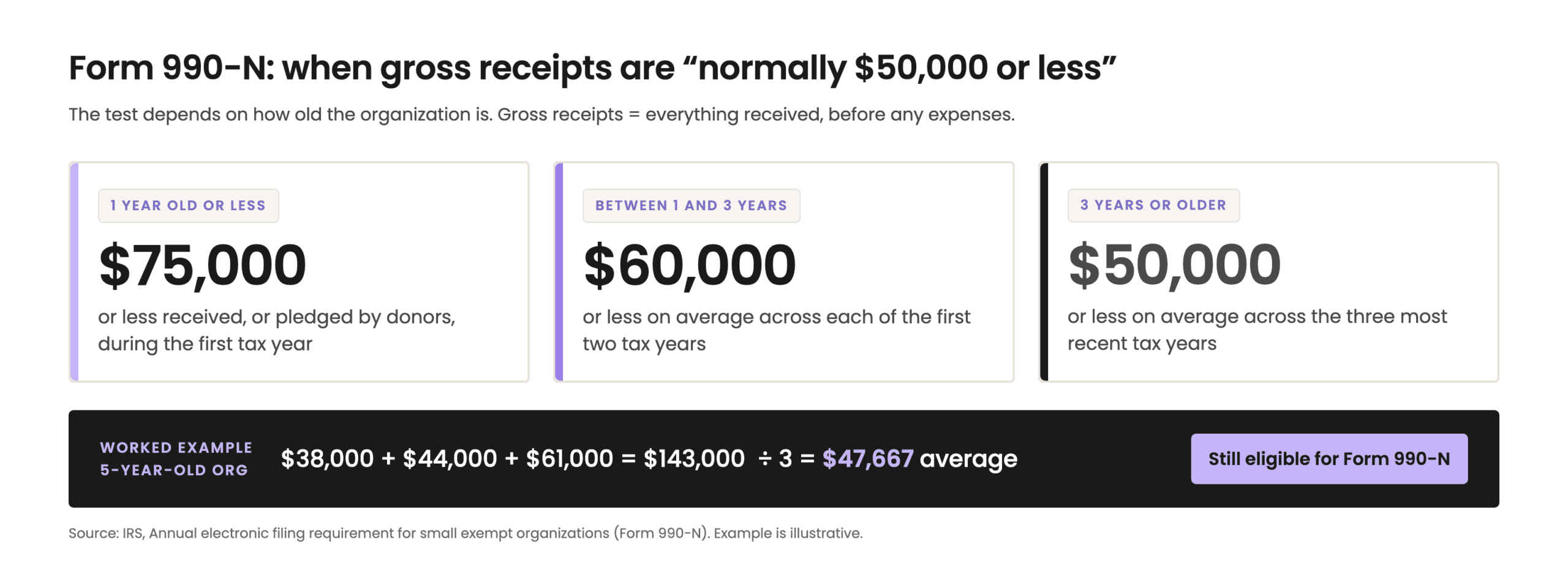
“Normally” is what keeps one good year from knocking you out. The IRS applies a test that changes with the organization’s age:
$75,000
or less received, or pledged by donors, during the first tax year.
$60,000
or less on average across each of the first two tax years.
$50,000
or less on average across the three most recent tax years.
So a five-year-old organization that took in $38,000, $44,000, and $61,000 over its last three years averages $47,667 and is still a 990-N filer, even though last year crossed the line on its own. Run the average every spring before you file, write the three numbers and the result in the file, and the question of which form is settled in two minutes. If the average tips over, you move to the 990-EZ; the thresholds for that form are on the IRS filing-thresholds page.
Eight items. No financial statements, no schedules, no program descriptions. If you have your determination letter and last year’s bank statements within reach, the whole thing is a form you fill in once and mostly confirm in later years.
Item 7 is the only one that requires arithmetic, and it is the averaging test above. Item 5 is the one that quietly goes stale: if the principal officer on file is a founder or a treasurer who has since rotated off, the record is wrong until someone updates it. There is no way to amend an e-Postcard once it is accepted, so the correction happens on next year’s filing. That is fine, as long as someone still knows the login.
The e-Postcard is due by the 15th day of the 5th month after the close of the tax year: May 15 for a calendar-year organization, with the usual move to the next business day when that falls on a weekend or holiday. Three features of this deadline are different from every other return you have met, and each one is a trap for a small organization.
Year 1 missed
Nothing happens
No penalty. The IRS may send a reminder notice. The organization is still exempt.
Year 2 missed
Still nothing
Same as year one. If the person who knew about the filing has moved on, nobody notices.
Year 3 missed
The clock runs out
Three consecutive missed 990-series filings, e-Postcards included, trigger automatic revocation.
Effective date
Backdated
Revocation is effective on the original due date of the third missed filing, not the day the letter arrives. There is no appeal.
There is no penalty for filing late. The IRS says so directly: it may send a reminder, but it will not assess a penalty for a late e-Postcard. This is the feature that causes the problem. A missed 990-EZ generates a daily penalty and a notice; a missed 990-N generates silence, and silence does not get put on anyone’s to-do list. There is no extension. Form 8868, which extends the other 990-series returns, does not apply to the e-Postcard, and since there is no penalty there is nothing to extend away from; a late e-Postcard is simply a late e-Postcard, and it still counts. And you cannot file early. The system will not accept an e-Postcard until the tax year has ended, so the well-meaning treasurer who tries to “get it done” in November is turned away and may not come back in May.
The three-year clock is not a theory. When the requirement first took effect, the IRS announced in June 2011 that approximately 275,000 organizations had automatically lost exemption for failing to file for 2007, 2008, and 2009; the IRS believed the vast majority were defunct, which is the point of the rule, but not all of them were. The automatic revocation list has been updated monthly since. Our Form 990 deadline guide covers the calendar for every form in the series; the nonprofit compliance checklist puts the e-Postcard next to the state filings that usually share its season.
Two names, one date. Put the e-Postcard due date on the treasurer’s calendar and on one other person’s. If you would rather it lived on ours: GivingArc files the 990-N for its bookkeeping clients as part of the annual close.
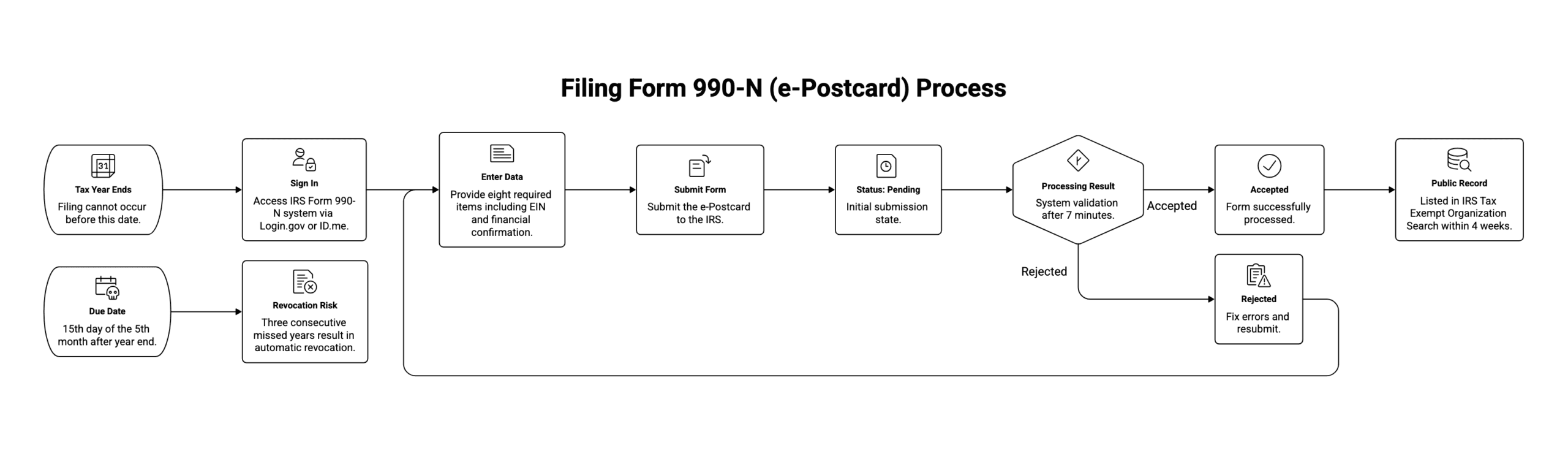
See what every plan includes →There is no paper Form 990-N and no software to buy. The IRS provides its own submission system, documented in the Form 990-N user guide (Publication 5248). From a cold start, budget half an hour the first year, most of it creating the sign-in account; after that, ten minutes.
Wait for the IRS to know you exist
A brand-new organization that just received its EIN or determination letter (see how to become a nonprofit organization) may not yet be in the system. If the EIN is rejected as unrecognized, the IRS FAQ says to call its exempt-organization line and allow about six weeks for records to update before filing.
Sign in with Login.gov or ID.me
The IRS requires one of these accounts to submit the e-Postcard. Use an email address the organization controls, not a volunteer’s personal one, and record which account was used. An account tied to a person leaves with that person.
Create the e-Postcard profile
Choose “Exempt Organization” as the user type and enter the EIN. Use only letters, numbers, and hyphens in names and addresses, and keep each entry to 35 characters; the user guide says other characters cause errors.
Enter the eight items and submit
Confirm the tax year, check the $50,000 box after running the averaging test, and submit. Print the confirmation page before leaving it, for your own reference; the guide warns you cannot print that page again, and the accepted filing can later be printed from the IRS Tax Exempt Organization Search.
Come back for the status
The submission shows as “Pending.” After about seven minutes, refresh, click “Get Updated Status,” and the status changes to “Accepted” or “Rejected.” Rejected means fix and resubmit; the IRS FAQ says to click the Submission ID link for the details. Save the accepted confirmation with the year’s records.
Check the public record in a month
Allow up to four weeks for the filing to appear in the IRS Tax Exempt Organization Search. Funders and donors look there, so it is worth confirming.
Two limits to know before you need them. You cannot file a prior year’s e-Postcard through the IRS site; prior years go through one of the IRS-approved e-file providers, which may charge a small fee. And there is no amended 990-N: a wrong address or officer is corrected on the next year’s filing.
Eligibility for the e-Postcard is permission, not an order. The IRS says an organization eligible to submit Form 990-N can instead choose to file Form 990-EZ or Form 990. The reasons to choose the longer form have nothing to do with the IRS.
Stay on the e-Postcard when
Consider a 990-EZ instead when
Filing the EZ voluntarily has a cost, in hours or in fees, and it starts the daily-penalty clock that the e-Postcard does not have. It is not the default; it is a decision. Our Form 990 filing cost guide puts numbers on the trade-off, and the step-by-step Form 990 guide is the place to start if you decide to make the move.
One or two missed years: file the current year now through the IRS system, file the missed years through an approved e-file provider, and the clock resets. There is no penalty to pay and nothing to explain. The only cost is the hour it takes and the mild embarrassment of the board hearing about it, which is worth incurring on purpose so the date gets a second owner.
Three missed years: check the automatic revocation list before assuming anything. If the organization is on it, exemption has already ended, backdated to the third missed due date, and the way back is a new application. For organizations that were eligible to file the 990-N or 990-EZ for all three years and have not been revoked before, the IRS offers streamlined retroactive reinstatement: submit the application and user fee within 15 months of the revocation letter or the list posting, whichever is later, and exemption is restored as if it never lapsed. Miss that window and the application needs a reasonable-cause statement for each year. Either way, this is the moment to bring in someone who has done it before rather than the moment to save a fee.
Whichever situation you are in, the fix going forward is the same and it is not a system. Two names on one date, the averaging test written down each spring, and the login stored somewhere the organization owns, ideally in the same place as the rest of your bookkeeping setup. A short routine you actually run every year beats a thorough one you keep meaning to set up.
Small enough for the e-Postcard, growing toward the 990-EZ?
Our bookkeeping plans start at $300 a month, include the e-Postcard filing, and hand you a one-page board report every month. When you cross the threshold, Form 990-EZ preparation starts at $500 per return.
Common questions from small nonprofits about the Form 990-N e-Postcard.
No. The IRS may send a reminder notice, but it does not assess a penalty for a late e-Postcard. The consequence is cumulative: an organization that fails to file a required 990-series return or notice for three consecutive years automatically loses its tax-exempt status, effective on the original due date of the third missed filing.
No. Form 8868 extends the Form 990, 990-EZ, 990-PF, 990-T, and several other exempt-organization returns, but it does not apply to Form 990-N. Because there is no late penalty, a late e-Postcard simply gets filed late and still counts toward the three-year requirement. The e-Postcard also cannot be submitted before the tax year has ended.
One year over the line does not by itself disqualify you. Eligibility depends on gross receipts being “normally” $50,000 or less, which for an organization at least three years old means an average of $50,000 or less across the three most recent tax years. Younger organizations use a $75,000 first-year test or a $60,000 two-year average. Run the average each spring and file the 990-EZ once the average, not a single year, crosses the threshold.
Yes, but not through the IRS website, which only accepts the current filing. Prior-year e-Postcards are filed through one of the IRS-approved e-file service providers. Filing the missed years promptly stops the three-year clock; if three years have already passed, check the automatic revocation list and use the reinstatement process instead.
It may. An organization eligible for the e-Postcard can choose to file Form 990-EZ or Form 990 instead. The usual reasons are a funder that requires a full return, receipts that are rising toward the threshold, or a wish to show program spending in public charity databases. The trade-off is preparation time or fees, and a daily late-filing penalty that the e-Postcard does not carry.
GivingArc provides bookkeeping, Form 990 preparation, and nonprofit-specialized accounting for small and mid-size 501(c)(3) organizations across the US. The averaging example is illustrative and not drawn from any client. Sources are linked where cited, as checked on September 7, 2026. Reviewed by Min Kim, CPA.