
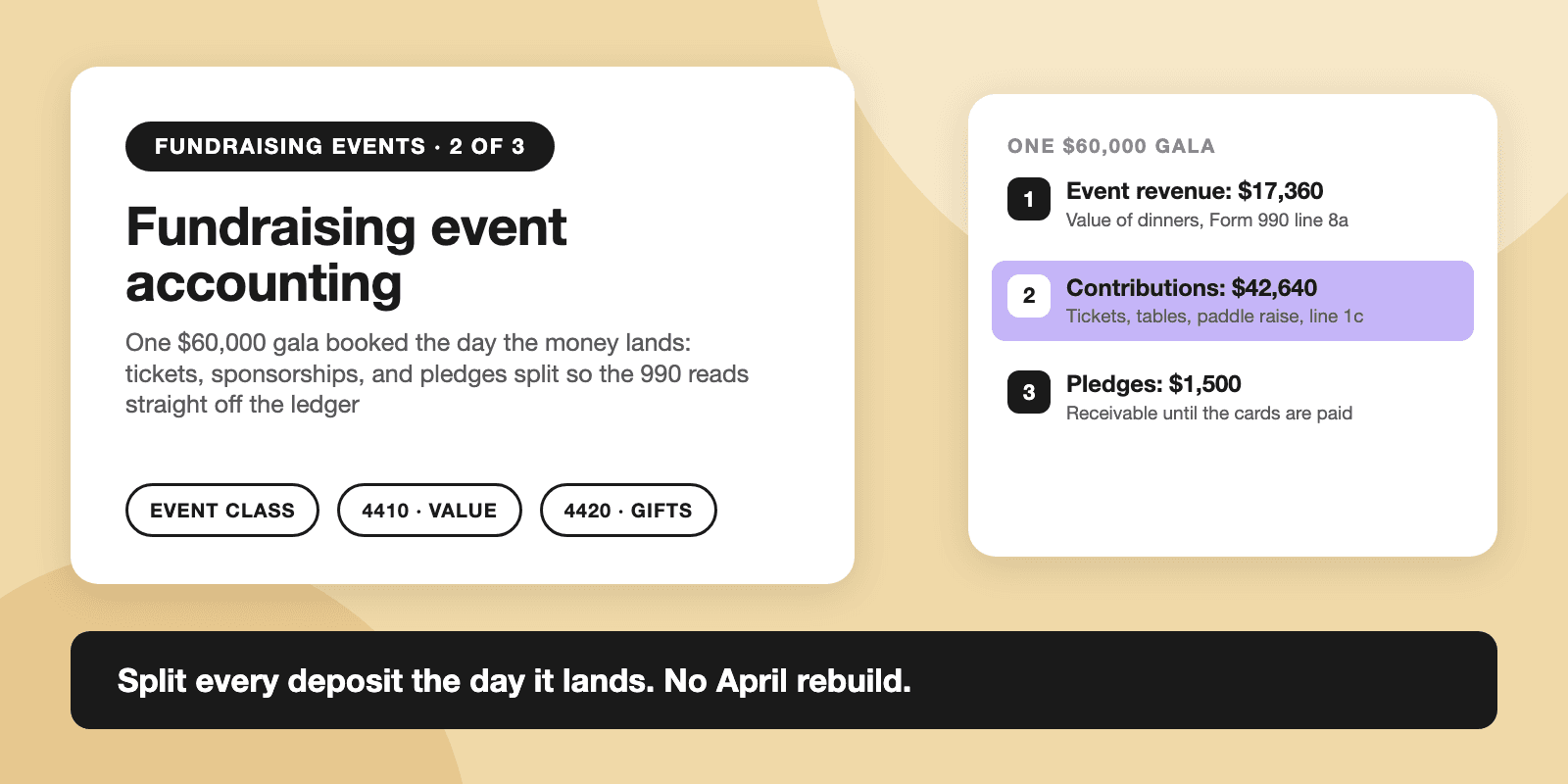
Key Takeaways
It is April, and the person preparing the Form 990 asks about the spring gala. What comes back from the books is one line: a deposit of $60,000 labeled “Gala.” Somebody now has to rebuild the night from the ticketing export, the sponsor emails, and memory, and work out which part of every payment bought dinner and which part was a gift.
That rebuild is avoidable. This guide shows how to book the same illustrative $60,000 gala from our Schedule G walkthrough as it happens, so the audit, the board report, and the return all come out of one ledger. The accounts are our suggested setup; the rules behind them are cited as we go.
Sorting mail at the front door takes a second per envelope. Sorting a year of it in the attic takes a weekend. Event money works the same way: the split is easy on the day the payment arrives, because that is when you know what the payer received.
One ticket deposit
$150
Dinner with a good-faith value of $70
$70 to Event revenue, value of benefits
$80 to Event contributions
This is the same split the IRS uses on the return and the one GAAP uses in the audit. The PwC not-for-profit guide puts it plainly: tickets are normally accounted for as part ticket sale and part contribution, with each portion recognized under its own rules. The value you use is your good-faith estimate of what the guest received, and it is the same number that goes on the guest’s disclosure.
Most of the structure is two income accounts and a class. The account numbers below are our suggested setup for a QuickBooks Online chart of accounts; the names matter more than the numbers.
| Account (suggested) | What goes in it | Where it ends up |
|---|---|---|
| 4410 Event revenue, value of benefits | The fair market value of dinners, seats, and other benefits guests and sponsors receive | Form 990 line 8a; Schedule G line 3 |
| 4420 Event contributions | Everything paid above that value, plus paddle raises and cash gifts made at the event | Form 990 line 1c; Schedule G line 2 |
| 1250 Pledges receivable | Signed pledges made at the event and not yet paid | Balance sheet until collected |
| 5410 to 5440 Event expenses | Venue, food and beverage, entertainment, and other direct costs, one account each | Form 990 line 8b; Schedule G lines 6 to 9 |
| Class or tag: the event name | On every income and expense line for the event | Schedule G column (a) or (b) |
Why separate expense accounts instead of one “Gala expenses” bucket? Because Schedule G asks for rent, food and beverages, entertainment, and other direct costs on separate lines, and a statement of functional expenses has to show them by natural classification anyway. The PwC guide notes that costs grouped under a label like direct benefits to donors must still be reported by natural classification when a statement of functional expenses is presented. Our guide to reading nonprofit financial statements covers that statement.
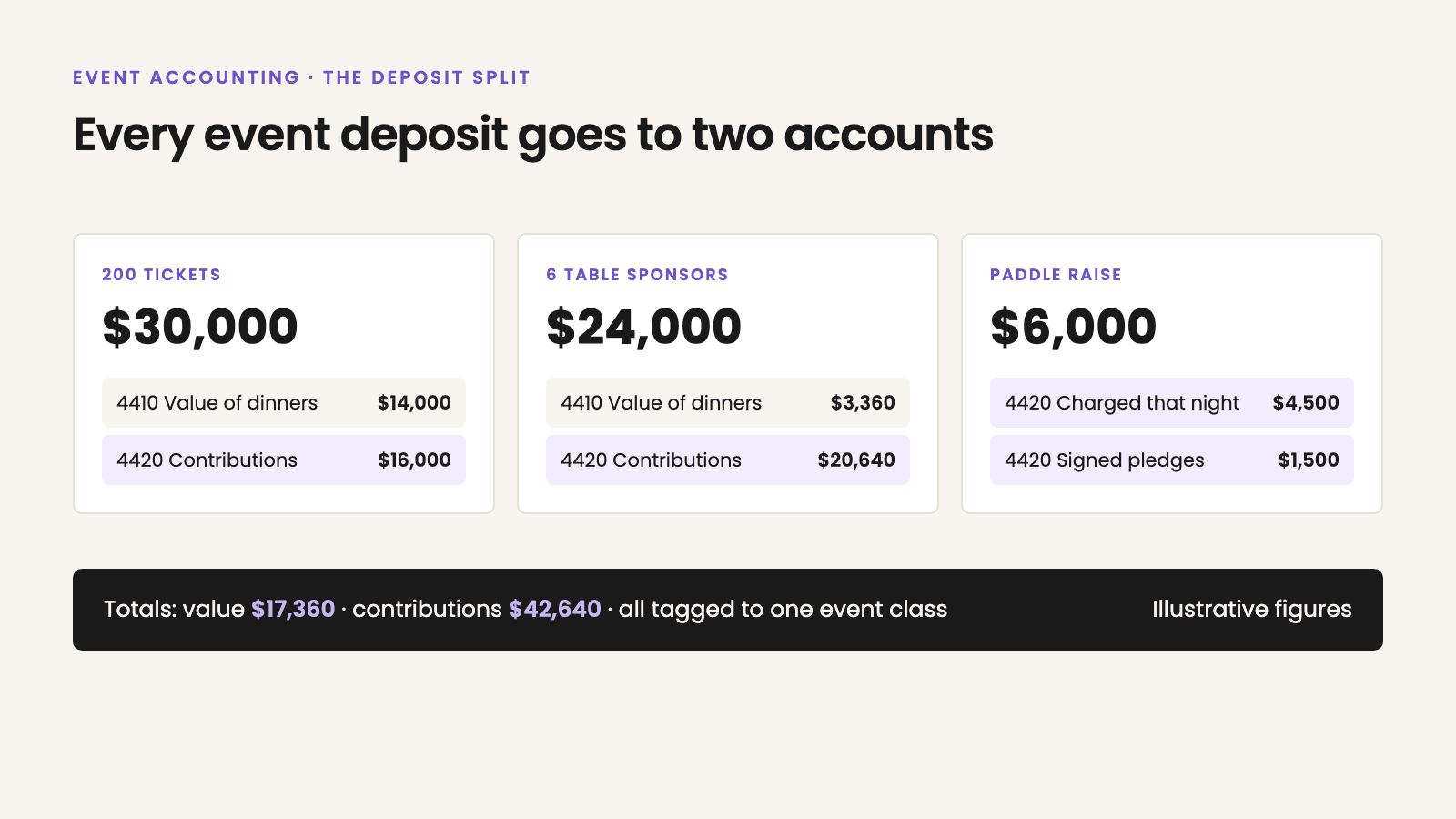
Here is the whole gala as four entries. The figures match the Schedule G walkthrough, and the organization is illustrative.
| Entry and account | Debit | Credit |
|---|---|---|
| 1. Ticket sales: 200 tickets at $150, dinner valued at $70 | ||
| Cash | $30,000 | |
| 4410 Event revenue, value of benefits | $14,000 | |
| 4420 Event contributions | $16,000 | |
| 2. Table sponsorships: 6 at $4,000, 8 dinners each | ||
| Cash | $24,000 | |
| 4410 Event revenue, value of benefits | $3,360 | |
| 4420 Event contributions | $20,640 | |
| 3. Paddle raise: $4,500 charged that night, $1,500 on signed pledge cards | ||
| Cash | $4,500 | |
| 1250 Pledges receivable | $1,500 | |
| 4420 Event contributions | $6,000 | |
| 4. Direct costs, all tagged to the event | ||
| 5410 Event, venue | $5,000 | |
| 5420 Event, food and beverage (248 guests) | $13,640 | |
| 5430 Event, entertainment | $2,500 | |
| 5440 Event, other direct (invitations, printing, décor, ticketing) | $1,500 | |
| Cash or accounts payable | $22,640 | |
Add up the event class and you have the night in three numbers: $17,360 of event revenue, $42,640 of contributions, and $22,640 of direct costs. The event kept $37,360; Schedule G line 11 will show ($5,280), and our Schedule G guide explains why both are right.
Record the pledge when it is made, as contribution revenue and a pledge receivable. It has to be a promise, not an intention, and there must be verifiable documentation: a signed pledge card works. When the payment arrives, it clears the receivable; it is not new revenue.
ASC 958-310-25-1 and 958-605-55-18 to 55-19, as summarized in the PwC guide.
A donated item is a contribution when it arrives, at its fair value, in a noncash contributions account rather than 4420, because Form 990 reports it on lines 1f and 1g, not 1c. When it sells, anything bid above that value is an event contribution. In the IRS example, a $5,000 item sold for $7,500 shows $5,000 as event income, $2,500 as an event contribution, and the $5,000 value plus $500 of other direct costs, $5,500, on line 8b.
Form 990 instructions, Part VIII line 8c; see our in-kind donations guide.
A sponsorship that comes with seats splits like a ticket: the value of the seats and dinners is event revenue, and the rest is a contribution. If the package includes other benefits, such as a program ad, value those too and write down how.
The same split feeds the sponsor’s written disclosure and acknowledgment.
Want the split done for you each month? Our bookkeeping plans start at $300 a month.
See pricing →The split gets one more wrinkle when the calendar gets in the way. Suppose the same gala is held on January 15, and 120 tickets, $18,000, are sold in December, before a December 31 year-end. At year-end the event hasn’t happened, so none of it is revenue yet.
December 31 balance sheet
January 15, after the gala
The reason for the second liability is a presumption in the guidance: the contribution part of tickets sold before year-end is presumed to be conditioned on the event taking place, unless the donor explicitly waives that condition. The PwC guide works through the same pattern with a $500 opening-night ticket. Our year-end close guide covers the rest of the December work.
Because the ledger was split from the start, every report reads the same numbers. This is the crosswalk we use when the return is prepared.
| Ledger (event class) | Amount | Financial statements | Form 990 | Schedule G Part II |
|---|---|---|---|---|
| 4420 Event contributions | $42,640 | Contributions | Line 1c, and inside the line 8a parentheses | Line 2 |
| 4410 Event revenue, value of benefits | $17,360 | Special event revenue | Line 8a | Line 3 |
| Total received | $60,000 | Both lines above | Part IV line 18 test | Line 1 |
| 5410 to 5440 Event expenses | $22,640 | May be shown as direct costs under the event revenue, with a subtotal; by natural classification in the functional expense statement | Line 8b | Lines 6 to 10 |
| Result | $37,360 kept | Event subtotal | Line 8c: ($5,280) | Line 11: ($5,280) |
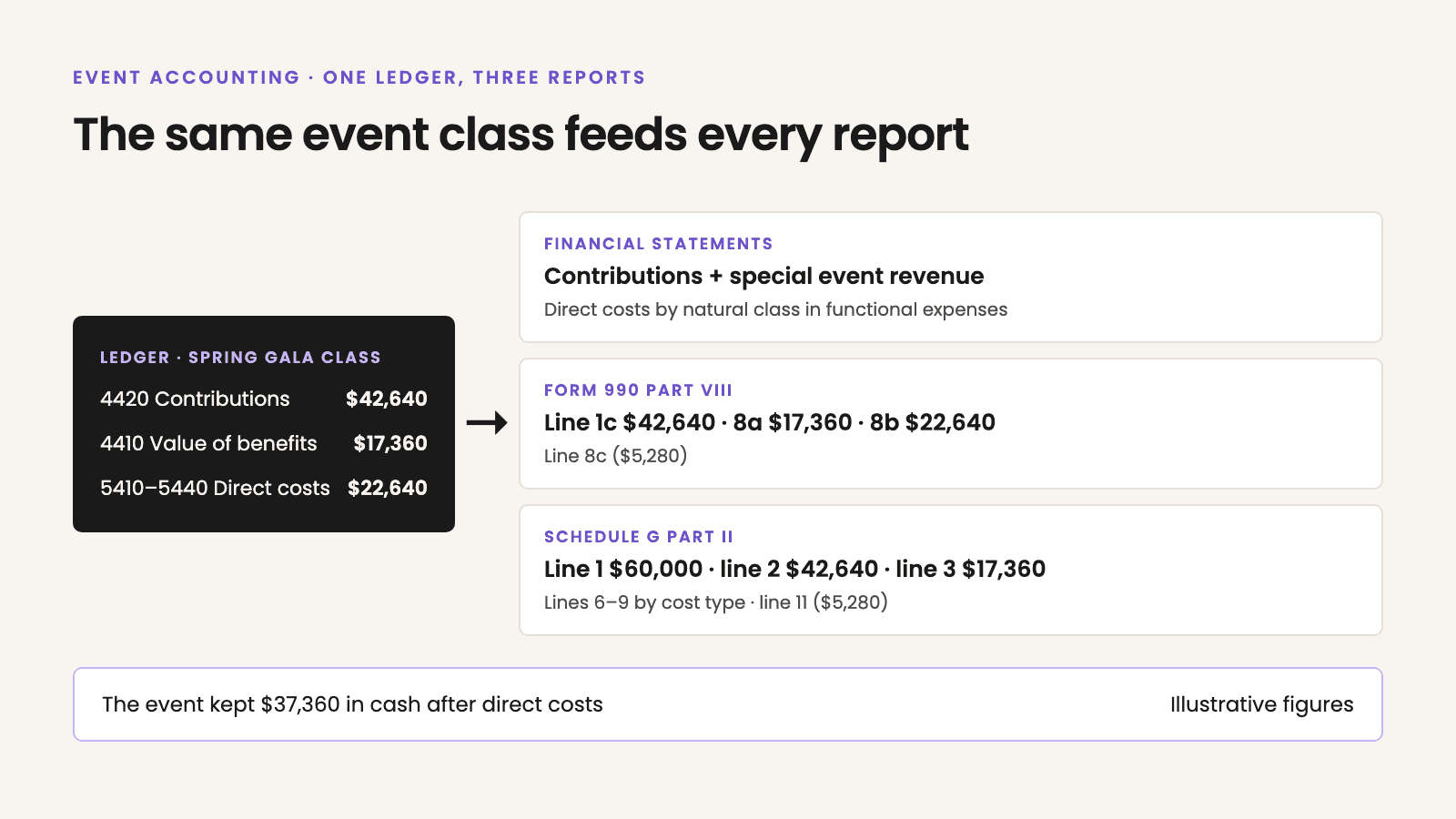
The financial statement column is a presentation choice to settle with your auditor; the guide allows gross revenues from special events less their direct costs, followed by a subtotal. The Form 990 and Schedule G columns are not choices: they follow the line instructions, and our Schedule G guide walks through each one.
Start with these six steps within a month of the event, and add to them as your events grow. A short list you actually run after every event beats a perfect one you avoid.
For the wording of the disclosure and acknowledgment, see our donation acknowledgment letter guide and the donation receipt template. To plan the next event in the same shape, use our free fundraising event budget template.
In our monthly bookkeeping, we can code event income and costs to an event class as they clear, so there is no April rebuild. The event shows up in that month’s one-page board report, and when we prepare the Form 990, Schedule G is filled from the same class. Plans start at $300 a month on the pricing page, and our nonprofit bookkeeping guide covers the rest of the monthly close.
Questions about booking gala tickets, sponsorships, pledges, and event costs.
Split it when the money arrives. Post the fair market value of what the guest receives, such as the dinner, to an event revenue account and the rest to an event contributions account, and tag both lines with a class for the event. A $150 ticket with a $70 dinner is $70 of event revenue and $80 of contribution.
At year-end both parts are liabilities, not revenue. The value of the benefit is a contract liability, and the contribution part is presumed to depend on the event taking place, so it is a refundable advance unless the donor waives that. After the event, both move to revenue.
When it is made, as long as it is a promise and not just an intention, and there is verifiable documentation such as a signed pledge card. It is recorded as contribution revenue and a pledge receivable, and cleared when the payment arrives.
They are costs of the event. In the books they sit in event expense accounts tagged to the event, on Form 990 they are direct expenses on line 8b, and in a statement of functional expenses they are still shown by their natural classification, such as rent and food.
No. A class or tag for the event on every income and expense line does the same job, and keeps one bank reconciliation. What matters is that every deposit is split and tagged when it is recorded.
Hold the event. We’ll keep the books that follow it.
Event income and costs coded in your monthly bookkeeping, and Schedule G filled from the same ledger with your Form 990.
GivingArc provides bookkeeping, Form 990 preparation, and nonprofit-specialized accounting for small and mid-size 501(c)(3) organizations across the US. The gala in this guide and all of its figures are illustrative, and the account numbers are a suggested setup. General information, not tax or legal advice. Reviewed by Min Kim, CPA.