
Key Takeaways
The planning committee has a number: raise $62,000. The spreadsheet has ticket prices, a catering quote, the band, and a line for flowers. Then the event happens, and three people ask three different questions. The board asks whether it made money. A donor asks how much of the ticket is deductible. And in April, the Form 990 preparer asks for the event’s gross receipts, contributions, and direct costs by category.
A budget built only around cash can answer the first question. This fundraising event budget template is built to answer all three, from the same lines. It uses the same illustrative gala as our Schedule G walkthrough and our guide to fundraising event accounting, so you can follow one set of numbers from the plan to the return.
Free Excel file · no email required
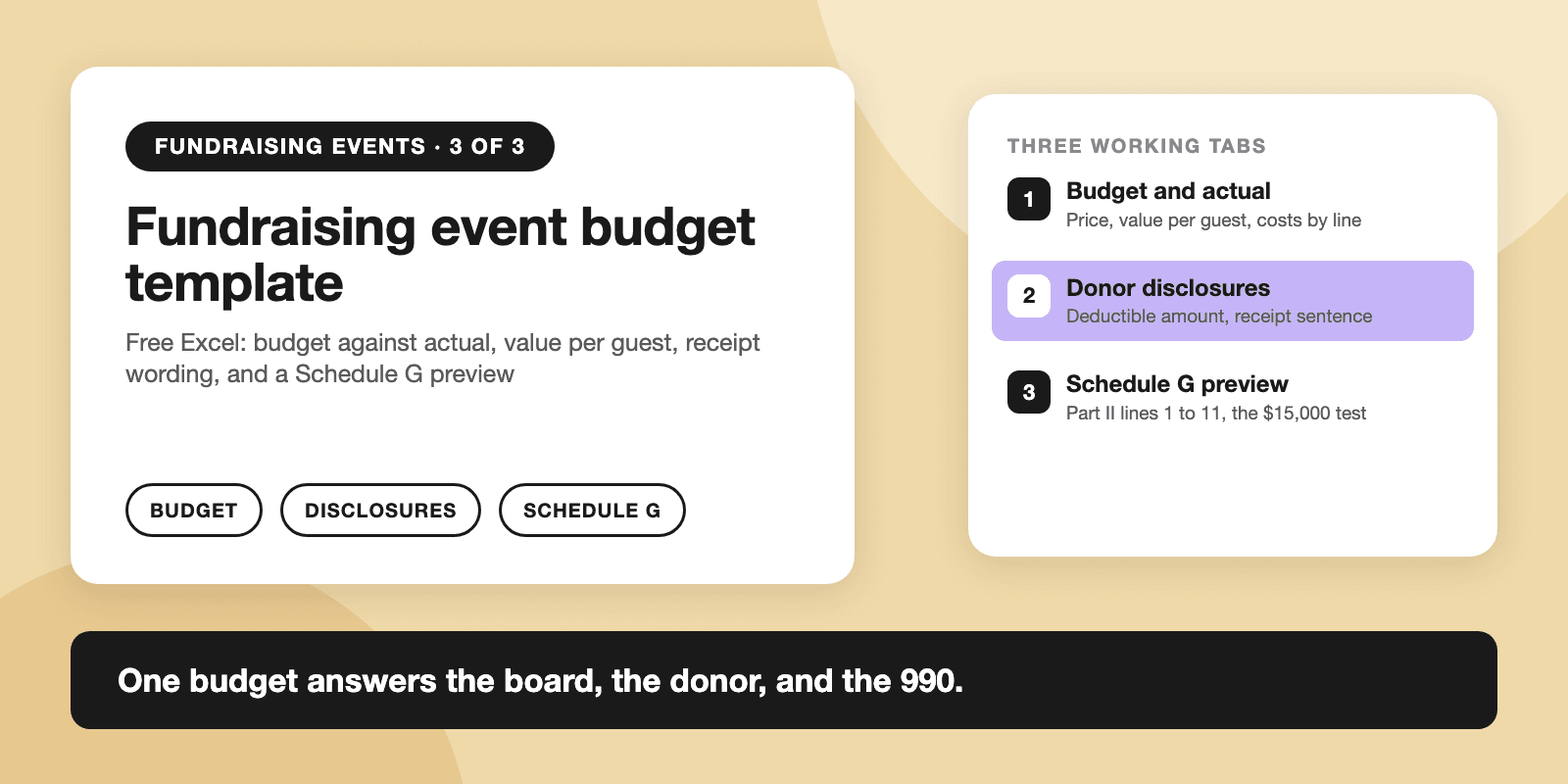
Fundraising Event Budget Template
Opens in Excel, Google Sheets, or Numbers. Yellow cells are yours; white cells calculate.
Download the template (.xlsx) ↓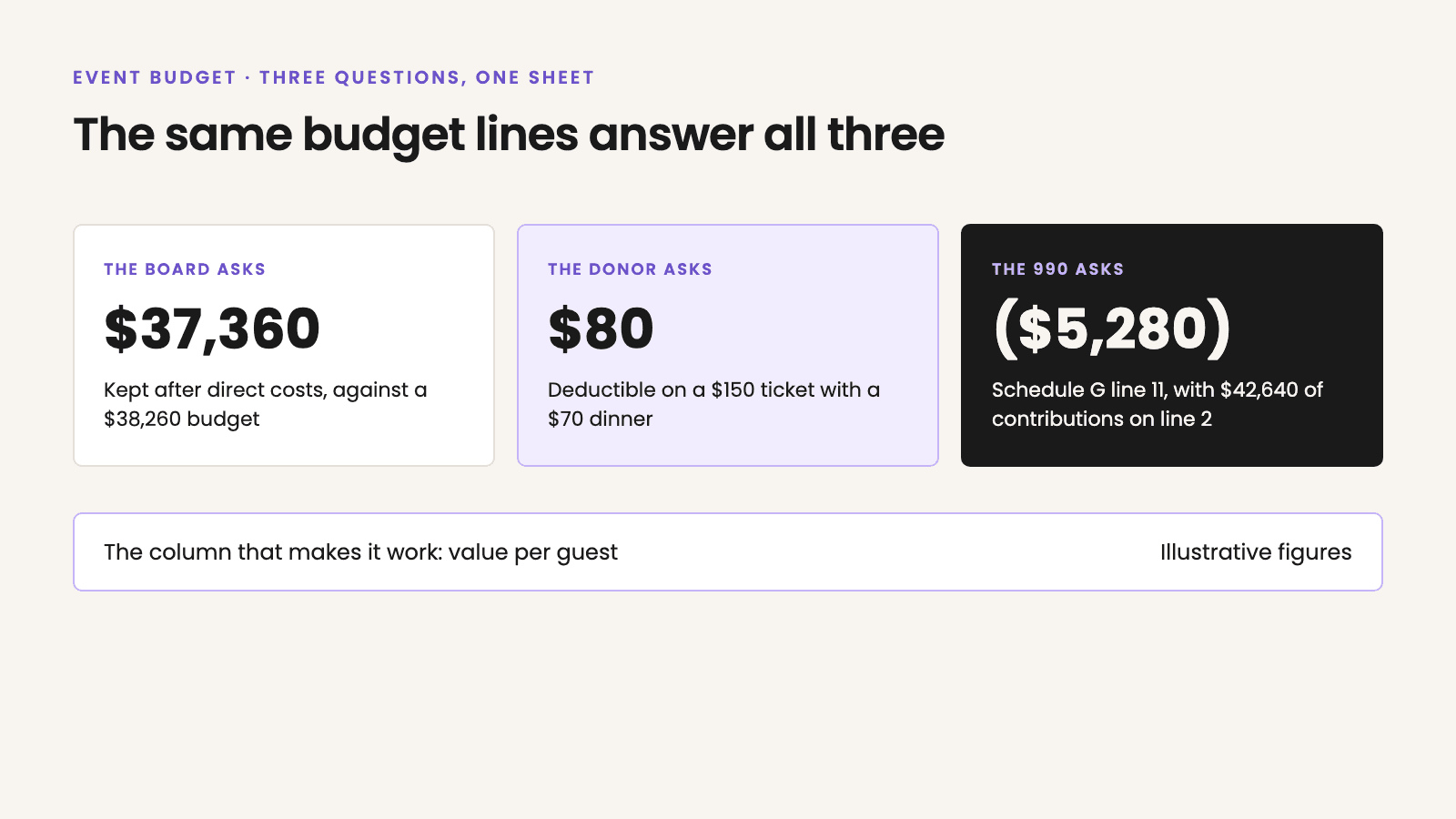
A wedding budget counts the guests before it counts the flowers, because the guest count drives the biggest line. An event budget for a nonprofit needs one more number beside each ticket: the value of what the guest receives. That column is the reframe this template is built around. Cash tells you what the event kept; the value per guest tells you what the event was, in the terms the donor receipts and the return use.
Price
$150
What the guest pays. Schedule G line 1 counts all of it.
Value per guest
$70
What the guest receives. Event income, Form 990 line 8a.
The gift
$80
Everything above the value. Contribution, line 1c, and the deductible amount.
The template does this split on every benefit line, using the actual quantities, and adds the gifts that came with no benefit, such as the paddle raise. The rule behind it is in the Form 990 Part VIII instructions for lines 1c and 8a; our event accounting guide shows the same split as journal entries.
The value per guest is a good-faith estimate, and the IRS guidance on quid pro quo contributions allows any reasonable method applied in good faith. For something not sold commercially, you may use the value of similar or comparable goods or services. The IRS example values a private event in a museum room at the cost of renting a comparable hotel ballroom.
For a gala dinner, the caterer’s per-guest charge or the price of a comparable dinner are both reasonable starting points. Write down how you set it in the template’s note column; an auditor or a donor may ask to see it.
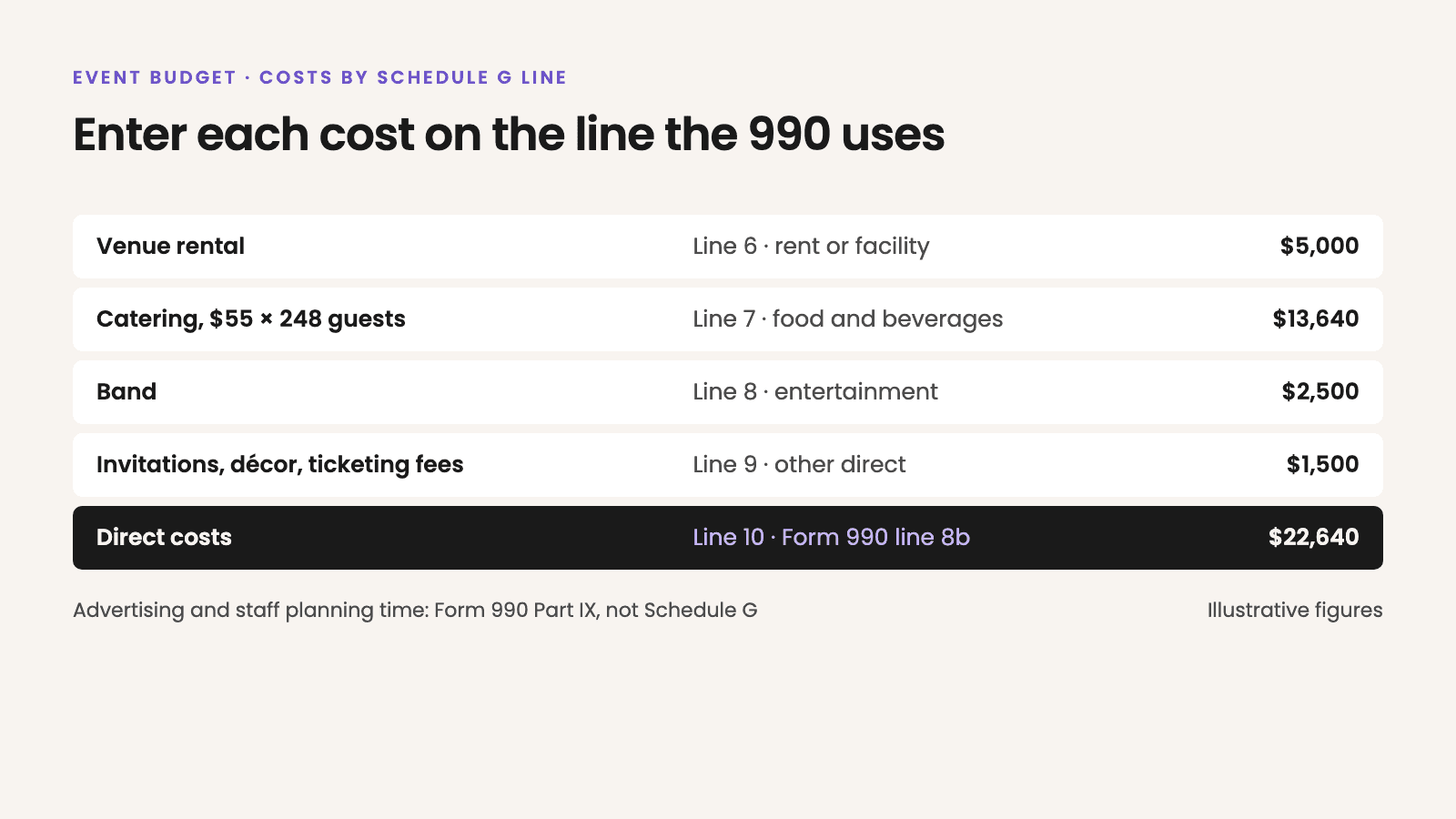
Each direct cost goes on the line for its category, so the Schedule G tab can fill itself. The line definitions come from the Schedule G instructions.
| Template line | Schedule G Part II | Sample actual |
|---|---|---|
| Cash prizes; noncash prizes at value | Lines 4 and 5 | $0 |
| Venue rental | Line 6, rent or facility costs | $5,000 |
| Catering at $55 per guest, bar and beverages | Line 7, food and beverages | $13,640 |
| Band or entertainment | Line 8, entertainment, including labor | $2,500 |
| Invitations, décor, ticketing fees, auction items and selling costs | Line 9, other direct expenses; keep an itemized list | $1,500 |
| Advertising, staff planning time | Not Schedule G; Form 990 Part IX | Separate section |
Catering is the line that moves with the headcount, so the template multiplies the per-guest cost by the guests from your ticket and table lines. Donated auction items follow the IRS example in the Form 990 line 8c instructions: the item’s value when donated is a noncash contribution when it arrives, and when it sells, that value and the selling costs become direct expenses. The template’s self-check reproduces that example. One judgment call: invitations whose main job is to ask for gifts can be treated as fundraising costs in Part IX rather than direct event costs, so settle that line with your preparer.
Filing a Form 990 with Schedule G this year? Give your preparer the Schedule G tab, or let us prepare the return from it.
Form 990 preparation →Here is the illustrative gala as the template’s summary shows it. The plan assumed 220 individual tickets and a $5,000 paddle raise; 200 tickets sold, and the paddle raise brought in $6,000.
| Summary line | Budget | Actual |
|---|---|---|
| Guests | 268 | 248 |
| Gross receipts | $62,000 | $60,000 |
| Direct costs | $23,740 | $22,640 |
| Kept after direct costs | $38,260 | $37,360 |
| Direct cost per $1 raised | $0.38 | $0.38 |
| Contributions, Schedule G line 2 | $42,640 | |
| Value of benefits, line 3 | $17,360 | |
| Schedule G line 11 | ($5,280) |
The event kept $37,360, and Schedule G will show ($5,280). That is not a mistake: line 11 sets the direct costs against the $17,360 value of benefits only, because the $42,640 of contributions is reported on its own line. Our Schedule G guide explains how to say that to the board in one sentence.
What about the direct cost per dollar raised? We know of no authoritative benchmark for a good number at a gala, so the template doesn’t grade it. Its use is comparison: this year’s event against last year’s, and the budget against the actual.
A receipt is like a restaurant bill that also shows the tip: two amounts, each with a different job. The Donor disclosures tab writes one sentence per benefit line from the price and the value you entered.
Individual ticket, $150
Thank you for your payment of $150. You received goods or services valued at about $70. The amount you may deduct as a contribution is limited to $80.
Table sponsorship, $4,000
Thank you for your payment of $4,000. You received goods or services valued at about $560. The amount you may deduct as a contribution is limited to $3,440.
The IRS requires this written disclosure for any payment over $75 that is partly a contribution and partly for goods or services, given with the solicitation or the receipt, and it can charge $10 per contribution, up to $5,000 per event or mailing, when it is missing, unless the failure was due to reasonable cause. The sponsor’s $3,440 gift also needs a written acknowledgment because it is $250 or more; our donation acknowledgment letter guide and donation receipt template cover the wording.
Start with these steps for your next event, and add sections as your events grow. A short budget you update after every event beats a detailed one you avoid.
Planning the rest of the year’s budget? Our nonprofit budget template covers the operating budget, and the grant budget template covers funder budgets.
If we keep your books, we can fill the actual column from the ledger after the event closes, and if we prepare your Form 990, the Schedule G tab can serve as the working paper for Schedule G. Form 990 preparation starts at $1,500 and monthly bookkeeping at $300 a month, with the full list on our pricing page.
Questions about budgeting a gala, valuing benefits, and what counts as a direct cost.
Yes. It is a free Excel file with no email required. Download it from this page, replace the sample gala with your own lines, and it opens in Excel, Google Sheets, or Numbers.
Use any reasonable method in good faith, such as the price of a comparable meal or the caterer’s per-guest charge. The IRS lets you value items that are not sold commercially by using similar goods or services. The value you choose is the one that goes on the donor’s receipt.
Put them in the budget so you see the full cost, but keep them out of direct costs. Schedule G direct expenses are costs of producing the event itself; indirect fundraising costs such as advertising belong in Form 990 Part IX. The template has a separate section for them.
For Form 990, the donated use of a facility is not reported as a contribution in Part VIII, and there is no rent to enter on Schedule G line 6. Guests still receive the dinner, so its value still sets the deductible amount on their receipts.
Raffles, other than ones with only nominal prizes, are gaming on Form 990, not part of the fundraising event. Income and expenses from a raffle held at the gala are split out and reported with gaming on line 9a, not in the event budget’s Schedule G Part II figures. Schedule G Part III applies once gaming income for the year tops $15,000.
Plan the event. We’ll carry the numbers to the 990.
Actuals from your monthly bookkeeping, and Schedule G prepared with your Form 990.
GivingArc provides bookkeeping, Form 990 preparation, and nonprofit-specialized accounting for small and mid-size 501(c)(3) organizations across the US. The gala in this guide and all of its figures are illustrative. General information, not tax or legal advice. Reviewed by Min Kim, CPA.