
Key Takeaways
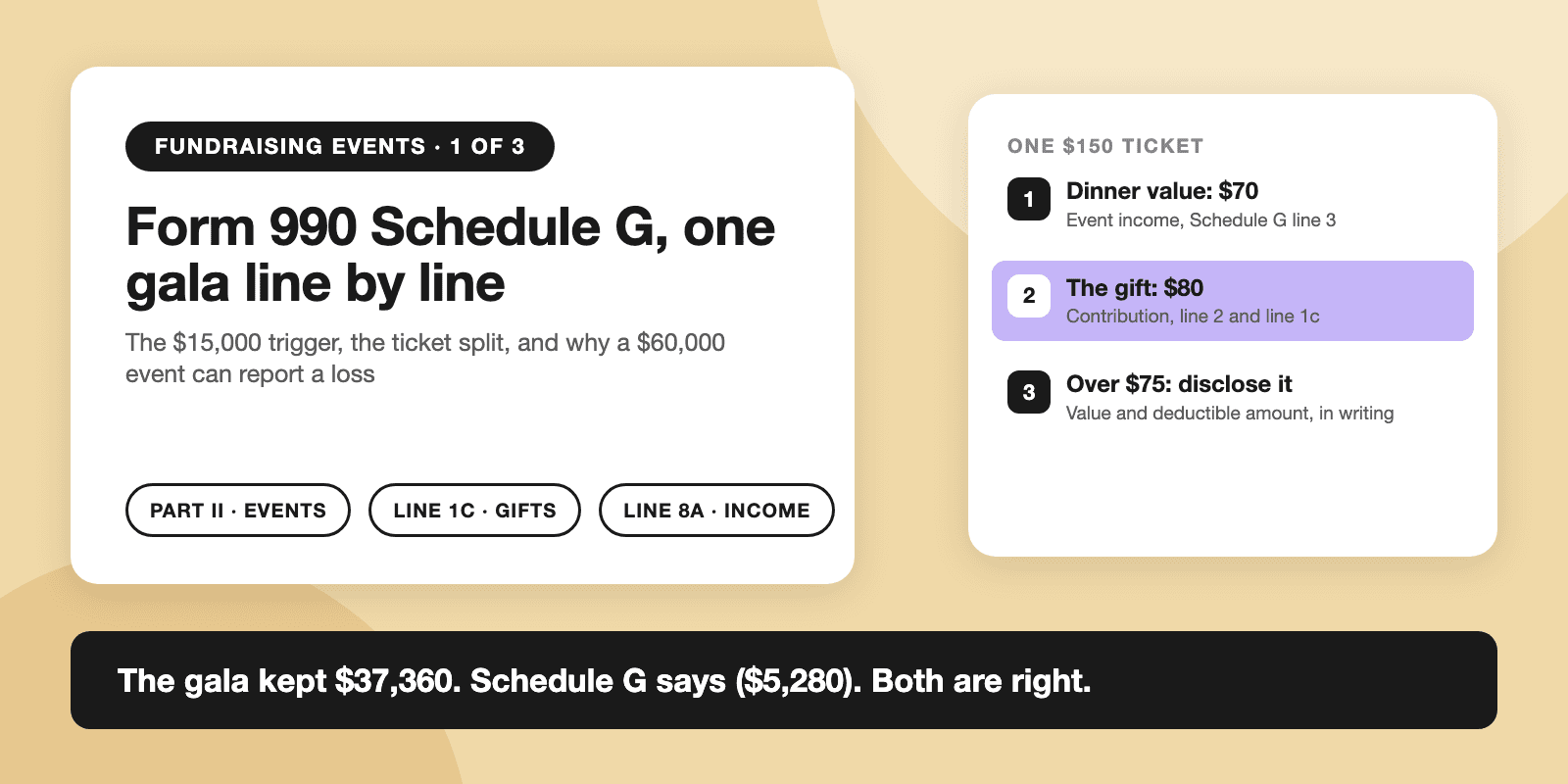
Picture a good gala night, the illustrative one this guide follows. The room is full, the paddle raise beats the goal, and the bank tells a simple story: after paying the venue, the caterer, and the band, the organization kept $37,360.
Then the Form 990 Schedule G is filled in, and it says the event lost $5,280.
Nobody made a mistake. That line is doing exactly what the IRS built it to do, and once you see how Schedule G splits a ticket, the number stops being alarming and starts being useful. This guide walks through who has to file it, the one split that drives every line, and a single $60,000 gala mapped onto Schedule G, Form 990 Part VIII, and Form 990-EZ.
Schedule G has three working parts, and each one has its own $15,000 trigger. For an organization that holds a gala or a benefit dinner, Part II is the one that matters. The thresholds below come from the Instructions for Schedule G (Form 990), revised December 2024.
| Part | Covers | Required when | Form 990 trigger | Form 990-EZ trigger |
|---|---|---|---|---|
| Part I | Professional fundraising services | More than $15,000 of professional fundraising expenses (Part IX lines 6 and 11e) | Part IV, line 17 | Not required |
| Part II | Fundraising events | Event contributions plus event gross income above $15,000 | Part IV, line 18 (Part VIII lines 1c + 8a) | Line 6b plus its parenthetical |
| Part III | Gaming, such as bingo, pull tabs, and raffles | Gaming gross income above $15,000 | Part IV, line 19 (Part VIII line 9a) | Line 6a |
Part II lists only events with more than $5,000 in gross receipts. The two largest get their own columns, (a) and (b); column (c) holds the number of other events over $5,000, with their totals combined.
What counts as a fundraising event is narrower than it sounds. The Form 990 instructions list dinners and dances, concerts, carnivals, sports events, and auctions. They exclude solicitation campaigns that only bring in gifts, sales of items of only nominal value, and events that substantially further your mission even if they raise money. The IRS example is a folk music society’s annual festival: its ticket sales are program service revenue on line 2, not event income.
A gala ticket is a dinner receipt with a donation envelope stapled to it. Schedule G asks you to unstaple them.
Ticket price
$400
What the guest pays
Retail value of dinner
$160
Event income: Part VIII line 8a, Schedule G line 3
Contribution
$240
Line 1c, and in the line 8a parentheses; Schedule G line 2
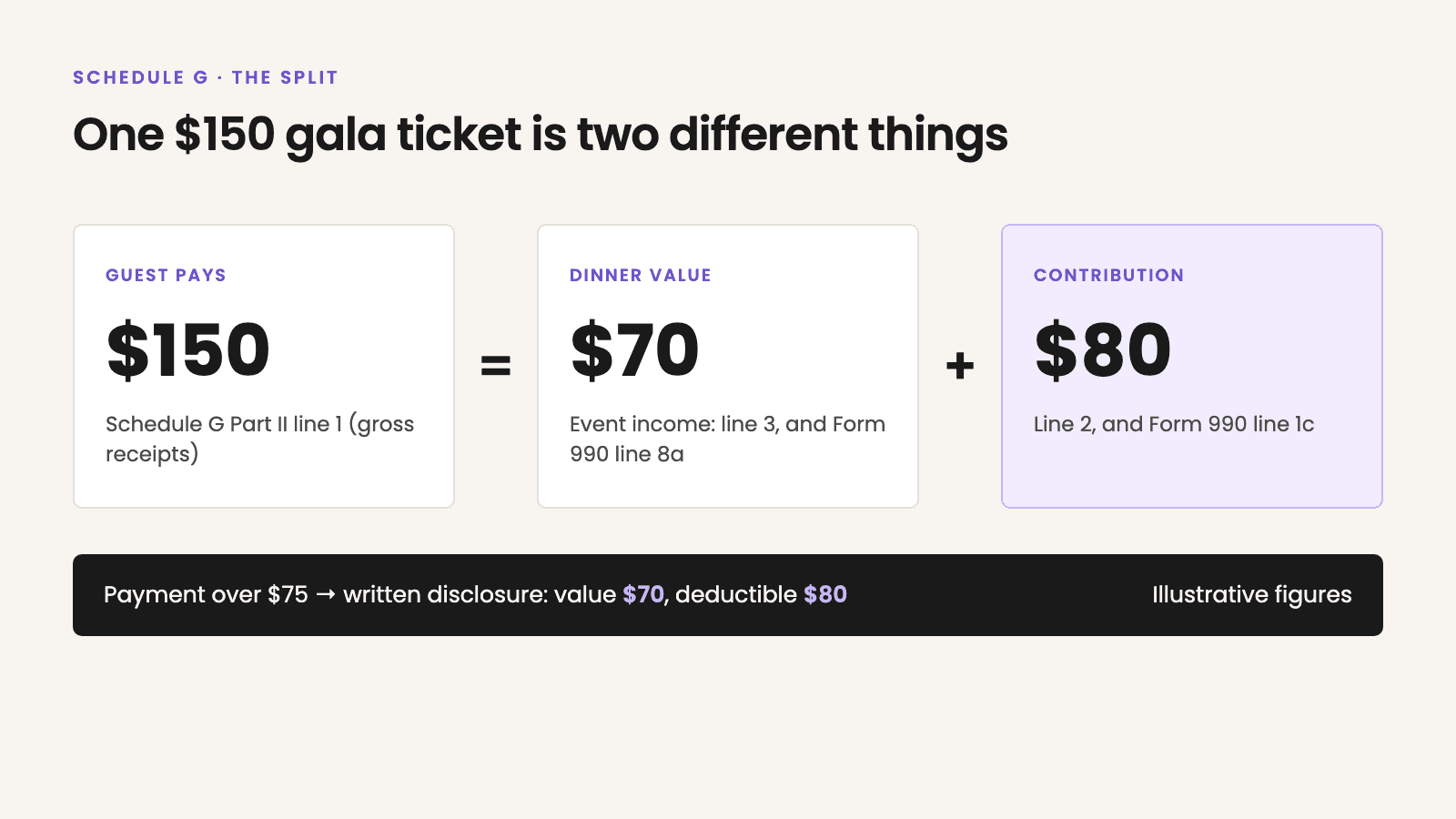
That split is the IRS’s own example in the line 1c instructions: a dinner sold for $400 per person with a retail value of $160 is $160 of event revenue and a $240 contribution. The Form 990-EZ instructions make the same point with a $100 payment for goods worth $40, and add something worth knowing before you print invitations: calling the ticket price a “donation” doesn’t change how it’s reported.
Who decides the $160? You do, with a good-faith estimate. The IRS guidance on quid pro quo contributions lets you use the price of comparable goods or services. Its example values a private event in a museum by what a hotel ballroom of similar size and atmosphere would rent for, even though the ballroom has no art on the walls. For a gala dinner, that means asking what the same meal would cost at a comparable venue, and writing down how you got the number.
Here is one spring gala, followed all the way through. The organization and every figure are illustrative, and the numbers are chosen so each line is easy to trace.
What came in (good-faith value of dinner: $70 per guest)
| Source | Received | Value of benefit | Contribution |
|---|---|---|---|
| 200 tickets at $150 | $30,000 | $14,000 | $16,000 |
| 6 table sponsorships at $4,000, 8 seats each | $24,000 | $3,360 | $20,640 |
| Paddle raise, no benefit | $6,000 | $0 | $6,000 |
| Total | $60,000 | $17,360 | $42,640 |
Schedule G, Part II, column (a) (with one event, column (d) repeats these totals and column (c) says None)
| Line | What it asks for | Amount |
|---|---|---|
| 1 | Gross receipts, before any costs or contributions are taken out | $60,000 |
| 2 | Less: contributions | $42,640 |
| 3 | Gross income (line 1 minus line 2) | $17,360 |
| 4 | Cash prizes | $0 |
| 5 | Noncash prizes, at fair market value | $0 |
| 6 | Rent or facility costs (the venue) | $5,000 |
| 7 | Food and beverages, including catering (248 guests) | $13,640 |
| 8 | Entertainment (the band) | $2,500 |
| 9 | Other direct expenses (invitations, printing, décor, ticketing software) | $1,500 |
| 10 | Direct expenses (lines 4 through 9) | $22,640 |
| 11 | Net income or (loss) (line 3 minus line 10) | ($5,280) |
Where the same gala lands on the return itself
| Return | Line | Amount |
|---|---|---|
| Form 990, Part IV | Line 18: fundraising events above $15,000? ($42,640 + $17,360 = $60,000) | Yes |
| Form 990, Part VIII | Line 1c: contributions from fundraising events | $42,640 |
| Line 8a: gross income, with the line 1c amount shown in the parentheses | $17,360 | |
| Line 8b: direct expenses | $22,640 | |
| Line 8c: net income or (loss) | ($5,280) | |
| Form 990-EZ | Line 1: the $42,640 of contributions is included here | $42,640 |
| Line 6b: $42,640 in the parentheses, gross income in the right-hand column | $17,360 | |
| Line 6c: direct expenses from gaming and fundraising events | $22,640 |
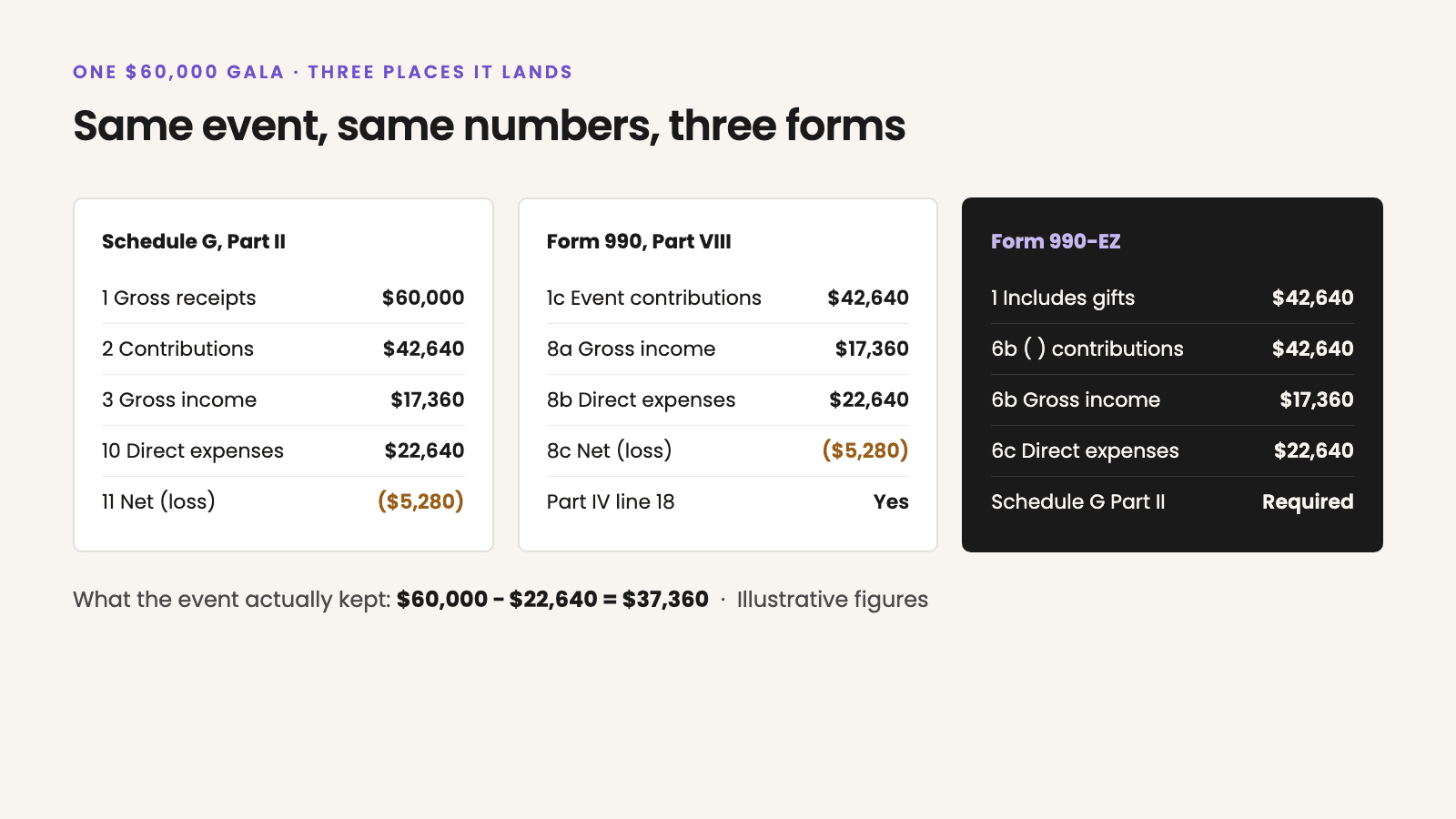
Notice what never happens: the $42,640 is never netted against the costs. It is counted once, as a contribution, and the costs are set only against the $17,360 that paid for dinner. The Form 990-EZ instructions handle it the same way, with the contribution entered both on line 1 and inside the line 6b parentheses so the event’s full size stays visible.
Think of a bakery that sells its bread at cost and keeps a tip jar by the register. The register tape shows break-even; the tip jar is where the money is. Schedule G reads the register tape. The tip jar is line 1c.
What the event kept
$37,360
$60,000 received minus $22,640 of direct costs. This is the number for the board’s fundraising report.
Schedule G, Part II line 11
($5,280)
$17,360 of event income minus the same $22,640. The $42,640 of gifts is reported, just not here.
Both numbers are true, and a board should see both. When a treasurer asks why the return says the gala lost money, the answer fits in one sentence: the IRS separates what guests paid for dinner from what they gave, and only the dinner part is measured against the costs. If the organization wants to track event performance over time, the $37,360 is the figure to compare year to year. Schedule G line 11 answers a narrower question: did the dinner itself pay for the dinner?
One practical consequence: a lower good-faith value per guest moves money from line 3 to line 2 and makes line 11 look worse, not better. The value should reflect what the guest actually received, and the same value has to appear in the disclosure you give the guest.
Is your event already on the calendar?
Send us your ticket prices and what each one includes, and we’ll review your good-faith values and disclosure wording with you.
The same split that drives Schedule G also drives a rule for the guest. Under the IRS quid pro quo rules, when a donor pays more than $75 and receives something in return, the organization must give a written statement that does two things: tells the donor that the deductible amount is limited to what they paid above the value of what they received, and gives a good-faith estimate of that value. The statement can go out with the invitation or with the receipt.
The threshold is on the payment, not the deductible part. A $100 payment for a $40 concert ticket needs the statement even though only $60 is deductible. The penalty for missing it is $10 per contribution, up to $5,000 per fundraising event or mailing, unless the organization shows reasonable cause.
Sample wording from the example
Ticket, $150: “Your ticket includes dinner with a good-faith estimated fair market value of $70. The amount of your payment that is deductible for federal income tax purposes is limited to $80, the amount by which your payment exceeds the value of the dinner.”
Table sponsorship, $4,000: “Your sponsorship includes 8 dinners with a good-faith estimated fair market value of $560. The deductible amount of your payment is limited to $3,440.”
This disclosure is a separate rule from the written acknowledgment a donor needs for a single gift of $250 or more. The sponsor’s $3,440 triggers both rules, and one written statement can satisfy both if it includes what each one requires. Our guide to the donation acknowledgment letter covers what that letter must say, and the donation receipt template includes a version for event tickets.
The cost of producing the event’s revenue, before, during, or after it: venue, catering, entertainment and the labor for it, prizes, invitations for the event, and the cost of any items sold. Keep an itemized list of whatever lands on line 9.
Fundraising costs that raise the contributions rather than produce the dinner, such as certain advertising, are reported with your other fundraising expenses, not on line 8b.
If gaming happens at an event, split the income and expenses between the two. All gaming income goes on Part VIII line 9a, and Schedule G Part III applies once gaming gross income passes $15,000.
Columns (a) and (b) hold your two largest events over $5,000. Column (c) shows how many other events passed $5,000 and their combined totals. Smaller events aren’t listed in Part II, but their revenue still goes on Part VIII (or Form 990-EZ lines 1 and 6b) and counts toward the $15,000 test.
The IRS example: a donated item worth $5,000 that sells for $7,500 puts $2,500 on line 1c, $5,000 on line 8a, and the $5,000 value plus auction costs on line 8b, while the donated item itself is also reported as a $5,000 contribution on lines 1f and 1g. Our in-kind donations guide covers valuing the item.
If every donor gets something of only nominal value, like a logo keychain, the whole amount is a contribution on line 1f and nothing is reported as event income on line 8.
When we prepare a return with Schedule G, the event work happens before tax season, not in April. For each event we ask for three things: gross receipts by source (tickets, tables and sponsorships, paddle raise, auction, and any gaming, kept separate), the good-faith value of each benefit and how it was set, and the invoices for the direct costs. If we keep your books, those are already coded to the event as they come in, so the numbers on Schedule G tie to the ledger. Our guide to fundraising event accounting shows those entries, and the free fundraising event budget template lays an event out the same way before it happens.
Schedule G isn’t priced as a separate item, though the number of schedules on a return is one of the things that sets the quote. It’s part of the return: our Form 990 preparation starts at $500 for a Form 990-EZ and $1,500 for a full Form 990, and the pricing page lists what moves a quote. For the schedules around it, see our guides to Schedule A and Schedule B, and our comparison of Form 990-EZ and Form 990.
Questions about reporting a gala, dinner, or auction on Form 990 and Form 990-EZ.
Not Part II, as long as your fundraising event contributions plus event gross income for the year total $15,000 or less and you had no gaming or professional fundraising above $15,000. The event still belongs on Form 990 Part VIII, lines 1c and 8a, or on Form 990-EZ line 6b.
No. The Form 990-EZ instructions say that calling a required payment a donation doesn’t control how it is reported. The fair market value of what the guest receives, such as the dinner, is event income, and only the amount above that value is a contribution.
Because the contribution part of every ticket, table, and paddle raise is moved to line 2 of Part II and to line 1c of Part VIII, while all the direct costs stay against the smaller fair market value part. A negative line 11 can sit next to a healthy bank deposit, and both are correct.
The same way as tickets, when seats and dinners are the only benefits. Their fair market value is event income, and the rest of the payment is a contribution. Other benefits, such as a program ad, need their own value. The sponsor also needs a written disclosure, because the payment is over $75.
Schedule G is prepared as part of the return, not as a separate line item, although the number of schedules is one of the things that sets the quote. Our Form 990-EZ preparation starts at $500 and a full Form 990 at $1,500, per return, and you get a fixed quote before any work begins.
Hold the gala. We’ll handle the schedule it lands on.
Events coded as they happen in your monthly bookkeeping, and Schedule G prepared with your Form 990.
GivingArc provides bookkeeping, Form 990 preparation, and nonprofit-specialized accounting for small and mid-size 501(c)(3) organizations across the US. The gala in this guide and all of its figures are illustrative. General information, not tax or legal advice. Reviewed by Min Kim, CPA.