
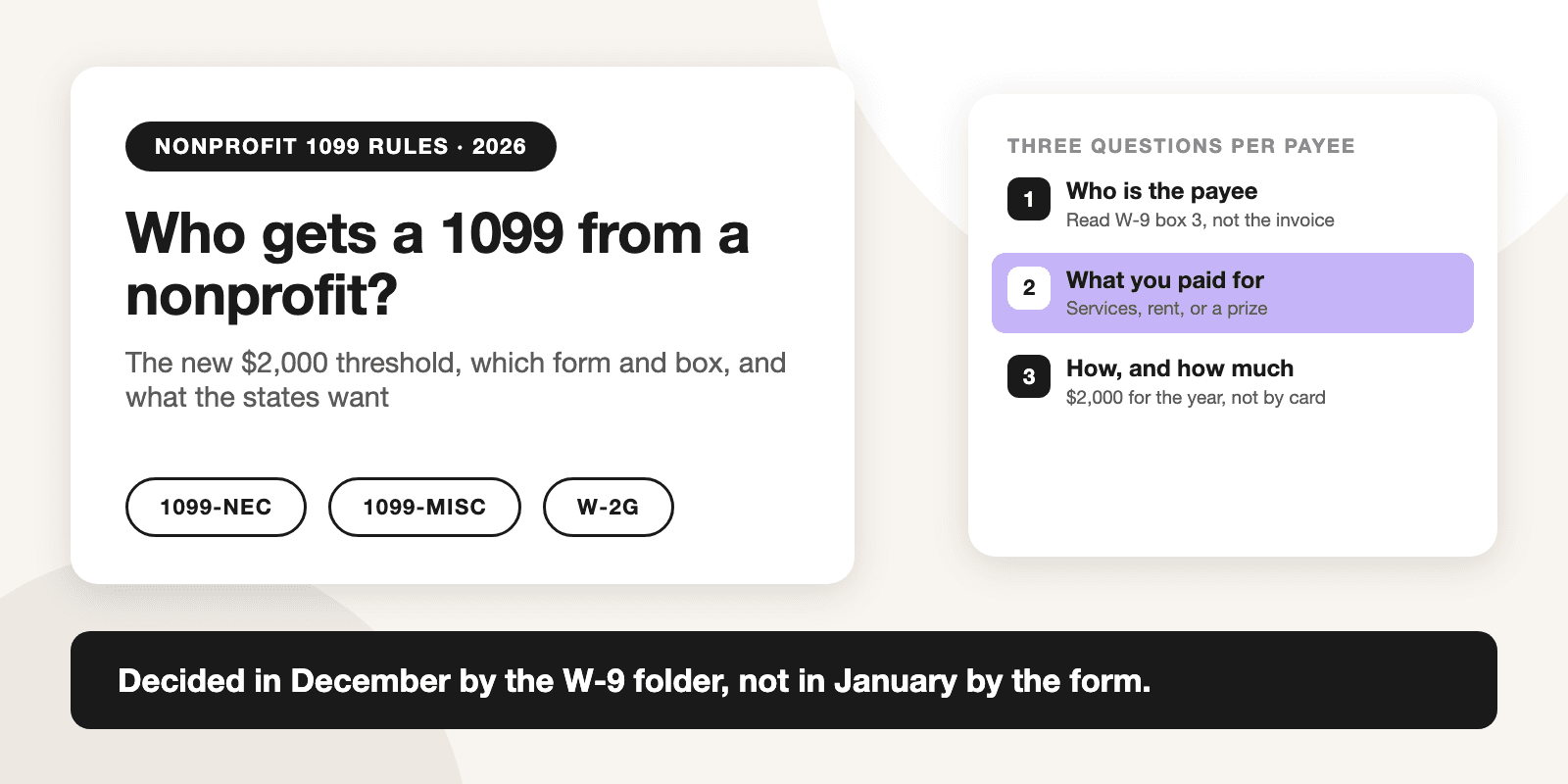
The January version of this question arrives as a spreadsheet. Someone has exported every payment the organization made last year, sorted it by payee, and is now staring at forty names trying to remember which ones were companies, which ones were people, and which ones were the church that rents you the hall. Two questions sit under all forty rows: does this payee get a 1099, and if so, which one?
This is the 1099 for nonprofits guide we would want open in January, because for payments made in 2026 the answers changed. The reporting threshold for contractor payments, rent, and prizes that had been $600 since 1954 is now $2,000, the raffle rules moved with it, and the payment-app rules moved back. It covers who gets one, at what dollar amount, which form and box, what the states want on top of the IRS, the deadlines and the four penalty numbers, and how we prepare them and what we charge. The tracker spreadsheet and the one-page checklist at the end do the sorting for you.
Key Takeaways
Start with the rule the IRS applies to everyone. A tax-exempt organization must file the same information returns a business files: if you paid a person or an unincorporated business $2,000 or more during the calendar year for services performed in the course of your activities, you report it on Form 1099-NEC. Rent, prizes, and other income of $2,000 or more go on Form 1099-MISC. The 501(c)(3) letter changes nothing about your obligation as a payer; it changes what happens when someone pays you, which is the section after next.
What makes a nonprofit’s vendor list harder than a business’s is not the rule but the payees. Businesses pay contractors and landlords. Nonprofits also pay board members, guest speakers, scholarship recipients, raffle winners, families in crisis, and other nonprofits, and each of those sorts differently. The table below is the sort, using the current IRS instructions for Forms 1099-MISC and 1099-NEC, the W-2G instructions for raffles, and Publication 3833 for hardship assistance. Every row assumes the calendar-year total to that payee reached the threshold; below it, nothing is filed.
An individual or sole proprietor for servicesGrant writer, web developer, cleaner, program consultant
1099-NEC, box 1a
Nonemployee compensation of $2,000 or more. Parts and materials billed with the service count toward the total.
An LLC for servicesThe bookkeeper who is “Something Bookkeeping LLC”
Depends on the W-9
An LLC taxed as a sole proprietorship or partnership gets a 1099-NEC. An LLC that elected S or C corporation status is a corporation and does not. The tax classification box on the W-9 decides it, which is why the W-9 comes first.
A corporation for servicesThe software vendor, the printing company
No 1099
Payments to corporations are exempt from reporting, with a short list of exceptions. The ones a nonprofit meets are attorneys’ fees, gross proceeds paid to an attorney in a settlement, and medical or health care payments.
A law firm for legal feesEven if the firm is incorporated
1099-NEC, box 1a
Attorneys’ fees of $2,000 or more are reportable regardless of the firm’s entity type. Gross proceeds paid to an attorney in a settlement go on 1099-MISC box 10, which kept its old $600 line; ordinary fees are NEC.
RentOffice, storage, the hall you use on Saturdays
1099-MISC, box 1
Rents of $2,000 or more, when the landlord is an individual, partnership, or LLC not taxed as a corporation. Rent paid to a corporation, a tax-exempt organization, or a government is not reported, and neither is rent you pay through a real estate agent or property manager, whatever its entity type; the agent reports what it passes to the owner.
Board members for their serviceDirectors’ fees, stipends for attending meetings
1099-NEC, box 1a
The instructions name directors’ fees specifically, including payments made after retirement. Reimbursed travel under an accountable plan is not compensation and is not reported.
Guest speakers, trainers, performersHonoraria for a workshop or a gala performance
1099-NEC, box 1a
An honorarium is a payment for services, whatever it is called. Sort the payee by entity type as above.
Volunteers who receive a stipendA monthly allowance, a bonus, a cash “thank you”
1099-NEC, or W-2
Cash stipends, allowances, and bonuses you pay your own volunteers are compensation: a W-2 if the person functions as an employee, otherwise nonemployee compensation on a 1099-NEC. Out-of-pocket reimbursements under an accountable plan are neither. Federal service programs follow their own rules; AmeriCorps education awards are reported by AmeriCorps itself, and supportive-service payments under RSVP, Foster Grandparent, and Senior Companion are excluded from income. See our expense reimbursement policy guide for the accountable-plan test.
A prize or award not tied to servicesA community award with a cash gift, a contest prize
1099-MISC, box 3
Other income of $2,000 or more, including the fair market value of merchandise. A prize for services performed by a nonemployee is NEC instead.
A raffle winnerThe 50/50 drawing, the donated car
Form W-2G, not a 1099
Report on W-2G when the winnings minus the ticket price meet the reporting threshold, $2,000 for 2026, and are at least 300 times the wager. Withhold 24% when the proceeds exceed $5,000. A noncash prize is valued at fair market value, and the instructions give two withholding methods for it.
Scholarship or fellowship recipientsTuition help, a research fellowship
Not on a 1099-MISC
The instructions say not to use Form 1099-MISC for scholarship or fellowship grants. A grant that is taxable because it pays for teaching, research, or other services is wages and goes on a W-2.
Individuals helped by a hardship or disaster programRent assistance after a fire, a medical emergency grant
No 1099
Payments individuals receive under a charity’s disaster or emergency-hardship program are gifts, excluded from the recipient’s income under section 102, so they are not the kind of income a 1099 reports. That treatment fails when the recipient is an employee, when the payment is for services, or when the charity expects something back. Keep the eligibility file.
Another nonprofit, a church, a government agencyA pass-through grant, a fee to the county
No 1099
Payments to tax-exempt organizations and to federal, state, and local governments are exempt from reporting.
Anyone you paid by card or payment appCredit card, PayPal Goods and Services, a marketplace
No 1099-NEC or MISC from you
Card and third-party network payments are reported by the payment settlement entity on Form 1099-K and are not reported on 1099-MISC or 1099-NEC by the payer. Cash, check, ACH, and bank transfer stay with you.
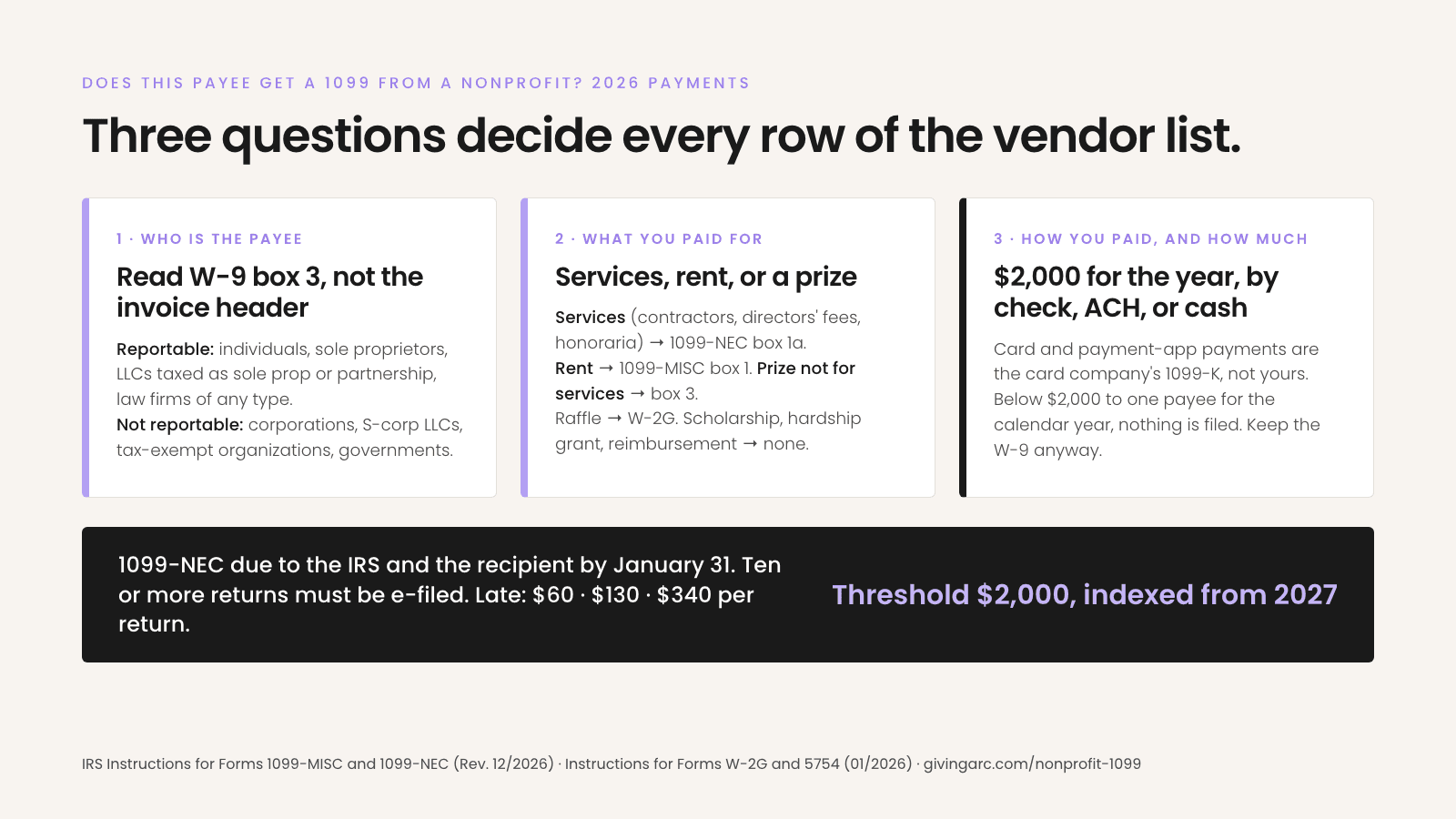
Two things about that table. The rows are decided by facts you can only get before the payment, which is the whole argument for a no-W-9-no-check rule; our W-9 guide covers how to collect them and what to do with the ones you receive. And the thresholds are totals for the year to one payee, not per invoice. Four $600 checks to the same consultant are a $2,400 1099-NEC.
The 2025 tax law raised the minimum reporting amount for Forms 1099-NEC and 1099-MISC, effective for payments made after December 31, 2025, with inflation adjustments beginning in 2027. The instructions for Forms 1099-MISC and 1099-NEC list the boxes it applies to, and the W-2G instructions carry the same $2,000 figure for 2026. The 1099-K threshold went the other direction: the same law restored the pre-2021 level, so payment apps report a payee only above $20,000 and more than 200 transactions. The W-9 guide linked above has the history and the January 2027 timing; here is the current line for each form. Boxes the law did not touch keep their old lines: gross proceeds paid to an attorney on 1099-MISC box 10 stays at $600, and royalties stay at $10.
1099-NEC box 1a
$2,000
Nonemployee compensation, including attorneys’ fees and directors’ fees. Per payee, per calendar year.
1099-MISC box 1
$2,000
Rents of all types.
1099-MISC box 3
$2,000
Other income: prizes and awards not for services, including merchandise at fair market value.
W-2G, raffles
$2,000 and 300×
Winnings minus the wager at the reporting threshold and at least 300 times the ticket price. Withholding of 24% starts above $5,000.
1099-K, filed by the card company
$20,000 and 200
Gross payments over $20,000 and more than 200 transactions, reported by the settlement entity, not by you.
Backup withholding
24%
If a payee will not give you a taxpayer identification number, withhold 24% and report it on Form 945.
One caution about where you check these numbers. As of September 2026 the IRS page written for charities about information returns still shows the old $600 figure; the statute and the current form instructions control, and both say $2,000. When a number on an IRS page and a number in the current instructions disagree, the instructions win.
The other half of the search traffic on this topic is the reverse question: a sponsor, a fiscal agent, or a company that bought a table at the gala asks for your W-9 and you wonder whether a 1099 is coming. The IRS instructions exempt payments to tax-exempt organizations from 1099 reporting, so one usually does not follow, and if it does, it is not a problem.
Give them the W-9.
The payer needs your legal name, EIN, and exempt status for its own records. There is nothing to negotiate; the form takes five minutes and the W-9 guide walks through the boxes a 501(c)(3) checks.
Expect no 1099-NEC or MISC.
Payments to a tax-exempt organization are on the IRS list of payments exempt from 1099-MISC and 1099-NEC reporting. A sponsor that reads the instructions will not send one. The form that can arrive is a 1099-K from your own card processor or payment app, once it has paid you more than $20,000 across more than 200 transactions.
If one arrives anyway, file it, do not fear it.
A 1099 is an information return, not a tax bill. Match it to the revenue already in your books, keep it with the year’s records, and ask the payer to correct it if the amount is wrong. Whether the sponsorship itself is taxable is a separate question about what the sponsor received, covered in our Form 990-T guide.
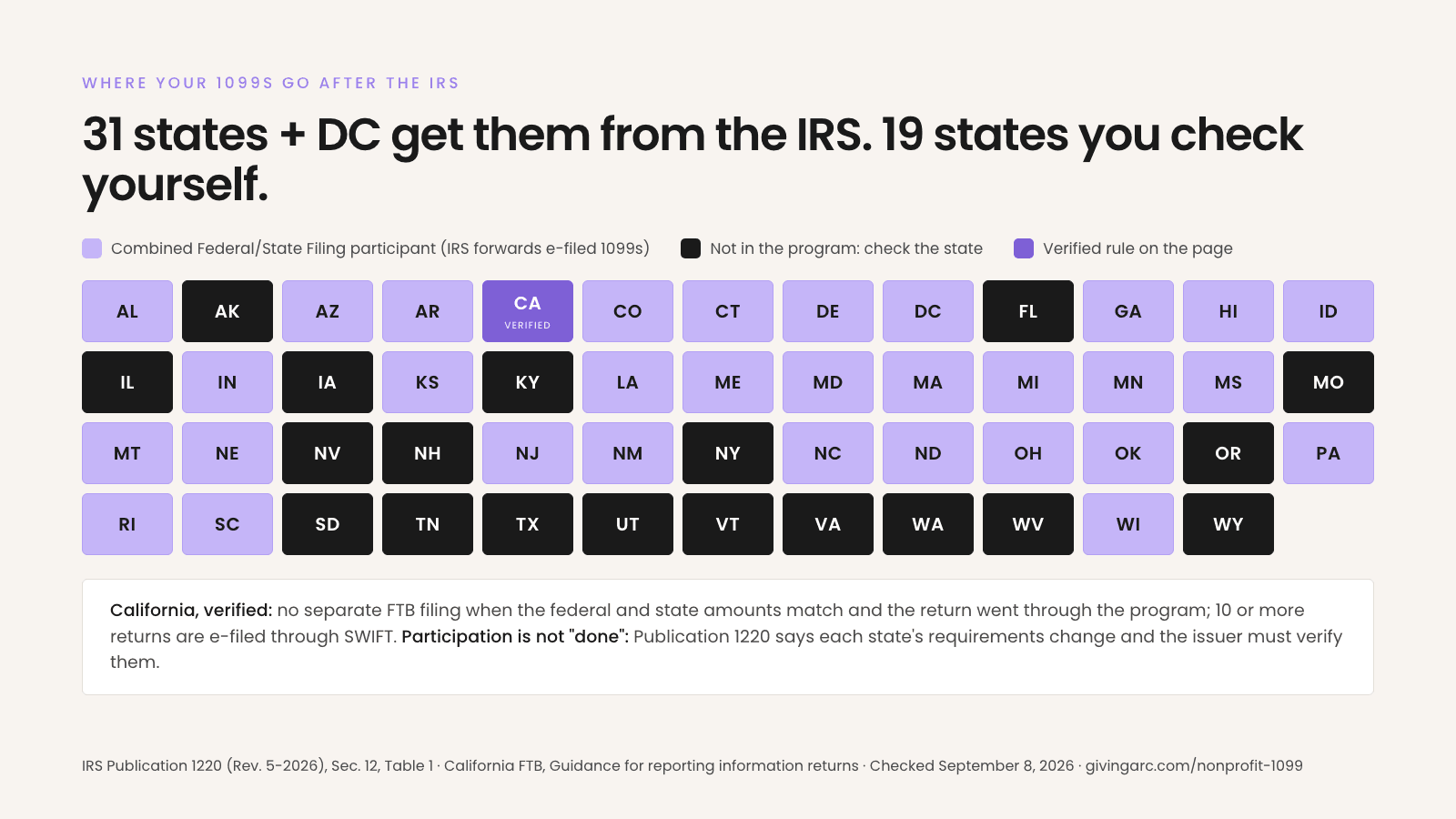
Here is the part the IRS cannot answer for you. Federal filing is one return to one agency. State filing is fifty answers, and they come in two layers. The first layer is the Combined Federal/State Filing Program: when you e-file through the IRS and code the payee’s state, the IRS forwards the data to participating states at no charge, and Form 1099-NEC is included in the program. The second layer is each state’s own rule, because participation in the program does not by itself mean a state asks for nothing else. Publication 1220 says so directly: each state’s requirements can change, and the issuer is responsible for verifying them.
In the Combined Federal/State Filing Program (31 states + DC)
Alabama, Arizona, Arkansas, California, Colorado, Connecticut, Delaware, District of Columbia, Georgia, Hawaii, Idaho, Indiana, Kansas, Louisiana, Maine, Maryland, Massachusetts, Michigan, Minnesota, Mississippi, Montana, Nebraska, New Jersey, New Mexico, North Carolina, North Dakota, Ohio, Oklahoma, Pennsylvania, Rhode Island, South Carolina, Wisconsin
The IRS forwards your e-filed 1099s to these states. Some of them still require a direct filing in certain cases, so this list means “ask whether anything more is needed,” not “done.”
Not in the program (19 states)
Alaska, Florida, Illinois, Iowa, Kentucky, Missouri, Nevada, New Hampshire, New York, Oregon, South Dakota, Tennessee, Texas, Utah, Vermont, Virginia, Washington, West Virginia, Wyoming
Nothing is forwarded. Several of these states have no personal income tax and no 1099-NEC filing of their own; others require you to file directly with the state revenue department. Check the state’s current instructions for the year you are filing.
California, verified
If you file with the IRS through the Combined Federal/State program and the federal and state amounts are the same, do not file with the Franchise Tax Board; the IRS forwards it. File separately only when an amount differs for state purposes. Ten or more returns must be filed electronically through the FTB’s SWIFT system.
Source: FTB, Guidance for reporting information returns, checked September 8, 2026.
If your payees are in one or two states, this is a ten-minute check once a year. If you have contractors in a dozen states, it is the reason to let whoever files your 1099s handle the state layer too, since the software that e-files through the IRS program codes each payee’s state as part of the same submission.
DecemberClose the vendor list
Run payments by payee for the calendar year, flag every payee at $2,000 or more, and chase the missing W-9s while the vendor still wants next year’s work. Backup withholding at 24% is the rule for a payee who refuses a taxpayer identification number, and it is far easier to never need it.
January 31Form 1099-NEC, both copies
Due to the IRS and to the recipient on the same day, with no automatic extension. Form 1099-MISC recipient copies are also due January 31, except February 15 when box 8 or box 10 is reported. Raffle W-2Gs go to winners by January 31. For 2026 payments the date falls on a Sunday, so the operative deadline is Monday, February 1, 2027.
February 28 / March 31Form 1099-MISC to the IRS
February 28 on paper, March 31 electronically; for 2026 payments the paper date shifts to Monday, March 1, 2027. Filing everything with the 1099-NECs collapses two deadlines into one and is the simpler practice.
10 or more returnsYou must e-file
Count every information return you file, of every type, together. At ten, paper is no longer allowed. The IRS’s free system for this is IRIS.
Late or missing$60 · $130 · $340 · $690
Per return, for the returns filed in 2027 that cover 2026 payments, set by Rev. Proc. 2025-32: $60 if filed within 30 days of the due date, $130 if filed by August 1, $340 after August 1 or never, and $690 for intentional disregard (or 10% of the amounts that should have been reported, if greater), which has no annual cap. For a small filer the annual caps on the first three tiers are $244,500, $698,500, and $1,397,000. The same schedule applies separately to the recipient copy, so one forgotten contractor can cost two penalties.
The reframe we would offer a new executive director is this: the 1099 question is not decided in January by the form. It is decided in December by the W-9 folder. Every row in the payee table above turns on a fact that lives on the W-9, and every penalty in the timeline comes from a fact you did not have when the check went out. The January work is a sort; the December work is the whole job, and it sits on the same year-end calendar as everything else in our nonprofit compliance checklist.
We prepare and e-file Forms 1099-NEC and 1099-MISC at $30 per form. That covers the federal e-file, the recipient copy, and the state data sent through the Combined Federal/State Filing Program for participating states. You collect the W-9s; that part cannot be outsourced, because the vendor will only give it to the organization paying them.
For organizations whose books we keep, the vendor totals come straight out of the ledger we close every month, so the January list is already sorted by payee, entity type, and payment method, and the forms are a review rather than a project. For organizations that keep their own books or use another bookkeeper, the same $30 applies: send us the payee list with calendar-year totals and the W-9s, and we sort the rows, prepare the forms, and file. Our nonprofit tax service page describes the 990 side of the same annual work, and the pricing page lists everything else we charge for.
1099s prepared and e-filed at $30 per form, books with us or not.
Send the payee totals and W-9s, or let us pull them from the books we keep. Federal e-file, recipient copies, and the combined federal/state submission are included; the price is on the page, not on a call.
Two free files go with this guide, no email required. The 1099 vendor tracker is a spreadsheet where you enter each payee’s entity type from the W-9, the kind of payment, how you paid, and the year’s total; a formula returns the form and box, or “none,” and a second tab holds the threshold so you can update it when the IRS indexes it. The one-page decision checklist is the same logic on paper, for the board treasurer who wants it next to the check register.
Common questions from small nonprofits about issuing and receiving Form 1099.
Yes. A tax-exempt organization must file the same information returns a business files. For payments made in 2026, that means a Form 1099-NEC for each individual or unincorporated business paid $2,000 or more for services during the year, and a Form 1099-MISC for rents, prizes, and other income of $2,000 or more. Payments to corporations, other tax-exempt organizations, and governments are not reported, with a few exceptions, chiefly attorneys’ fees of $2,000 or more and medical payments, which are reported even when the payee is a corporation.
Generally no. The IRS instructions list payments to a tax-exempt organization among the payments that are exempt from Form 1099-MISC and 1099-NEC reporting, so a sponsor or customer that asks for your W-9 is collecting it for its records and should not send a 1099. If one arrives anyway, it is an information return rather than a tax bill: match it to the revenue already in your books, keep it with the year’s records, and ask the payer to correct it if the amount is wrong.
$2,000 per payee per calendar year, for payments made after December 31, 2025. It applies to nonemployee compensation on Form 1099-NEC and to rents, other income, and several other boxes on Form 1099-MISC, and the same $2,000 figure is the 2026 reporting threshold for raffle winnings on Form W-2G. The amount is indexed for inflation beginning in 2027. The separate Form 1099-K threshold for payment apps is over $20,000 and more than 200 transactions.
It depends on the arrangement. Cash stipends, allowances, and bonuses your organization pays its own volunteers are compensation. If the person works under your direction like an employee, the payment is wages on a W-2; otherwise it is nonemployee compensation on Form 1099-NEC once the year’s total reaches $2,000. Federal service programs such as AmeriCorps report their own awards. Reimbursements of documented out-of-pocket expenses under an accountable plan are not compensation and are not reported, which is why a written reimbursement policy matters.
It depends on the state. Thirty-one states and the District of Columbia participate in the IRS Combined Federal/State Filing Program, which forwards e-filed 1099 data, including Form 1099-NEC, to the state; some of those states still require a direct filing in certain cases. Nineteen states are not in the program, and each has its own rule, ranging from no filing at all to a mandatory direct submission. California, for example, does not require a separate filing when the federal and state amounts match and the return went through the program. Check each state’s current-year instructions before filing.
GivingArc provides bookkeeping, Form 990 preparation, and nonprofit-specialized accounting for small and mid-size 501(c)(3) organizations across the US. The January spreadsheet and the payee examples are illustrative and not drawn from any client. Thresholds, due dates, and penalties are taken from the IRS instructions for Forms 1099-MISC and 1099-NEC (Rev. December 2026), the Instructions for Forms W-2G and 5754 (January 2026), IRS Publication 1220 (Rev. May 2026), IRS Publication 3833, and the IRS information return penalties page, and the California rule from the Franchise Tax Board, all as checked on September 8, 2026. Reviewed by Min Kim, CPA.