

Creating an effective nonprofit budget format is one of the most critical financial management tasks for nonprofit organizations. Unlike for-profit businesses focused solely on revenue generation, nonprofits must balance mission-driven priorities with complex reporting requirements, donor restrictions, and regulatory compliance. A well-structured budget serves as both a planning tool and a transparency mechanism that demonstrates responsible stewardship to donors, board members, and regulatory agencies.
The format you choose directly impacts your organization’s ability to track restricted funds, allocate costs appropriately, and meet IRS reporting requirements. With proper budget formatting practices that align with Generally Accepted Accounting Principles (GAAP) and sector-specific requirements, organizations can transform their financial management and achieve greater mission impact.
Download our free 2026 Nonprofit Budget Template — 5-tab Excel workbook plus a 3-phase zero-based PDF worksheet. ASU 2016-14 ready.
Nonprofit budget formats operate under fundamentally different principles than their for-profit counterparts, primarily due to the mission-driven nature of these organizations and specific regulatory requirements. The most significant distinction lies in functional expense reporting requirements established by the Financial Accounting Standards Board (FASB) under ASU 2016-14.
While for-profit businesses typically organize expenses by department or cost center, nonprofits must categorize expenses by function: program services, management and general, and fundraising. This functional approach ensures donors and stakeholders understand how resources directly support the organization’s mission versus administrative overhead.
Revenue streams also differ significantly. For-profit budgets focus on sales, services, and investment income, while nonprofit budgets must account for diverse funding sources including individual donations, foundation grants, government contracts, and earned revenue. Each revenue source may carry specific restrictions that affect how funds can be allocated and spent, requiring careful tracking within the budget format.
The net asset classification system represents another crucial difference. Under current GAAP standards, nonprofits must distinguish between resources with donor restrictions and those without restrictions, replacing the old temporarily restricted and permanently restricted categories. This classification directly impacts budget presentation and requires specific formatting considerations that don’t exist in for-profit environments.
Board oversight responsibilities also shape nonprofit budget formats. Unlike private company budgets that serve primarily internal management purposes, nonprofit budgets become accountability tools that demonstrate fiscal responsibility to diverse stakeholder groups including donors, regulatory agencies, and the general public.
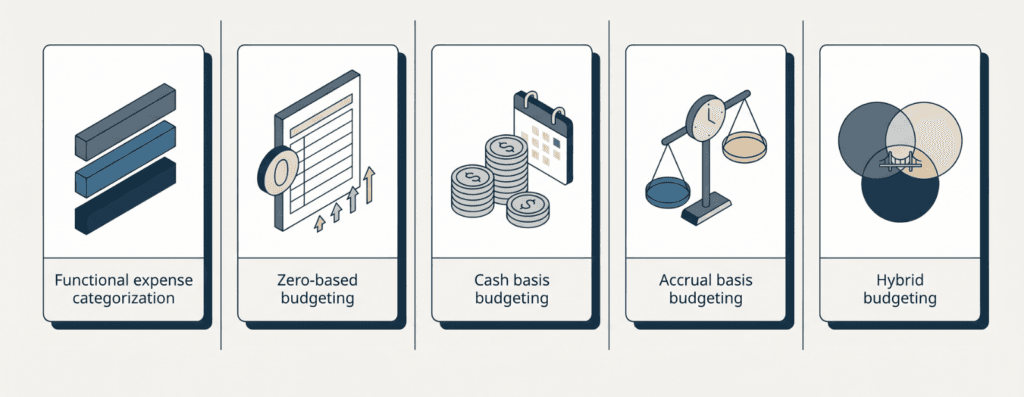
A comprehensive nonprofit budget format begins with a detailed revenue section that reflects the organization’s diverse funding streams. Individual giving should be broken down into specific categories such as major gifts (typically donations over $1,000), annual fund contributions, planned giving commitments, and board member contributions. This granular approach enables more accurate forecasting and helps identify which revenue streams require additional development focus.
Foundation and corporate grants deserve separate line items with clear identification of restricted versus unrestricted funding. Government contracts and grants should be categorized by funding agency and program, with careful attention to reimbursement timing and cash flow implications. Many organizations experience significant delays between program delivery and government reimbursement, making accurate timing projections essential for cash flow management.
Earned revenue categories might include program fees, merchandise sales, rental income, or social enterprise activities. In-kind donations require special consideration, as they must be valued at fair market value and recorded as both revenue and expense when the organization would have otherwise purchased similar goods or services.
Investment income and endowment distributions should reflect board-approved spending policies and realistic return expectations. Conservative projections help prevent budget shortfalls while maintaining appropriate reserve levels for organizational sustainability.
Direct mission-aligned expenses as a share of total operating budget.
Management and general overhead kept lean to maximize program impact.
Minimum cash cushion for sustained operations during disruption.
Net asset classification with vs. without donor restrictions required.
The expense section must align with FASB functional reporting requirements while providing sufficient detail for effective management oversight. Program expenses represent the direct costs of delivering mission-related services and should typically comprise at least 65-75% of total expenses to maintain optimal efficiency ratios — though this varies by nonprofit type.
Management and general expenses include administrative costs, executive leadership, accounting and legal services, insurance, and facility costs not directly attributable to programs. Our nonprofit bookkeeping services help organizations implement proper cost allocation methodologies that ensure accurate functional expense reporting.
Fundraising expenses encompass all costs related to donor cultivation, grant writing, fundraising events, and development staff salaries. The IRS provides specific guidelines for distinguishing between fundraising costs and educational activities that serve program purposes.
Cost allocation methodologies require clear documentation, particularly for shared expenses like facility costs, utilities, and staff time that benefits multiple functions. Time studies, square footage calculations, and direct cost percentages provide defensible allocation methods that withstand audit scrutiny.
Effective nonprofit budget formats incorporate multiple time perspectives to support both operational management and strategic planning. Monthly budget columns enable regular variance analysis and cash flow monitoring, particularly important for organizations with seasonal funding patterns or program cycles.
Quarterly projections align with typical board meeting schedules and grant reporting requirements. Many foundations require quarterly financial reports, making this format essential for compliance and relationship management.
Annual totals provide the comprehensive view needed for Form 990 filing and organizational planning. Budget versus actual comparison columns help identify trends and inform future planning decisions, while prior year comparison data provides historical context for growth and variance analysis.
Self-check against the four GAAP requirements for your 2026 budget
GAAP compliance significantly influences nonprofit budget format requirements, particularly regarding net asset classification and revenue recognition principles. The FASB’s ASU 2016-14 eliminated the three-category net asset system, replacing it with a simplified approach distinguishing between net assets with donor restrictions and those without restrictions.
This change requires budget formats to clearly identify restricted revenue sources and their corresponding expense limitations. Temporarily restricted funds must be tracked by purpose restriction (program-specific, time-specific, or capital campaign), while permanently restricted funds typically represent endowment principal that cannot be spent.
Revenue recognition timing follows specific rules that impact budget presentation. Contributions are recognized when received, while exchange transactions follow earned revenue principles. Grant revenue recognition depends on whether the funding represents a contribution or an exchange transaction, affecting both timing and classification within the budget format.
Functional expense allocation requirements mandate that budgets support the organization’s ability to report expenses by function on financial statements. This means budget categories must align with the functional expense reporting that appears on audited financial statements and Form 990 submissions.
The contribution versus exchange transaction distinction affects both revenue and expense reporting. Exchange transactions, where the organization provides equivalent value in return for payment, require different treatment than pure contributions where donors receive no commensurate benefit.
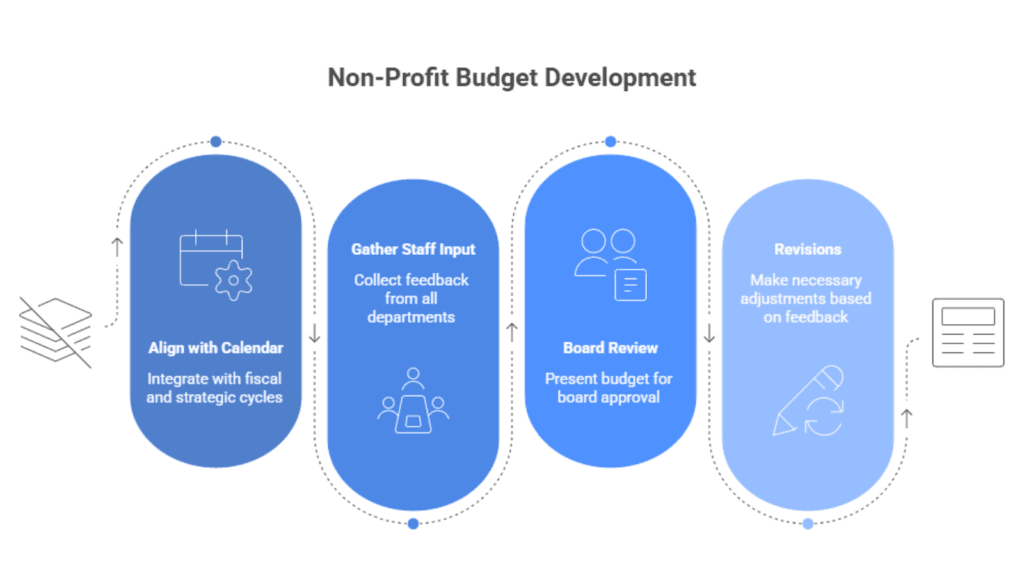
Budget development begins with aligning the process to your board’s fiscal calendar and strategic planning cycle. Most nonprofits benefit from starting budget development 3-4 months before the fiscal year begins, allowing adequate time for staff input, board review, and necessary revisions.
Historical data gathering forms the foundation for realistic projections. Collect at least three years of financial statements, donor databases, and program cost analyses. This historical perspective helps identify trends, seasonal patterns, and growth trajectories that inform future projections.
Program planning alignment ensures that budget allocations support mission priorities. Department heads and program managers should provide detailed activity plans, including new initiatives, program expansions, and anticipated changes in service delivery that impact resource requirements.
Start three to four months before fiscal year. Each phase feeds the next.
Align on mission priorities, review prior-year results, set assumptions and approval timeline.
Build conservative revenue forecasts by stream and donor restriction status.
Map costs to functional categories, validate program ratios, finalize for board approval.
Revenue forecasting requires careful analysis of donor pipelines, grant application timelines, and earned revenue potential. Individual donor projections should consider donor retention rates, upgrade potential, and new donor acquisition goals. Historical giving patterns help establish realistic baselines for annual fund projections.
Grant revenue timing requires detailed tracking of application deadlines, award notification schedules, and funding periods. Consider a scenario where an organization applies for a $50,000 foundation grant in January with award notification expected in May and funding available in July – this timing significantly impacts cash flow planning and budget implementation.
With over 23 years of collective nonprofit accounting experience, our team has seen how conservative estimation principles protect against revenue shortfalls while maintaining organizational sustainability. We recommend budgeting foundation grants at 70-80% of requested amounts (unless you have a written commitment) and building in 10-15% contingency factors for economic uncertainties or donor changes. Yes, it feels pessimistic, but it beats explaining program cuts to your board mid-year.
Get a free custom quote tailored to your organization — no obligation.
Program cost calculations require detailed analysis of direct and indirect expenses needed to deliver services effectively. Staff salaries, benefits, program supplies, and allocated facility costs must align with anticipated service levels and quality standards. For federal awards, the indirect line should rest on a calculated rate rather than a guess; our free indirect cost rate calculator computes it on the MTDC base and compares it with the 15% de minimis rate.
Administrative expense budgeting should maintain appropriate ratios while ensuring adequate infrastructure support. While many watchdog organizations expect administrative costs below 15-20%, the appropriate level depends on organizational size, complexity, and growth stage. Smaller organizations often require higher administrative percentages to maintain basic operational capacity.
Zero-based budgeting principles work particularly well for nonprofits, requiring justification for each expense rather than simply adjusting prior year amounts. This approach helps identify cost-saving opportunities and ensures resources align with current strategic priorities rather than historical patterns.
Struggling with functional expense allocations?
Our CPAs specialize in nonprofit budget formats that pass audits.
One frequent error involves underestimating the complexity of restricted fund tracking within budget formats. Organizations often create budgets that look balanced overall but fail to match restricted revenue with allowable expenses, leading to compliance issues and potential donor dissatisfaction.
Cash flow timing represents another critical oversight area. Many nonprofits create annual budgets without monthly cash flow projections, then face crisis situations when major grant payments arrive months after expenses are incurred. Monthly variance reports become essential management tools for identifying these timing issues before they create operational problems.
Inadequate contingency planning leaves organizations vulnerable to unexpected changes. Whether facing sudden funding cuts, emergency facility repairs, or economic downturns, budgets without appropriate reserves force reactive decision-making that can damage programs and relationships. We typically recommend maintaining 3-6 months of operating reserves, though this varies by funding stability and organizational risk factors.
Failure to align budget categories with financial statement requirements creates reconciliation nightmares and audit complications. Budget line items should mirror the chart of accounts structure to enable seamless reporting and avoid year-end reclassification exercises.
Match your budget software to your organization’s size, complexity, and reporting needs.
~$0–$90 / month
~$400+ / month
QuickBooks Online Nonprofit edition provides built-in features for fund accounting and functional expense tracking that align with standard nonprofit budget formats. The class tracking feature enables organizations to monitor restricted funds while maintaining GAAP-compliant financial records suitable for audit preparation.
Excel remains a powerful tool for budget development, particularly when using templates designed specifically for nonprofit organizations. Key features should include automatic calculation of functional expense ratios, variance analysis formulas, and dashboard visualizations that make board reporting more effective.
Specialized nonprofit accounting software like Sage Intacct or Blackbaud Financial Edge offers advanced features for complex organizations managing multiple programs, locations, or funding sources. These systems provide real-time budget versus actual reporting and sophisticated allocation tools that simplify compliance with various grant requirements.
Free resources from organizations like the National Council of Nonprofits and BoardSource offer budget templates and best practice guides tailored to different organizational sizes and subsectors. These templates provide starting points that organizations can customize to their specific needs while maintaining sector standards.
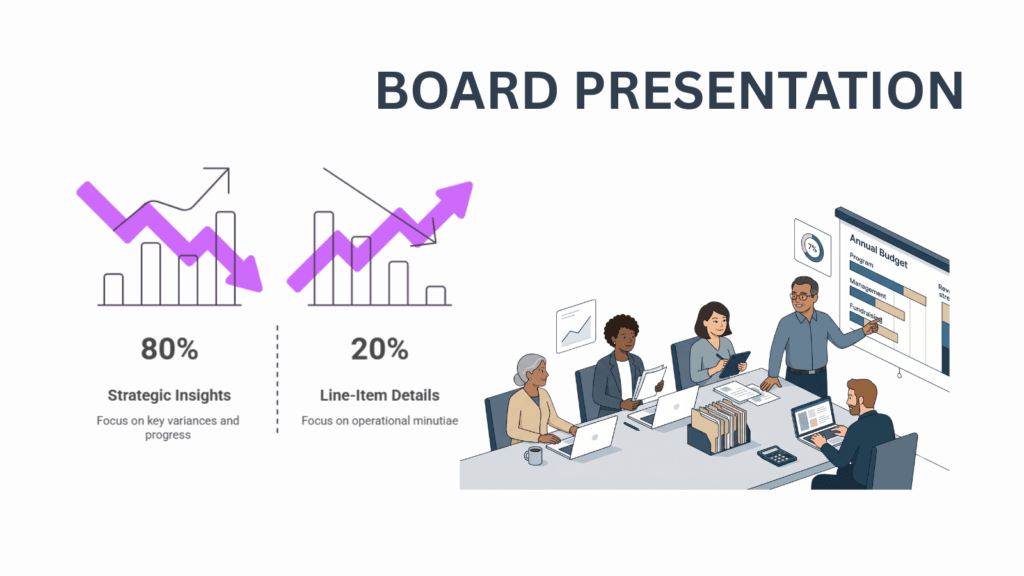
Board presentation formats should emphasize strategic insights rather than line-item details. Executive summaries highlighting key variances, ratio analyses, and progress toward strategic goals help board members fulfill their fiduciary responsibilities without getting lost in operational minutiae. Visual dashboards showing program efficiency ratios, months of cash on hand, and fundraising ROI metrics enhance understanding and engagement.
Donor-facing budget formats require different considerations than internal management reports. Major donors and foundations often request detailed program budgets showing exactly how their contributions support specific outcomes. Creating modular budget formats that can be easily customized for different audiences saves time while ensuring consistent messaging.
Staff-level budgets need sufficient detail for operational decision-making while remaining accessible to non-financial managers. Department managers should receive monthly reports showing their specific budget versus actual performance with clear variance explanations and projected year-end positions. This transparency promotes accountability and enables proactive adjustments.
The connection between budget formats and Form 990 reporting deserves special attention. Since the Form 990 requires detailed functional expense reporting and program service accomplishments, budget categories should align with these reporting requirements from the beginning. This alignment simplifies year-end reporting and ensures consistency across all financial communications.
A well-designed nonprofit budget format serves as the backbone of effective financial management and mission achievement. Start by evaluating your current budget format against the GAAP compliance requirements and best practices outlined in this guide. Identify gaps in functional expense tracking, restricted fund monitoring, or stakeholder reporting that may be limiting your organization’s effectiveness.
For organizations seeking to professionalize their financial management, partnering with experienced nonprofit accounting professionals can accelerate improvement and ensure compliance. Our team at GivingArc specializes in helping nonprofits implement budget formats that satisfy both regulatory requirements and management needs. We understand the unique challenges nonprofits face in balancing mission focus with financial sustainability.
Take the first step today by downloading our free nonprofit budget template or scheduling a consultation to discuss your specific budget formatting needs. With the right structure in place, your budget becomes a powerful tool for advancing your mission and demonstrating impact to all stakeholders. Don’t let another budget cycle pass without implementing the improvements that will transform your financial management and organizational effectiveness.
Answers to the most common nonprofit budget format questions for 2026.
The ideal format is a functional expense budget structured under ASU 2016-14, with revenue separated into “without donor restrictions” and “with donor restrictions” net asset classes. It should include monthly time periods, a 12-month cash flow forecast, and a ratio dashboard tracking program (65–75%), management & general (under 15–20%), and fundraising allocations.
The widely cited benchmark is 65–75% of total expenses on direct program services. Sector matters: human services often run 80–85%, advocacy organizations 60–65%, and arts or research nonprofits closer to 70%. Watchdogs like Charity Navigator flag organizations below 65%, but mission and growth stage should drive the conversation more than a single ratio.
Use a three-phase process starting 3–4 months before fiscal year:
Phase 1 — Planning: Align with mission priorities, review prior-year results, set economic assumptions, and confirm the approval timeline.
Phase 2 — Revenue projections: Forecast each revenue stream conservatively (budget at 70–80% of grants under review), separating restricted from unrestricted.
Phase 3 — Expense planning: Allocate every dollar to program, management & general, or fundraising, validate ratios, and present to the board for approval.
ASU 2016-14 is the FASB accounting standard (effective for fiscal years beginning after December 15, 2017) that simplified nonprofit net asset reporting from three classes to two: with donor restrictions and without donor restrictions. It also requires a functional expense statement, liquidity disclosures, and updated cash flow reporting. Your 2026 budget format must reflect these classifications or you will fail GAAP audit standards.
Functional categories report why money was spent, not just what it bought. Three categories are required by GAAP:
Program services — costs that directly fulfill the mission (e.g., direct service delivery, grants made).
Management & general — overall operations, governance, and accounting that aren’t tied to any single program.
Fundraising — costs to solicit contributions, run campaigns, or maintain donor systems.
Most experts recommend 3 to 6 months of operating expenses in unrestricted reserves, with 6+ months considered healthy. During economic uncertainty or for organizations with concentrated revenue (e.g., a single government contract), 9–12 months may be appropriate. Build reserves with a planned annual surplus (1–3% of budget) rather than treating any year-end positive variance as automatically restricted.
Zero-based budgeting (ZBB) starts every line at $0 each year and requires written justification for every dollar requested, rather than rolling forward last year’s numbers with an inflation adjustment. ZBB is especially useful when programs change, after a strategic planning cycle, or when a board wants every expense aligned with mission impact. The trade-off is more upfront staff time, so many organizations use ZBB every 2–3 years and incremental budgeting in between.
You don’t need separate budget documents, but every revenue and expense line must be classified by net asset category (with vs. without donor restrictions) inside one integrated budget. Restricted funds can only be spent on the donor-specified purpose and time horizon, so your budget should track the release-from-restriction schedule month by month. A unified budget with a restriction column is the most audit-ready format.