
A longtime supporter calls on a Thursday afternoon. He has a building. It is paid off, it is yours if you want it, and he would like to announce it at the gala in three weeks.
Every instinct in the room says yes. Saying anything else in that moment feels like ingratitude, and you have about four seconds to answer. This is the part nobody warns you about in nonprofit work: the hardest financial decisions arrive disguised as good news, wrapped in a relationship you cannot afford to damage, on someone else’s timeline.
A nonprofit gift acceptance policy exists to move that decision. Not to make it harder — to make it earlier. The work of deciding what your organization can responsibly take on happens once, in a calm room, with the board present and no donor waiting on the line. After that, the Thursday phone call has an answer already in it.
Key Takeaways
Start with what it is not. A gift acceptance policy is not a fundraising strategy, not a donor-facing brochure, and not a list of things you refuse to take. Organizations that write it as a wall end up with a document nobody opens.
It is closer to a building code. A building code doesn’t tell you what to build — it tells you which decisions can be made on site by whoever is holding the hammer, and which ones require an engineer to sign off first. Nobody experiences that as an obstacle. It’s what lets the crew move fast on everything ordinary, because the boundary of “ordinary” was drawn in advance.
That is the whole function. Nearly everything that comes in is routine — cash, checks, ordinary in-kind goods — and none of it should ever reach a board agenda. The policy exists so that the remaining fraction — the building, the pickup truck, the shares in a family business, the gift with a string attached — gets routed somewhere a considered answer is possible.
The second function is quieter and matters more to the people doing the asking. A written policy gives your development staff and board members something to stand behind. “Our gift acceptance policy requires board review for gifts of real property” is a sentence anyone can say to a donor without it becoming personal. Without the policy, the same conversation requires a staff member to invent a reason on the spot, in front of someone whose feelings are involved — and most people, reasonably, will just say yes instead.
This is the part most organizations don’t realize until they are sitting with a completed return. The question isn’t hypothetical or aspirational — it is printed on a schedule of your Form 990, and the answer is public.
Schedule M (Form 990) is the noncash contributions schedule. You complete it if your organization received more than $25,000 in noncash contributions during the year, or received contributions of art, historical treasures, or other similar assets, or qualified conservation contributions. Part I sorts what you received into categories — art, books, clothing, vehicles, publicly traded securities, closely held stock, real estate, food inventory, and so on. Then Part II asks about your practices.
Schedule M, Part II — what it asks
The instructions define a nonstandard contribution as an item the organization isn’t reasonably expected to use to further its exempt purpose, for which there is no ready market to liquidate it, and whose value is highly speculative or difficult to ascertain.
Line 31 is a yes-or-no question, and “no” is not a violation of anything. No penalty attaches to answering it honestly either way. But Form 990 is a public document, and the governance questions are the part grantmakers and charity raters read closely. The gift acceptance question sits on Schedule M rather than in Part VI — but readers treat it the same way they treat the Part VI policy questions on conflict of interest, whistleblower, and document retention. A “no” tells a reader something about how decisions get made at your organization, and you don’t get to add context to a checkbox.
The practical reading: if you are large enough to trigger Schedule M, you are large enough to be receiving the kinds of gifts a policy governs. The form is telling you that.
Most gifts transfer cleanly. Money arrives, you record it, you thank the donor, the transaction is complete. The gifts that need a policy are the ones where accepting is not the end of the transaction but the beginning of one — where the asset comes attached to a cost, a liability, or a promise your organization now has to keep.
Real property
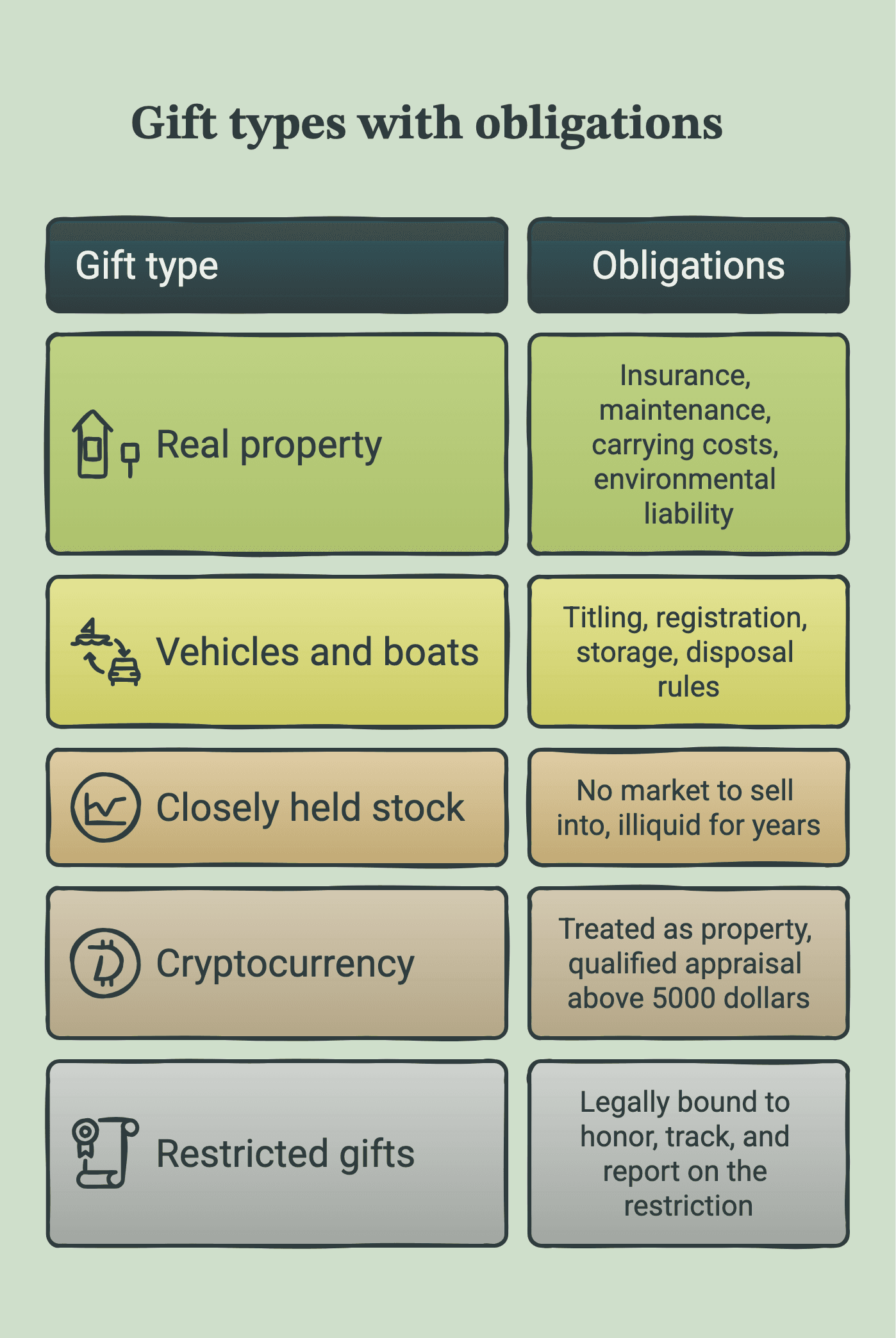
The gift is the building; the obligation is everything the building does after that. Insurance, maintenance, property tax exposure while it sits unused, carrying costs until it sells, and the possibility of environmental liability that transfers with the deed. This is the one category where most organizations make an inspection and a review by counsel a condition of accepting, rather than something handled afterward.
Vehicles, boats, and equipment
Titling, registration, storage, and insurance start immediately, and disposal has its own rules — including hazardous-waste and licensing questions for some equipment. Donated vehicles also carry their own substantiation regime, and most of it falls on you: for a qualified vehicle valued over $500, your organization furnishes Form 1098-C to the donor and files a copy with the IRS.
Closely held stock and business interests
Unlike publicly traded shares, there is no market to sell into and no daily quotation to value against. Your organization may hold an illiquid position for years, and depending on the entity, may take on reporting or unrelated business income consequences it did not anticipate. Nonpublicly traded stock also sits in an odd spot on the donor’s paperwork: at a claimed deduction of more than $5,000 but not more than $10,000, the donor files Section B of Form 8283 — and still needs your signature at Part V — but no qualified appraisal is required.
Cryptocurrency and digital assets
The IRS treats these as property, not currency. In Chief Counsel Advice 202302012, the IRS concluded that a donor claiming a deduction over $5,000 needs a qualified appraisal — a value printed by an exchange is not a substitute, because cryptocurrency is not among the publicly traded securities the appraisal exception covers. Chief Counsel Advice isn’t binding precedent, but it tells you how the IRS is reading the rule. Your policy should say who holds the wallet, how quickly you convert, and who is authorized to do it.
Gifts with donor restrictions
The least obvious risk on this list, because the asset itself is often just cash. Accepting a restricted gift generally binds the organization to honor the restriction — donor restrictions are enforceable under state law in most states — and ASC 958 requires you to track and report the restricted balance separately. A restriction narrow enough to be unusable becomes a permanent line on your balance sheet you cannot spend. Our guide to restricted vs. unrestricted funds covers what that obligation looks like in practice.
Notice what these have in common: in every case the decision requires information the person receiving the offer does not have. Whether the roof leaks. Whether the restriction fits any program you actually run. Whether anyone on staff can legally sign a title transfer. That is precisely why the answer has to be routed rather than improvised.
Once a gift is accepted, valuation and recording become a separate discipline — how to measure it, when it hits your statements, and what lands on Schedule M. That side of the work is covered in our guide to in-kind donations. This article stops at the decision.
Policies fail in two directions. Too short, and it says “the board will review unusual gifts” without defining unusual, which means every gift is a judgment call again. Too long, and it becomes a forty-page document written by a law firm for an organization ten times your size, and the staff who need it never read past page three.
Seven sections is usually enough for a small or mid-size organization. Start here, and add sections as your organization starts receiving gift types this doesn’t cover — a short policy that gets used every month beats a comprehensive one nobody opens.
01 — PURPOSE
Two or three sentences on why the policy exists: to protect the organization and the donor, and to give staff a consistent answer. Name the mission, because every later judgment call routes back to it.
02 — GIFTS ACCEPTED WITHOUT REVIEW
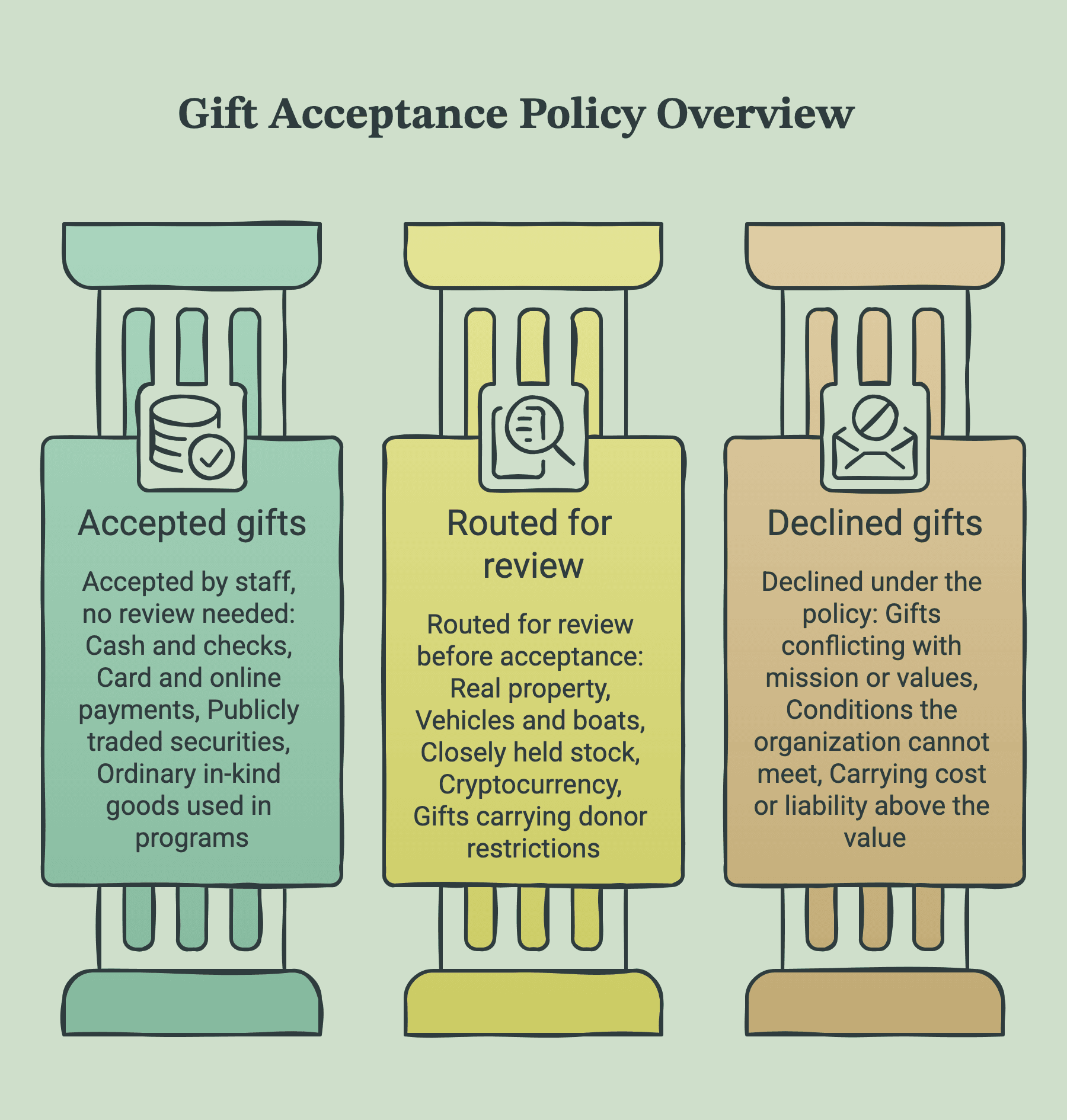
Cash, checks, card and online payments, publicly traded securities, and ordinary in-kind goods that support program delivery. Be generous here. Everything on this list is a decision your staff never has to escalate.
03 — GIFTS REQUIRING REVIEW
Real property, vehicles and boats, closely held stock and partnership interests, cryptocurrency, life insurance policies, gifts requiring your organization to take on debt, and any gift carrying a restriction outside your normal program categories.
04 — GIFTS NOT ACCEPTED
A short, plain list. Gifts that would compromise the organization’s values or standing, gifts whose conditions your organization cannot practically meet, and gifts whose carrying cost or liability would plainly exceed their value. Keep this section principled rather than exhaustive.
05 — WHO DECIDES
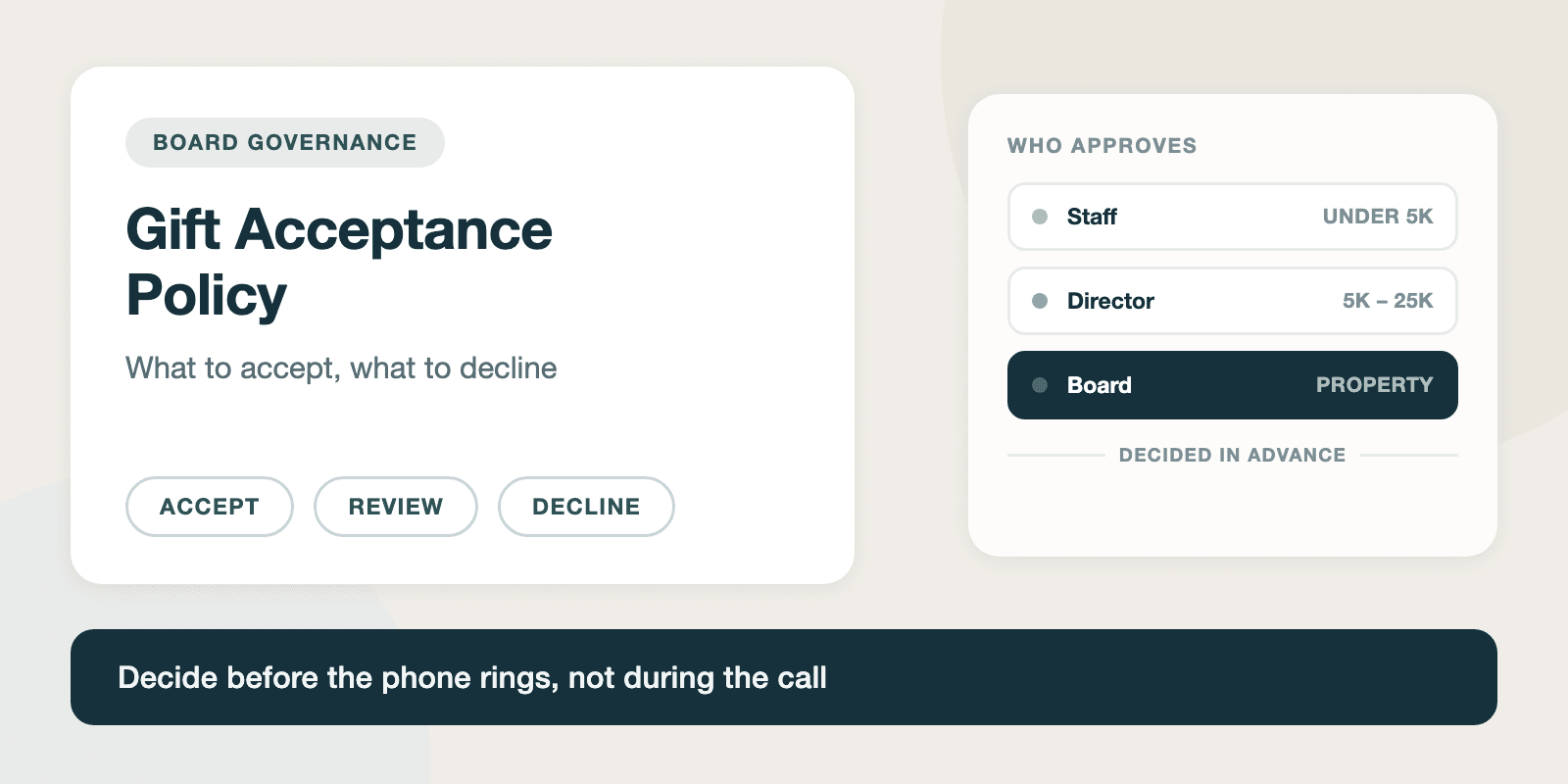
The approval ladder, with dollar thresholds attached. This is the section that makes the rest operational, and it gets its own treatment below.
06 — APPRAISALS, COUNSEL, AND COSTS
State plainly that valuation for the donor’s deduction is the donor’s responsibility and expense, that your organization does not appraise gifts, and that legal or environmental review may be required before acceptance of real property.
07 — REVIEW AND ACKNOWLEDGMENT
How often the board revisits the policy, and how accepted gifts get acknowledged. Substantiation has its own IRS rules, which our guide to donation acknowledgment letters covers in detail.
The National Council of Nonprofits maintains guidance and sample language worth reading alongside this before you draft, particularly on real property and the risk of environmental hazards passing with a donated parcel.

Already accepted something you’re not sure how to record? Noncash gifts land in three places at once — your books, your statements, and Schedule M. We handle all three.
Nonprofit bookkeeping →Here is where most policies quietly break. An organization writes “the board shall review noncash gifts” and discovers that the board meets six times a year, which means a donor offering a laptop in March waits until May for an answer. Within two cycles, staff are approving things informally again and the policy is decorative.
Thresholds fix this. Three tiers are enough. The dollar figures below are a starting point for an organization in the $250K to $2M range — set yours relative to your budget, and revisit them when your budget changes materially.
| Who approves | What | Turnaround |
|---|---|---|
| Staff | All cash and card gifts, publicly traded securities, and in-kind goods valued under about $5,000 that the organization can use directly. | Same day |
| Executive director | In-kind gifts roughly $5,000 to $25,000, restricted gifts that fit an existing program, and any gift needing a modest disposal plan. | Within a week |
| Board or finance committee | Real property in every case regardless of value, closely held interests, cryptocurrency, gifts above roughly $25,000, restrictions creating a new program obligation, and anything the ED escalates. | Next meeting, or a scheduled call |
One detail worth writing into the policy: give the board or finance committee a way to act between meetings. A short email vote or a called fifteen-minute meeting, documented in the minutes, keeps the top tier from becoming a two-month wait. Delegated authority that can’t be exercised in time isn’t delegated authority.
Approval thresholds also do double duty as an internal control. A gift that changes hands without anyone above the receiving staff member knowing about it is the same structural gap that shows up in cash handling — which is why this belongs in the same conversation as your other internal controls.
When a donor claims a deduction for a noncash gift, paperwork eventually reaches your desk. Two forms matter, and the relationship between them catches organizations off guard years later.
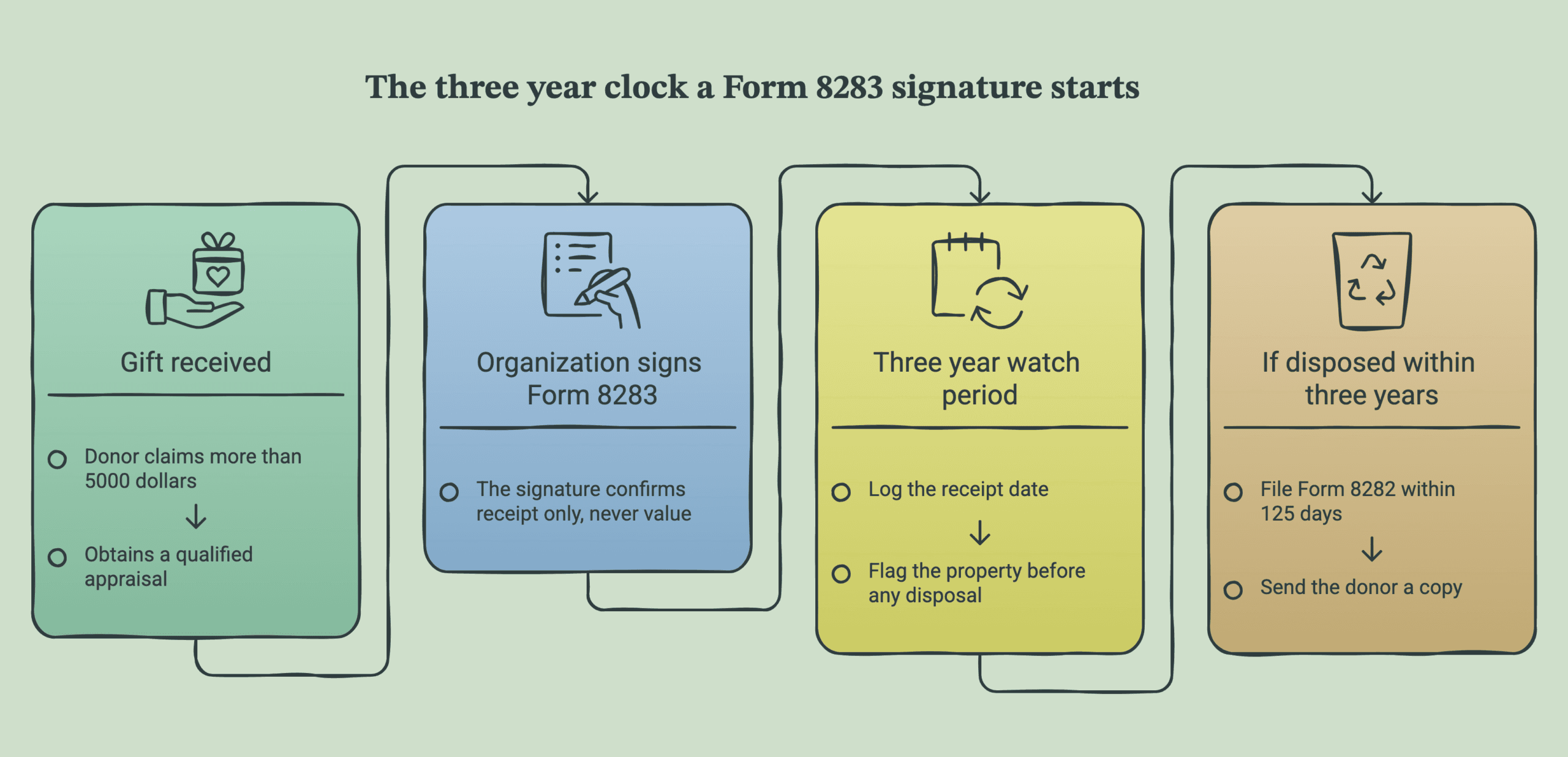
Form 8283 is the donor’s form, not yours. For a claimed deduction of more than $5,000 per item or group of similar items, the donor generally completes Section B, obtains a qualified appraisal, and brings the form to your organization for a signature in the Donee Acknowledgment at Part V. Below that threshold, Section A applies and no signature from you is needed.
Several categories stay in Section A even above $5,000 — publicly traded securities, qualified vehicles whose deduction is limited to the gross sale proceeds, intellectual property, and inventory. Section A has no donee acknowledgment line, so none of these require a qualified appraisal or a signature from your organization on Form 8283. Vehicles and intellectual property carry their own separate donee filings instead.
What your signature does and does not mean
It confirms receipt — and commits you. You are acknowledging that your organization is a qualified organization and received the described property on the stated date, and in the same signature agreeing to the Form 8282 obligation below.
It does not confirm value. Signing is not an endorsement of the appraised amount, and your organization should never supply a value for a donor’s deduction. Write that sentence into your policy so no one has to decide it under pressure.
It starts a three-year clock. If you sell, exchange, or otherwise dispose of that property within three years of receiving it, your organization generally must file Form 8282 within 125 days of the disposition and send the donor a copy. Two exceptions: items the donor identified as worth $500 or less and signed for in Section B, Part III of Form 8283, and property consumed or distributed without consideration in fulfilling your exempt purpose.
The trap is ordinary and entirely avoidable. Your organization accepts donated equipment, signs Form 8283 in the spring, and sells the equipment eighteen months later during a cleanout that nobody connects to a tax form filed the year before. The obligation was created by a signature and comes due long after everyone has moved on.
The fix is a single line in your policy: any gift for which the organization signs a Form 8283 gets logged with its receipt date and a three-year flag, and that log is checked before anything is sold or disposed of. It costs a spreadsheet column. For the rest of the return’s noncash reporting, our step-by-step Form 990 guide walks the schedules in order.
There is an unspoken fear attached to this policy: that its real function is to make you turn down money from people who love you.
In practice it works the other way. Most donors offering a difficult gift are trying to help and have not thought through what accepting would cost you — because there is no reason they would have. What damages the relationship is not “no.” It is the slow version: three weeks of silence, a vague answer, and a gift that quietly disappears into an organization that never mentions it again.
A clear early answer that names something better usually lands fine. The shape that works has three parts, in this order.
The three-part decline
1. Thank them for the specific thing
“Thank you for thinking of us with the property — that you’d consider giving us something that significant means a great deal.”
2. Put the policy in front, not the person
“Our board adopted a gift acceptance policy that keeps us from taking on real property we can’t maintain. It applies to every gift of this kind, and it exists so we don’t end up spending program money on carrying costs.”
3. Offer the version you can accept
“If you’re open to it, a gift of the proceeds after a sale would let us put the full value directly into the program — and we’d be glad to recognize it exactly the same way.”
The middle step is the one that carries the weight. “Our policy” is not a dodge — it is the honest answer, and it moves the decision from a judgment about this donor to a rule that applied before they called. That is the difference between being turned down and being told no.
The third step is worth rehearsing before you need it. A donor who wanted to give you a building usually wants to give you the value of a building; the building was just the form it happened to be sitting in. Naming a form you can accept keeps the gift alive.
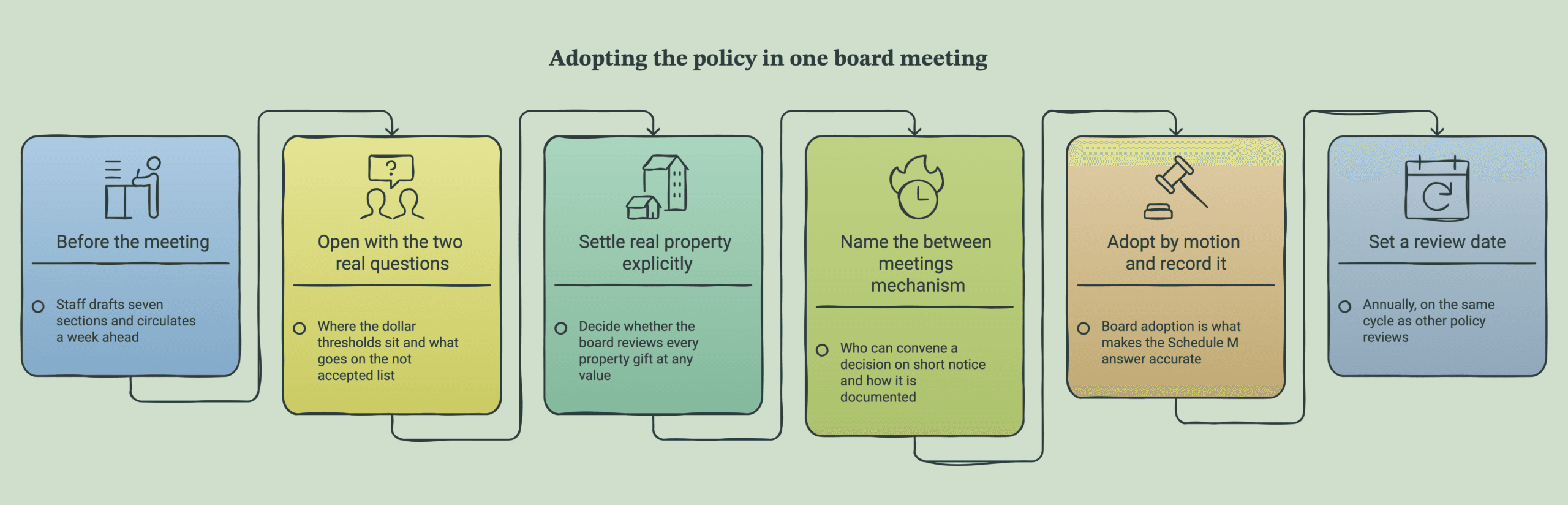
This does not need a task force. A gift acceptance policy is one of the few governance documents a small board can genuinely finish in a single meeting, provided someone brings a draft rather than a blank page.
A one-meeting adoption path
Once it is adopted, the policy needs one more thing to be real: the people who take the calls have to know it exists. Development staff, the board chair, whoever answers the phone at the front desk. A policy that lives in a governance binder and not in the heads of the people receiving offers is a policy your organization does not actually have.
Add it to your annual governance review alongside conflict of interest and document retention — it sits naturally on the same page of a nonprofit compliance checklist, and reviewing the whole set at once is less work than handling any of them separately.
The building may still be a bad idea. But the Thursday phone call goes differently when the answer was decided in March, by people who weren’t looking anyone in the eye.
Common questions from EDs and board members drafting a gift acceptance policy.
No. There is no legal requirement to have one and no penalty for not having one. But Schedule M, line 31 of Form 990 asks whether the organization has a gift acceptance policy that requires the review of nonstandard contributions, and Form 990 is a public document. The answer sits alongside the other governance questions grantmakers and charity raters read.
An item the organization is not reasonably expected to use to satisfy or further its exempt purpose, for which there is no ready market to liquidate it and convert it to cash, and whose value is highly speculative or difficult to ascertain. Closely held stock, unusual collectibles, and specialized equipment tend to fall in this category; cash and publicly traded securities do not.
Generally, yes. A gift is an offer, and an organization is normally free to decline it before acceptance. Declining is often the responsible choice when a gift carries carrying costs, legal exposure, or restrictions the organization cannot meet. A pledge already accepted or a gift arriving through a will can be more complicated, and those are worth a call to counsel. Having the decision documented in a board-adopted policy makes it easier to apply consistently and easier to explain.
When a donor claims a deduction of more than $5,000 for an item or group of similar items, they generally complete Section B and the donee organization signs the acknowledgment at Part V. Publicly traded securities are the main exception — no donee signature is required. The signature confirms that you are a qualified organization and received the described property, not what it is worth — an organization should not supply a valuation for a donor’s deduction. Signing can also commit the organization to filing Form 8282 if the property is disposed of within three years.
For the donor to claim a deduction over $5,000, yes. In Chief Counsel Advice 202302012 the IRS concluded that cryptocurrency is not cash and not a publicly traded security, so it does not fall under the appraisal exception — a value reported by an exchange is not a substitute for a qualified appraisal. Chief Counsel Advice is not binding precedent, but it shows how the IRS reads the rule. The appraisal is the donor’s responsibility, not the organization’s.
An annual review is enough for most organizations, handled on the same cycle as conflict of interest and document retention policies. Update it sooner if your budget changes materially, since the dollar thresholds should stay proportional, or if you start receiving a gift type the policy does not address.
The gifts that need a policy are the ones your books notice first.
GivingArc handles bookkeeping and Form 990 preparation for small and mid-size 501(c)(3)s.
GivingArc provides bookkeeping, Form 990 preparation, and nonprofit-specialized accounting for small and mid-size 501(c)(3) organizations across the US. This article is general information, not legal or tax advice — gifts of real property, business interests, and other complex assets should be reviewed with your CPA and legal counsel before acceptance. References are to the 2025 Form 990 and Schedule M and their IRS instructions. Reviewed by Min Kim, CPA.