
June has a particular rhythm in a small nonprofit. Programs are wrapping up, summer schedules are thinning the office, half the board is already on vacation — and somewhere in the back of your mind sits a quiet date: June 30. The end of the fiscal year.
If your stomach tightened a little at that sentence, this article is for you. Not because your books are a disaster — they’re probably better than you think — but because “year-end close” sounds like an event that requires someone more qualified than whoever is currently doing it.
It isn’t. A year-end close is a finite list of small, boring tasks. Done over three calm weeks, none of them is hard. Done in a panic in late August because the 990 preparer just asked for things — that’s when it gets expensive. So let’s do the three calm weeks.
Key Takeaways
Your June 30 close isn’t paperwork for its own sake. It’s the foundation for everything your organization files, survives, and plans over the next six months:
Your Form 990
For a June 30 fiscal year, Form 990 is due November 15 — the 15th day of the 5th month after year-end. Every number on it comes from the books you close now.
Your audit or review
If a funder or state requires an audit, the auditor starts from your closing trial balance. A clean close is the cheapest audit prep there is.
Next year’s budget
Your FY2027 budget is only as honest as the actuals underneath it. Closed books are where honest actuals come from.
The deadlines aren’t ours, by the way — they come straight from the IRS Form 990 rules, and the automatic extension lives on Form 8868.
A clean close is like washing the dishes the night before: morning-you inherits a kitchen that works. A skipped close doesn’t disappear — it waits, with interest, for the moment a funder, an auditor, or the IRS asks a question.
One reassurance before the checklist: this list is a starting point, not an exam. If your organization is small, do the version that fits — and add steps as you grow. A short close you actually finish every year beats a perfect close you avoid.
Nothing fancy this week — just bring the books current.
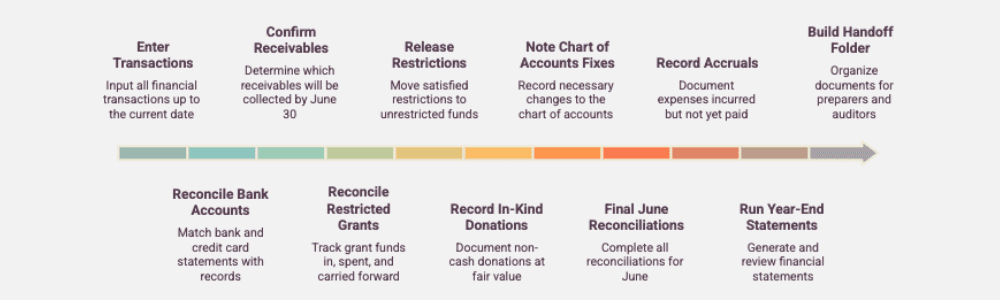
Enter everything through today. Outstanding bills, June payroll, the last program expenses, the reimbursement someone has been carrying on a personal card since April. The close can’t start until the books reflect reality.
Reconcile every bank and credit card account through May, so June’s reconciliation in early July is one month of work, not three. If reconciliations have slipped, this is the single highest-value catch-up on this list — unreconciled accounts are where expensive bookkeeping mistakes hide.
Chase your receivables. Invoices owed to you, pledges promised, grant installments due — confirm what’s actually arriving by June 30 and what belongs to next year.
This is the part generic small-business checklists skip — and the part funders actually look at.
Reconcile your restricted funds. For each restricted grant: what came in this year, what was spent on its purpose, and what carries forward. If restricted and unrestricted money lives in one bank account (it usually does), this is a bookkeeping exercise, not a banking one — the guide to restricted vs unrestricted funds walks through it, and our free fund tracking register template gives you the worksheet.
Release what you’ve earned. Restrictions you satisfied this year move to unrestricted. This step is easy to forget and quietly powerful — it’s how the work you already did shows up in your numbers.
Check your in-kind donations. Donated services, space, and goods belong in the books at fair value, with documentation — the rules are in our in-kind donations guide.
Give your chart of accounts one honest look. If this year’s reports needed constant manual translation for the board or funders, note it now — July 1 is the one painless moment to fix your categories for the new year.
Finish the final reconciliations as June statements arrive in early July.
Record the easy accruals — payroll earned in June but paid in July, the big known bills. Perfection isn’t the goal here; consistency from year to year is.
Run the year-end statements — the Statement of Financial Position and Statement of Activities — and read them once as a human, not an accountant: Did we end with a surplus? What’s our unrestricted cash? Does anything surprise you? (If the statements themselves feel like a foreign language, this guide translates them.)
Build the handoff folder. Bank statements with reconciliations, payroll reports, grant agreements, board minutes, year-end statements. Whether it goes to a 990 preparer, an auditor (our audit preparation checklist covers that road), or simply to future-you — the folder is the close.
Want the whole close as a working checklist? Our year-end accounting checklist is free — no email gate, just the spreadsheet.
Get the checklist →Once the books are closed, don’t file them away just yet. Three numbers deserve five quiet minutes — and one page at the July board meeting:
Months of cash
Unrestricted liquid funds ÷ average monthly expenses. We just published a full guide to your reserve target — or get the number from our free calculator.
Surplus or deficit
Did the year end ahead or behind — and was that the plan? An unplanned deficit is a budget conversation, not a shame conversation.
Restricted balance carried forward
Money with promises attached — next year’s obligations, already sitting in the bank. Your new budget should know about it.
Open your bank reconciliations. If May is done, you’re in better shape than you feared — book 90 minutes next week for the restricted-funds pass and call it Week 2. If reconciliations have slipped, start there and don’t look further down the list yet.
Either way: three weeks, small boring tasks, one folder at the end. That’s the whole event.
Rather hand off the whole close?
We close June 30 books for small nonprofits every year — reconciliations, restricted funds, and a 990-ready handoff folder.
Request a quote →Common questions from small nonprofits closing a June 30 fiscal year.
Form 990 is due on the 15th day of the 5th month after your fiscal year ends — November 15 for a June 30 year-end. If you need more time, Form 8868 grants an automatic 6-month extension, moving the deadline to May 15.
Closing the books is your internal process of finalizing the year’s records — reconciling accounts, recording final entries, and producing year-end statements. An audit is an independent CPA’s verification of those closed books. The close always comes first; auditors start from your closing trial balance.
If you keep cash-basis books, keep it simple — but record large, obvious items like June payroll paid in July consistently from year to year. If your Form 990 or audit is prepared on the accrual basis, your year-end close should match that basis.
Catch up in order: enter all transactions first, then reconcile each month, then close. A late, accurate close in July or August is far better than a rushed one — and much cheaper than handing a 990 preparer a shoebox in October.
Yes. Exempt organizations generally make the change by filing a short-period Form 990 for the transition months, and some situations call for IRS Form 1128. It adds a transition year of extra bookkeeping, so it’s usually worth changing only when grant cycles or program seasons clearly demand it.
A clean close, without the three weeks.
GivingArc handles year-end closes for small nonprofits — monthly bookkeeping that makes June 30 a non-event, and Form 990 prep straight from the closed books.
GivingArc provides bookkeeping, Form 990 preparation, and nonprofit-specialized accounting for small and mid-size 501(c)(3) organizations across the US. Filing deadlines referenced are for June 30 fiscal year-ends. Reviewed by Min Kim, CPA.