

Key Takeaways
Form 990 filing costs in 2026 range from $0 (Form 990-N e-Postcard, for organizations with gross receipts normally $50,000 or less) to about $230 with self-file software, and from $500 to $2,000 or more at the published prices of professional preparers (see the price table below). Which form your size requires — and how clean your books are — drives most of the price. Here’s the full breakdown.
Not every firm publishes a Form 990 price. Here are four that do: ours first, then two CPA firms and one self-file tool, all checked September 21, 2026.
GivingArc Form 990 prices, per return
| Return | Who files it | Our price |
|---|---|---|
| Form 990-N (e-Postcard) | Gross receipts normally $50,000 or less (some organizations, such as private foundations, cannot use it) | Free with the IRS. We file it for our bookkeeping clients; it is not sold on its own. |
| Form 990-EZ | Gross receipts under $200,000 and total assets under $500,000 (these organizations may file the full 990 instead) | From $500 |
| Form 990 | Gross receipts $200,000 or more, or total assets $500,000 or more | From $1,500 |
| Forms 1099-NEC and 1099-MISC | Payers who owe them, filed each January | $30 per form, whether or not we keep your books |
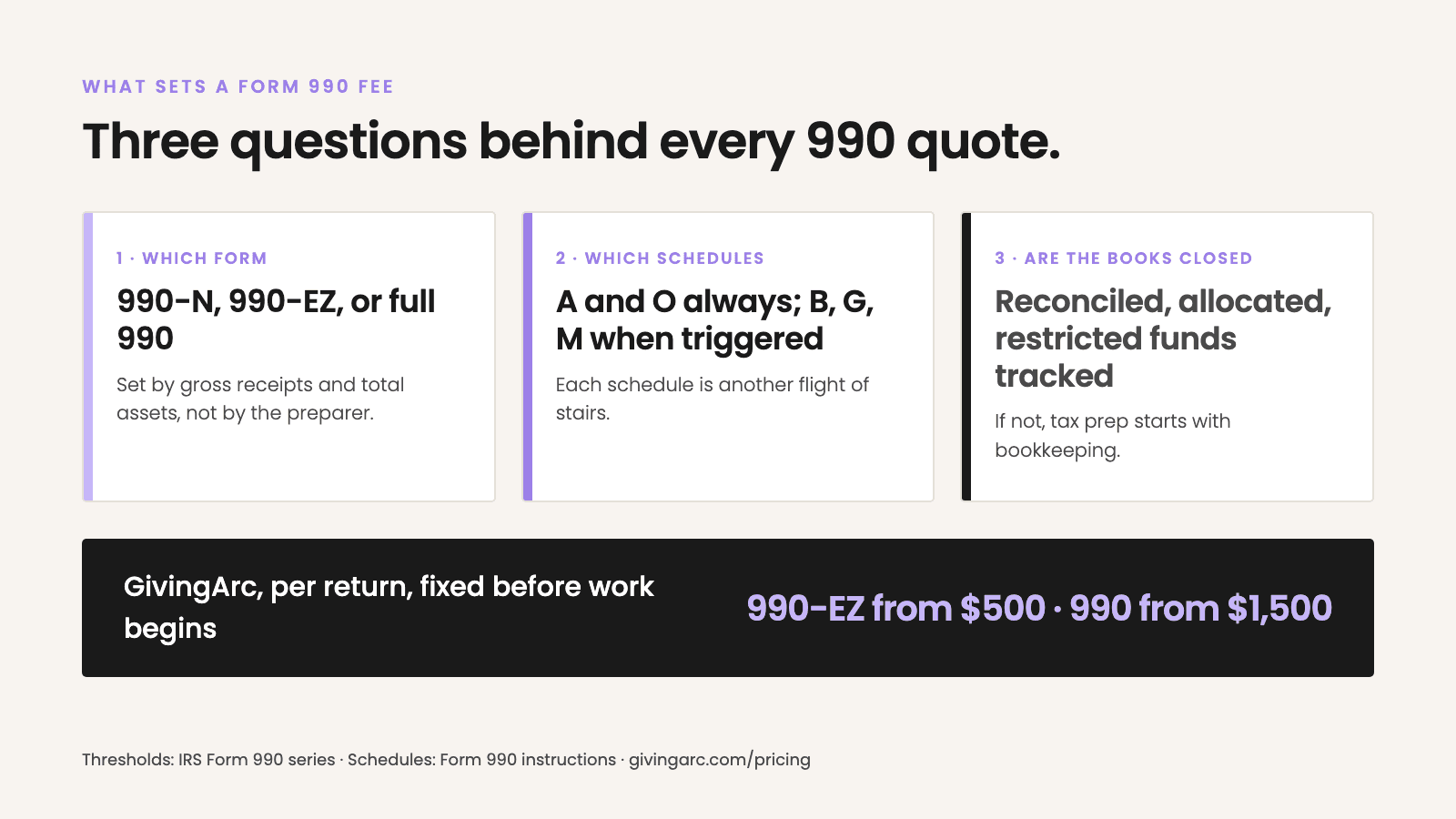
Form 990 preparation is priced per return and is separate from monthly bookkeeping. “From” moves with the schedules you owe and whether your books are closed, and you get a fixed quote before any work begins. Full price list: givingarc.com/pricing. Filing thresholds: IRS, which forms exempt organizations file.
Published Form 990 prices, checked September 21, 2026
| Provider | Form 990-N | Form 990-EZ | Form 990 | What the page says |
|---|---|---|---|---|
| GivingArc | Free with the IRS; filed for bookkeeping clients | From $500 | From $1,500 | Fixed quote before any work begins |
| MHC CPA | Not listed | Starts at $800 | Starts at $1,700 | Increases with the quality of your records and the complexity of the organization |
| Taylor Roth | Prepared free | About $200 less than a full 990 | Typically $1,075 to $2,000 | Range depends on the number of schedules and applies when the firm also performs your audit or review; higher without one |
| Tax990 (self-file software) | $19.90 | $109.90 | $229.90 | You enter the return yourself; the software e-files it |
Third-party prices are quoted from each provider’s own page on the date shown and may change.
What moves a quote above “from”: the schedules
| Schedule | When it is required |
|---|---|
| Schedule A | Every 501(c)(3) filer (public charity status and public support) |
| Schedule O | Every Form 990 filer (the narrative explanations) |
| Schedule B | Contributors of $5,000 or more; 501(c)(3) organizations that meet the 33⅓% public support test in Schedule A Part II may list only contributors above the greater of $5,000 or 2% of total contributions |
| Schedule G | More than $15,000 of fundraising event gross income and contributions combined, more than $15,000 of professional fundraising expenses, or more than $15,000 of gaming income (see our Schedule G guide) |
| Schedule M | More than $25,000 of noncash contributions, or any contribution of art, historical treasures, or a qualified conservation contribution |
Two organizations with the same revenue can owe a different number of schedules, which is one reason their quotes differ. Sources: IRS instructions for Schedule A, Schedule B, Schedule G, Schedule O, and Form 990 Part IV.
The cost of filing Form 990 largely depends on which version your organization needs to file. The IRS requires different forms based on your organization’s gross receipts and total assets:
All Form 990 series returns for calendar year 2025 are due by May 15, 2026. Every Form 990, 990-EZ, and 990-PF must now be filed electronically under the Taxpayer First Act, so you’ll need compatible software or a preparer who e-files.
The filing deadline is firm, and understanding which form you need to file is crucial for accurate cost planning. Many organizations qualify for a simpler form than they realize, which can significantly reduce filing costs. For detailed guidance on determining your filing requirements, check out our step-by-step Form 990 filing guide.
Form 990-N filers have the most cost-effective option available. The e-Postcard is completely free when filed directly through the IRS website. This simple online form takes just a few minutes to complete and requires basic organizational information.
Organizations that file a 990-EZ or a full Form 990 need an IRS-authorized e-file provider, because both returns must be filed electronically. That is where paid software and preparers come in.
For organizations that don’t qualify for free filing, several online platforms offer Form 990 preparation services with pricing based on organizational size:
Popular platforms include Form990.org, Tax990.com, and File990.org. These services typically include e-filing, customer support, and basic error checking. The sliding fee structure ensures smaller organizations pay proportionally less than larger ones.
When comparing software options, consider features like multi-user access, data import capabilities, and state filing support. Some platforms charge extra for amendments or additional state filings, so factor these potential costs into your decision. We’ve noticed that organizations often underestimate the importance of customer support until they encounter a complex question mid-filing.
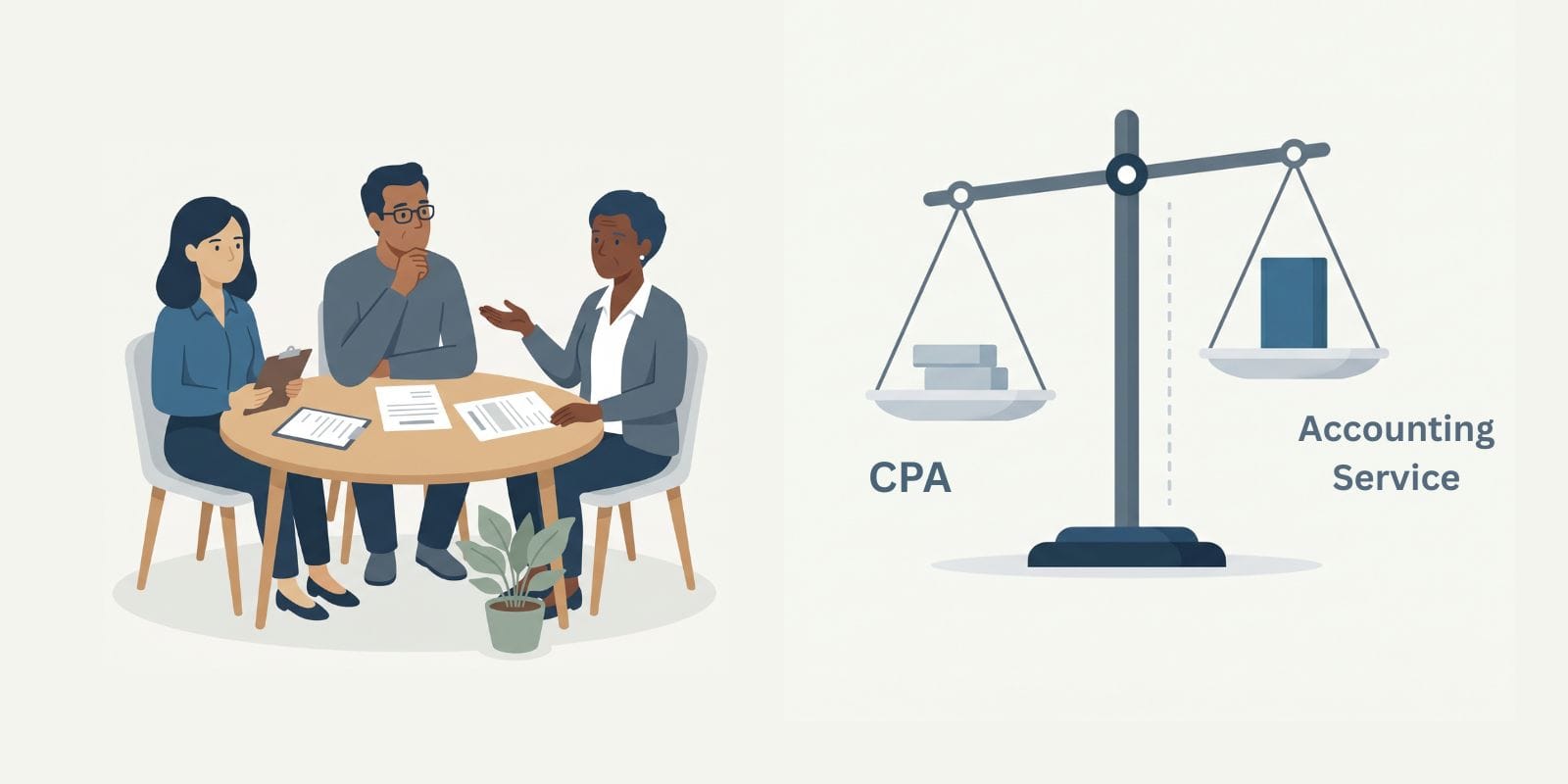
Professional Form 990 preparation costs vary significantly based on several factors. Published prices start at $500 for our Form 990-EZ and $1,500 for our full Form 990; MHC CPA starts at $800 and $1,700; Taylor Roth typically charges $1,075 to $2,000 for a Form 990 when it also performs the audit or review. Costs increase based on:
Organizations requiring multiple schedules or having complex transactions can expect costs at the higher end of this range.
Firms specializing in nonprofit accounting often charge premium rates but provide additional value through sector-specific expertise. These services typically include:
Our Form 990 filing services focus exclusively on nonprofit organizations, ensuring we understand the unique challenges and requirements your organization faces. While specialized services may cost more upfront, they often prevent costly mistakes and penalties that can far exceed the initial investment.
Professional services also save significant time. A preparer who already keeps your books starts from reconciled numbers instead of rebuilding the year. Our team brings 23 years of collective nonprofit accounting experience to that work.
Many organizations overlook state-level filing requirements when budgeting for Form 990 compliance. State costs can include:
For example, California requires Form 199 or 199-N filing along with additional fees. Organizations soliciting donations in multiple states may need to file in each jurisdiction, multiplying these costs significantly. Consider a scenario where a nonprofit operates programs in five states – the state filing fees alone could exceed the federal filing cost.
The IRS penalty structure for late Form 990 filing can quickly exceed the cost of timely filing:
State penalties vary but can add hundreds or thousands of dollars in additional costs. These penalties make timely filing essential from both compliance and cost perspectives. Our Form 990 deadline guide helps organizations stay on track and avoid these costly penalties.
Get a free custom quote tailored to your organization — no obligation.
Understanding the cost differences between form types helps organizations budget appropriately and make informed decisions about filing options:
DIY Cost
Free through the IRS
Professional Cost
Free for our bookkeeping clients
Core form length
Online e-Postcard
DIY Cost
$109.90 (Tax990)
Professional Cost
From $500 (GivingArc)
Core form length
4 pages plus schedules
DIY Cost
$229.90 (Tax990)
Professional Cost
From $1,500 (GivingArc)
Core form length
12 pages plus schedules
Some organizations choose to file a more comprehensive form than required for transparency purposes. While this increases costs, it can enhance donor confidence and demonstrate organizational commitment to accountability. Consider your organization’s strategic goals when deciding between form options.
Organizations near the thresholds should also plan for potential changes. A nonprofit with $180,000 in gross receipts that expects growth should budget for the possibility of needing a full Form 990 next year. Planning ahead prevents budget surprises and ensures smooth transitions between form requirements.
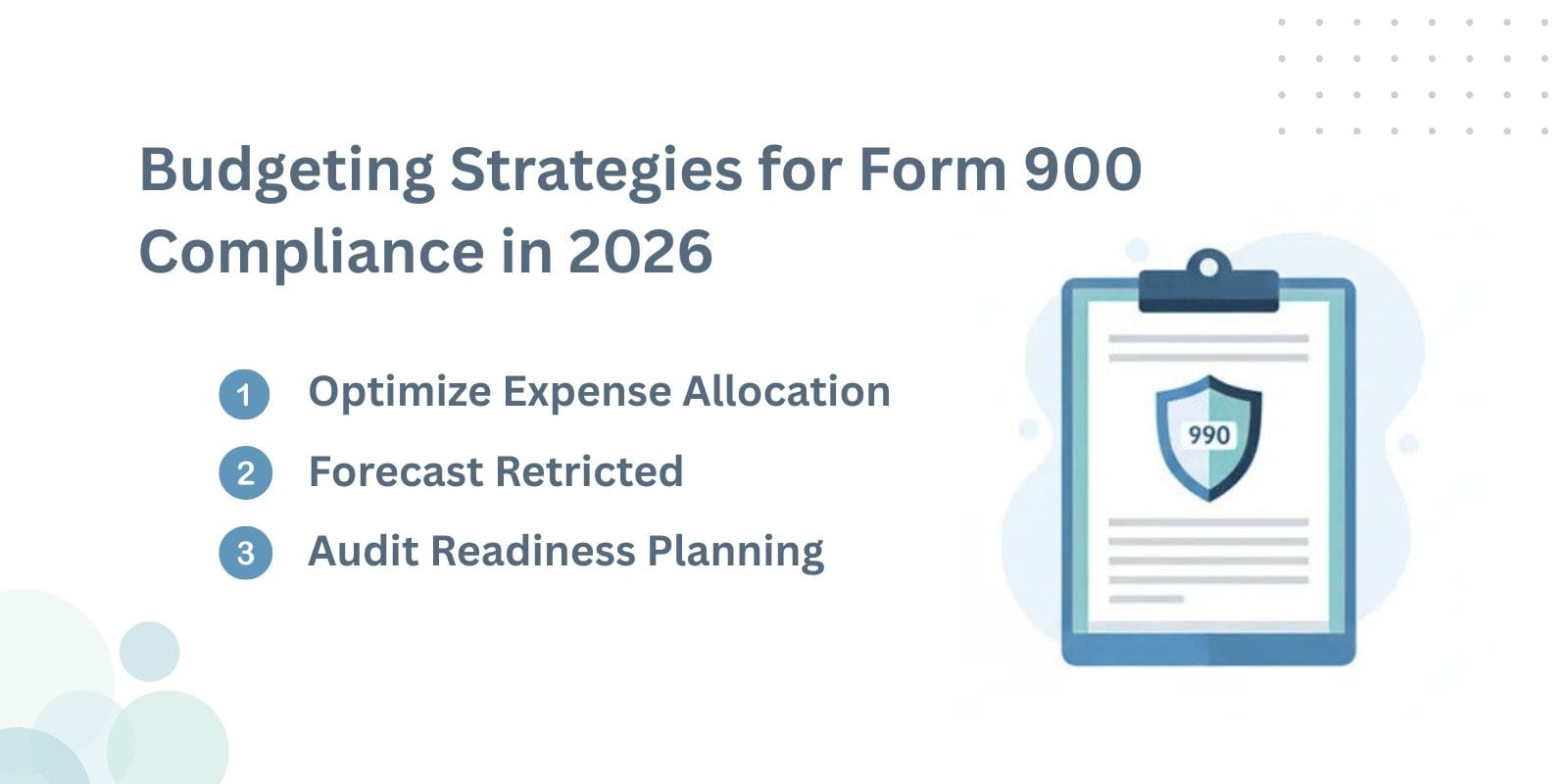
Effective Form 990 budgeting starts with understanding your total compliance costs beyond just filing fees. Create a comprehensive budget that includes:
Organizations should budget for Form 990 costs as recurring annual expenses, not one-time costs. This approach ensures funds are available when needed and prevents last-minute scrambling for resources.
The decision between DIY and professional filing depends on several factors beyond just cost. Consider these elements in your analysis:
At the full Form 990 level, the core form runs 12 pages before any schedules. Compare a fixed quote against the staff hours your own team would spend on it. Contact our team for a personalized compliance consultation.
Smart planning throughout the year can significantly reduce your Form 990 filing costs:
Organizations that keep reconciled books through the year avoid paying for cleanup at filing time, which is one of the things that moves a quote above its starting price. This proactive approach also reduces stress and improves accuracy.
Choosing the right Form 990 filing approach requires balancing cost, complexity, and risk. Small organizations with simple operations may find DIY filing perfectly adequate, while larger nonprofits often benefit from professional expertise. The key is matching your filing strategy to your organization’s specific needs and resources.
As you plan for 2026 Form 990 filing, remember that the cheapest option isn’t always the most cost-effective. Factor in the value of your time, the risk of errors, and the potential impact on your organization’s reputation. Whether you choose DIY software or professional services, starting early and staying organized will help minimize costs and ensure compliance.
Ready to ensure accurate and timely Form 990 filing while managing costs effectively? Our team specializes in helping nonprofits navigate compliance requirements efficiently. Schedule a consultation to discuss your organization’s specific needs and discover how professional filing services can save you time and reduce compliance risks.
Filing costs depend on which form you file and who prepares it. Form 990-N is free through the IRS for organizations with gross receipts normally $50,000 or less. Self-file software such as Tax990 lists $109.90 for a 990-EZ and $229.90 for a Form 990. Published preparation prices start at $500 for a 990-EZ and $1,500 for a Form 990 at GivingArc, and at $800 and $1,700 at MHC CPA (prices checked September 21, 2026). More schedules and unreconciled books raise any quote.
Form 990-EZ from $500 and a full Form 990 from $1,500, priced per return and separate from monthly bookkeeping. The final price depends on which schedules you owe and whether your books are closed, and you get a fixed quote before any work begins. We file Form 990-N for our bookkeeping clients; it is free with the IRS. Forms 1099-NEC and 1099-MISC are $30 per form.
Form 990-N (e-Postcard) is for organizations with gross receipts of $50,000 or less. Form 990-EZ is for organizations with gross receipts under $200,000 AND total assets under $500,000. The full Form 990 is required when gross receipts reach $200,000 or more, or total assets reach $500,000 or more.
For organizations on a calendar fiscal year, Form 990 series returns covering 2025 are due May 15, 2026. Organizations on a non-calendar fiscal year file by the 15th day of the 5th month after their fiscal year ends. A 6-month automatic extension is available by filing Form 8868 before the original deadline.
DIY filing works well for small organizations with simple operations filing Form 990-N or basic 990-EZ. Professional CPA help becomes cost-effective once you file the full Form 990, particularly with multiple schedules, complex transactions, restricted grants, or significant assets – staff time saved and reduced penalty risk often offset the fee.
Late filing penalties are $25 per day for most organizations (capped at the lesser of $13,000 or 5% of gross receipts) and $130 per day, up to $65,000, for organizations with gross receipts over $1,309,500, for returns required to be filed in 2026. The most serious consequence is automatic revocation of tax-exempt status, which occurs after three consecutive years of non-filing. Reinstatement requires applying with the IRS and paying additional fees, making timely filing far less expensive than recovering from non-filing.