
Key Takeaways
Walk through any small nonprofit’s inbox today and you’ll find a stack of monthly newsletters that read the same way: an opening that says “we are excited to share,” a stat-heavy middle that describes the organization, a closing donate button. Most were drafted with ChatGPT or Claude in about three minutes. None of them were edited.
And donors notice. The average nonprofit email open rate hovers around 28%, and the share that get forwarded to a friend — the real metric for stewardship content — is much smaller. The problem with most small-nonprofit newsletters in 2026 isn’t AI. It’s that AI shows. The fix isn’t to stop using AI. The fix is to use it without your donors being able to tell.
In our analysis of donor retention, we walked through why first-time donors disappear at an 80% rate and why the 90-day stewardship window after a first gift is the highest-leverage period for a small nonprofit. Step three of that stewardship sequence was a non-ask touchpoint — a newsletter, a note, a story. This article is what that newsletter actually looks like in 2026, when almost everyone is using AI to draft it: the format that works, the four prompts you can paste into ChatGPT this afternoon, and the five edits that turn AI output into something that sounds like a human wrote it. This guide draws on our team’s collective 23+ years working with small nonprofits.
If even four prompts feel like too much, we’ll point you to a free tool at the end.
When Penelope Burk and her team at Cygnus Applied Research interviewed hundreds of individual donors across the U.S. and Canada — research that became the most-cited book on donor preferences in the sector, Donor-Centered Fundraising — the answer that came back about newsletters surprised the nonprofit-consulting industry.
Donors said they preferred a targeted, one-page bulletin about one specific program to the multi-page newsletters most nonprofits send. The longer “comprehensive” versions, donors reported, “often didn’t get read” and frequently felt like “thinly veiled promotion pieces for upcoming fundraising events.” Burk also found that information about the work and its measurable results is the single biggest driver of donor loyalty — bigger than thank-you notes, bigger than recognition, bigger than free swag.
The brief that emerges from her research is unusually narrow:
That brief, applied honestly, sounds nothing like the AI-default newsletter — which is exactly why AI shows. The good news is that AI can produce content that doesn’t show, if you give it the right four prompts.
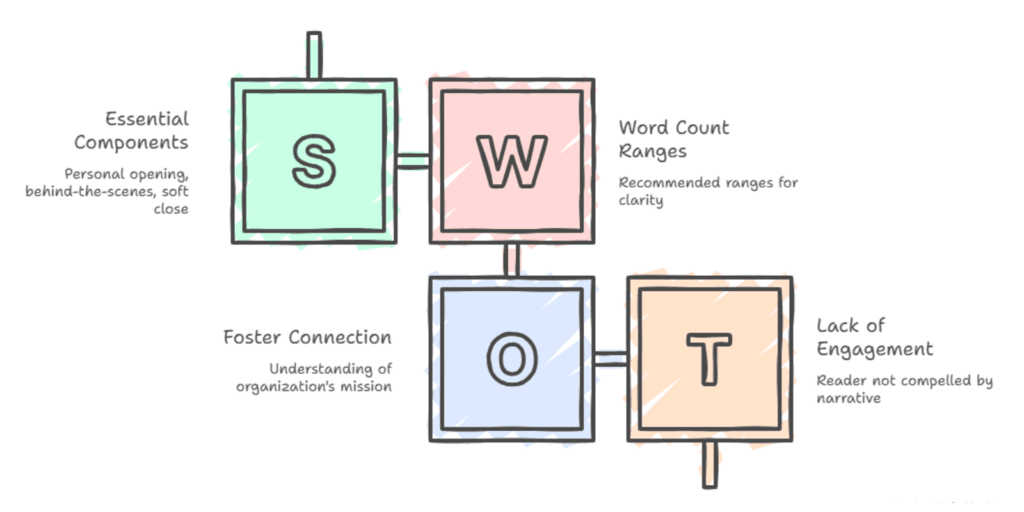
The 4-section format works the way a good road trip works. You don’t drive aimlessly; you have waypoints — the diner with the famous pie, the overlook before the bridge, the lighthouse at sunset, the bakery you stop at on the way home. Each waypoint is specific. Each is short. The trip is memorable because of the waypoints, not the miles between them.
A nonprofit newsletter has four waypoints:
One paragraph that addresses the donor as a known person, mentions one specific recent moment, and sets up what the issue is about. Reads like the first paragraph of a letter from a friend.
One specific person, one specific moment, one specific outcome. Not a roundup. Not statistics with a face attached. One scene, one quote, one connection back to donors.
The small detail that makes the donor feel like an insider. A logistical challenge you solved, an unexpected donation, the executive director’s candid observation.
One specific non-money action the reader can take, plus a real thank-you signed by a human. End the way you’d end a letter to a friend.
Total length: 475–610 words. Reads in three minutes on a phone. Designed to be forwarded, not just opened.
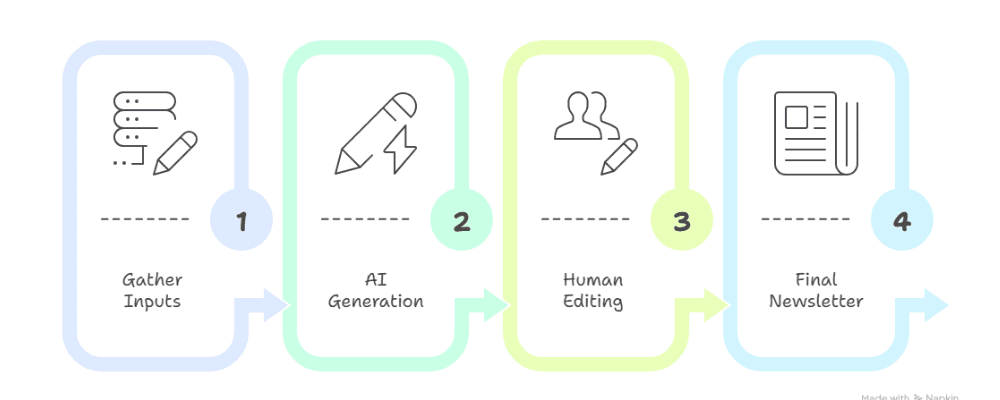
These four prompts are the practical core of how to write a nonprofit newsletter when you don’t have a marketing team and don’t want to spend hours on prompt engineering. They’re written for ChatGPT or Claude (free tier of either works). Replace the bracketed placeholders with your organization’s specifics. The prompts are designed to produce drafts that need only light editing — usually 5–10 minutes per section.
Prompt 1
You are writing the opening paragraph of a monthly donor newsletter for [ORGANIZATION NAME], a [SECTOR — e.g., literacy / food security / animal welfare] nonprofit serving [BENEFICIARY GROUP] in [REGION].

Write a 100–130 word opening paragraph that:
- Addresses the reader directly using "you" (not "our supporters" or "donors like you")
- References one specific true thing that happened in [MONTH], which is: [DESCRIBE THE EVENT IN ONE SENTENCE — e.g., "the Saturday morning when 47 volunteers showed up to pack 600 weekend backpacks despite the rain"]
- Sounds like a warm letter from a friend — not a press release
- Avoids these phrases: "we are excited to announce," "we are proud to," "leverage," "stakeholder," "ecosystem," "impact" used in the abstract
- Ends with a one-sentence transition that introduces the story we'll tell next, which is about: [ONE-LINE TEASE OF THE STORY]

Write in first person plural ("we") from the organization's voice, but with personal warmth. Use contractions ("we're," "didn't"). Sign off the paragraph with one short sentence that feels like a friend wrote it.
Prompt 2
You are writing one specific impact story for [ORGANIZATION NAME]'s monthly donor newsletter. Donors read this as proof their gifts are doing something real.

The story is about [ONE SPECIFIC PROGRAM — e.g., the after-school tutoring program] and features [ONE PERSON, FAMILY, OR MOMENT — anonymize if needed: "a mother of three," "a high-school senior who started attending in October," "a volunteer who showed up every Tuesday for six months"].

Here are the specific details you should use:
- Setting: [DESCRIBE WHERE / WHEN]
- The moment: [DESCRIBE WHAT HAPPENED — one or two sentences]
- The change: [DESCRIBE WHAT IS DIFFERENT NOW BECAUSE OF IT]
- A quote (real or paraphrased): [PASTE QUOTE — note whether real or paraphrased]

Write 200–250 words that:
- Open with one specific scene — a moment, a sentence, a sensory detail (NOT background)
- Include the quote naturally, not as a callout block
- Show the impact through what changed for the person, not through statistics
- Mention donor support explicitly with one line: "Because of supporters like you..."
- End with one sentence connecting this individual story to the broader mission

Avoid: "lives transformed," "our beneficiaries," generic gratitude, numbers without a face. If you need details I haven't given you, ask before writing — do not invent them.
Prompt 3
You are writing a "behind the scenes" section for [ORGANIZATION NAME]'s monthly donor newsletter. This makes donors feel like insiders, not fundraising targets.

Pick ONE of these to write 100–130 words about (I'll tell you which):
- [OPTION A] A logistical challenge we solved this month: [DESCRIBE ONE THING THAT WORKED OUT — e.g., "we figured out a faster way to get backpacks to families on the east side"]
- [OPTION B] An unexpected gift, partnership, or moment: [DESCRIBE WHAT HAPPENED — e.g., "the local hardware store called and offered to donate 200 LED bulbs"]
- [OPTION C] An ED candid observation: [DESCRIBE — e.g., "I spent Tuesday calling our top 50 donors personally and here's what surprised me"]

I want you to write Option [A/B/C].

Tone: candid, slightly informal, the kind of detail you'd share over coffee with a friend who cares about your work. Use contractions. Include one specific number, name, or place. Avoid corporate framing, anything that reads like fundraising, and any nonprofit jargon.
Prompt 4
You are writing the closing of [ORGANIZATION NAME]'s monthly donor newsletter. This is a stewardship update — NOT a fundraising appeal. The goal is keeping the relationship warm, not asking for another gift.

Write 75–100 words that:
- Suggest ONE specific non-money action the reader can take, which is: [PICK ONE — e.g., "forward this to one friend who cares about literacy," "reply with a question," "follow us on Instagram at @[handle]," "join us at [SPECIFIC EVENT] on [DATE]"]
- Include a sincere, specific thank-you (NOT "we couldn't do this without you")
- Sign off with the executive director's first name: [ED FIRST NAME]
- End with the equivalent of a friendly P.S. — one line that says nothing about money

Tone: warm, human, no second ask hidden in the close. End the way you'd end a letter to a friend.
Editing AI output to sound human works the way moving into a spec home works. The walls are the same beige, the floor plan is the same as your neighbor’s, the light fixtures came from the same supplier. What makes it your home isn’t the construction — it’s the photo on the mantel from a specific weekend, the lamp from your grandmother, the dining chair you found at an estate sale in 2019. The architecture stays. The texture is what makes it lived-in.
The five edits below are the texture. Total editing time: about five minutes per newsletter.
AI defaults to these, and donors skim past them automatically. Replace with one specific concrete sentence.
Before
“We are excited to share our latest impact report.”
After
“Three months in, the after-school program has 28 regular attendees — and last Friday two of them got into their dream colleges.”
Words to remove on sight: leverage, stakeholder, ecosystem, synergize, holistic, impact (when used as a noun).
Before
“Leveraging strategic partnerships to maximize community impact.”
After
“The local hardware store called us last Tuesday and offered to donate 200 LED bulbs.”
AI prose tends toward the timeless and the general. Specificity is the texture that signals a human wrote it.
Before
“Volunteers helped at our event this weekend.”
After
“Forty-seven volunteers showed up Saturday morning at the Lincoln Park distribution site.”
AI writes “we are,” “do not,” “it is.” Humans write “we’re,” “don’t,” “it’s.” Read the draft out loud — if a sentence sounds like a press release, rewrite it.
AI prose floats outside time. Add one reference to when you’re writing — the season, the weather, an event in the news, the upcoming holiday.
Before
“We are continuing our work serving the community.”
After
“With Thanksgiving two weeks away, the food bank line started forming at 6 a.m. yesterday — the earliest we’ve seen it this year.”
These five edits applied to any AI-drafted newsletter close the gap between “obviously AI” and “this is from someone who knows me.”
Imagine your own inbox tomorrow morning. You have 47 unread emails. You’re in a Tuesday meeting between calls. You scan the subject lines for two seconds each. Which of these gets opened?
The first and third are AI defaults — descriptive, polite, instantly forgettable. The second and fourth signal something specific is inside.
The data backs the gut. According to nonprofit email research compiled by Nonprofit Tech for Good, questions get 50% higher open rates than statements, subject lines with numbers get 17% higher, and personalized subject lines (using the recipient’s first name) get 26% higher. The same source notes that subject lines of 6–10 words (roughly 40–50 characters on a typical mobile screen) tend to outperform longer or shorter alternatives. Separately, GetResponse’s email marketing benchmarks find that emails with preheader text average a 44.67% open rate compared with 39.28% without. Industry research consistently points to Tuesday through Thursday, 9–11 a.m. local time as the strongest send windows for nonprofit email.
A small-nonprofit subject line that follows all of these would look like: “Sarah, what 47 volunteers did at Saturday’s distribution” — 53 characters, personalized, specific, descriptive without being an ask.
If even setting up four prompts feels like more work than the newsletter is worth, our sister company runs a free tool that handles the prompt work for you. ConnectNPO Content AI is purpose-built for small-nonprofit content, with a dedicated nonprofit newsletter generator where you fill in a few fields about your month — recent events, impact stories, upcoming activities — and it produces a structured draft you can edit.
It’s free up to 100 generations per month, which is enough for a monthly newsletter plus most social posts. We mention this honestly because we built it: ConnectNPO is GivingArc’s sister company, and the tool exists because the prompt-engineering bar is real even when the underlying technology is free.
For nonprofits that want full prompt control, the four prompts above are the better path. For nonprofits that just need the newsletter to ship every month without the prompt-writing overhead, the tool is faster. For more on AI in small-nonprofit marketing generally, see our AI for nonprofit marketing on a lean budget guide.
By GivingArc’s sister company · Free for nonprofits
Skip the prompts — try ConnectNPO Content AI free
Fill in a few fields about your month and get a structured nonprofit newsletter draft you can edit. 100 free generations per month. No credit card required.
A newsletter inside a stewardship system works the way companion planting works in a vegetable garden. Tomatoes grow alongside basil; the basil keeps pests away from the tomatoes; the marigolds at the border protect both. None of them is the garden. Together they are. Pulled out alone, the basil is just an herb.
A newsletter on its own is just a newsletter. A newsletter inside a donor stewardship system is the third installment of the 90-day machine that turns first-time donors into long-term supporters. The four-section format and the four prompts above produce one piece of that system. The other pieces — the 48-hour thank-you, the 30-day impact note, the 90-day second-gift invitation — are the rest of the garden.
The fastest small nonprofits to scale are not the ones with the cleverest copy. They’re the ones running a system that produces a real, human-feeling, donor-centered newsletter every single month — without the executive director spending six hours writing it from scratch.
Four prompts. Five edits. One free tool as a backup. That’s the system that lets you use AI without your donors noticing. Because the goal was never about AI. It was always about whether the person on the other end can tell you wrote them a real letter.
GivingArc handles the financial side of small and mid-sized nonprofits — monthly bookkeeping, Form 990 preparation, audit readiness, and outsourced finance. Knowing how to write a nonprofit newsletter that performs is one piece of donor stewardship; the books, the donor records, and the impact reporting are the invisible foundation that makes that newsletter credible. We build that foundation.
For more on the financial side of running a sustainable small nonprofit, see our analysis of the hidden cost of free fundraising software, our bookkeeping best practices guide, and our short nonprofit financial health checklist. You can also learn more about our team.
Want a financial system that supports real donor stewardship?
Get a free 30-minute review — we’ll show you where donor data, impact reporting, and bookkeeping connect (or don’t) for your size.
Common questions from small-team executive directors writing nonprofit newsletters with AI assistance.
Penelope Burk’s donor research found that a one-page bulletin focused on one specific program outperforms multi-page comprehensive newsletters — donors said the longer versions “often didn’t get read.” Practically, that translates to roughly 475–610 words across four short sections that read in three minutes on a phone. Anything longer than 800 words for a stewardship update is asking for trouble; donors are reading on mobile during a meeting break.
There’s no general legal requirement to disclose AI assistance in routine marketing copy in the U.S. as of 2026 — just as nonprofits don’t typically disclose that staff used spell-check or a template. The exception: AI-fabricated quotes, testimonials, or beneficiary stories that could mislead a reasonable reader fall under FTC endorsement guidance and require clear disclosure or outright avoidance. Practical rule: AI assistance for drafting, editing, and structuring is fine without disclosure; AI-fabricated quotes from real or imagined donors and beneficiaries is not.
Monthly is the standard cadence and the right one for most small nonprofits. M+R Benchmarks data shows nonprofits sending an average of 62 emails per subscriber per year — which includes appeals, advocacy, and event invites alongside the newsletter. The retention math from donor stewardship research is clear that consistency matters more than frequency: a real, human-feeling monthly newsletter outperforms a sporadic “quarterly comprehensive update” every time. Pick monthly, ship it on the same week each month, and don’t miss.
A newsletter is a stewardship touchpoint; a fundraising appeal asks for a gift. The two should never be the same email. Burk’s research found that donors quickly notice when a newsletter is “a thinly veiled promotion piece for upcoming fundraising events,” and the cost of that recognition is measurable in retention. The four-section format described above ends with a soft non-ask close on purpose — the donor should finish a newsletter feeling informed and appreciated, not pitched. Save the ask for a separate, clearly-labeled appeal email.
Not by themselves — but with the right prompts and a five-minute edit pass, yes. AI’s default mode is the “spec home” voice: technically correct, structurally fine, indistinguishable from any other AI-drafted nonprofit content. The four prompts above force the AI to use specifics (your organization, your programs, your recent events) and avoid the patterns that make AI obvious (we are excited to…, leverage…, stakeholder…). The five edits then add the texture — specific numbers, contractions, current-time references — that no AI tool reliably produces on its own. The combination clears the bar.