
Key Takeaways
Every executive director of a small nonprofit has heard the pitch: “100% free for nonprofits. No platform fees. Just sign up and start raising money.”
Free isn’t a gift. Free is an invoice — paid in time, in donor trust, and in end-of-year clarity. The bill arrives. It just doesn’t look like a bill.
This isn’t a takedown of any particular free fundraising software platform. Many of them do useful things, and a handful are genuinely free in the way they advertise. It’s an honest look at what you’re trading when you choose tools by their sticker price — and what to consider before you make that trade. The framing draws on our team’s collective 23+ years working with small nonprofits on bookkeeping, audit prep, and the financial systems behind whatever fundraising platform they choose.
The first installment is paid in hours.
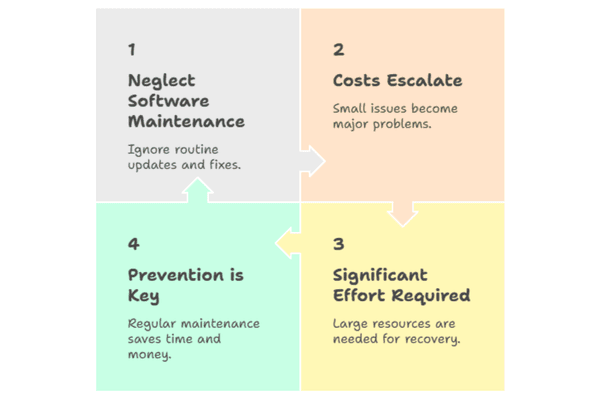
Hidden costs in free fundraising software work the way an unweeded garden works. One week of skipped weeding doesn’t ruin anything. Two months in, the lettuce bed is a meadow — and recovering it costs a weekend that the original 15 minutes of weekly weeding would have prevented.
Picture your development director on a Tuesday afternoon. The spring appeal closed last week. The summer board meeting is three weeks out. She is supposed to be drafting donor stewardship plans. Instead, she is exporting a CSV from the fundraising platform, opening it in Excel, deduping against last year’s records, and pasting cleaned rows into the bookkeeping file. She is not doing fundraising. She is doing reconciliation in disguise.
A 2024 ProcessMaker analysis found that office workers spend roughly 10% of their working time on manual data entry into business applications such as CRMs and spreadsheets. A separate Smartsheet survey reported that nearly 60% of workers estimate they could save six or more hours a week if their repetitive tasks were automated. In a small nonprofit, those hours are not invisible overhead. They are the difference between strategic work and surviving the week.
The harder cost is what happens when you try to leave.
Deciding whether to switch fundraising software feels the way it feels when you realize, twenty miles into a road trip, that you took the wrong exit. The right route is behind you. Turning around now means an hour of frustration. Continuing means two more hours of slow traffic — and most drivers, like most nonprofits, just continue.
NTEN — the largest nonprofit technology member organization in the U.S. — surveyed 379 nonprofits in 2024 about their donor management systems. The most striking finding wasn’t about which platforms organizations preferred. It was that more than half of nonprofits stayed with their current donor management system, primarily citing familiarity with it and a desire to avoid switching disruptions. The cost of switching felt worse than the cost of staying — even when staying meant putting up with a tool that no longer fit. That is not loyalty. That is lock-in disguised as inertia.
Mid-market platform migrations typically take two to six weeks; complex Salesforce NPSP implementations more often run two to four months. Implementation costs range from a few thousand dollars for a basic configuration to six figures for a full deployment with custom objects, automation, and data migration from a legacy system. A part-time internal admin spending 10 hours a week on the transition costs an organization roughly $20,000–$30,000 per year in salary allocation. The platform’s website says “free.” Switching off free fundraising software later — when your donor base grows or your reporting needs change — will not be.
The second installment is paid by your donors. Most of them don’t know they’re paying.
Donor tipping is the medical-bill model of nonprofit software. The headline price is zero. The actual cost arrives in installments — a fee from one place, a surcharge from another — and the donor learns months later that “free” meant “free for the nonprofit, billed to the supporter.” They didn’t read the fine print because nobody told them there was fine print.
When the fundraising platform OneCause published donor research on tipping fatigue, three quotes came back that should disturb every executive director:
I thought the tip was going to the nonprofit and not the software.
— donor John B., quoted in OneCause research
Tipping is a total rip-off. I don’t make any of those donations anymore; I’ll find a way to directly donate to the cause.
— donor Hannah S., quoted in OneCause research
These are not anti-nonprofit donors. They are pro-mission donors who feel ambushed at checkout. Bankrate’s 2024 tipping culture survey of 2,445 U.S. adults found that 63% hold at least one negative view about tipping, with 41% saying tipping culture has gotten out of control. A WalletHub tipping survey separately found that 55% of Americans say they often leave a tip due to social pressure rather than good service.
The fee structures are public. Anyone can read them. The contrast is what matters:
A nonprofit moving $200,000 a year through a platform charging an effective blended 5% rate (typical when processing and tip spillover are combined) is paying $10,000 a year for “free” software. That is a paid subscription. It just doesn’t have a subscription line item in your QuickBooks. Read each provider’s pricing page carefully — the math varies, and the published fees change.
The third installment comes due on December 30.
Fund accounting works the way a household budget works when you keep cash in envelopes — one labeled rent, one labeled college, one labeled groceries. You can’t pay rent from the college envelope even if the rent envelope is empty. Donors give your nonprofit envelopes, not cash. A fundraising tool shows the total dollars received; a bookkeeping system shows which envelopes those dollars belong in.
It is December 30. The last business day of your fiscal year. The board chair has asked for a one-page summary by January 5: how much of the year-end campaign was restricted, how the matching gifts posted, what your actual cash position is by program. The fundraising platform shows you donor records. The bookkeeping system shows you cash. Neither shows you fund-level reality at the speed your board chair needs it.
So you do what every executive director in this position does: you open a spreadsheet, label the tab “YE close,” and start moving rows by hand.
This is not a software problem. This is the gap that opens when “free fundraising software” is treated as a complete financial system. Fundraising tools track donors. They do not track funds. Those are different jobs.
NTEN’s Data Empowerment Report found that 72% of nonprofits use three or more systems that don’t talk to each other. That fragmentation is what makes year-end visibility expensive — and it grows quietly as you bolt on free fundraising software that was never designed to work alongside your bookkeeping system.
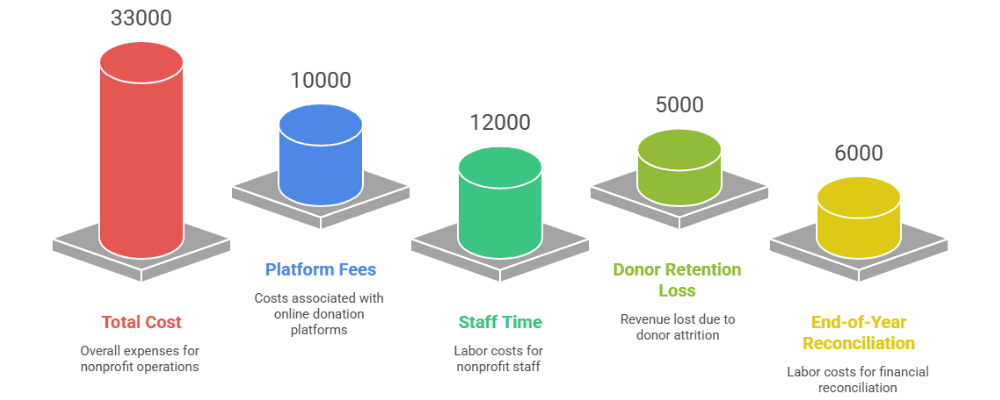
If you want to see what your own free fundraising software is actually costing, work the math on the back of an envelope. Take an organization with $500,000 in annual revenue, $300,000 of which flows through online giving — a profile that fits a large share of small nonprofits.
| Line item | Calculation | Annual cost |
|---|---|---|
| Platform fees | 4% blended on $300K (processing + tip spillover) | $12,000 |
| Staff time | 10 hrs/week × 1 staff × $25/hr blended | $13,000 |
| Lost donor retention | 2-pt drop from checkout friction × $300K base | $6,000 |
| End-of-year reconciliation | 40 hrs ED time × $50/hr | $2,000 |
| Total — for a tool advertised as free | ~$33,000/year | |
These numbers will be off for any specific organization — the right number depends on your donor mix, staffing structure, and how cleanly your tools talk to each other. But the order of magnitude holds: the true cost of “free” software for a small nonprofit is usually 5–10% of total revenue, hidden inside other line items.
“Free” is not the price. The 5–10% is the price. The receipt just doesn’t say so.
Free fundraising software isn’t free or expensive. It’s a tool that fits a particular stage of organizational growth — and stops fitting when growth happens.
For an all-volunteer organization raising $50,000 a year, a free tool like Zeffy or Give Lively is the right answer. The trade-offs are small relative to the resources saved.
For a $750,000 organization with three staff, a development plan, and grant reporting requirements, the trade-offs invert. Time is the scarcest resource, not money. Visibility into financial position matters more than saving on a subscription. The “free” tool starts charging in the currencies that matter most: hours, focus, and trust.
The question is not “Can we afford to pay for software?” The better question is: what is the actual cost of the software we’re using — in dollars, in time, and in clarity — and what would change if we paid that cost more visibly, with less of it landing on our donors and our staff?
Three checks worth your hour this week:
Pull a recent month of online gifts and compare gross donations to net receipts. The difference, divided by gross, is your true cost per dollar raised. If it’s above 5%, the “free” pricing is doing real work against you.
Ask whoever closes the month how many hours they spend reconciling fundraising-platform data against your bookkeeping. More than three hours per close means the integration isn’t working — and that’s a fixable problem, not a permanent tax.
If you wanted to leave your current platform tomorrow, what would you lose? Reports? Custom fields? Donor segments? Recurring-gift schedules? Document the answer now — that’s your switching cost, and you’ll want to know it before you need it.
Most small nonprofits don’t need to switch free fundraising software. They need to see what their current platform is actually costing them — and whether their bookkeeping system is positioned to catch what the fundraising platform misses.
GivingArc handles the financial side of small and mid-sized nonprofits — monthly bookkeeping, Form 990 preparation, audit readiness, and outsourced finance. We work behind whatever fundraising platform you use, so the books balance, restricted funds stay restricted, and the December 30 reconciliation panic stops being an annual event. If you’re weighing whether to outsource your nonprofit accounting, the savings often start in the time recovered from manual reconciliation alone.
For broader background on running a financially clear nonprofit, see our bookkeeping best practices guide, our nonprofit fund accounting basics, and our short nonprofit financial health checklist. You can also learn more about our team and how we work with nonprofits nationwide.
Every nonprofit gets the invoice. The question is whether you’re holding it, your donors are, or your bookkeeper is finding it the night before the audit. Pick the version where you can see it.
Want to see what your “free” platform is actually costing you?
Get a free 30-minute financial systems review — we’ll map the hidden costs and the cleanest fix for your size.
Common questions from small-team executive directors weighing free fundraising platforms against the true cost of using them.
Some platforms (Zeffy, Give Lively) are genuinely free of platform fees, though both rely on optional donor tipping to fund operations. Most others advertise “free” while recovering costs through donor tipping prompts of up to 30%, platform fees of 1.6–5% if tipping is disabled, or paid upgrades for features small nonprofits eventually need (custom reporting, automation, advanced segmentation). The honest test is your effective rate — gross donations minus net receipts, divided by gross. If that number is above 5%, the platform is not free in any meaningful sense.
For a typical $500K nonprofit running $300K through online giving, the true annual cost usually lands around $30,000–$35,000 once platform fees ($12K), staff time on manual reconciliation ($13K), donor retention loss from checkout friction ($6K), and end-of-year reconciliation labor ($2K) are added up. The order of magnitude tends to be 5–10% of total revenue, hidden across line items boards rarely review. The right number for your organization depends on your donor mix, staffing structure, and how cleanly your fundraising platform talks to your bookkeeping system.
Not always. For all-volunteer organizations under $50K in annual revenue, free tools like Zeffy or Give Lively are usually the right answer. The trade-offs become clearly worth paying for around the $300K–$500K mark, when staff time becomes the scarcest resource and grant reporting requires fund-level visibility the free tools don’t provide. Before switching, calculate your effective rate, document your data exit cost, and verify the new platform’s integration with whatever bookkeeping system you use. NTEN’s 2024 research found that more than half of nonprofits stayed with their current system primarily because of familiarity and a desire to avoid switching disruptions — once that switching cost is honestly priced, the math more often favors moving than staying.
Fundraising platforms are built around donor records — who gave, when, and how much. Fund accounting, by contrast, tracks money by donor restriction, program allocation, and grant compliance. These are different problems, and most fundraising tools (free or paid) don’t solve the second one. Restricted vs. unrestricted balances, matching-gift posting, and program-level reconciliation typically need a separate bookkeeping system. The gap between “total dollars received” and “dollars in the right envelope” is where most year-end reconciliation pain comes from.
For all-volunteer organizations under $50K in annual revenue, Zeffy and Give Lively are the closest to genuinely free — both charge 0% platform fees, and Zeffy also absorbs payment processing. Both rely on optional donor tipping to fund operations, so check the donor checkout experience to confirm it matches your brand. For larger budgets, the calculation shifts: the donor-experience cost of tip prompts and the staff-time cost of manual reconciliation usually outweigh the savings from using a free tier. Verify each platform’s current model on its own pricing page before committing — the fundraising-software market changes fast.