

The sponsorship is approved. The check is “in process.” Then accounts payable sends the email every executive director has received at least once: “Before we can issue payment, please complete the attached W-9.” And for a moment you hesitate — is signing a tax form going to create a tax bill for us?
Here’s the whole truth in two sentences. A W-9 your nonprofit fills out never creates a tax bill — it’s identity paperwork, like showing your driver’s license at hotel check-in. The W-9 that costs money is the one you forget to collect — because when your nonprofit is the one writing checks to contractors, missing W-9s turn into missed 1099s, and those carry real penalties.
A nonprofit W-9 is the standard IRS form (Form W-9, Rev. March 2024) your 501(c)(3) gives a payer to certify its legal name, EIN, and tax status — and this guide covers both directions: how to fill it out correctly (including the exempt payee code most blogs get wrong), and the new $2,000 reporting threshold that changes the collection side for 2026.
Key Takeaways
Because their accounting department needs to know exactly who they’re paying. Corporate sponsors, grantmakers, fiscal agents, and online marketplaces request a W-9 from every payee so they can (a) verify your legal name and EIN against IRS records and (b) decide whether they must report the payment on a Form 1099. That’s the entire function. The form goes into their vendor file — the IRS explicitly says the W-9 is given to the requester, not filed with the government.
For a 501(c)(3), the answer they’ll find on your form is usually “nothing to report”: payments to organizations exempt under Section 501(a) are exempt from most 1099 reporting, which is exactly what your exempt payee code tells them. Signing the form doesn’t change what your organization owes — if you’re wondering what a nonprofit actually pays taxes on, that’s a separate question with a more interesting answer. Refusing to provide the form, on the other hand, has a very concrete cost: the payer is required to hold back 24% of your payment as backup withholding. On a $10,000 sponsorship, hesitating over a one-page form costs $2,400 in cash flow until it’s sorted out.
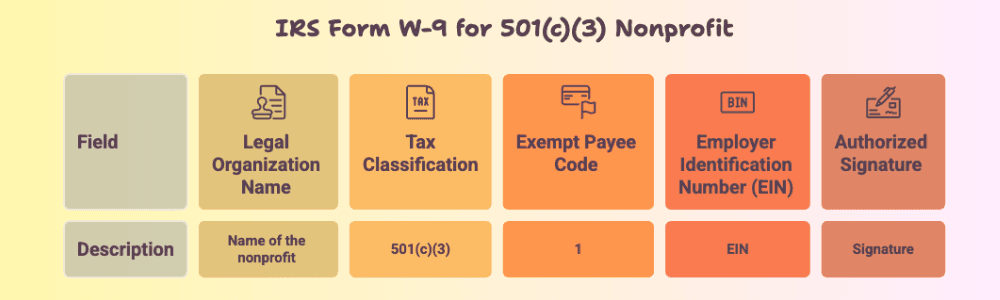
Five minutes, six decisions, on the current revision (Rev. March 2024 — check the top-left corner of the form you were sent):
About that line 4 code: search the same question and you’ll find major nonprofit sites telling you to leave it blank, enter code 1, or enter code 5. Code 5 is for ordinary corporations. Leaving it blank works but invites cautious payers to treat you as reportable. Code 1 is the one written for tax-exempt organizations — it’s on page 3 of the IRS’s own form. When three answers circulate, go with the one you can point to.
Anyone authorized to act for the organization can sign — the ED, the treasurer, a finance director. The certification says three things under penalty of perjury: the EIN is right, you’re not subject to backup withholding, and you’re a U.S. person. None of that creates tax. Before signing, an executive director should run exactly three checks:
Vendor files, W-9s, January 1099s — this is the unglamorous plumbing our nonprofit bookkeeping service quietly handles so it never lands on your desk in the first place. Talk to us →
Here’s the side of the desk where real money is at stake. Tax-exempt status exempts your income — it does not exempt your paperwork. When your organization pays a freelance grant writer, a bookkeeping contractor, a web designer, or the landlord, the IRS holds you to the same 1099 rules as any business. Which payees get which form, what the states want, and the deadlines are in our 1099 for nonprofits guide; the W-9 mechanics:
What a missed 1099-NEC costs (2026 returns)
$60
per form if you fix it within 30 days
$130
per form if fixed by August 1
$340
per form after that — and doubled when the contractor’s copy is missing too
Per Rev. Proc. 2025-32 for returns filed in 2027. Intentional disregard has no cap.
For two decades the reflex was “$600 and up gets a 1099.” That number just changed. Under the 2025 tax law, for payments made after December 31, 2025, the reporting threshold for 1099-NEC and most 1099-MISC payments rises to $2,000, inflation-indexed in later years — and the backup-withholding trigger moves to the same line (Rev. Proc. 2025-32; confirmed in the current 1099-NEC instructions).
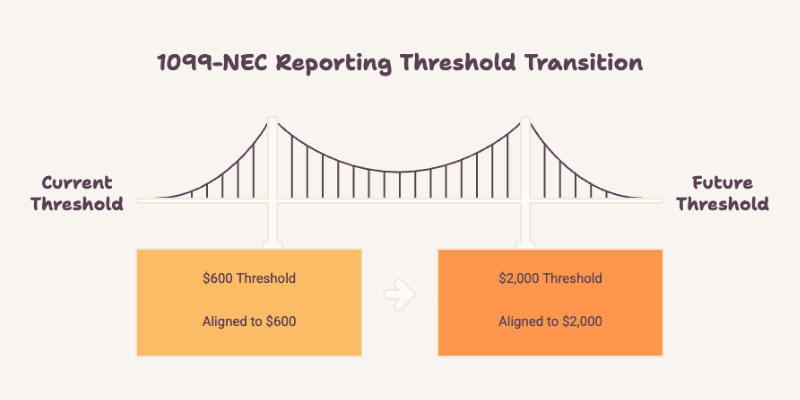
Three practical notes before you rewrite your vendor policy. First, this doesn’t apply retroactively — the 1099s you file in January 2027 for 2026 payments use $2,000, but 2025 payments stayed at $600. Second, some IRS pages haven’t caught up and still display the old figure; the statute and the current form instructions control. Third, don’t confuse this with the separate 1099-K rules for payment apps, which reverted to $20,000 and 200 transactions. And a word of judgment from the bookkeeping side: keep collecting W-9s below $2,000 anyway. A $1,500 contractor this year is a $3,000 contractor next year, and the form is far easier to get before the first check than after the last one.
Watch: the new $2,000 1099 threshold and the three questions to ask about every payee (video).
You don’t need to memorize any of the above. You need one sentence in your payment process, enforced without exceptions:
“No W-9, no first check.”
That’s the entire system. It costs nothing, it’s enforceable by whoever cuts your checks, and it converts a compliance topic into a two-minute onboarding habit — the same logic that separates organizations with clean books from the ones paying dearly to rebuild them later. If contractors are a growing share of how your work gets done, your treasurer’s job description should say who owns this file — it’s one of the simplest internal controls a small nonprofit can add.
One last reframe worth keeping. The W-9 conversation feels like paperwork trivia, but it’s really a solvency check on your operations: an organization that knows exactly who it pays, and can prove it every January, is an organization a funder can trust with bigger money. The form is one page. The habit is the asset.
Vendor files that survive January — and an ED who never thinks about them.
GivingArc’s nonprofit bookkeeping and tax services build W-9 collection and 1099 filing into your monthly routine.
Common W-9 questions from nonprofit executive directors.
Yes, whenever a payer with a legitimate payment relationship — a sponsor, grantor, bank, or marketplace — requests one. Signing creates no tax liability; it certifies your legal name, EIN, and exempt status for the payer’s records. Refusing can trigger 24% backup withholding on your payment.
The IRS instructions never name a specific box for nonprofits. An incorporated 501(c)(3) fits the IRS’s own corporation-to-“C corporation” mapping, while many organizations check “Other” and write in “Nonprofit corporation exempt under IRC Section 501(c)(3)” — payers accept either. The entry that actually controls your treatment is exempt payee code 1 on line 4.
Code 1 — defined on the IRS form as an organization exempt from tax under Section 501(a), which includes all 501(c)(3) organizations. It tells the payer your payments are generally exempt from 1099 reporting. Advice you may see elsewhere to use code 5 or leave the line blank is not what the form’s own instructions support.
Yes. Tax-exempt organizations follow the same payer rules as businesses: collect a W-9 from each unincorporated contractor and file Form 1099-NEC by January 31 once payments cross the reporting threshold — $600 for payments made through 2025, $2,000 for payments made in 2026 and later under the 2025 tax law.
No. The W-9 goes to the requester and stays in their vendor records as the basis for any 1099 they may need to file. Keep a copy of every W-9 you sign and every W-9 you collect — the form itself never travels to the IRS.
GivingArc provides bookkeeping, Form 990 preparation, and nonprofit-specialized accounting for small and mid-size 501(c)(3) organizations across the US. This article is general information, not tax advice — consult your tax professional about your organization’s specific situation. Reviewed by Min Kim, CPA.