

It’s a Tuesday in March. A donor from last spring — $500, one of your larger individual gifts — forwards you a note from her CPA: “Can you send the written acknowledgment for this contribution?” You search your inbox. You check the spreadsheet. What you find is the thank-you email you sent in April — warm, sincere, and missing the dollar amount and the one sentence her CPA is actually looking for.
Here’s the part most nonprofits have backwards: when a donation acknowledgment letter is missing or incomplete, the IRS doesn’t fine your organization. It disallows your donor’s deduction. The penalty for your paperwork gap lands on your donor’s tax return — the person you most want feeling good about your organization.
A donation acknowledgment letter is the written receipt a 501(c)(3) sends a donor documenting a gift — and for any single contribution of $250 or more, it’s the only thing standing between your donor and a lost deduction. This guide covers exactly what the IRS requires (six elements, straight from Publication 1771), the deadline that actually matters, the one situation where your organization can be penalized, and four copy-paste templates you can put to work today.
Key Takeaways
A donation acknowledgment letter is the written statement a nonprofit gives a donor confirming a gift — who gave it, what was given, and whether the donor received anything in return. The IRS calls it a contemporaneous written acknowledgment (CWA); most fundraisers call it a donation receipt or thank-you letter. Legally, the same document can be all three at once.
Think of it like the permission slip your kid brings home from school. It reads like a friendly note, but it’s really a legal document — it needs specific things to count, and it’s worthless if it comes back after the bus has left. And when it’s missing, the school isn’t the one who suffers; your kid is the one left standing in the parking lot. An acknowledgment letter works the same way: six required elements, a real deadline, and a donor — not you — who pays the price if it never shows up.
One distinction worth keeping straight: a thank-you letter is a stewardship gesture with no rules at all, while an acknowledgment letter carries specific IRS language requirements. The best practice — and the entire premise of the templates below — is to write one letter that does both jobs: warm enough that the donor feels seen, precise enough that her CPA files it without a follow-up question.
Yes — for any single contribution of $250 or more, a donor cannot claim a federal income tax deduction without a contemporaneous written acknowledgment from your organization, per IRS rules on written acknowledgments. But the enforcement mechanism surprises most people. Publication 1771 says it plainly: an organization that fails to acknowledge a contribution incurs no penalty. The donor is the one who loses.
That design tells you what this document really is. It isn’t a compliance shield for your organization — it’s a service to your donor. A nonprofit that acknowledges every gift promptly is protecting its donors’ money at tax time. A nonprofit that doesn’t is quietly transferring a cost to the exact people funding its mission. Donors rarely complain about it. Their accountants remember it.
Three fine points that trip up small organizations:
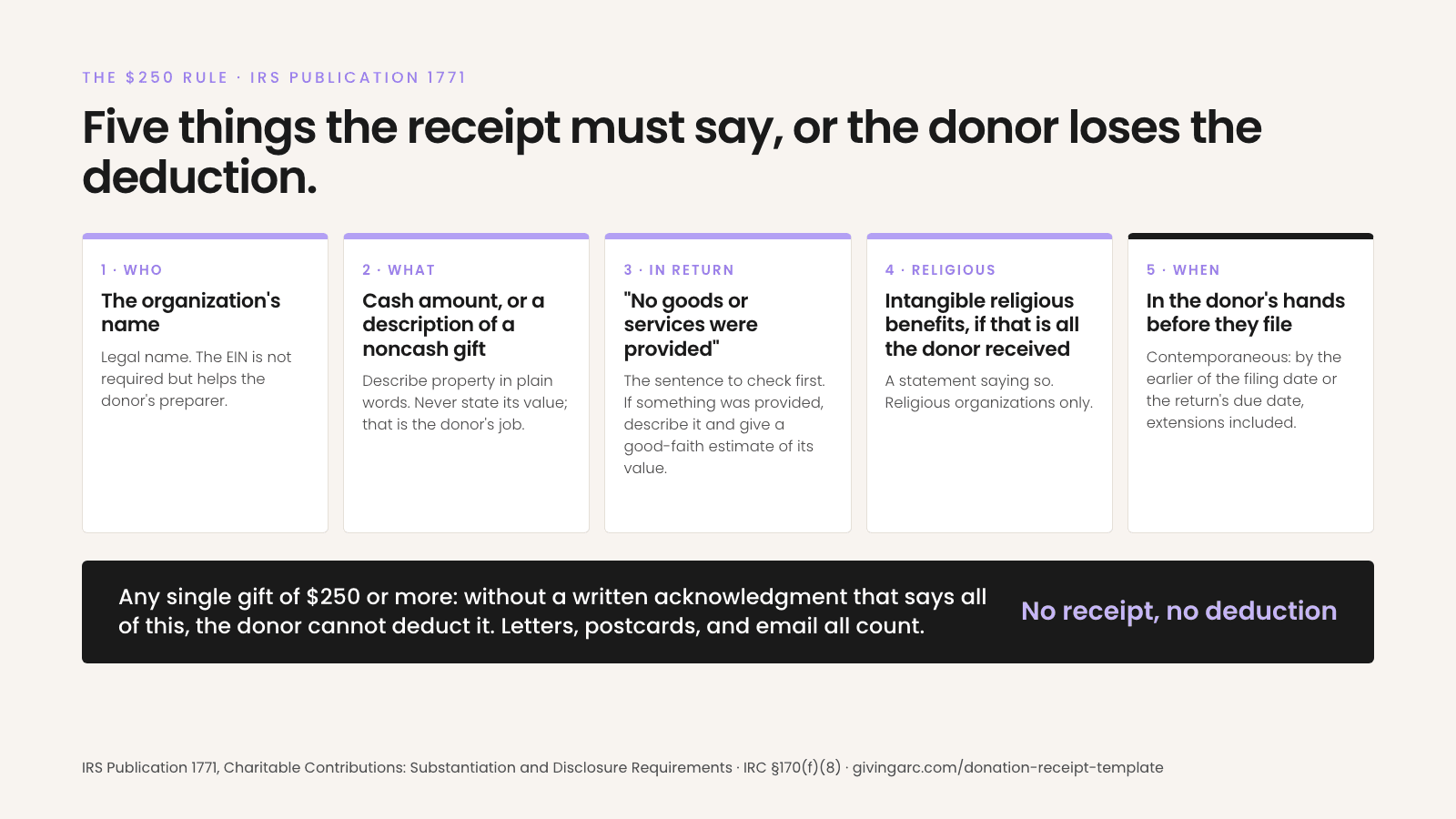
Publication 1771 requires six elements. Miss one and the letter may not hold up when your donor’s return is examined:
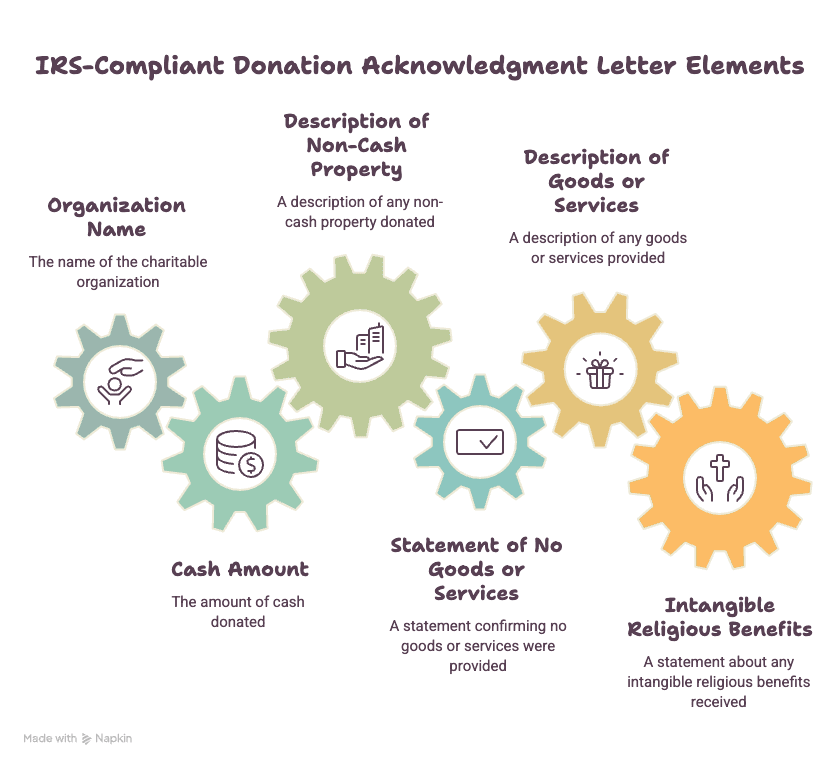
Two things you should leave out: the donor’s Social Security number (the IRS explicitly says it isn’t needed, and collecting it creates risk you don’t want) and any dollar value on donated property. If a donor asks you to value their gift, point them kindly to IRS Publication 561 — and if the gift is significant, to their tax advisor. How you record that gift on your own books is a separate question; our guide to categorizing donations properly covers that side.
The IRS word is “contemporaneous,” and it has a precise meaning that most articles blur: the donor must receive the acknowledgment on or before the earlier of (a) the date they actually file their return for the year of the gift, or (b) the return’s due date, including extensions. Not “the same year.” Not “by January 31” — that’s a convention, not the rule. But it’s a good convention, because you can’t know when each donor will file.
The timing rule in practice
The wrinkle worth knowing: a late acknowledgment isn’t merely late — for a donor who has already filed, it’s void. The Tax Court has disallowed deductions — in one case a $64.5 million gift — because the letter in the donor’s hands at filing was missing required language, and the corrected version came too late. Like the permission slip, timing isn’t a detail of the document. It is the document.
One efficiency the IRS allows: a single year-end summary can substantiate multiple $250+ gifts from the same donor. For monthly donors, that’s the clean solution — one January letter listing each gift by date and amount (template 3 below).
Everything so far has been about protecting your donor. This section is about protecting you — because there is one acknowledgment failure the IRS does penalize the organization for, and almost nobody writes about it.
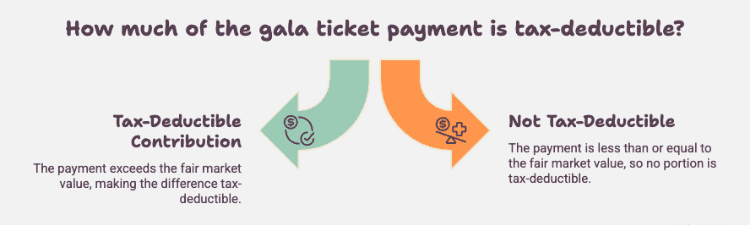
A quid pro quo contribution is a payment made partly as a gift and partly in exchange for goods or services — the gala ticket, the charity auction, the benefit concert. When a donor pays more than $75 in this way, you are required to give them a written disclosure that (a) tells them only the amount above the fair market value of what they received is deductible, and (b) provides your good-faith estimate of that value. The trigger is the payment, not the deductible portion — a $100 ticket to a $40 concert still requires the disclosure even though the deductible part is only $60.
Skip the disclosure and the penalty is $10 per contribution, up to $5,000 per fundraising event or mailing. For a 200-seat gala with no disclosure language on the invitation or the receipt, that’s a $2,000 exposure for a sentence’s worth of work. The IRS waives it for reasonable cause — but “we didn’t know” is an uncomfortable position to argue from. Our Form 990 Schedule G guide shows the sentence for a gala ticket, and the free fundraising event budget template writes one for every ticket and table.
Small mercies exist. You can skip the disclosure when what the donor receives is insubstantial: for 2026, benefits worth no more than the lesser of 2% of the payment or $139, or token logo items (mugs, calendars, tote bags) costing your organization no more than $13.90 on a payment of at least $69.50, per the IRS’s annual inflation adjustments. Annual memberships of $75 or less with routine member privileges are also disregarded. If your events team can’t tell whether the mugs qualify, that’s a fifteen-minute question for your accountant — not a reason to skip the language.
Gala receipts, auction items, donor letters — if year-end paperwork keeps eating your January, our nonprofit bookkeeping team builds the acknowledgment workflow into your books.
Get a quote →Each template below satisfies the six required elements where they apply. Replace the bracketed fields, put it on letterhead or in the body of an email — the IRS accepts either — and keep a copy in your donor records. The first sentence of each is yours to rewrite in your organization’s voice; the compliance sentences should stay close to as written. If you would rather start from a file, our donation receipt template pack has the same four scenarios as a fillable PDF and an editable Word document.
Cash gift — nothing given in return
Dear [First Name],
Because of you, [one concrete sentence: what this gift makes possible]. Thank you.
This letter acknowledges your contribution of $[amount], received by [Legal Organization Name] (EIN [XX-XXXXXXX]), a tax-exempt organization under Section 501(c)(3), on [date]. No goods or services were provided in exchange for this contribution.
Please retain this letter for your tax records.
With gratitude,
[Name, Title]
Quid pro quo — event ticket, auction, or benefit
Dear [First Name],
Thank you for joining us at [event] — [one warm sentence about the evening or its result].
This letter acknowledges your payment of $[amount] to [Legal Organization Name] (EIN [XX-XXXXXXX]) on [date]. In exchange, you received [description, e.g., dinner and entertainment] with an estimated fair market value of $[FMV]. For federal income tax purposes, your deductible contribution is limited to the amount of your payment that exceeds the fair market value of the goods and services you received — $[amount minus FMV].
Please retain this letter for your tax records.
With gratitude,
[Name, Title]
Year-end summary — monthly and repeat donors
Dear [First Name],
Twelve months, [N] gifts, one steady vote of confidence in [mission phrase]. Here is your giving summary for [year].
[Legal Organization Name] (EIN [XX-XXXXXXX]) gratefully acknowledges the following contributions received from you during [year]: [list each gift: date — $amount]. Total: $[total]. No goods or services were provided in exchange for any of these contributions.
Please retain this letter for your tax records.
With gratitude,
[Name, Title]
In-kind gift — describe, never value
Dear [First Name],
Your gift is already at work — [one sentence about how the donated item is being used].
This letter acknowledges your generous donation of [specific description: “one used commercial refrigerator” / “40 children’s winter coats”], received by [Legal Organization Name] (EIN [XX-XXXXXXX]) on [date]. No goods or services were provided in exchange for this contribution. As required by the IRS, we have not assigned a value to the donated property; determining fair market value is the responsibility of the donor.
Please retain this letter for your tax records.
With gratitude,
[Name, Title]
In-kind gifts carry their own recording, Form 990, and FASB reporting rules on your side of the books — our full guide to in-kind donations for nonprofits covers those, plus a free donation record template.
Watch: what to record for in-kind gifts, and why your audit and Form 990 show different totals (video).
Free download · PDF · no signup
Want these as a ready-to-send pack?
Get all four letters plus two more — major gift and memorial — and a one-page IRS language cheat sheet.
Four gift types don’t fit the standard letter — and they’re exactly the ones where a well-meaning acknowledgment can create problems:
Vehicles over $500
Different rulebook entirely: Form 1098-C, furnished within 30 days of the sale (or of the gift, if you’ll use or materially improve the vehicle). If you sell it, the donor’s deduction is generally capped at the gross sale proceeds — not book value.Stock & securities
Non-cash property: describe the gift (“50 shares of [company]”) and the date received, assign no value. The donor values it at the date-of-gift market price and files Form 8283 once total non-cash gifts for the year top $500 — and publicly traded stock never needs an appraisal, even above $5,000. Their side of the paperwork, not yours.Donor-advised fund grants
The deduction happened when the donor funded the DAF — not when the grant reached you. Thank the advisor warmly, but do not send deductible-gift language: no “no goods or services” tax receipt for a DAF check.Volunteer out-of-pocket expenses ($250+)
The acknowledgment describes the services the volunteer provided (“supplies purchased for the spring food drive she coordinated”) plus the standard goods-and-services statement. The volunteer keeps her own receipts for the dollar amounts.Here’s the uncomfortable backdrop for all this compliance talk. According to the Fundraising Effectiveness Project, only 18.9% of first-time donors ever make a second gift, overall donor retention sits at 43.3%, and the number of American donors has now declined for five consecutive years. For most small nonprofits, the acknowledgment letter is the first thing a donor receives after giving. It is a retention touchpoint wearing a receipt’s clothing.
18.9%
of first-time donors give again (FEP, Q4 2025)
59.3%
of repeat donors give again (FEP, Q4 2025)
The gap between those two numbers is the second gift, and a prompt, personal thank-you is the cheapest place to start working toward it. The compliance letter you’re already required to send can do that work. Three upgrades cost nothing:
If retention is the problem you’re actually trying to solve, start with our guide to donor retention for small nonprofits — and if your donor communications need a system rather than a scramble, the nonprofit newsletter guide pairs well with it.
The acknowledgment letter looks like tax paperwork. It’s really the first ask of next year — delivered at the exact moment your donor feels best about you. Write it for the IRS, and you’ll have a compliant document. Write it for the donor and the IRS, and you’ll have a compliant document that gets read twice: once in gratitude, once at tax time. Both readers matter. Only one of them gives again.
Acknowledgments, clean books, and a 990 that files itself on time.
GivingArc handles nonprofit bookkeeping and Form 990 preparation so your team can spend January thanking donors, not reconciling them.
Common questions from small nonprofits handling donation acknowledgment letters.
For any single gift of $250 or more, the donor cannot claim a federal tax deduction without a contemporaneous written acknowledgment from the charity. The organization itself faces no IRS penalty for not sending one — except for quid pro quo contributions over $75, where a missing written disclosure can cost the nonprofit $10 per contribution, up to $5,000 per event.
Yes. IRS Publication 1771 states there is no required form: letters, postcards, or computer-generated documents are acceptable, and the acknowledgment can be provided on paper or electronically, such as an email addressed to the donor. What matters is the content — the six required elements — not the medium.
The donor must receive it by the earlier of the date they file their tax return for the year of the gift or the return’s due date, including extensions. Because you can’t know when each donor files, the safe operational practice is to send all acknowledgments by January 31. A letter that arrives after the donor has already filed cannot restore the deduction for that gift.
No. The acknowledgment should describe the donated property — “one used commercial refrigerator” — but never assign it a dollar value. Determining fair market value is the donor’s responsibility, using IRS Publication 561 and, for larger gifts, their own tax advisor or a qualified appraisal.
Per single gift. Four separate $100 donations never trigger the requirement, and separate contributions under $250 are not added together. Payroll-deduction gifts count per paycheck, not per year. That said, acknowledging every gift regardless of size is the retention-smart practice — one year-end summary letter can cover a monthly donor’s whole year.
GivingArc provides bookkeeping, Form 990 preparation, and nonprofit-specialized accounting for small and mid-size 501(c)(3) organizations across the US. This article is general information, not tax advice — consult your tax professional about your organization’s specific situation. Reviewed by Min Kim, CPA.