
Almost every small nonprofit’s finances begin the same way: someone in the room says, “I can handle the books.” Maybe it’s a board member who’s good with numbers. Maybe a retired accountant who believes in the mission. Maybe a part-time admin who already knew the bank login. They step up, and it’s a genuine gift — the kind of generosity that keeps a young organization alive.
And for a while, it works. The transactions are few, the grants are simple, and one careful person at a kitchen table can keep the whole thing straight.
Then the organization grows. And one day — usually quietly, usually around Form 990 season — you realize the arrangement that carried you here might not carry you forward. This article is about that moment: how to tell when your nonprofit has outgrown a volunteer treasurer doing the books, and how to move on without making the person who saved you feel pushed aside.
Key Takeaways
Think about the friend who helps you move. When you’ve got a studio apartment and a hatchback, a friend with a free Saturday is exactly the right answer — calling a moving company would be silly. But nobody asks that same friend to move them every single weekend, into bigger and bigger houses, forever. At some point the load outgrows the favor. Not because the friend got worse — because the job got bigger.
A volunteer treasurer is the friend with the free Saturday. For a nonprofit running on a five-figure budget with one funding source, it’s the right answer. But nonprofit accounting doesn’t stay simple. Add a restricted grant, then a second program, then payroll, then a board that wants real reports, then a Form 990 instead of a postcard 990-N — and the “free Saturday” quietly turns into a second full-time job that one person is doing alone, at night, unpaid.
The model didn’t fail. The organization succeeded. Those are easy to confuse, and confusing them is how good volunteers end up buried.
Let’s name the thing that makes this conversation so hard. When someone suggests moving the books off the volunteer’s plate, it can feel like an accusation — as if the organization is saying we don’t trust you anymore. That fear is exactly why so many boards avoid the conversation for years.
So let’s be clear: this is almost never about trust. The volunteer treasurer who has carried your books is usually one of the most trustworthy people in the organization. The problems that show up as a nonprofit grows are structural, not personal:
The question is never “can we trust this person?” It’s “should an entire organization’s financial future depend on one unpaid person’s evenings?”
Complexity outgrows any single generalist. Continuity breaks when one person holds all the knowledge. Oversight disappears when the person doing the books is also the only person checking them. None of that is a character flaw — it’s just what happens when a growing organization leans its whole weight on a role that was built for a smaller season. (We wrote more about that “one person, no second set of eyes” risk in our guide to nonprofit internal controls.)
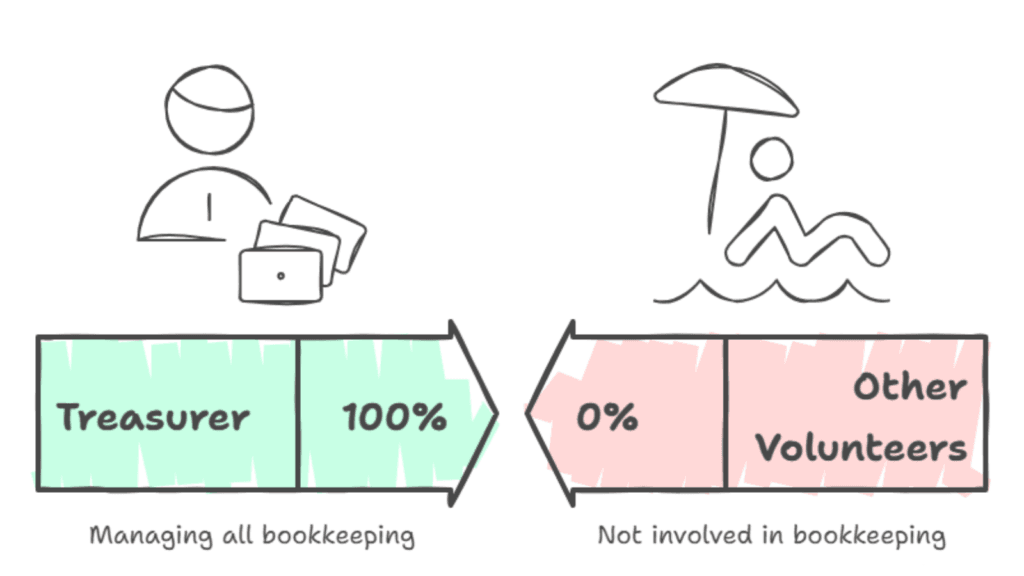
No single sign means it’s time. But if you’re nodding at three or four of these, the arrangement is probably straining — and the strain usually lands hardest on the volunteer.
Financial reports are late or inconsistent
The board asks for numbers and waits days or weeks. Each month’s report looks a little different from the last.
Only one person understands the books
If your treasurer went on vacation — or got sick — no one else could produce a current financial picture. That’s a continuity risk, not a convenience issue.
Restricted funds and grants are hard to track
You can’t quickly answer “how much of that grant is left, and what can it be spent on?” Restricted-fund tracking is where generalist bookkeeping most often breaks.
Board meetings rely on verbal updates
Instead of a clear statement everyone can read, finances are summarized out loud — “we’re doing okay, I think” — and no one quite knows how to ask a harder question.
Form 990 season is stressful every year
Tax time means a scramble to reconstruct the year. If messy books turn every spring into a fire drill, the system is overloaded.
Payroll, reimbursements, and approvals keep getting more complex
What used to be a few checks a month is now payroll taxes, contractor 1099s, and reimbursement policies — specialized work the role was never scoped for.
The volunteer is tired, unavailable, or hard to replace
The clearest sign of all. When you can’t imagine who would ever take this on next, you’ve already learned the role is too big to leave to chance.
Here’s the part that reframes everything: the goal isn’t to take the treasurer’s job away. It’s to give them back the job they were actually elected to do.
A nonprofit treasurer is a governance role, not a bookkeeping role. According to the National Council of Nonprofits, board members — the treasurer chief among them — serve as fiduciaries who oversee the organization’s financial health. The treasurer’s job is to question, interpret, and guide; it was never meant to be processing every transaction. The IRS reinforces this expectation too: Form 990, Part VI asks whether the board reviews the return and oversees governance — board-level work, not data entry. When a volunteer is buried in transactions, that actual oversight role — the valuable one — is the first thing that gets squeezed out.
The treasurer should keep
The treasurer shouldn’t be stuck doing
Notice that a treasurer who reviews the books someone else prepares is also a stronger control. The person checking the numbers is no longer the same person entering them — which is exactly the independent oversight a healthy organization wants.
When a nonprofit decides to lift the day-to-day load off a volunteer, the work that moves to specialized support is fairly predictable. It’s the recurring, technical, easy-to-fall-behind-on work — the part that benefits most from someone who does only this, every day:
This is different from a broad “hire staff vs. hire a firm” cost decision — if that’s where you are, our guide on when to outsource nonprofit accounting compares the models in detail. For the narrower choice a small organization actually faces, a freelance bookkeeper, a firm, or doing it yourself with a CPA check, this guide walks through all three. The point here is narrower and gentler: the recurring technical work leaves the volunteer’s kitchen table, and the oversight stays with the board. If you want a sense of what “good” looks like day to day, our best practices for nonprofit bookkeeping is a useful companion, and clean books make reading your financial statements far less intimidating for the whole board.
This is the part the brief-writers of the world skip, and it’s the part that actually matters. A volunteer who gave you years of unpaid evenings deserves a transition that feels like gratitude, not replacement. A few principles make that possible:
Name the growth, not the gap. Frame the change around what the organization achieved — “we’ve grown to the point where the books are a full-time job” — not around anything the volunteer did wrong. Because they didn’t do anything wrong.
Offer the better role, don’t remove the role. You’re not asking the treasurer to leave. You’re inviting them to step up into oversight — reviewing the work, guiding the board — and to put down the data entry that was never the point.
Make the handoff gradual and documented. Bring in support to work alongside the volunteer for a cycle or two, capturing the institutional knowledge that lives only in their head. That protects the organization and lets the volunteer hand off with pride instead of a shrug.
Say thank you out loud, on the record. A board resolution, a note in the newsletter, a moment at the annual meeting. The volunteer carried the organization through a season most people never see. Honor it.
If you want a quick gut-check, run through these. The more you check, the more likely it’s time to move the day-to-day work to specialized support — and free your treasurer to actually be a treasurer.
Our financial reports are often late, or the board waits for them.
If our treasurer disappeared tomorrow, no one could pick up the books.
We struggle to track restricted funds or report on grants accurately.
Form 990 or audit season is a yearly scramble.
The board makes decisions on verbal updates, not clear statements.
Our volunteer treasurer seems stretched, tired, or hard to replace.
No one independent reviews the books the treasurer keeps.
Has your nonprofit outgrown volunteer bookkeeping?
GivingArc can help you move from one-person recordkeeping to a simple, reliable nonprofit accounting system — bookkeeping and Form 990 support — without making your treasurer feel pushed aside.
Common questions from boards and executive directors weighing whether they’ve outgrown a volunteer treasurer.
A nonprofit treasurer is a board governance role focused on financial oversight — reviewing financial statements, monitoring budgets and cash flow, ensuring internal controls and the Form 990 are sound, and helping the board understand the numbers. The treasurer is a fiduciary who questions and guides; the role is not the same as a bookkeeper who records day-to-day transactions.
For a very small organization, yes — and it’s common in the early days. The problem is that combining the two removes independent oversight: the person recording transactions is also the only one reviewing them. As a nonprofit grows, separating the treasurer (oversight) from the bookkeeper (day-to-day) strengthens internal controls and reduces continuity risk.
Watch for a cluster of signs: financial reports are late or inconsistent, only one person understands the books, restricted funds are hard to track, board meetings rely on verbal updates, Form 990 season is stressful, and the volunteer is stretched thin. No single sign is decisive, but three or more usually means the day-to-day work has outgrown a volunteer arrangement.
Frame the change around the organization’s growth, not the volunteer’s performance. Offer them the elevated oversight role rather than removing them, bring in support to work alongside them for a transition period so institutional knowledge is captured, and thank them publicly. Most volunteers feel relief, not rejection, when the data entry comes off their plate and the meaningful oversight stays.
Yes. Moving day-to-day bookkeeping to specialized support does not remove the need for a treasurer — it makes the treasurer’s real job possible. The board still needs a fiduciary who reviews the financials, asks questions, and provides oversight independent of whoever keeps the books. In fact, separating the two creates stronger checks than either alone.
GivingArc provides bookkeeping, Form 990 preparation, and nonprofit-specialized accounting for small and mid-size 501(c)(3) organizations across the US. We’ve spent years in the seat next to the executive director — and the volunteer treasurer. Reviewed by Min Kim, CPA.