

Key Takeaways
Choosing between Form 990-EZ and Form 990 can make the difference between a straightforward annual filing and a complex, time-consuming process that strains your nonprofit’s resources. With over 23 years of nonprofit accounting experience, our team understands this critical decision inside and out. The wrong choice doesn’t just mean extra work—it can lead to compliance issues, penalties, and unnecessary stress for your team.
Both forms serve the same basic purpose: fulfilling your organization’s annual reporting requirements to the IRS. However, the eligibility thresholds, reporting requirements, and preparation complexity differ significantly. Understanding these differences ensures your nonprofit stays compliant while minimizing administrative burden and costs.
Form 990-EZ, officially called the “Short Form Return of Organization Exempt From Income Tax,” serves as the streamlined annual filing option for smaller nonprofits. This four-page form requires significantly less detailed reporting compared to the full Form 990, making it an attractive option for organizations that qualify.
The IRS designed Form 990-EZ to reduce the compliance burden on smaller organizations while still capturing essential financial and operational information. Organizations filing this form report basic revenue and expense categories, provide a summary of program accomplishments, and disclose key governance information—but without the extensive detail required on Form 990.
Form 990-EZ filers must meet specific size thresholds and cannot include certain types of organizations, regardless of their financial metrics. The simplified format typically requires 15-25 hours to complete, depending on the organization’s complexity and record-keeping systems.
Form 990, the comprehensive “Return of Organization Exempt From Income Tax,” represents the full annual information return that larger nonprofits must file. This extensive form can span dozens of pages when including required schedules, demanding detailed financial disclosures, governance information, and operational reporting.
The full Form 990 serves multiple purposes beyond tax compliance. It functions as a public accountability document, providing donors, grantmakers, and regulatory agencies with comprehensive information about your organization’s financial health, program effectiveness, and governance practices. This transparency requirement means every section receives scrutiny from stakeholders and requires careful preparation.
Our Form 990 filing services typically involve 40-80+ hours of preparation time, depending on organizational complexity, number of required schedules, and the quality of underlying financial records. The investment in professional preparation often pays for itself through error prevention and compliance assurance.
Organizations eligible for Form 990-N may choose to file Form 990-EZ or the full Form 990 instead.
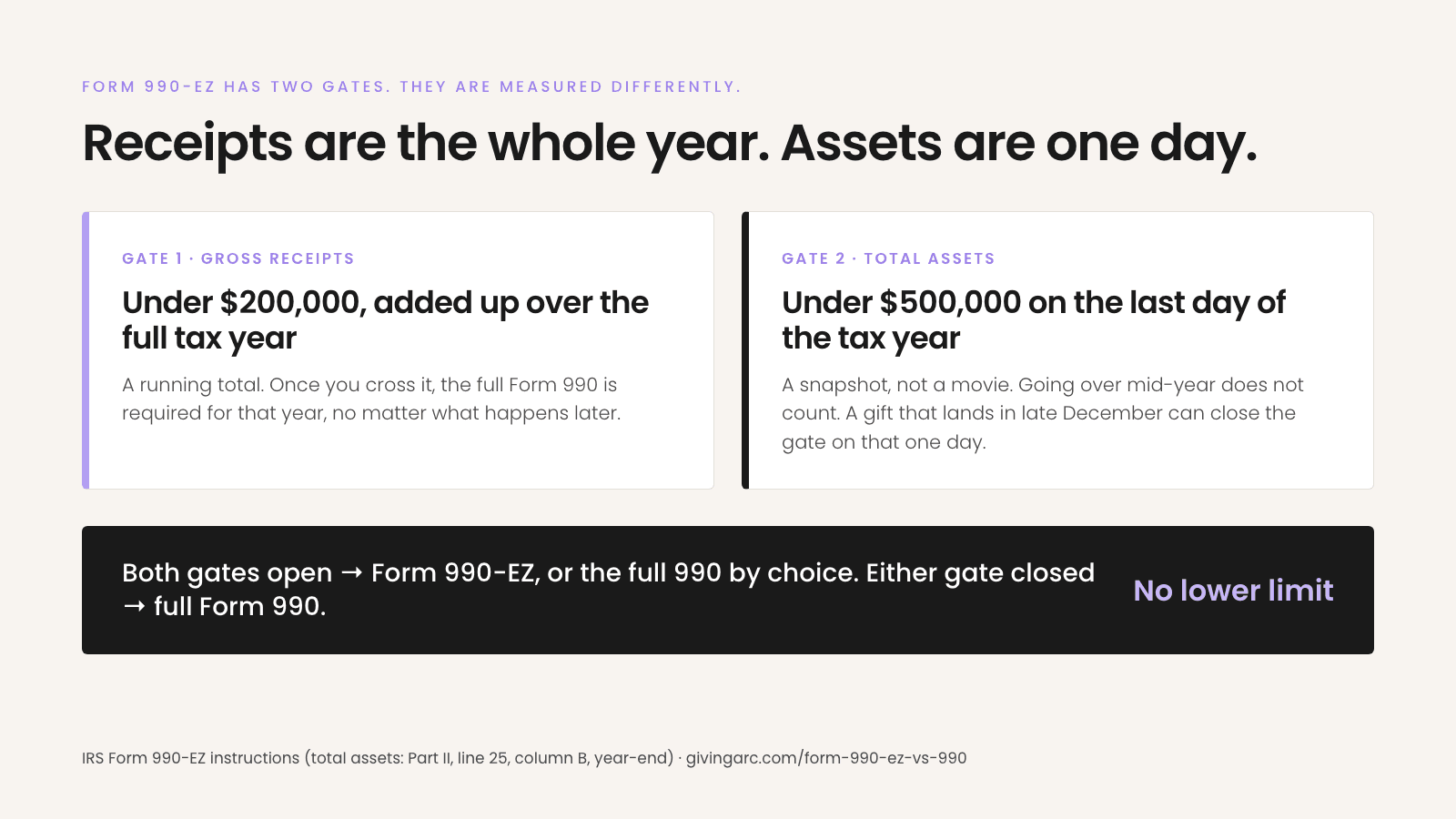
Your nonprofit qualifies for Form 990-EZ when it meets specific financial criteria during the tax year. The primary requirements are annual gross receipts under $200,000, plus total assets valued at less than $500,000 at the end of the tax year. There is no lower limit: an organization whose gross receipts are normally $50,000 or less may file Form 990-N instead, but it may also choose to file Form 990-EZ or the full Form 990.
Gross receipts calculation includes all revenue sources: donations, grants, program service revenue, investment income, and other income. The IRS defines gross receipts broadly, so organizations must carefully track all income streams throughout the year to determine eligibility.
However, certain organization types cannot file Form 990-EZ regardless of size. Private foundations must file Form 990-PF regardless of their financial metrics. Organizations with gross receipts under $50,000 typically file Form 990-N (the electronic postcard), though they may voluntarily file Form 990-EZ or 990 for greater transparency.
Organizations must file Form 990 when their annual gross receipts equal or exceed $200,000 for the year, or when total assets equal or exceed $500,000 on the last day of the tax year. These thresholds apply to most 501(c)(3) public charities and other exempt organizations.
Private foundations face different rules entirely—they must file Form 990-PF regardless of size. Section 527 political organizations have their own $25,000 threshold for Form 990 or 990-EZ filing requirements, while certain other exempt organizations may have specific rules based on their exemption category.
The asset threshold often surprises growing organizations. For example, if a nonprofit receives a large grant or major gift that pushes assets above $500,000 in June but spends back down below the line by December 31, the asset test is still met and Form 990-EZ remains available. The reverse is also true: a bequest that arrives in late December can put assets over the line on that one day and require the full Form 990 for that year. This situation frequently occurs with capital campaigns or multi-year grant awards, making financial planning and threshold monitoring essential for compliance.
Form 990-EZ requires basic financial information organized into simplified revenue and expense categories. Organizations report total contributions, program service revenue, other revenue, and basic expense breakdowns without extensive detail. The financial statements section captures essential balance sheet information but doesn’t demand the comprehensive analysis required on Form 990.
In contrast, Form 990 demands detailed financial reporting that mirrors audited financial statements. Organizations must complete a comprehensive Statement of Functional Expenses, showing current year and prior year comparisons across program services, management and general, and fundraising categories. The level of detail extends to specific revenue sources, detailed expense allocations, and comprehensive balance sheet reporting.
The program service accomplishments section illustrates another key difference. Form 990-EZ allows organizations to describe their three largest program activities in simple narrative form. Form 990 requires detailed program descriptions including specific metrics, beneficiary counts, and financial breakdowns for each significant program activity—and yes, the IRS actually reads these narratives.
Both forms address governance practices, but Form 990 goes much deeper. Form 990-EZ asks basic questions about board composition, conflicts of interest policies, and document retention practices. Organizations can typically answer these questions straightforwardly without extensive documentation.
Form 990’s Part VI governance section demands comprehensive disclosure about board practices, compensation procedures, conflict of interest policies, whistleblower protections, and document retention policies. Organizations must provide detailed explanations when policies don’t exist or when practices deviate from IRS expectations. This section often triggers follow-up questions from reviewers and requires careful preparation to avoid compliance red flags.
Form 990-EZ filers face limited schedule requirements, typically only completing Schedule A (Public Charity Status) and Schedule B (Schedule of Contributors) when applicable. Most smaller organizations avoid the complex schedules that can double or triple preparation time on Form 990.
Form 990 filers must navigate an extensive schedule matrix covering everything from political activities and lobbying (Schedule C) to supplemental financial statements (Schedule D) and compensation reporting (Schedule J). Each schedule carries its own preparation requirements and compliance considerations, making professional guidance valuable for most organizations.
Understanding nonprofit fund accounting basics becomes crucial when completing either form, as proper fund tracking throughout the year simplifies the reporting process and ensures accurate disclosures.
Form 990-EZ preparation typically requires 15-25 hours for most organizations, assuming well-organized financial records and basic familiarity with nonprofit accounting principles. The time investment breaks down into gathering financial data, completing the form sections, reviewing for accuracy, and obtaining required signatures.
Organizations need year-end financial statements, detailed revenue records, expense documentation, and basic governance information. The simplified format allows many organizations to handle preparation internally, especially when staff have experience with nonprofit financial reporting and access to professional guidance for complex questions.
However, preparation challenges still arise. Common issues include properly categorizing revenue sources, calculating program expense ratios, and ensuring compliance with public support tests. Organizations without proper nonprofit bookkeeping services throughout the year often discover that “simple” preparation becomes complex when records are incomplete or improperly categorized.
Form 990 preparation demands 40-80+ hours from experienced preparers, with complex organizations requiring even more time. The extensive reporting requirements, multiple schedules, and detailed disclosure obligations make professional preparation almost essential for most organizations.
The preparation process involves comprehensive financial analysis, detailed program reporting, governance policy review, and extensive documentation gathering. Organizations need audited or reviewed financial statements, detailed program metrics, compensation analysis, and comprehensive policy documentation. The public nature of Form 990 filing means every section requires careful review to ensure accuracy and appropriate disclosure.
Cost-benefit analysis consistently favors professional preparation for Form 990 filers. The potential penalties for errors, combined with the time investment required from internal staff, usually exceed the cost of professional services. In our experience, experienced preparers identify tax-saving opportunities and compliance improvements that benefit organizations long-term.

Starting July 1, 2019, the IRS has required certain organizations to file electronically. For tax year 2026, organizations that file at least 250 returns during the calendar year (including income tax withholding and information returns) must file Form 990 series returns electronically. Organizations with $10 million or more in total assets must file Form 990 electronically regardless of the number of returns filed.
However, practical considerations make electronic filing advantageous for most organizations regardless of the mandate. IRS-approved e-filing reduces processing time from months to weeks and provides immediate confirmation of receipt. This faster processing particularly benefits organizations needing to demonstrate current filing status for grant applications or state registrations.
We’ve seen that electronic filing reduces common errors through built-in validation checks and eliminates the risk of lost mail. The system also provides automatic acknowledgment letters required for many state charity registrations, saving organizations time and documentation headaches.
Making the correct choice between Form 990-EZ and Form 990 starts with careful threshold monitoring throughout the fiscal year. Organizations approaching the $200,000 gross receipts or $500,000 asset thresholds should prepare for the possibility of filing Form 990, even if they ultimately remain eligible for Form 990-EZ.
Consider these key factors when planning your filing strategy:
Remember that filing requirements represent minimum compliance standards. Many organizations voluntarily file the more comprehensive form to demonstrate transparency and accountability to stakeholders. This proactive approach can strengthen donor confidence and simplify the eventual transition when Form 990 becomes mandatory.
Get a free custom quote tailored to your organization — no obligation.
Whether your organization files Form 990-EZ or Form 990, accurate preparation remains essential for maintaining tax-exempt status and public trust. The differences between these forms extend beyond simple page counts—they reflect fundamentally different approaches to nonprofit accountability and transparency.
Smart organizations start planning their annual filing well before the deadline. Review your financial thresholds quarterly, maintain clean financial records throughout the year, and consider whether your current form choice aligns with your organization’s growth trajectory and stakeholder expectations.
Ready to ensure your nonprofit files the right form correctly and on time? Contact GivingArc today to discuss your Form 990 or 990-EZ filing needs. Our experienced team helps you navigate the complexities of nonprofit tax compliance while you focus on advancing your mission.
Form 990-EZ is a 4-page short return for organizations with gross receipts under $200,000 AND total assets under $500,000, requiring 15-25 hours to prepare. The full Form 990 is a 12+ page comprehensive return for organizations with gross receipts of $200,000 or more, OR total assets of $500,000 or more, typically requiring 40-80+ hours. Both forms satisfy annual IRS reporting requirements but differ significantly in detail, required schedules, and disclosure depth.
File Form 990-N (e-Postcard) if gross receipts are normally $50,000 or less. File Form 990-EZ if gross receipts are under $200,000 AND total assets are under $500,000. Organizations eligible for Form 990-N may choose to file Form 990-EZ or the full Form 990 instead. File the full Form 990 if gross receipts are $200,000 or more, OR if total assets are $500,000 or more. Certain organization types (such as private foundations) must always file specific forms regardless of size.
Yes. Many organizations voluntarily file the full Form 990 even when eligible for 990-EZ, particularly when major funders or institutional donors prefer the deeper transparency. Filing Form 990 voluntarily can strengthen donor confidence and ease the eventual transition once your organization grows past the 990-EZ thresholds.
Form 990-EZ typically takes 15-25 hours to prepare, depending on record-keeping quality and organizational complexity. The full Form 990 typically takes 40-80+ hours, varying with the number of required schedules, transaction complexity, and quality of underlying financial records. Professional CPA preparation is often more cost-effective for full Form 990 filers due to the time and expertise required.
You determine the correct form based on the gross receipts and total assets reported for the full tax year. Gross receipts are a full-year total, so once you cross $200,000 the full Form 990 is required for that year. Total assets are measured only on the last day of the tax year — going above $500,000 mid-year does not matter if you are back under it at year-end, and a gift that arrives in late December can push you over on that one day. Track your thresholds quarterly so the filing requirement never comes as a surprise at year-end.