
Picture the November board meeting. The statement of activities shows a $42,000 surplus, someone says “great year,” and the room applauds. Three weeks later, the executive director is quietly moving money around to make payroll. Nobody lied. Nothing was hidden. The board just read the wrong report — because the one that explains this exact moment is the one most boards skip.
A nonprofit cash flow statement (formally the statement of cash flows) reports the actual cash that moved in and out of your organization during a period, grouped into operating, investing, and financing activities. Here’s what makes it different from every other report in your financial package: it can’t be fooled. Pledges that haven’t arrived, donor restrictions, depreciation — all the things that make a surplus look bigger or smaller than your bank account — vanish. Only cash that actually moved remains.
Think of your statement of activities as the weather report — how much rain was promised. The cash flow statement is the water meter: it only counts what actually flowed through the pipe, and nobody argues with the meter. This guide walks through the three sections, a complete worked example you can copy, the direct vs indirect choice, how to build one from QuickBooks, and the three numbers your board should read first.
Key Takeaways
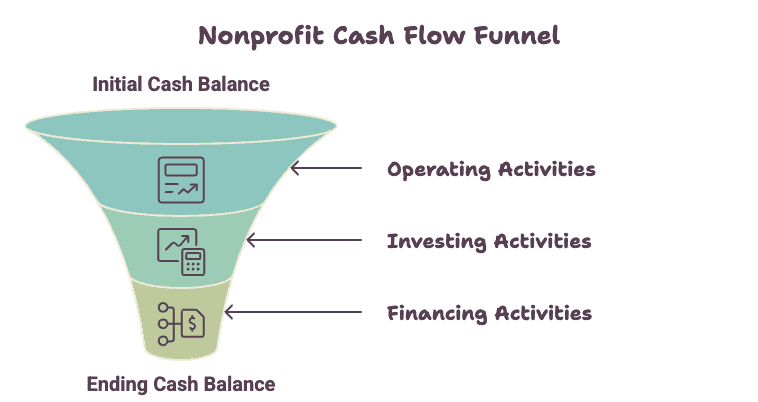
Every cash flow statement — nonprofit or not — sorts cash movement into three buckets. Under FASB ASU 2016-14, nonprofits classify and report cash receipts and payments as operating, investing, or financing activities, just like businesses. What’s different is what lands where.
Operating
Daily mission money
Unrestricted donations and grants received, program fees collected, payroll, rent, and supplies paid. The section that answers: does the day-to-day operation generate or consume cash?
Investing
Long-lived assets
Buying or selling equipment, vehicles, buildings, and investments. A negative number here often means something healthy — you bought a van, not lost money.
Financing
Capital that builds capacity
Loan proceeds and repayments — plus the nonprofit twist below that surprises almost everyone.
The twist: when a donor restricts a gift to a long-term purpose — acquiring or improving property and equipment, or building an endowment — FASB says that cash belongs in financing activities, not operating. A $50,000 capital-campaign check feels like a donation, but on this statement it’s treated like capital, because it builds capacity rather than funding this year’s programs. Two related rules worth knowing: restricted cash must be included when reconciling beginning and ending cash totals (ASU 2016-18), and donated cryptocurrency that’s converted nearly immediately to cash follows the same restricted-vs-not logic under ASU 2023-08. If restrictions are fuzzy territory for you, start with our guide to restricted vs unrestricted funds.
Here’s a full indirect-method statement for a hypothetical small community organization with a $520,000 budget. Read the operating section closely — this example is built to show the exact trap from our opening scene: a healthy-looking surplus and negative operating cash in the same year.
Sample statement of cash flows (indirect method)
Hypothetical community organization · Year ended December 31
| Cash flows from operating activities | |
|---|---|
| Change in net assets | $42,000 |
| Add back: depreciation (non-cash) | 18,000 |
| Less: increase in grants receivable (promised, not received) | (25,000) |
| Add: increase in accounts payable (billed, not yet paid) | 6,000 |
| Add: decrease in prepaid expenses | 2,000 |
| Less: contributions restricted for building purchase (reported below) | (50,000) |
| Net cash used by operating activities | $(7,000) |
| Cash flows from investing activities | |
| Purchase of equipment Net cash used by investing activities | (30,000) $(30,000) |
| Cash flows from financing activities | |
| Contributions restricted for building purchase Net cash provided by financing activities | 50,000 $50,000 |
| Net increase in cash and restricted cash | $13,000 |
| Cash and restricted cash, beginning of year | 48,000 |
| Cash and restricted cash, end of year | $61,000 |
Now read it the way the meter reads it. The statement of activities said +$42,000 — and the board applauded. But $25,000 of that surplus is a grant that’s still a promise, $50,000 is restricted to a building the organization can’t spend on programs, and depreciation never touched cash at all. Strip the non-cash noise away and daily operations actually consumed $7,000 of cash this year. Total cash still grew by $13,000 — but almost entirely from capital money with strings attached. That single reading — surplus up, operating cash negative — is the earliest warning this report gives and the other statements hide.
Direct method
Lists the actual flows
Cash received from donors, cash paid to employees, cash paid to vendors — line by line. Easier for boards to read. Since ASU 2016-14, nonprofits choosing it no longer must attach the indirect reconciliation, which removed the old double-work penalty.
Indirect method
Works backward from the surplus
Starts from the change in net assets and removes everything non-cash (depreciation, receivable and payable changes) — exactly like our example above. It’s what audit firms prepare by default, and what QuickBooks generates.
The honest when-to-choose rule: if your statements are audited or reviewed, you’ll almost certainly end up with the indirect method, because that’s the auditor’s default and your software’s default. If you’re preparing an internal version purely for board readability, the direct method tells a clearer story — and it is fully permitted on its own. Neither is “more accurate”; they arrive at the same operating number by different roads.
If your books are current — reconciled accounts, receivables and payables recorded — QuickBooks does most of the assembly. Here’s the practical path for a small organization:
Five steps in QuickBooks Online
Reconcile every bank and credit card account through the period end — an unreconciled month makes every number below it fiction.
Run Reports → Statement of Cash Flows for the period. QBO builds an indirect-method draft starting from net income — for a nonprofit file, that line is your change in net assets.
Reclassify the nonprofit twist by hand: QuickBooks doesn’t know a gift was restricted to your building campaign — move those receipts from operating to financing.
Check that restricted cash is included in the beginning and ending totals — a separate building-fund savings account still counts as cash on this statement.
Sanity-check the ending cash against your reconciled bank balances. If they don’t tie, something upstream (usually an unrecorded receivable or payable) needs attention first.
The quality of this statement is downstream of the quality of your bookkeeping — if the ledger is behind, the meter reads wrong. Our guides to QuickBooks for nonprofits and the nonprofit chart of accounts cover the setup that makes step 2 push-button, and our complete bookkeeping guide covers the monthly rhythm that keeps it that way.
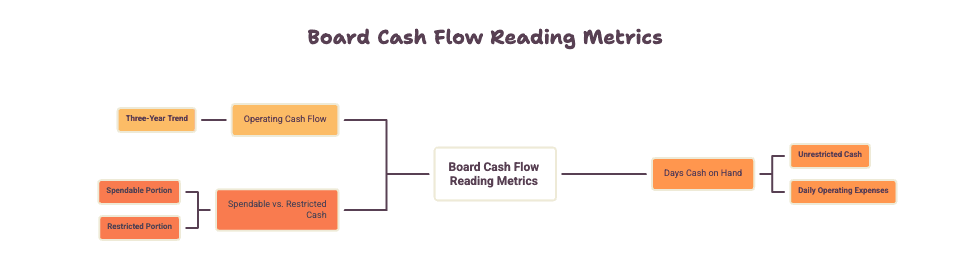
You don’t need to prepare this statement to govern with it. Three numbers, in order:
Three numbers before any discussion
Operating cash flow — and its 3-year trend. One negative year can be timing. Three negative years while surpluses keep getting reported means the mission is being financed by capital gifts and reserves.
Days cash on hand. Unrestricted cash ÷ (annual operating expenses minus depreciation, ÷ 365). Our sample org: $38,000 ÷ ($502,000 ÷ 365) ≈ 28 days — under a month of runway, whatever the surplus said.
How much of ending cash is actually spendable. $61,000 in the bank, but $50,000 belongs to the building. The treasurer’s report should always show total cash and unrestricted cash side by side.
What counts as healthy runway varies by revenue model, but the widely used formula above comes from public-sector finance practice (UNC Environmental Finance Center), and the Nonprofit Finance Fund tracks the same idea as months of cash. For benchmarks and companion ratios, see our nonprofit financial ratios guide and operating reserves guide. And when the statement reveals a problem, the fix lives in cash flow management — forecasting, timing, and the strategies that change next year’s meter reading.
Two facts orient everything. First: the Form 990 does not include a cash flow statement. Its financial sections are the statement of revenue, functional expenses, and a balance sheet — which is why an organization can file 990s for years without ever producing one. Second: the moment you need GAAP financial statements, the cash flow statement stops being optional — FASB requires a complete set (statement of financial position, statement of activities, statement of cash flows, plus notes). In practice that trigger is usually an audit: California requires audited GAAP statements at $2 million in gross revenue, New York above $1 million (with a CPA review from $250,000), and many funders ask sooner. Where you stand determines the work: our guides to nonprofit audit requirements and reading nonprofit financial statements map the full landscape — this statement is one of the four, with the statement of financial position as its balance-sheet sibling.
Never seen a cash flow statement for your own organization? That usually means the books aren’t producing one — fixable in a month. GivingArc prepares board-ready financial packages, statements included.
See the service →Go back to that November board meeting. Same organization, same numbers — but this time someone flips to the cash flow statement and asks one question: “Why is operating cash negative when we’re showing a surplus?” Ten minutes of honest discussion follow — about the grant that hasn’t arrived, the building money that can’t buy groceries, the 28 days of runway. No crisis three weeks later, because the crisis got discussed while it was still a line item.
That’s all this statement is: the water meter on your mission. The weather report matters — but fund the organization on what actually comes through the pipe.
Common questions from treasurers and EDs about the nonprofit cash flow statement.
Not for the Form 990 — the IRS return has no cash flow section. It becomes required when you produce GAAP financial statements, which must include a statement of financial position, statement of activities, and statement of cash flows. In practice the trigger is an audit: California requires one at $2 million in gross revenue, New York above $1 million, and many grantmakers ask sooner.
Both are permitted, and since ASU 2016-14 the direct method no longer requires an added indirect reconciliation. If your statements are audited, expect the indirect method — it’s the auditor’s and QuickBooks’ default, starting from the change in net assets. For internal board reporting, the direct method is often easier to read. Both arrive at the same operating cash number.
Anything that isn’t cash: pledges and grants awarded but not yet received, in-kind donations of goods and services, depreciation, and unrealized investment gains or losses. That exclusion is the statement’s superpower — it shows what your organization can actually spend, not what it has been promised.
Two main ways. The indirect method starts from the change in net assets rather than net income. And gifts that donors restrict to long-term purposes — building campaigns, endowments — are classified as financing activities rather than operating, because FASB treats them as capital that builds capacity rather than revenue that funds current programs.
Formally, once a year as part of your financial statements. Practically, run the QuickBooks version alongside every board financial package — monthly or quarterly — and pair it with a forward-looking cash flow forecast. The statement shows where cash went; the forecast shows whether you’ll have enough next quarter.
Board-ready statements, every month — meter included.
GivingArc prepares monthly financial packages with bookkeeping and Form 990 support for small and mid-size 501(c)(3)s.
GivingArc provides bookkeeping, Form 990 preparation, and nonprofit-specialized accounting for small and mid-size 501(c)(3) organizations across the US. This article is general information, not accounting advice — audit thresholds vary by state and the sample statement is illustrative. Reviewed by Min Kim, CPA.