
There’s a particular kind of math nonprofit leaders do in their heads. It happens in the car, or at 11 p.m., or in the quiet moment after a funder says “we’ll let you know.” It goes something like: if that grant doesn’t come through, and the event underperforms, how long can we keep the lights on?
If you’ve done that math recently, you’re not behind, and you’re not failing. You’re running a small nonprofit, and this is what the job feels like when there’s no cushion under it.
The good news: the cushion has a name — operating reserves — and a number you can actually calculate, build toward, and stop losing sleep over. Let’s find yours.
Key Takeaways
Ask almost any accountant, funder, or board treasurer, and you’ll hear the same range: three to six months of operating expenses. The National Council of Nonprofits cites three to six months as a commonly used goal — and notes, just as importantly, that many nonprofits report having less than three months on hand.
So if you’re below three months right now, you’re not an outlier — you have plenty of company. The benchmark isn’t a pass/fail grade; it’s a direction to walk in.
One myth to clear up before we go further: there is no IRS rule against nonprofits holding reserves. Building a healthy cushion does not endanger your 501(c)(3) status, and a funder who sees three months of reserves on your books reads it as competence, not hoarding. If anything, clean reserves are part of what makes your organization ready to apply for grants in the first place.
Here’s where many calculations quietly go wrong. Months of cash is not your bank balance divided by your monthly spending — because part of that bank balance probably isn’t yours to spend freely.
The honest formula
Months of cash = unrestricted, liquid funds ÷ average monthly operating expenses
Average monthly expenses = your last 12 months of operating expenses ÷ 12. Not your lightest month.
Three words in that formula do the heavy lifting:
Unrestricted. Money a donor or funder designated for a specific program doesn’t count, even though it sits in the same account. If you’re not sure what’s restricted, start by untangling restricted vs unrestricted funds — it changes this number more than anything else. (The mechanics live in fund accounting.)
Liquid. Cash and things that become cash within days — not the building, and not the pledge that arrives in October. Your statement of financial position shows what qualifies.
Average. Take your last twelve months of operating expenses and divide by twelve. Don’t use your lightest month — that’s the financial equivalent of weighing yourself right after the flu.
You don’t have to do this by hand. Our free calculator takes the numbers you already have and gives you your reserve ratio in months — no spreadsheet required.
Try the free calculator →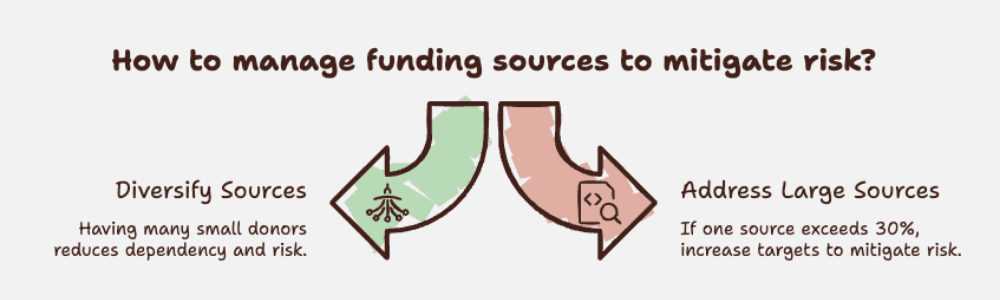
Asking how much reserve your nonprofit needs is a bit like asking how much sleep you need. There’s a textbook answer — eight hours, three months — and then there’s your answer, which depends on how you actually live. Four questions get you there.
How concentrated is your revenue?
If one grant or one event is more than 30% of your budget, lean toward the high end. Two hundred small donors can absorb losses; three funders can’t lose one.
How long does money take to arrive?
Government contracts that reimburse 60–90 days after you spend are a built-in cash gap. If you carry receivables like that, your reserve is the bridge you’re already standing on.
How fixed are your costs?
Payroll, rent, insurance — costs you can’t pause — argue for more reserve. An organization that can scale program costs down has more natural flexibility.
How seasonal is your year?
If December giving funds your spring, your reserve has to cover the deepest valley in your cash flow projection — with room to spare.
Score yourself honestly. Mostly low-risk answers: start with a 3-month target. Two or more high-risk answers: aim for 6. Either way, you now have a number that’s yours — defensible to your board and grounded in how your organization actually operates. (If you haven’t mapped your seasonal valleys yet, our guide to nonprofit cash flow management and this free cash flow projection template will show you exactly where they are.)
First: breathe. A reserve is built, not found — and it’s built in stages that are smaller than you think.
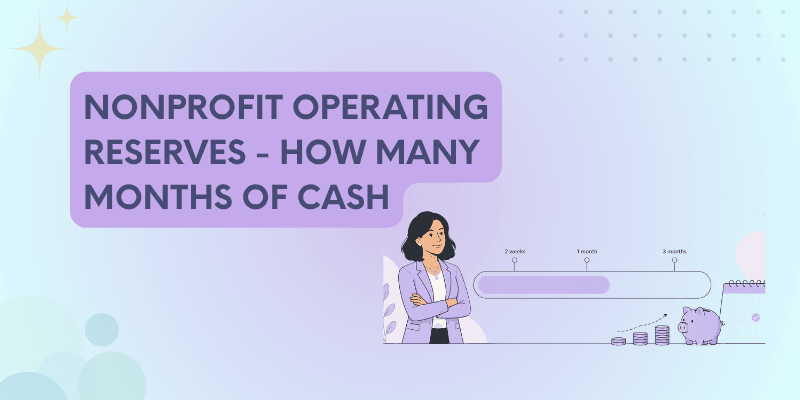
Two weeks
One payroll cycle of unrestricted cash, set apart. For many small nonprofits this is one good appeal letter or one board challenge gift.
One month
A late grant payment stops being an emergency and becomes an annoyance. That’s a different job — and a different night’s sleep.
Three months
The benchmark. From here, you make decisions from strategy instead of scarcity.
Two practical ways the money shows up:
Budget a surplus on purpose. A small intentional surplus line — even 2–3% of expenses — compounds quietly. A budget that breaks exactly even every year, forever, is actually a plan to never have reserves. Build the line into your budget format (or start from our free budget template).
Route windfalls before they melt. Bequests, one-time grants, an event that overperforms: decide in advance, in policy, that a percentage goes to reserves. Money that isn’t assigned a job finds one on its own.
And once the reserve exists, keep it somewhere boring and safe — the National Council of Nonprofits has a practical primer on where to keep operating cash.
When you have a target, give it a sentence in board minutes and a page in your policies. A useful reserve policy answers four things:
The one-page reserve policy
That last line matters most. A reserve you can never touch is a museum piece; a reserve with no refill plan is a one-time trick. The policy is what makes it a system — and it pairs naturally with the internal controls your auditor (and your sleep) already want. When the board asks how the reserve shows up in the numbers, our guide to reading nonprofit financial statements covers it.
We’ve seen these patterns show up quietly before reserve trouble — and none of them look dramatic at the time:
Restricted funds quietly covering payroll. If unrestricted cash runs dry and a restricted grant “temporarily” bridges the gap, that’s not a reserve problem anymore — it’s a compliance problem wearing a reserve problem’s clothes.
The same vendor invoice aging 60+ days, twice. Stretching payables is borrowing — from your vendors’ patience and your own reputation.
Reserve math done only at budget season. Months of cash is a monthly number. It belongs on the one-page dashboard your board sees, right next to the bank balance it explains. (Our free financial health checklist makes a good monthly companion.)
Open the calculator, enter your unrestricted net assets and monthly expenses, and read your months. That’s it — that’s the whole assignment. You can’t walk toward a number you haven’t met yet.
And if the number that comes back is smaller than you hoped: remember that many nonprofits are standing exactly where you’re standing. The difference between the ones that stay there and the ones that don’t is rarely a windfall. It’s a target, a policy, and a small surplus line — three things you can set in motion this month.
Common questions from small nonprofits about operating reserves and months of cash.
No. The IRS sets no cap on operating reserves for public charities, and holding 3 to 6 months of expenses does not threaten tax-exempt status. Extremely large accumulations with no spending plan can draw questions from watchdogs and funders, but that is a transparency issue, not a legal one.
No. Operating reserves are unrestricted, liquid funds only. Donor-restricted grants and program funds may sit in the same bank account, but they are not available for general operations — counting them overstates your real cushion.
An operating reserve is spendable savings for disruptions and opportunities. An endowment is typically invested permanently, with only the earnings available for use. A small nonprofit almost always needs the operating reserve first.
Divide your unrestricted, liquid funds by your average monthly operating expenses (last 12 months of expenses divided by 12). Our free financial ratios calculator computes your reserve ratio in months for you.
Start with a two-week payroll cushion, then one month, then three. Budget a small intentional surplus of 2 to 3 percent of expenses, and adopt a policy that routes a percentage of windfalls — bequests, overperforming events — directly to reserves.
Reserve math only works on clean books.
GivingArc gives small nonprofits the foundation reserves are built on — monthly bookkeeping with restricted funds tracked properly, plus Form 990 prep when you need it.
GivingArc provides bookkeeping, Form 990 preparation, and nonprofit-specialized accounting for small and mid-size 501(c)(3) organizations across the US. This article is general guidance, not financial advice for your specific situation. Reviewed by Min Kim, CPA.