
Key Takeaways
A first-time donor isn’t a transaction. It’s a first date.
Most small nonprofits are running an acquisition machine — they get a lot of first dates and almost no second ones. According to the Association of Fundraising Professionals’ Fundraising Effectiveness Project, only 19.4% of first-time donors give again the following year. Translated into a small-nonprofit reality: out of every five people who said yes to your spring appeal, four are never coming back.
The organizations that grow are running something different. They’re running a second-gift machine — and the difference is decided in the first 90 days. This isn’t a takedown of acquisition. Acquisition is necessary. But acquisition without a second-gift machine attached to it is the most expensive growth strategy a small nonprofit can run, and it’s the one almost everyone defaults to. This guide draws on our team’s collective 23+ years working with small nonprofits on the financial systems behind their fundraising.
Pull your last spring appeal budget. Add the postage on the mailers. Add the digital ad spend. Add the staff hours that went into the email sequence. Add the platform fees on the donations themselves. Now divide that total by the number of new donors the appeal actually brought in.
The number is almost certainly between $1.00 and $2.00 of cost for every $1 of first-time gifts you received. That’s not a sign you ran a bad campaign. That’s the industry average for an acquisition machine.
If you’ve ever planned a wedding, you already understand donor acquisition cost. The first invitation is cheap to print. Convincing someone to actually come, dress up, drive across town, and stay for the toast — that’s where the money goes. Acquiring a new donor works the same way. Bloomerang’s practitioner guidance on donor acquisition costs cites industry estimates of roughly $1.50 for every $1 raised from a first-time gift, versus about $0.20 per $1 raised to retain a donor who already said yes.
That’s a 7.5× multiplier. Every donor your organization loses has to be replaced by a new one that costs more than seven times as much to bring through the door. Most small nonprofits never put this number on a board report. The expensive part isn’t the appeal that didn’t work. It’s the second gift that never came.
Once a first-time donor makes a second gift — any second gift, any size — their retention rate jumps to 69.2%. That’s the FEP number for repeat donors across the sector. The second date is the relationship. Once someone gives twice, you’ve moved from “she sent me a thank-you note” territory to “we have a thing.” The work changes. The math changes. The lifetime value changes.
Charity:Water built its entire growth model around exactly this insight. Their flagship “Spring” program — publicly described in founder Scott Harrison’s writing and in Charity:Water’s annual transparency reports — is structured to convert first-time donors into monthly recurring supporters early in the relationship, specifically because that conversion is what locks in long-term retention. The pitch isn’t about the second gift. The pitch is about the ongoing relationship the second gift unlocks.
Most small nonprofits don’t have Charity:Water’s marketing budget. They don’t need to. The mechanic is the same at every scale: ask for the second gift before the first one fades from memory.
The leak isn’t between gifts five and six. It’s between gifts one and two. And the standard small-nonprofit fundraising calendar — spring appeal, fall appeal, year-end push — quietly fails most of the donors it acquires. A donor who gives in April and hears nothing meaningful from your organization until November will not give again in November. They’ll be gone by July. The next time they think about your cause, they’ll Google someone else.
Habits work the same way relationships do. Behavioral research consistently finds that a new behavior takes roughly 60 to 90 days to feel automatic — long enough for the brain to stop registering it as “new” and start registering it as “who I am.” A first-time donor’s relationship with your nonprofit follows the same arc. The window in which “I gave to that group” becomes “I’m a supporter of that mission” is roughly 90 days long. Miss it, and you’re not retaining a donor — you’re trying to recruit them again.
Adrian Sargeant and Jen Shang’s research, distributed through Bloomerang, has shown that additional touchpoints in the first 90 days dramatically change retention odds. The compounding logic is what makes the 90-day window so valuable. Adrian Sargeant’s foundational research, summarized by Bloomerang, found that improving donor retention by just 10% can double a donor base’s lifetime value — a finding repeated often enough in the sector that it has become the basic math behind every retention conversation.
Translation: small, consistent, personal touches in the 90 days after a first gift are the highest-ROI fundraising work a small nonprofit can do. They aren’t glamorous. They don’t show up on a campaign dashboard. They are, however, what turns a check into a relationship.
Imagine your last new donor for a moment. They gave $50 in March because someone they trusted shared your appeal. Within an hour, your fundraising platform sent them a generic receipt with a tax-deduction line. A week later, the donor got a newsletter mostly about an upcoming event they don’t yet know to care about. By June, they’ve heard nothing else from you. By November — when your year-end appeal lands — they no longer remember exactly which nonprofit they gave to in March, or what their $50 actually accomplished.
That isn’t bad fundraising. It’s the absence of a second-gift machine. The donor didn’t disappear. The relationship was never built.
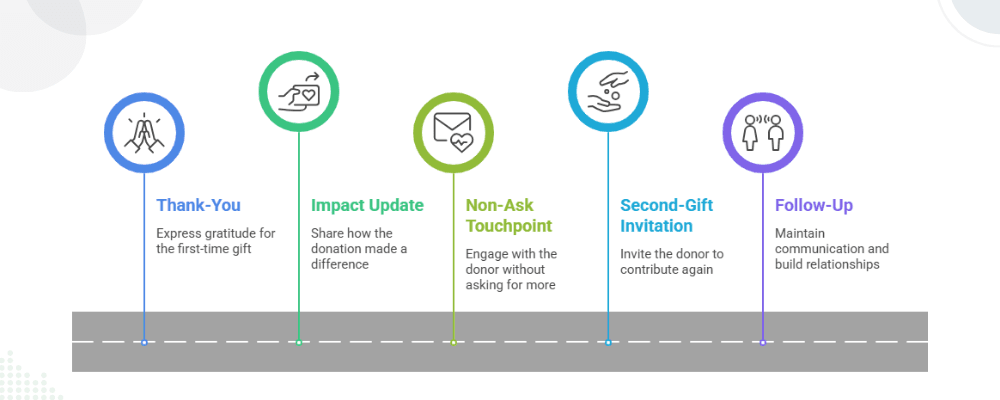
Stewardship is a recipe, not a list. The order of the steps is the recipe — because each step prepares the donor for the next. Skip the impact step, and the second-gift invitation lands as a transaction. Skip the non-ask touchpoint, and the relationship feels purely commercial. The ingredients are simple. The sequence is the dish.
Not the auto-receipt the platform sent — that’s a transaction record. A real thank-you addressed by name, ideally signed by a human, that says nothing about giving more money. The message you’d send after a great first date.
Tell the donor what happened because of their gift. Not the program in general — the specific outcome. “Your $50 paid for one literacy kit, in use this week.” Specificity is what makes the second gift feel earned.
A newsletter, a note, a story — anything that isn’t a fundraising appeal. The equivalent of “checking in to see how your week’s going.” It signals the relationship isn’t transactional.
Not a generic appeal. A specific invitation that references their first gift and what it accomplished. Small nonprofits that get this right convert a meaningful share of first-time donors into second-gift donors. The ones that don’t, lose 80%.
Even a small monthly gift — $10, $15 — changes everything that follows. Recurring monthly donors retain dramatically better than one-time donors — about 71% after a full year per the latest M+R Benchmarks, with average lifetime value around $7,600. A $15-a-month giver in their first quarter is no longer a one-and-done.
This is the entire playbook. There isn’t a sixth secret. The reason it doesn’t get done isn’t because it’s hard — it’s because it doesn’t feel urgent on any single Tuesday, and Tuesday is when development directors decide what to do.
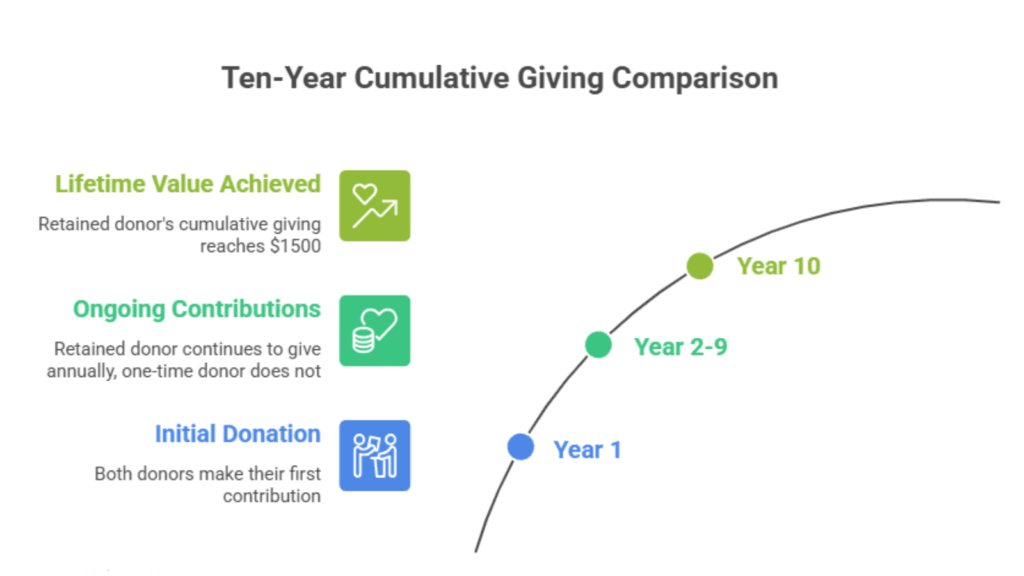
Donor retention compounds the way a young tree compounds. In the first two seasons, you can’t see anything different — the trunk doesn’t visibly thicken, the canopy doesn’t measurably widen. By year five, there’s noticeable shade. By year ten, neighbors are using it for shelter — and the underground roots that made year ten possible were laid down in the first 90 days, invisible to everyone, including the gardener.
The math gets clarifying. A donor who gives $100 once and is never seen again is worth $100 to your organization. A donor who gives $100, gets stewarded properly, and continues giving an average $100 per year is worth approximately $1,550 in industry-modeled lifetime value over ten years (Neon One) — the number compounds because retained donors also tend to upgrade their giving. Same first gift. Roughly 15× difference in long-term value, decided almost entirely by what happened in the first 90 days.
Donor A — lost in 90 days
Lifetime value: $100
Donor B — kept by 90-day system
Lifetime value: ~$1,550+
Same first gift. Same $100 in March 2026. Different system in the 90 days that followed.
The reason small nonprofits underinvest in donor retention isn’t financial illiteracy. It’s that the cost of losing a donor never appears on a P&L. The cost of acquiring one does. So the visible expense is acquisition, and the invisible expense is the leak. Until the board asks why annual giving keeps stalling at the same dollar figure year after year — at which point the conversation usually goes to “we need a bigger appeal.” It almost never goes to “we need a better second gift.”
Three checks worth your hour this week:
Donor retention isn’t a campaign. It’s a habit. And like most habits, it compounds quietly — until one quarter you notice your donor base hasn’t shrunk for the first time in five years.
That’s the moment your nonprofit becomes financially sustainable. Not when the spring appeal hits a record. When you stop running an acquisition machine and start running a second-gift machine.
The first date is what gets them in the door. The second one is what builds your nonprofit.
GivingArc handles the financial side of small and mid-sized nonprofits — monthly bookkeeping, Form 990 preparation, audit readiness, and outsourced finance. Donor retention is a fundraising discipline, but it sits on top of a financial system: clean donor records, accurate impact reporting, and books that match what your fundraising platform shows. We build that financial foundation behind whatever fundraising tools you use, so the second-gift machine has clean data to run on.
For more on the financial side of running a sustainable small nonprofit, see our analysis of the hidden cost of free fundraising software, our fund accounting basics guide, our bookkeeping best practices for nonprofits, and our short nonprofit financial health checklist. If you’re weighing whether to outsource your nonprofit accounting, the time saved on donor-data cleanup alone often justifies the conversation — clean data is what makes restricted-fund tracking possible without spreadsheet sprawl. You can also learn more about our team and how we work with nonprofits nationwide.
Want a financial system your second-gift machine can run on?
Get a free 30-minute review — we’ll show you where donor data, impact reporting, and bookkeeping connect (or don’t) for your size.
Putting the numbers where people look
Showing donors what their last gift did is easier with a page built for it. Our sister practice, connectNPO, builds websites for small nonprofits that show what the money did: an Impact page with this year’s results, and a financials page with your latest Form 990 and statements, both brought up to date each year after the filing. You see the finished site before you pay for it; after that it is one plan, $180 a month.
See a sample financials page →
GivingArc and connectNPO are both run by Daybooks Web Solutions, LLC.
Common questions from small-team executive directors trying to improve donor retention without a development department.
The sector average for overall donor retention is roughly 42–45%, with first-time donor retention much lower at around 19–20% (AFP Fundraising Effectiveness Project). For small nonprofits specifically, anything above 50% overall retention or 25%+ first-time retention is solid. Top-performing nonprofits typically reach 65% or higher overall retention in vendor-published benchmarks, but those are CRM-vendor aggregations rather than direct FEP figures. The most useful benchmark, though, is your own number from last year — improvement of 3–5 percentage points year over year is a more meaningful goal than chasing a sector average.
Pull a list of donors whose first gift was in the previous calendar year. Of that group, count how many gave again in the current year (any amount, any campaign). Divide the second number by the first, multiply by 100. That’s your first-time donor retention rate. If your CRM doesn’t separate first-time vs returning donors cleanly, that’s a data-cleanliness problem worth fixing before chasing a retention strategy — you can’t improve a number you can’t measure consistently.
The single highest-leverage action is a personal thank-you within 48 hours of the first gift — specifically, one that is NOT a fundraising appeal disguised as a thank-you. Sargeant and Shang’s research shows that the timing, personalization, and explicit non-ask quality of the first acknowledgement disproportionately predict whether a donor gives again. After that, an impact update within 30 days that names what their specific gift accomplished is the next-highest lever. Both are cheap to execute and dramatically underused at small nonprofits.
Within 48 hours, ideally within 24. The auto-receipt your donation platform sends is a transaction record, not a thank-you — donors process those mentally as “tax confirmation,” not as appreciation. A separate, personal acknowledgement (email is fine for first-time gifts under $100; a handwritten note or call is appropriate above that) within two business days carries far more retention weight than a beautifully written thank-you that arrives three weeks later. Speed matters because first impressions in the first week disproportionately shape whether the donor remembers your nonprofit by November.
Both, but in the right ratio. Pure retention without acquisition leaves your donor base shrinking through natural attrition (relocations, life changes, mortality). Pure acquisition without retention is the 7.5×-cost treadmill described above. Practitioner consensus among small-nonprofit fundraising consultants is to aim for roughly a 70/30 split of effort — 70% on retention and stewardship of existing donors, 30% on acquisition of new ones — not as a hard rule, but as a corrective for the 90/10 acquisition-heavy default most small nonprofits drift toward. The exact ratio matters less than recognizing that pure-acquisition strategies plateau, while retention compounds.