

Key Takeaways
The nonprofit audit landscape has grown increasingly complex in 2026, with organizations facing a web of federal, state, and funder-specific requirements that can significantly impact their operations and growth opportunities. Recently, we’ve seen a noticeable uptick in nonprofits coming to us specifically to prepare for grant-required audits — the funder conditions the award on a clean external opinion. Understanding when your organization needs an audit isn’t just about compliance; it’s about positioning your nonprofit for sustainable growth and maintaining the trust of donors, grant makers, and the communities you serve. Whether you’re approaching revenue thresholds, applying for major grants, or simply planning ahead, knowing the various nonprofit audit requirement triggers can save your organization time, money, and potential compliance headaches.
Answer 5 quick questions to find out which audit type your nonprofit requires.
Includes direct federal grants and pass-through funding from state or local governments using federal dollars.
CA: $2M+ | NY, MA, CT, RI, NJ, FL, GA: $1M+ | PA: $750K+ contributions | CO, NC, OR, TX, VA: no audit tier
Many large grants require audits. Common for private foundations ($25K–$100K+) and government grants ($100K+).
42% of nonprofits include audit requirements in bylaws. Common triggers: revenue thresholds ($500K–$1M) or time intervals (every 2–3 years).
Rapid revenue growth, significant restricted funds, leadership transition, or D&O insurance recommendations.
Based on your answers, your nonprofit is required to undergo a full financial audit. Expected cost: $15,000 – $50,000. Timeline: 8–12 weeks. Begin preparation 3–4 months in advance.
Get Audit-Ready →No mandatory audit triggers detected, but risk factors suggest a review engagement would strengthen your financial credibility. Cost: 40–60% of full audit. Accepted by 73% of funders for grants under $500K.
Discuss Your Options →No mandatory triggers detected. A compilation engagement may be sufficient for internal reporting and small foundation applications. Consider a review if you anticipate growth or pursuing larger grants.
Strengthen Your Books →Single Audit Act
Revenue Thresholds
Funder Requirements
The federal government doesn't require nonprofits to conduct annual financial audits simply by virtue of their tax-exempt status. The IRS focuses primarily on Form 990 filing compliance
rather than mandating external audits. However, federal audit requirements do kick in under specific circumstances, most notably through the Single Audit Act. The most significant federal trigger occurs when a nonprofit expends $1,000,000 or more in federal awards during its fiscal year. This threshold, established under the OMB Uniform Guidance (2 CFR 200)
, requires organizations to undergo a Single Audit, which examines both financial statements and federal program compliance. Audit costs typically range from $15,000 to $50,000 depending on the complexity and number of federal programs involved.

The $1,000,000 threshold applies to federal expenditures, not just direct grants received. This calculation includes all federal awards expended during the fiscal year, regardless of when the funds were originally received. Organizations receiving pass-through funding from state or local governments using federal dollars must count these amounts toward the threshold. Single Audits must be completed within nine months of the fiscal year-end, with the audit report submitted to the Federal Audit Clearinghouse
. The auditor must test compliance with specific federal program requirements, making these audits more comprehensive than standard financial statement audits. Extensions are rare and require documented extenuating circumstances.
Beyond the Single Audit threshold, individual federal grants may contain specific audit clauses. Some agencies require audited financial statements as part of the application process, while others mandate audits for multi-year awards exceeding certain dollar amounts. Organizations should carefully review all grant agreements and cooperative agreements for audit-specific language that might create additional requirements. HHS and Department of Education grants frequently include such provisions.
The state layer is where the answer to "do we need an audit" actually lives for a small or mid-sized nonprofit, and it is the layer that goes stale fastest, because the figures move. Three of the six states this page originally listed changed their thresholds between 2023 and 2025. The table below covers eighteen states, each checked against the statute or the regulator's own page on the date shown. Read the "measure" column carefully: some states count total revenue, some count contributions only, and Washington averages three years.
WashingtonRCW 19.09.541
$3,000,000gross revenue averaged over the three preceding accounting years
$1,000,000 to $3,000,000: CPA-prepared Form 990 or audited statements made public
The audit may be waived when cash receipts average $500,000 or less over three years or the $3,000,000 was reached by an unusual one-year gift (WAC 434-120-107). Source
CaliforniaGov. Code §12586(e)
$2,000,000gross revenue, excluding government grants and contracts for which the agency requires an accounting
—
Audit under generally accepted auditing standards by an independent CPA; no review tier. Threshold unchanged since the Nonprofit Integrity Act. Source
New YorkExec. Law §172-b (Article 7-A)
$1,000,000gross revenue and support (over)
$250,000 to $1,000,000: CPA review
Audit tier reached $1,000,000 for reports due on or after July 1, 2021; under $250,000 an unaudited financial report suffices. Source
MassachusettsM.G.L. c.12 §8F, as amended by St. 2024 c. 238
$1,000,000gross support and revenue (over), excluding gains on capital assets
$500,000 to $1,000,000: CPA review
Raised from $500,000 (audit) and $200,000 (review) by a law approved November 20, 2024; the old figures still circulate online. Source
ConnecticutC.G.S. §21a-190c(b)
$1,000,000gross revenue (over), excluding government grants and fees
$500,000 to $1,000,000: CPA audit or review
Applies to statements first due after July 1, 2023 (P.A. 23-98); before that the audit line was $500,000 with no review tier. The Commissioner may waive for good cause. Source
Rhode IslandR.I. Gen. Laws §5-53.1-4
$1,000,000annual gross income (over)
—
Raised from $500,000 effective July 1, 2025; at or under $1,000,000 a Form 990 or compiled statements are accepted. Source
FloridaFla. Stat. §496.407(1)(b)
$1,000,000annual contributions
$500,000 to $1,000,000: review or audit
Tiers in place since July 1, 2014; under $500,000 a compilation, review, or audit is optional. Source
New JerseyN.J.S.A. 45:17A-24(d), P.L. 2021 c. 381
$1,000,000gross revenue in monetary donations (in-kind excluded)
—
Raised from $500,000 by a law effective January 18, 2022; the regulation text still prints $500,000, but the statute controls. Between $25,000 and $1,000,000 an officer-certified report is filed. Source
GeorgiaO.C.G.A. §43-17-5(b); Rule 590-9-4-.06
$1,000,000amounts received or collected in the prior fiscal year, excluding investment income
$500,000 to $1,000,000: CPA review
At or under $500,000 financial statements with the Form 990 or 990-EZ are accepted. Source
Pennsylvania10 P.S. §162.5(f), Act 71 of 2017
$750,000annual contributions, not total revenue
$250,000 to $750,000: review; $100,000 to $250,000: compilation
Tiers set by Act 71 of 2017, effective February 2018; under $100,000 internally prepared statements are accepted. Source
MinnesotaMinn. Stat. §309.53 subd. 3
$750,000total revenue (over)
—
GAAP statements with an independent CPA opinion; donated food to a food shelf is excluded from the count. No review tier. Source
MichiganMCL 400.273(3)
$575,000contributions, excluding government grants, net of special-event direct expenses
$325,000 to $575,000: review or audit
Statutory base of $500,000 steps up $25,000 every five years; $575,000 applies to registrations filed 2025 through 2029, then $600,000 from 2030. The Attorney General may waive once. Source
Illinois225 ILCS 460/4
$500,000contributions; $25,000 if a paid fundraiser is used
$300,000 to $500,000: review (no paid fundraiser)
Raised from $300,000 on January 1, 2024 (P.A. 103-121); the change sunsets January 1, 2029, when the $300,000 audit line returns unless extended. Source
ColoradoC.R.S. 6-16-104
No audit tier—
—
Annual report on the Secretary of State's financial form or a Form 990; the statute has no audit or review requirement. Source
North CarolinaN.C.G.S. 131F-6
No audit tier—
—
A financial report on the Department's form or a Form 990 or 990-EZ with Schedule A satisfies the license; audited statements are optional. Source
OregonORS 128.670; OAR 137-010-0020
No audit tier—
—
Annual CT-12 report; an auditor's report is attached only if an audit was prepared. Source
VirginiaVa. Code §57-49(A)(6)
No audit tier—
—
Registration accepts a Form 990 (or, for 990-N filers, a treasurer-verified balance sheet and income statement); no audit or review tier. Source
TexasNo general charitable registration
No audit tier—
—
Texas has no general charitable solicitation registration, so no state audit tier; narrow registrations exist for public-safety, veterans, and law-enforcement telephone solicitors. Source
Three patterns fall out of the table. Five of the eighteen states (Colorado, North Carolina, Oregon, Texas, and Virginia) have no audit or review tier at all; a Form 990 or the state's own financial form satisfies the filing. Four states (Pennsylvania, Illinois, Michigan, and Florida) measure contributions, so an organization with large program-fee revenue and modest donations can sit below the line even at a size where a revenue-based state would require an audit. The rest measure some form of gross revenue, with New York, Massachusetts, Connecticut, Rhode Island, New Jersey, Florida, and Georgia all now at $1 million and California alone at $2 million.
Recent changes are the trap. Massachusetts doubled its audit line to $1 million in November 2024, Connecticut moved to $1 million for statements due after July 2023 and added a review tier, Rhode Island moved to $1 million in July 2025, New Jersey moved to $1 million in January 2022 while its regulation text still prints $500,000, Illinois raised its line to $500,000 in January 2024 with a statutory sunset in 2029, and Michigan's figure steps up every five years. If a funder, a board member, or an older article gives you a number that is not in this table, check the statute linked in the row before you act on it.
If you solicit in more than one state, each state's rule applies to its own registration, so the practical threshold is the lowest one among the states where you are registered, measured the way that state measures it. Organizations that fall in a review tier can often satisfy a funder that asks for "audited or reviewed" statements without paying for a full audit; our audit vs. review vs. compilation guide explains what each engagement produces.
Private foundations and corporate funders increasingly require audited financial statements as part of their due diligence processes, even when no legal mandate exists. The single most common gap is organizations being caught off-guard by funder audit requirements that arrive with major grant opportunities. Grant agreements can require audited financials at any size, and that expectation has grown as funders emphasize accountability and transparency. Foundation audit requirements often focus on demonstrating fiscal responsibility and organizational stability rather than regulatory compliance. Family foundations may have specific audit preferences based on their investment committees' standards, while community foundations often follow uniform policies across their entire grant portfolio.
Our team helps nonprofits prepare for clean grant-ready audits.
Many private foundations require audited financial statements for grants exceeding specific thresholds, typically ranging from $25,000 to $100,000. Some foundations accept reviewed financial statements for smaller grants but require full audits for multi-year commitments or capacity-building investments. Organizations should clarify audit requirements during the initial grant inquiry process to avoid complications later in the application cycle. The Gates Foundation, for example, requires audited financials for any grant exceeding $75,000.
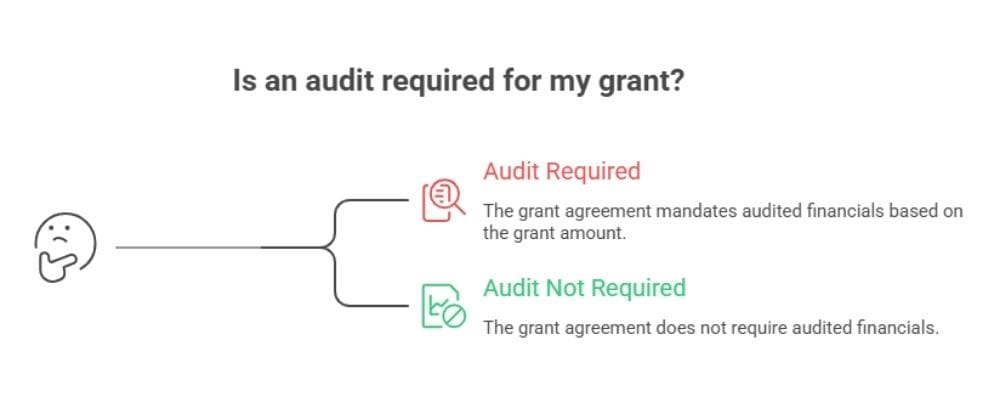
Corporate social responsibility programs often mirror their internal financial controls by requiring audited statements from grantee organizations. State and local government grant programs frequently impose audit requirements for awards exceeding $100,000, with some requiring single audit compliance even for non-federal funding sources. These requirements reflect increased scrutiny of public fund expenditures and accountability to taxpayers. Municipal grant programs increasingly adopt federal-style compliance standards.
Approximately 42% of nonprofits include audit requirements in their organizational bylaws, typically triggered by revenue thresholds, time intervals, or board discretion. These internal mandates often reflect the organization's commitment to transparency and sound financial management, particularly when board members have fiduciary experience from corporate or foundation backgrounds. Board-initiated audits have increased notably as nonprofit governance standards have evolved. Organizations proactively implement audit policies to demonstrate accountability to stakeholders, even when no external requirements exist. This approach strengthens grant applications and donor confidence while identifying operational improvements that might otherwise go unnoticed.
Interactive PDF with 29 fillable checkboxes covering 12 compliance items, 5-trigger framework, and 3-month preparation timeline.
Common bylaw provisions require audits when annual revenue exceeds specific amounts, typically $500,000 to $1 million, or mandate audits every two to three years regardless of revenue. Some organizations include graduated requirements, such as reviews for moderate revenue levels and full audits for higher thresholds. Board resolutions can also create audit requirements for specific circumstances, such as leadership transitions or significant operational changes. Well-drafted bylaws include provisions for waiving audit requirements when circumstances warrant.
Board members' fiduciary duties may effectively create audit requirements in certain situations, particularly when organizations experience rapid growth, handle restricted funds, or face financial challenges. Many nonprofit directors' and officers' insurance policies include provisions encouraging or requiring periodic audits as a risk management measure. Understanding these connections helps organizations plan audit timing and scope more effectively while managing insurance premiums.
Preparing for a grant-required audit requires systematic organization of financial records, governance documentation, and compliance materials. The following checklist helps ensure your organization presents well-documented financial practices and internal controls to auditors and potential funders.
Download our free 90-day Nonprofit Audit Preparation Checklist. Interactive PDF with 43 fillable checkboxes.
Organizations should begin audit preparation at least three to four months before fiscal year-end, with ongoing monthly financial close procedures throughout the year. Our team recommends implementing these practices as part of routine nonprofit bookkeeping services rather than scrambling to organize materials when audit requirements arise.
Proper chart of accounts standardization forms the foundation of audit-ready financial records. Organizations should implement monthly financial close procedures that include account reconciliations, accrual adjustments, and management review processes. Supporting documentation systems should allow auditors to easily trace transactions from summary reports to underlying source documents. Digital document management systems significantly streamline this process.
Board governance policies should include written procedures for conflict of interest management, executive compensation approval, and major financial decision-making. Documentation should demonstrate active board oversight through meeting minutes that reflect substantive discussions and informed decision-making processes. Comprehensive audit preparation
includes reviewing governance materials for completeness and accuracy. Missing or inadequate board documentation remains a common audit finding.
01
Highest assurance level. Required for federal/state mandates and large grants.
02
Limited assurance. 73% of funders accept for grants under $500K.
03
No assurance. Internal management or board reporting only. Lowest cost option.
Not every situation requiring external financial statement preparation necessitates a full audit. Review engagements provide limited assurance at approximately 40-60% of full audit costs, while compilation engagements offer the lowest-cost option for organizations needing professionally prepared financial statements without assurance. Approximately 73% of funders accept reviewed financial statements for grants under $500,000, making reviews an attractive middle-ground option for many organizations. However, organizations should confirm specific funder requirements before committing to review-level engagements. Some institutional funders maintain strict audit requirements regardless of grant size.
Reviews provide limited assurance based on analytical procedures and inquiries rather than the extensive testing required for audits. While less comprehensive than audits, reviews still require external CPA firm involvement and result in formal financial statements suitable for most funding applications. The reduced scope typically shortens engagement timelines and costs while providing meaningful external validation of financial information. Reviews work particularly well for organizations with strong internal controls and clean accounting records.
Compilation engagements assist management in presenting financial information in standard financial statement format without providing any assurance about the accuracy or completeness of the information. These engagements work well for internal management purposes, board reporting, or situations where external preparation is desired but assurance is not required. Some smaller family foundations accept compilations for initial grant applications.
Get a free custom quote tailored to your organization — no obligation.
Successful audit outcomes depend on advance planning, clear communication, and systematic preparation throughout the year rather than last-minute scrambling. Average nonprofit audit timelines extend eight to twelve weeks from initiation to completion, with management letter findings averaging three to five items per organization. Early preparation significantly reduces both timeline and findings. Selecting qualified audit firms requires evaluating nonprofit expertise, industry specialization, and fee structures that align with organizational budgets and needs. Organizations should request references from similar nonprofits and discuss audit approach, timeline expectations, and communication preferences during the selection process. Fee quotes should include all anticipated costs to avoid budget surprises.
Nonprofit expertise represents the most critical selection factor, as specialized accounting standards
and compliance requirements differ significantly from for-profit auditing. Firms should demonstrate experience with organizations of similar size and complexity, particularly regarding fund accounting, grant compliance, and donor restriction tracking. Fee structures should include clear scope definitions and billing arrangements that avoid unexpected cost overruns. References from peer organizations provide valuable insights.
Effective audit management includes designating internal project coordinators, establishing auditor communication protocols, and maintaining realistic timeline expectations. Organizations should prepare audit request lists in advance, schedule key staff availability, and plan for management letter response and implementation processes. Professional guidance
can help organizations navigate complex audit requirements while maintaining focus on mission-critical activities. Post-audit implementation of recommendations strengthens future financial management. Understanding nonprofit audit requirements enables organizations to plan strategically, budget appropriately, and maintain compliance with the various regulatory and funder expectations they face. As these requirements continue evolving in 2026, staying informed about federal, state, and grant-specific triggers helps nonprofits make informed decisions about their financial reporting needs and organizational growth strategies.
If an audit is on the horizon: GivingArc offers audit preparation alongside monthly bookkeeping ($300 to $1,950 per month by volume) and Form 990 preparation (Form 990-EZ from $500, Form 990 from $1,500). Prices are on the pricing page; the how we work page describes the monthly close.
Putting the numbers where people look
An audit takes months of work; it is worth more when the people who fund you can read it. Our sister practice, connectNPO, builds websites for small nonprofits that show what the money did: an Impact page with this year’s results, and a financials page with your latest Form 990 and statements, both brought up to date each year after the filing. You see the finished site before you pay for it; after that it is one plan, $180 a month.
See a sample financials page →
GivingArc and connectNPO are both run by Daybooks Web Solutions, LLC.
Common questions about nonprofit audit requirements answered by GivingArc CPAs.
Written and reviewed by the GivingArc team · Updated September 2026