

Key Takeaways
Reading nonprofit financial statements comes down to four documents — the Statement of Financial Position, Statement of Activities, Statement of Cash Flows, and Statement of Functional Expenses — and a few line items on each that reveal whether the organization is financially healthy.
When a nonprofit board member receives a stack of financial statements during their monthly meeting, the documents can feel overwhelming. Yet understanding these statements isn’t just helpful—it’s essential for effective governance. According to the National Council of Nonprofits, organizations with financially literate boards are significantly more likely to maintain healthy reserves and achieve their mission-driven goals.
Whether you’re a new board member, donor, or nonprofit leader, knowing how to read nonprofit financial statements empowers you to make informed decisions about an organization’s financial health and sustainability. With over 23 years of collective nonprofit accounting experience, our team at GivingArc has seen firsthand how financial literacy transforms organizational decision-making through our nonprofit bookkeeping services.
The landscape for nonprofit accountability has intensified significantly. Donors increasingly demand transparency before making contributions, with the majority of major donors reviewing financial statements before giving, according to recent sector research. This scrutiny extends beyond individual donors to foundations, government agencies, and corporate partners who require detailed financial analysis as part of their due diligence process.
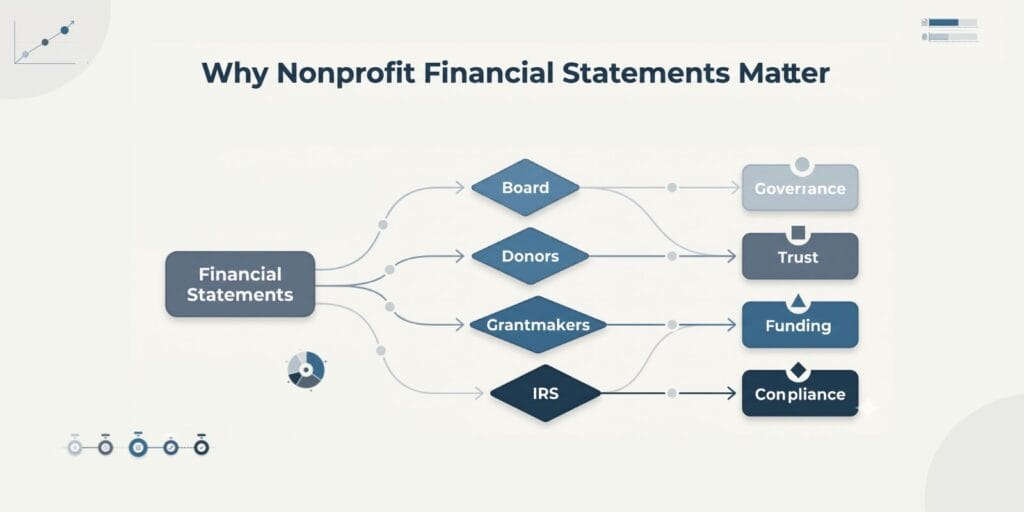
The IRS has strengthened its oversight of nonprofit organizations, implementing enhanced reporting requirements through Form 990 that demand greater detail about financial management and governance practices. State attorneys general have also expanded their monitoring of charitable organizations, with several states requiring additional financial disclosures beyond federal requirements.
For board members, understanding financial statements represents a core fiduciary responsibility. Directors who cannot interpret basic financial information may struggle to fulfill their duty of care, potentially exposing themselves and the organization to legal and financial risks. Grant-making organizations increasingly require board members to demonstrate financial competency as part of funding applications.
Organizations that maintain transparent, well-understood financial practices enjoy better access to funding opportunities, stronger donor relationships, and more effective strategic planning. If your nonprofit needs support maintaining accurate financial records that facilitate this transparency, our accounting services can help establish the foundation for clear financial communication.
What We Own
Financial “photograph” — assets, liabilities, and net assets at a point in time.
How We Changed
“Movie” of financial action — revenue, expenses, changes in net assets over time.
Where Cash Moved
Operating, investing, and financing activity — the reality check on liquidity.
Where Money Went
Program / management / fundraising breakdown — mission vs. overhead.
Every nonprofit organization produces four primary financial statements, each serving a distinct purpose in telling the organization’s financial story. Understanding how these statements interconnect provides a complete picture of organizational health and performance.
The statement of financial position provides a snapshot of the organization’s financial condition at a specific point in time. Think of it as a financial photograph—here’s what we own, here’s what we owe, and here’s what’s left over. This statement follows the fundamental accounting equation: Assets = Liabilities + Net Assets.
Assets include everything the organization owns: cash, investments, accounts receivable, inventory, equipment, and buildings. These appear in order of liquidity, with cash and cash equivalents at the top, followed by short-term investments and accounts receivable.
Liabilities represent what the organization owes: accounts payable, accrued expenses, debt obligations, and deferred revenue. Current liabilities (due within one year) appear before long-term obligations.
Net assets, the nonprofit equivalent of equity, show the organization’s accumulated financial position. Under current FASB standards, net assets appear in two categories: with donor restrictions and without donor restrictions. This classification replaced the previous temporarily and permanently restricted terminology to provide clearer information about spending limitations. For detailed guidance on preparing this statement, see our guide on nonprofit statement of financial position.
Get a free custom quote tailored to your organization — no obligation.
The statement of activities shows how the organization’s net assets changed during a specific period. If the balance sheet is a photograph, this is the movie—showing financial action over time.
Revenue appears in several categories: contributions, grants, program service revenue, investment income, and other sources. Each revenue type may have restrictions. For example, a grant might specify funds for a particular program, while general donations might support any organizational need.
Expenses appear by functional classification: program services, management and general, and fundraising. Program services represent direct mission delivery costs, while support services include infrastructure costs. The relationship between these categories reveals organizational efficiency and mission focus.
The bottom line shows the change in net assets—whether the organization’s financial position improved or declined. This change appears separately for assets with and without donor restrictions, providing transparency about how different funding types affected financial position.
Cash flow statements reveal how cash moved during the reporting period, categorized by operating, investing, and financing activities. It is worth remembering that you can’t pay bills with net assets—you need actual cash.
Operating activities include cash flows from primary activities: collecting donations, paying staff, purchasing supplies, and delivering programs. Positive operating cash flow indicates core activities generate sufficient cash to sustain operations.
Investing activities encompass buying or selling investments, purchasing or disposing of property and equipment, and making or collecting loans. These typically involve larger, less frequent transactions affecting long-term financial capacity.
Financing activities include borrowing money, repaying debt, and receiving or repaying restricted funds that must be returned if unused. These cash flows affect capital structure and debt obligations.
Organizations filing Form 990 (those with gross receipts normally exceeding $200,000 or assets exceeding $500,000) must provide a statement of functional expenses. This detailed breakdown shows spending by expense type within each functional category.
The statement reveals spending ratios, with most stakeholders expecting at least 75% of expenses to support program activities. However, these ratios must be interpreted contextually. For instance, a startup nonprofit might appropriately invest more in infrastructure during early years to build capacity for future impact.
Healthy Range
1.5–3.0
ratio value
Current Assets ÷ Current Liabilities
Target Reserve
90–180
days of cash
Unrestricted Cash ÷ Daily Expenses
Benchmark Minimum
≥75%
of total expenses
Program Expenses ÷ Total Expenses
Healthy Surplus
>5%
annual margin
Surplus ÷ Unrestricted Revenue
Financial ratios transform raw numbers into meaningful insights about performance, efficiency, and sustainability. Understanding these enables benchmarking against industry standards and identifying concerning trends.
The current ratio (current assets ÷ current liabilities) measures ability to meet short-term obligations. A ratio above 1.0 indicates sufficient assets to cover immediate debts. Most experts recommend maintaining ratios between 1.5 and 3.0. A ratio of 2.0 means $2 in current assets for every $1 owed near-term.
Days cash on hand (unrestricted cash ÷ average daily expenses) reveals operational runway using only existing reserves. Organizations should typically maintain 90-180 days of expenses in accessible funds, though this varies by funding stability.
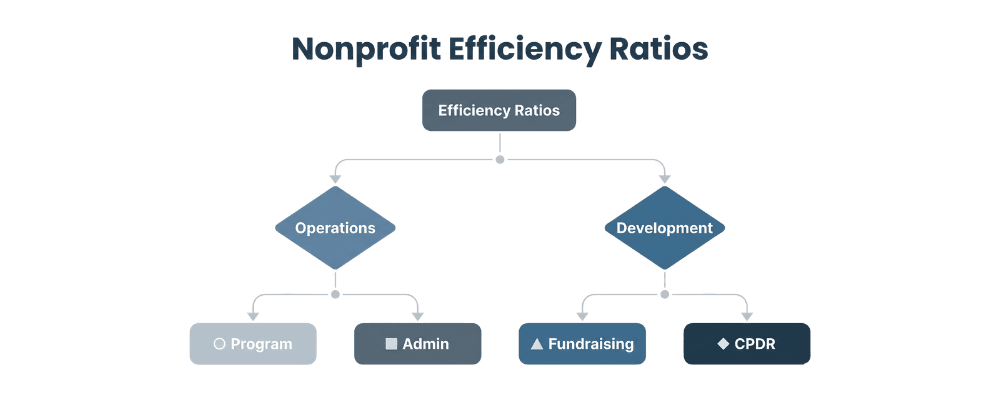
The program expense ratio (program expenses ÷ total expenses) shows the percentage directly supporting mission. While 75% is a common benchmark, context matters. Consider a scenario where a growing nonprofit invests in technology infrastructure—its program ratio might temporarily dip to 65%, but this investment could multiply future impact.
Administrative expense ratios above 25% often raise questions, though shouldn’t be applied mechanically. Strategic investments in systems, training, or capacity building may temporarily increase overhead while improving long-term effectiveness.
Revenue concentration analysis examines dependence on single funding sources. Organizations receiving over 50% of revenue from one source face higher risk if that funding disappears. Diversification strategies might include expanding individual giving programs, pursuing grants from multiple foundations, or developing earned revenue streams.
The operating margin (change in unrestricted net assets ÷ total unrestricted revenue) indicates whether core operations generate surpluses or deficits. Consistently negative margins signal unsustainable operations requiring immediate attention.
Certain financial indicators signal serious problems requiring swift action. Recognizing these warning signs enables proactive intervention before crises develop.
Declining cash reserves accompanied by increasing liabilities creates a dangerous squeeze. When days cash on hand drops below 30 while payables grow, the organization faces imminent liquidity crisis. This combination often results from delayed grant payments, unexpected expenses, or revenue shortfalls.
Persistent operating deficits, especially in unrestricted funds, indicate fundamental sustainability issues. While occasional deficits during expansion or economic downturns are manageable, chronic shortfalls erode organizational capacity and threaten long-term viability.
Restricted fund deficits represent serious compliance failures. Using restricted funds for unauthorized purposes violates donor trust and potentially breaches legal obligations. These deficits require immediate correction and may necessitate repayment from unrestricted sources. Our guide on restricted vs unrestricted funds provides detailed compliance guidance.
Effective financial oversight requires systematic review processes. Board members should receive statements at least five days before meetings, allowing adequate preparation time. Finance committees benefit from meeting monthly to review detailed reports before presenting summaries to full boards. If the packet needs a one-page summary on top, our free board financial report template lays it out.
Comparative analysis enhances understanding. Always review current results against prior periods, budgets, and peer organizations. Variances exceeding 10% warrant investigation and explanation. We’ve observed that organizations implementing regular variance analysis catch problems months earlier than those reviewing statements in isolation.
Ask probing questions during reviews. Why did this revenue source decline? What drove the expense increase? How will cash flow constraints affect programs? Effective governance requires moving beyond passive receipt of reports to active engagement with financial data.
Document review findings and follow-up actions. Meeting minutes should capture key discussions, concerns raised, and decisions made. This documentation protects directors legally while ensuring accountability for addressing identified issues.
Understanding nonprofit financial statements transforms overwhelming documents into powerful management tools. Regular review using the framework outlined here enables early problem detection, informed decision-making, and confident communication with stakeholders.
Start by scheduling dedicated time to review your organization’s most recent statements. Calculate the key ratios discussed and compare them to sector benchmarks. Identify one area needing improvement and develop an action plan. Financial literacy grows through practice—each review builds competence and confidence.
Remember that behind every number lies a story about your mission impact. Strong financial management isn’t about accumulating wealth but stewarding resources effectively to maximize community benefit. When board members, staff, and supporters understand the financial narrative, organizations thrive.
If your nonprofit struggles with financial statement preparation or wants to improve reporting quality, contact GivingArc today. Our experienced team can establish systems that produce clear, accurate statements while training your team to interpret and use financial data effectively. Don’t let financial complexity limit your mission impact—partner with professionals who understand nonprofit accounting’s unique requirements.
Putting the numbers where people look
Reading the statements is half of it; the other half is making them easy for donors to find. Our sister practice, connectNPO, builds websites for small nonprofits that show what the money did: an Impact page with this year’s results, and a financials page with your latest Form 990 and statements, both brought up to date each year after the filing. You see the finished site before you pay for it; after that it is one plan, $180 a month.
See a sample financials page →
GivingArc and connectNPO are both run by Daybooks Web Solutions, LLC.
Common questions about nonprofit financial statements answered by GivingArc CPAs.