
Key Takeaways
Nearly 70% of nonprofits struggle with budget accuracy, according to recent sector research, often missing projections by 15% or more. Whether you’re a small community organization or an established nonprofit, creating a realistic budget that aligns with your mission while meeting donor expectations requires more than good intentions—it demands the right framework and tools.

In this comprehensive guide, you’ll walk through everything you need to know about nonprofit budgeting for 2026, including a free downloadable nonprofit budget template that incorporates industry best practices. With over 23 years of collective nonprofit accounting experience, our team has seen firsthand how proper budgeting transforms organizational effectiveness. You’ll learn how to structure your budget for maximum transparency, avoid common pitfalls that trip up even seasoned finance directors, and create a financial roadmap that supports sustainable growth.
Ready to streamline your budgeting process? Contact our team to access our free nonprofit budget template and discover how professional financial management can strengthen your organization’s impact.
Nonprofit budgeting operates under fundamentally different principles than traditional business budgeting. While for-profit companies focus primarily on maximizing shareholder returns, nonprofits must balance mission effectiveness, donor accountability, and regulatory compliance—all while maintaining financial sustainability. After years working with nonprofits, we’ve seen plenty of corporate accountants struggle with this transition.
Your nonprofit budget serves as a financial expression of your mission priorities. Every dollar allocated should advance your organizational goals, whether through direct program services, essential administrative functions, or strategic fundraising efforts. This mission-centric approach means you’ll often need to make trade-offs between competing program needs rather than simply chasing the highest revenue opportunities.
Fund restrictions add another layer of complexity that can make even experienced treasurers reach for the aspirin bottle. Unlike businesses that can generally redirect resources as needed, nonprofits must carefully track and report on restricted versus unrestricted funds. For example, a grant specifically designated for youth programming cannot be used to cover general operating expenses, even if your organization faces cash flow challenges.
Our fund accounting basics guide provides detailed information on managing these restrictions effectively within your budget framework.
Get a free custom quote tailored to your organization — no obligation.
Nonprofit budgets must align with specific reporting requirements that don’t apply to for-profit entities. The Financial Accounting Standards Board (FASB) requires nonprofits to categorize expenses as program services, management and general, or fundraising—classifications that should be reflected in your budget structure from the outset.
Additionally, your annual budget directly impacts your Form 990 filing. Budget-to-actual variances exceeding certain thresholds may trigger additional scrutiny from the IRS, making accurate projections essential for maintaining your tax-exempt status. We’ve seen organizations face unnecessary audits simply because they treated budgeting as a back-burner task.
State registration requirements add yet another compliance layer. Many states require nonprofits to submit annual financial reports that include budget information, particularly for organizations engaged in fundraising activities across state lines.
For comprehensive support with compliance requirements, explore our Form 990 filing services to ensure your budget aligns with all regulatory obligations.
A well-structured nonprofit budget template must accommodate the unique revenue streams and expense categories that define the sector. Unlike businesses with relatively predictable income sources, nonprofits typically manage multiple funding streams with varying degrees of certainty and restriction. Here’s what you actually need.
Individual Donations: This category should include annual giving, major gifts, planned gifts, and recurring donations. Industry data from Giving USA shows that individual donors contribute approximately 64% of all charitable giving, making this your most critical revenue stream to forecast accurately. Break down projections by donor segments—new donors, renewing donors, and lapsed donor reactivation.
Grant Funding: Separate government grants, foundation grants, and corporate grants into distinct line items. Each type has different application timelines, reporting requirements, and probability of renewal. Apply realistic probability percentages to pending applications rather than budgeting grant income as guaranteed. (Pro tip: multiply that “sure thing” grant by 0.7 at most.)
Earned Revenue: Program fees, merchandise sales, training workshops, and consultation services should be budgeted conservatively. Factor in economic conditions that might affect demand for fee-based services, particularly as organizations adjust their own budgets for 2026.
Investment Income: Include dividend income, interest earnings, and endowment distributions if applicable. Given market volatility, many nonprofits use a three-year rolling average for investment income projections—a practice that tends to provide more stable forecasting.
In-Kind Contributions: Professional services, donated goods, and volunteer time should be valued according to in-kind donation guidelines. While these don’t represent cash flow, they’re essential for accurate program cost calculations and Form 990 reporting.
Program Expenses: Direct service delivery costs should represent the largest portion of your budget—typically 75-85% for most nonprofits. Include staff salaries allocated to programs, direct materials, program-specific technology, and participant support costs. Don’t forget those sneaky indirect costs that actually support program delivery.
Administrative Expenses: Finance, human resources, general management, and board governance costs fall into this category. The National Council of Nonprofits notes that healthy administrative expense ratios typically range from 15-25%, depending on organizational size and complexity. Smaller organizations often run higher—and that’s okay if you’re building capacity.
Fundraising Expenses: Development staff costs, donor database management, special events, and marketing materials should be tracked separately. Most donors expect fundraising costs to remain below 20% of total expenses, though this varies by fundraising strategy and organizational maturity.
Personnel Costs Breakdown: Salaries, benefits, payroll taxes, and professional development should be detailed by program and support function. Factor in anticipated salary adjustments (inflation is real, folks), healthcare cost increases, and retirement plan contributions for 2026.
Fixed vs. Variable Expenses: Rent, insurance, and loan payments remain constant regardless of program activity levels, while supplies, travel, and contract services may fluctuate based on program demand and funding availability.
For detailed guidance on expense categorization, review our nonprofit chart of accounts resource.
Review
Last Year
Project
Revenue
Plan
Expenses
Board
Approval
Monitor
& Adjust
Effective budget implementation requires a systematic approach that moves beyond simply filling in numbers. Your budget should tell the story of how your organization will achieve its mission while maintaining financial stability throughout 2026.
Begin by downloading our nonprofit budget template, which includes pre-formatted sections for all major revenue and expense categories. The template accommodates three scenario projections: conservative (75% of optimistic projections), realistic (your most likely outcome), and optimistic (best-case scenario assuming all variables align favorably). Always hope for the optimistic, but plan for the conservative.
Quarterly breakdowns are essential for cash flow management. Many nonprofits experience seasonal giving patterns—year-end donations often represent 30-40% of annual individual giving, while grant payments may be concentrated in specific quarters based on funding cycles. If December represents 40% of your revenue but only 8% of your year, you need to plan accordingly.
Schedule board budget presentations at least 60 days before your fiscal year begins. This timeline allows for thorough review, questions, and revisions without rushing the approval process. Include supporting documentation that explains major assumptions, such as donor retention rates, grant renewal probabilities, and expense inflation factors.
Program-based budgeting provides the clearest picture of your organization’s impact per dollar spent. Allocate shared costs like rent, utilities, and executive leadership across programs using reasonable methodologies—square footage for facility costs, time studies for personnel, or direct expense ratios for administrative support.
Calculate true program costs by including both direct expenses and allocated overhead. For example, consider a hypothetical youth mentoring program: its true cost includes mentor salaries ($120,000), program materials ($15,000), facility usage ($8,000 allocated), administrative support ($12,000 allocated), and organizational overhead like accounting and insurance ($18,000 allocated) for a total of $173,000.
Organizations receiving federal grants must comply with 2 CFR 200 federal cost principles for indirect cost calculations. Even if you don’t currently have federal funding, establishing compliant allocation methods positions your organization for future grant opportunities. Retrofitting your accounting system for federal compliance later is significantly more challenging—better to build it right from the start.
For organizations managing multiple funding restrictions, our nonprofit bookkeeping services can help establish systems that track program costs accurately throughout the year.
Sophisticated budget management goes beyond annual projections to encompass cash flow forecasting, multi-year planning, and scenario modeling. These advanced techniques help organizations weather uncertainty while positioning for strategic growth.

While annual budgets provide essential guidance, monthly cash flow projections prevent liquidity crises that can derail operations. Create a 13-week rolling cash flow forecast that updates weekly, tracking actual receipts and disbursements against projections. This granular approach helps identify potential shortfalls before they become critical.
Consider typical nonprofit cash flow patterns: grant payments often arrive quarterly or semi-annually, major gift solicitations peak in December, and program expenses may spike at the beginning of service periods. A nonprofit with $1 million in annual revenue might experience monthly cash flows ranging from negative $50,000 to positive $200,000 depending on timing.
Establish a line of credit or operating reserve equal to at least 90 days of operating expenses. This buffer allows you to manage timing differences between revenue recognition and cash receipt without compromising program delivery or vendor relationships.
Develop three-year budget projections that align with your strategic plan. These longer-term forecasts should incorporate planned program expansions, capital campaigns, major technology upgrades, and anticipated changes in funding sources. Build in conservative growth assumptions—typically 3-5% annually for established programs—while budgeting new initiatives separately with clear success metrics.
Factor in economic indicators that affect nonprofit revenue and expenses. Inflation projections, employment rates, and stock market performance all influence individual giving patterns and foundation endowment distributions. The Federal Reserve’s economic projections and sector-specific research from organizations like GivingUSA provide valuable planning inputs.
Create contingency plans for different economic scenarios. What would a 20% reduction in individual giving mean for program delivery? How would you respond to the loss of a major grant? Having pre-planned responses prevents panic-driven decisions that can damage long-term organizational health.
Even experienced nonprofit leaders fall into predictable budgeting traps. Understanding these common mistakes helps you build more realistic, useful budgets that support rather than constrain your mission.
Optimism bias leads many organizations to budget revenue based on best-case scenarios rather than historical performance. Review your past three years of actual revenue by source, calculating both the average and identifying trends. If individual giving has grown 5% annually, budgeting for 15% growth without a specific strategy is setting yourself up for mid-year budget cuts.
Grant revenue proves particularly susceptible to overestimation. Budget only awarded grants, not pending applications. For renewal grants, apply a discount factor based on your historical renewal rate. If you’ve renewed 80% of grants over the past three years, multiply expected renewals by 0.8 for budgeting purposes.
Special events revenue often disappoints relative to budgets. Factor in weather risks, competing events, and economic conditions when projecting auction proceeds or ticket sales. Many organizations find that budgeting special events at 85% of the previous year’s actual results provides a more realistic baseline.
Hidden costs plague nonprofit budgets. Employee benefits typically add 25-35% to base salaries once you include payroll taxes, health insurance, retirement contributions, and professional development. Technology costs extend beyond initial purchases to include training, maintenance, upgrades, and cybersecurity measures.
Inflation affects different expense categories unevenly. While general inflation might run 3%, health insurance premiums often increase 6-8% annually. Review vendor contracts for automatic escalation clauses and budget accordingly. Don’t forget seemingly minor expenses that add up: bank fees, insurance deductibles, professional memberships, and compliance costs.
Program expansion costs more than just scaling existing expenses. New programs require startup investments in staff training, marketing materials, evaluation systems, and relationship building that won’t generate immediate returns. Budget 15-20% above steady-state operating costs for the first year of any new initiative.
Professional bookkeeping support helps identify and track true costs throughout the year. Explore our nonprofit bookkeeping services to establish systems that capture full program costs for better budgeting.
Your budget serves multiple stakeholders beyond internal management. Board members rely on clear budget presentations for fiduciary oversight, while donors increasingly expect transparency about resource allocation. Effective budget communication builds trust and demonstrates professional management.
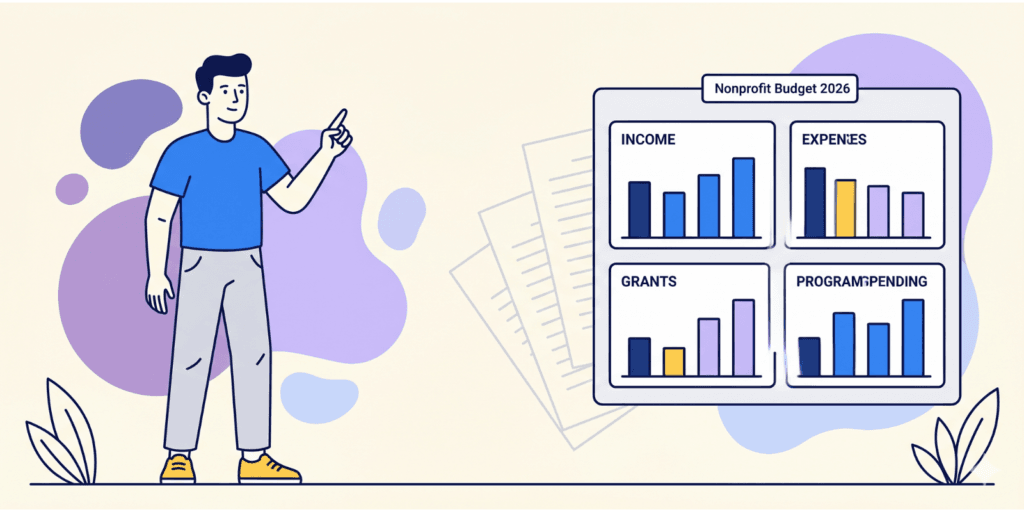
Transform dense spreadsheets into digestible board materials. Create executive summaries highlighting key metrics: projected surplus or deficit, program expense ratios, months of cash reserves, and major year-over-year changes. Visual representations like pie charts showing expense allocation by program help board members quickly grasp resource priorities.
Provide context for significant variances or changes. If you’re budgeting 30% more for technology, explain the strategic rationale and expected outcomes. When projecting revenue changes, reference environmental factors like economic conditions or shifting foundation priorities that support your assumptions.
Include comparative data that helps board members evaluate your budget decisions. Benchmark administrative expense ratios against similar organizations using resources like Charity Navigator or GuideStar data. Show how your budget aligns with sector standards while addressing your unique organizational needs.
Donors want assurance that their contributions create meaningful impact. Your budget tells that story through resource allocation. Create donor-friendly budget summaries showing the percentage of expenses devoted to direct program services versus support functions. Most donors expect to see 75% or more going to programs, though newer organizations building infrastructure may reasonably run lower ratios.
Translate budget line items into tangible outcomes. Instead of showing “$50,000 for program supplies,” explain that this investment provides school supplies for 500 children or meals for 2,000 families. This outcome-focused budgeting helps donors visualize their contribution’s impact.
Address overhead proactively. Rather than minimizing administrative costs, explain how investments in financial management, evaluation systems, and staff development strengthen program delivery. Forward-thinking donors understand that sustainable impact requires robust organizational infrastructure.
For guidance on presenting financial information effectively, review our resources on nonprofit financial statements and reporting best practices.
The right technology transforms budgeting from a painful annual exercise into an ongoing management tool. While Excel remains the most common nonprofit budgeting platform, purpose-built solutions offer advantages for growing organizations.
Excel or Google Sheets work well for organizations with straightforward structures: single funding sources, one or two programs, and stable operations. Spreadsheets offer complete customization, universal accessibility, and zero software costs. Most board members and staff already understand basic spreadsheet navigation.
However, spreadsheet limitations become apparent as complexity increases. Manual data entry invites errors, version control becomes nightmarish with multiple users, and creating automated reports requires advanced Excel skills most nonprofits lack. Organizations managing restricted funds, multiple programs, or complex allocation formulas often find spreadsheets inadequate.
QuickBooks Online Nonprofit edition includes budgeting features that integrate with your actual accounting data. Create budgets by class (program) or location, then run budget-to-actual reports without manual data manipulation. The ability to drill down from variance reports to underlying transactions streamlines budget monitoring.
Set up budget alerts to notify you when expenses approach limits or revenue falls short of projections. QuickBooks’ forecasting tools use your historical data to project future performance, though you’ll need to adjust for known changes like new grants or discontinued programs.
Integration represents QuickBooks’ primary advantage. Your budget lives alongside your books, eliminating duplicate data entry and ensuring consistency between projected and actual figures. However, QuickBooks budgeting works best for organizations already using it for accounting. Implementing QuickBooks solely for budgeting rarely justifies the cost and complexity.
Need help setting up QuickBooks for effective nonprofit financial management? Our bookkeeping services include QuickBooks configuration optimized for nonprofit reporting needs.
A budget only creates value when it drives daily decisions and long-term strategy. Too many organizations file their approved budget away until year-end, missing opportunities for course correction and continuous improvement.
Establish monthly budget review meetings involving program managers, not just finance staff. Discuss variances while memories remain fresh and adjustments can still make a difference. Create simplified budget-to-actual reports that highlight significant variances (typically 10% or $5,000, whichever is greater) without overwhelming managers with minutiae.
Build a culture of budget accountability without becoming rigid. Encourage program managers to flag potential overages early
, celebrating proactive communication rather than punishing honest assessments. When variances occur, focus on understanding causes and implications rather than assigning blame.
Your 2026 budget should be a living document that evolves with your organization. Download our comprehensive nonprofit budget template to get started, then consider how professional financial management support could strengthen your budgeting process. Whether you need help setting up better tracking systems, training staff on budget management, or ensuring compliance with funder requirements, strategic financial partnership amplifies your mission impact.
Take the first step toward stronger financial management. Contact GivingArc today to discuss how our nonprofit accounting expertise can support your budgeting goals and overall financial health. With the right foundation and ongoing support, your budget becomes a powerful tool for achieving your mission rather than a compliance burden.
A complete nonprofit budget template includes a revenue section broken down by source (individual donations, foundation grants, government contracts, earned revenue, in-kind contributions), an expense section organized by FASB functional categories (program services, management and general, fundraising), monthly columns for cash-flow tracking, and a separate column tracking restricted vs unrestricted funds.
Yes. The GivingArc 2026 nonprofit budget template is free to download. It includes pre-built revenue categories, functional expense classifications aligned with FASB requirements, monthly tracking columns, and budget-vs-actual variance formulas designed for organizations of any size.
At minimum, hold monthly budget-vs-actual review meetings with program managers and finance staff, revisit major projections quarterly, and revise the full budget annually before fiscal year-end. Treat your 2026 budget as a living document and update it for known changes like new grants, lost funding, or significant program shifts as they happen.
Most nonprofits flag variances of 10% or $5,000 (whichever is greater) for line-item discussion. Variances above these thresholds usually indicate a forecasting error, an unexpected event, or a programmatic change that warrants a course-correction conversation rather than waiting until year-end.
Nonprofit budgets must follow FASB functional expense reporting (program services / management and general / fundraising) instead of departmental cost-center reporting, track restricted vs unrestricted funds separately, account for diverse revenue streams (individual donations, grants, government contracts, earned revenue, in-kind), and align with Form 990 categories. For-profit budgets focus primarily on profit margin and shareholder return.