

Key Takeaways
Most executive directors face this decision once their organization passes a few hundred thousand dollars in revenue: hire an in-house bookkeeper, or outsource nonprofit accounting to a specialized firm? The right answer is rarely obvious, and the wrong choice quietly costs nonprofits real money — either through underused staff, missed compliance, or both. This guide walks through the real numbers, the warning signs that point to a switch, and a decision framework drawn from our team’s collective 23+ years of nonprofit accounting experience.
We’ll cover what an in-house bookkeeper actually costs once benefits, payroll taxes, and software are loaded in; what outsourced accounting includes (and where the cheap-looking quotes leave gaps); seven concrete signs you have outgrown DIY books; a side-by-side cost and capability comparison; the hybrid approach that fits many $2M–$10M nonprofits; the legitimate concerns about outsourcing and how to address them; and a clean decision framework you can apply this week.
If you already know you want to hand this off and you are here to compare providers rather than approaches, the short version is on our nonprofit bookkeeping and accounting service page, and you can see what it would cost for your organization in about a minute. The rest of this article is for the decision itself.
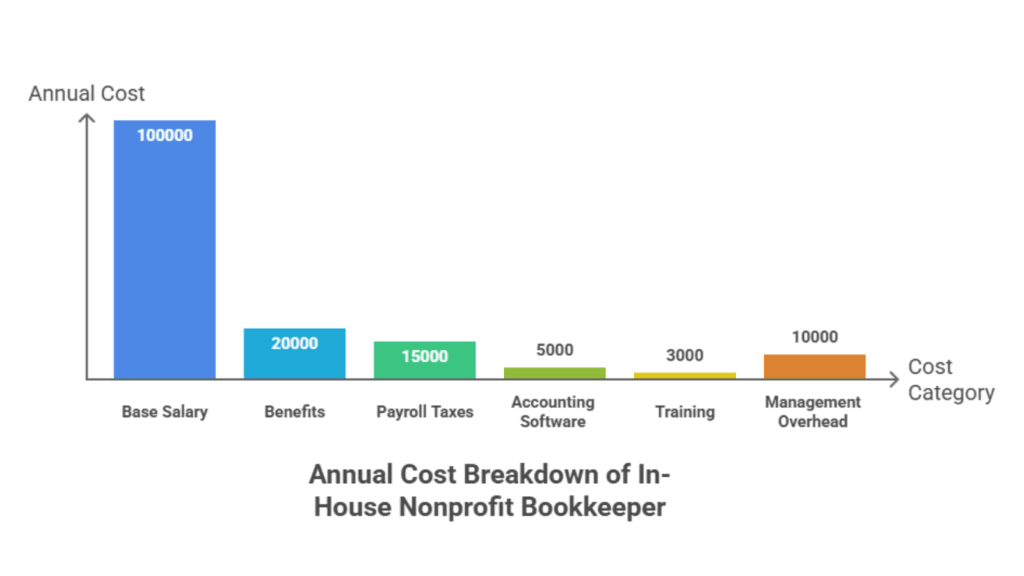
The base salary number is the part everyone sees. The total cost is the part that surprises boards.
According to the U.S. Bureau of Labor Statistics, the median annual wage for bookkeeping, accounting, and auditing clerks was $49,210 in May 2024, with the 10th percentile at $34,600 and the 90th percentile at $72,660. Nonprofit bookkeepers tend to cluster in the middle of that range, with metro markets like Boston, San Francisco, New York, and DC pulling the high end.
Salary alone, however, understates the cost an organization actually carries on its budget. The full loaded cost adds:
Pulled together, a $50,000 salaried bookkeeper typically costs the organization $65,000–$80,000 fully loaded. A $70,000 salaried bookkeeper (more common in higher-cost cities) lands closer to $90,000–$105,000 once benefits, software, and overhead are included. Those numbers are what a board should compare against an outsourced quote — not the salary line alone.
If you want that comparison with a real number on the other side, our pricing calculator gives you a monthly figure based on your transaction volume and account count — no email required. Monthly bookkeeping and accounting starts at $300/mo.
“Outsourced accounting” is a wide category. It can mean anything from a part-time freelance bookkeeper doing monthly reconciliations through a full client-accounting-services (CAS) engagement that delivers GAAP-ready financials, audit support, and Form 990. If you are a small organization weighing a freelancer against a firm, or keeping the books yourself, we compare those three arrangements in our freelancer vs. firm vs. do-it-yourself guide. Pricing reflects scope, so direct comparison requires lining up what is and is not included.
Typical scope tiers for nonprofit-specialized firms in 2026:
What sometimes hides in lower-tier quotes: catch-up bookkeeping, fund accounting, restricted-grant tracking, audit support, and 1099 preparation may all be billed extra. When you compare quotes, ask explicitly which of those are included in the monthly retainer and which trigger separate billing. A $200/month bookkeeping quote that bills $150/hour for any “non-routine” work can quickly cross the $500/month line during grant reporting season.
Some triggers are quantitative thresholds; others are operational signals. Watch for these.
Books that should close in 5–10 business days are dragging into February or March, delaying audit, 990, and board reporting.
You can’t answer “how much restricted funding do we still owe to programs?” without a manual spreadsheet rebuild.
IRS penalties accrue at $20–$120/day, and three consecutive missed filings auto-revoke tax-exempt status.
Recurring journal entries from the audit signal that monthly close isn’t catching what it should.
The Single Audit threshold rose to $1,000,000 for fiscal years beginning on or after October 1, 2024 — a major capability shift.
One person owns books, payroll, and bill-pay with no backup — vacation or resignation puts operations at risk.
Cash flow forecasts, program-level financials, or functional expense breakdowns require weeks instead of a click.
One signal in isolation isn’t conclusive. Two or more, especially the critical ones (Form 990 timeliness, board reporting), almost always means it’s time to evaluate alternatives.
Each approach has structural strengths. The right pick depends less on cost alone than on what your organization needs from its finance function over the next two to three years.
Direct employee, dedicated to your org
Loaded cost: $65,000–$105,000/year for a full-time mid-level bookkeeper
Specialized team across multiple nonprofits
Engagement cost: $1,800–$42,000/year (most $250K–$5M nonprofits land $400–$3,500/month)
Two takeaways are worth pulling out: first, an outsourced firm is rarely the most expensive option once you load benefits and overhead onto an in-house salary; second, the capability comparison is rarely apples-to-apples — an outsourced firm typically delivers CPA review, software, audit support, and 990 work as part of the engagement, while an in-house bookkeeper at $50K–$70K usually doesn’t.
Many nonprofits between $2M and $10M land on a hybrid model: an internal staffer handles day-to-day transaction work while an outsourced CPA firm or fractional CFO supplies oversight, technical accounting, and compliance specialization. This structure trades pure cost minimization for resilience and capability.
A common hybrid configuration looks like this:
The hybrid model works well when the in-house person is competent at daily transactional work but doesn’t need to be (or shouldn’t be expected to be) a Form 990 specialist or financial strategist. It also creates natural separation of duties — the outsourced firm reviews work the in-house staff member produced, which is meaningful internal control. According to the ACFE’s 2024 Report to the Nations, smaller organizations face elevated risk of billing fraud, check tampering, expense reimbursement schemes, and skimming — risks meaningfully reduced when an external party reviews monthly transactions.
The trade-off is total spend: a hybrid usually costs more than either pure option. The justification is strategic capacity and risk reduction, not cost savings.
Three concerns surface in nearly every board conversation about outsourcing. Each has a defensible answer once you know what to ask.
We’ll lose control of our books.
What changes: who keys the entries. What doesn’t: ownership of the data, approvals, and decision-making. The ED still approves payments and reviews monthly financials — the outsourced team executes inside guardrails the board sets.
Donor and payroll data won’t be safe.
What to verify: SOC 2 Type II of the firm’s tools (QuickBooks, bill-pay, payroll), an MSA with confidentiality clauses, named data-handling staff, and incident-response procedures. A firm that can’t answer these questions in writing is the wrong firm.
We’ll lose responsiveness.
What to set: SLAs in the engagement letter (e.g., questions answered within one business day, monthly close by the 15th), a named primary contact, and a quarterly check-in. Define expectations and the responsiveness gap usually narrows or reverses.
None of these concerns are unfounded; they’re all reasonable. The point is that they’re addressable through the engagement letter, vendor selection, and ongoing process — not through avoiding outsourcing.
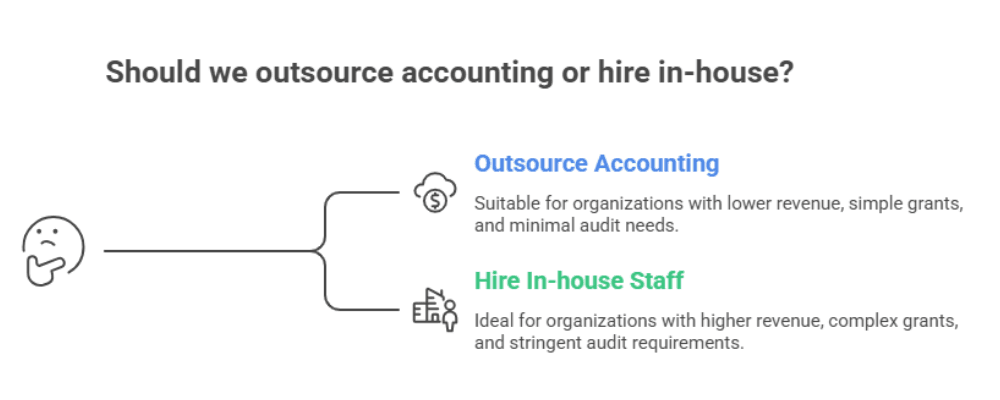
Run your situation through these four steps in order. The honest answer to each one usually points clearly toward one path.
Federal grants, restricted donor funds, multi-state registrations, audit requirements, and Form 990 schedules all push you toward outsourced expertise. If two or more apply, outsourcing is usually defensible regardless of revenue.
Salary + 7.65% FICA + 20–30% benefits + software + training + management overhead. Compare that number — not the salary line — to outsourced quotes for equivalent scope.
If your bookkeeper resigned tomorrow, how many days until books close cleanly again? If the answer is “weeks or months,” a firm with built-in coverage starts looking very attractive.
Smaller orgs ($250K–$1M): full outsourcing usually wins on cost and capability. Mid-size ($2M–$10M): hybrid often optimal. Larger ($10M+): in-house controller plus outsourced or fractional CFO is common.
For most small nonprofits at this stage, the right move is to outsource nonprofit accounting and Form 990 to a specialized firm and reserve in-house staffing for program and operations work. For organizations growing into the mid-size band, the hybrid model deserves serious evaluation. For larger or unusually complex organizations, the question shifts from outsource-vs-in-house to which specific functions to outsource (treasury, payroll, audit support) and which to build in-house (controller, financial planning).
GivingArc specializes exclusively in nonprofit accounting. Our practice covers monthly bookkeeping, Form 990 preparation, audit readiness, restricted-fund tracking, and outsourced finance for organizations from emerging 501(c)(3)s through $10M+ programs. We work with nonprofits nationwide remotely, with CPA oversight on every engagement.
If you’re weighing the decision to outsource nonprofit accounting and want a clean side-by-side comparison for your specific size and complexity, reach out for a free initial consultation. We’ll review your current situation honestly and tell you whether outsourcing makes sense — and if so, what an engagement would actually cost. For broader background, see our nonprofit bookkeeping best practices guide, nonprofit fund accounting basics, or take our short nonprofit financial health checklist to identify gaps in your current setup.
Ready to simplify your nonprofit accounting?
Get a free custom quote tailored to your organization — no obligation.
Answers to the most common questions about outsourcing nonprofit accounting.
In 2026, basic outsourced bookkeeping for nonprofits typically starts at $150–$250/month for organizations under $250,000 in revenue, scales to $400–$700/month for full-service work at $250K–$1M nonprofits, and runs $1,500–$3,500/month for outsourced finance at $1M–$5M nonprofits. Add a fractional CFO ($150–$500/hour or $3,000–$12,000/month) for strategic finance support. Always confirm whether catch-up work, audit support, fund tracking, and Form 990 preparation are included in the retainer or billed separately.
A reputable nonprofit accounting firm will use SOC 2 Type II compliant software (QuickBooks Online, bill-pay platforms, payroll providers), sign a master services agreement with confidentiality and data-handling provisions, name specific staff who access your data, and document an incident-response procedure. Internal controls actually tend to improve under outsourcing because the firm is independent of operations — an external party reviewing transactions creates separation of duties that’s hard to achieve with a single in-house bookkeeper. The 2024 ACFE Report to the Nations found smaller organizations face elevated risk of billing fraud, check tampering, and skimming, all of which an external review reduces.
A bookkeeper records transactions, reconciles accounts, and produces basic financial statements. A CPA is a licensed accountant who can sign tax returns, perform audits and reviews, and provide advisory services that require professional licensure. An accounting firm bundles bookkeepers, staff accountants, and CPAs into a team that handles everything from monthly close to Form 990 to audit support. For most small and mid-sized nonprofits, the practical question isn’t which credential to hire — it’s whether to hire one in-house bookkeeper or engage a firm that brings the full stack as a service.
Hiring in-house often makes sense once an organization passes roughly $5M in revenue with predictable transaction volume, has program staff who need daily on-site finance support (cash receipts, AP coordination, deposit tracking), and is large enough to absorb both salary and the management overhead of supervising the role. It also fits organizations with unusual operations — for example, retail or paper-heavy operations — that benefit from a physically present finance person. For most $250K–$2M nonprofits, outsourcing or a hybrid model usually delivers more capability per dollar than a single in-house bookkeeper could.
Yes — this is one of the most common reasons nonprofits outsource in the first place. A specialized nonprofit firm prepares Form 990 (and 990-EZ or 990-N where applicable) as part of its tax service, manages required schedules (Schedule A through O depending on facts), and supports your audit by providing reconciled trial balances, supporting schedules, and audit-ready financial statements. Note an important independence rule: under GAO Government Auditing Standards (Yellow Book), which apply to Single Audits and most federally funded nonprofits, the firm preparing your books cannot also audit those books for the same year. Under pure AICPA independence rules the same arrangement is permitted with documented safeguards, but in practice most boards engage a separate audit firm regardless. Plan to engage a separate auditor and keep your bookkeeping firm focused on close, 990, and audit support.